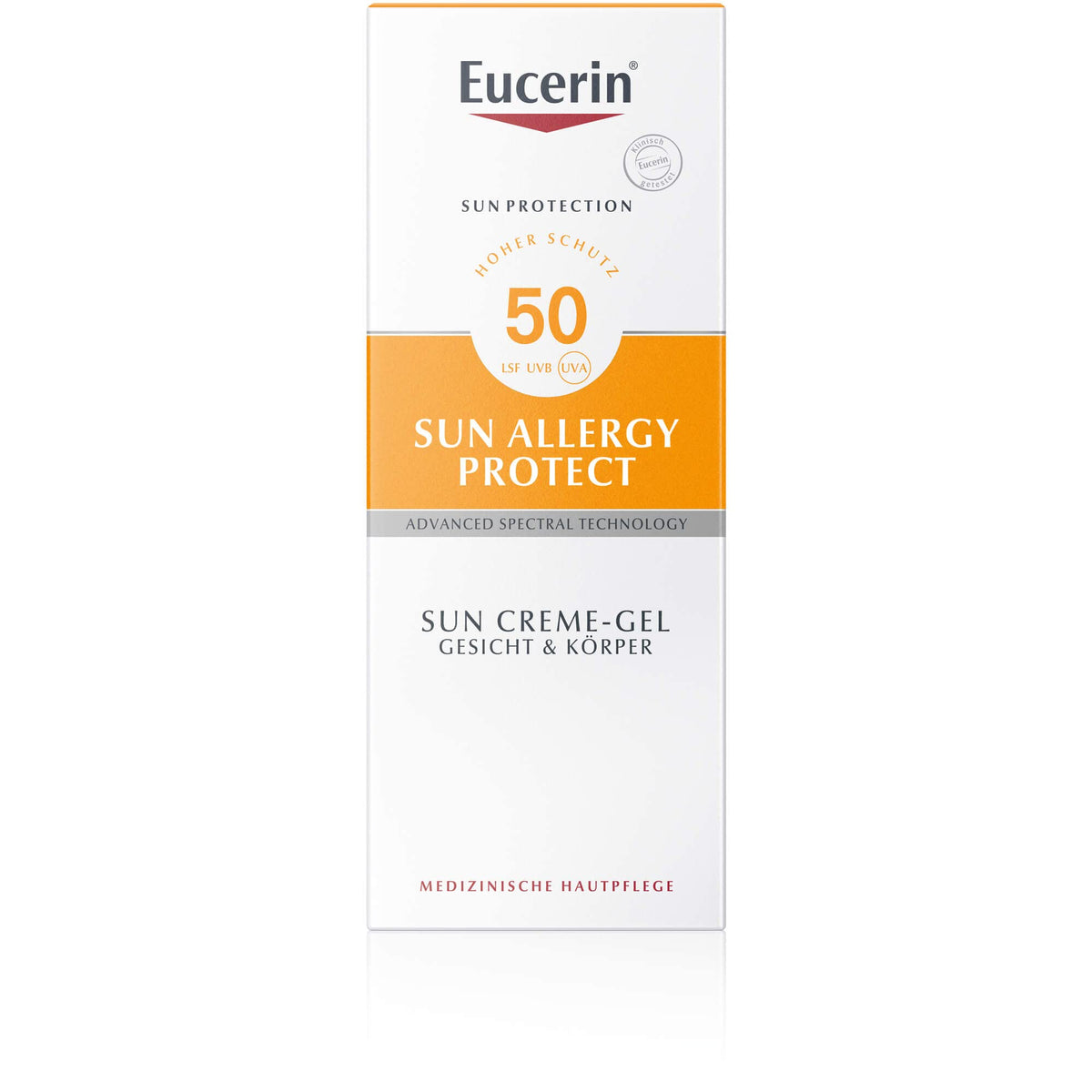
Eucerin Sun Allergy Protect Cream Gel SPF50-150ml
Eucerin Sun Allergy Protect Cream Gel SPF50-150ml
- ✔️ Specifically formulated to prevent polymorphic light eruption (PLE)
- ✔️ Contains Licochalcone A to calm UV-triggered skin reactions
- ✔️ Very high SPF50 with broad UVA and UVB protection
- ✔️ Fragrance-free and non-comedogenic for sensitive skin
- ✔️ Lightweight cream-gel absorbs quickly without greasiness
Price Checker
 Lowest price guarantee
 Includes FREE private prescription


Couldn't load pickup availability
Is Eucerin Sun Allergy Protect the Right Sun Allergy SPF50 Cream for You?
If your skin breaks out in an itchy, red rash every time you step into the sun, you are not alone. Polymorphic light eruption (PLE) — the most common form of sun allergy — affects a significant number of people in the UK, particularly those with fair or sensitive skin. The NHS describes sun allergy as a condition where the immune system reacts to sunlight, triggering uncomfortable skin reactions that can range from mild redness to blistering. Finding a sunscreen that actively works to prevent those reactions, rather than simply blocking UV rays, makes a real difference. That is exactly where a dedicated sun allergy SPF50 cream like Eucerin Sun Allergy Protect Cream Gel comes in. Available at Cured Pharmacy for £16.99, this 150ml tube is formulated specifically for skin prone to photoallergy and sun intolerance.
Unlike standard sunscreens, this product combines high-level UV filtration with an anti-inflammatory ingredient designed to calm the skin's reactive response. It has a lightweight cream-gel texture that absorbs quickly without leaving a heavy or greasy residue — something many people with reactive skin particularly appreciate. If you are exploring broader skin care options for sensitive or sun-damaged skin, Cured Pharmacy stocks a wide range of dermatologist-recommended products.
How Does Eucerin Sun Allergy Protect Cream Gel Work?
The formula works on two levels: UV filtration and skin-calming. Here is how each component contributes:
- Mexoryl SX and Mexoryl XL — photostable UVA filters that absorb a broad spectrum of UVA radiation, which is the primary trigger for sun allergy reactions.
- Tinosorb S and Tinosorb M — broad-spectrum organic filters providing both UVA and UVB protection, helping to achieve the SPF50 rating.
- Licochalcone A — an anti-inflammatory compound derived from liquorice root extract. It helps reduce the skin's reactive response to UV exposure, addressing the underlying inflammatory mechanism behind PLE.
- Glycerol — a humectant that supports the skin's moisture barrier, keeping skin hydrated during sun exposure.
Together, these ingredients create a multi-action approach. The UV filters reduce the amount of harmful radiation reaching the skin, while Licochalcone A works to dampen the inflammatory cascade that causes the characteristic rash of sun allergy.
Who Should Use Eucerin Sun Allergy Protect Cream Gel SPF50?
This product is designed for adults whose skin reacts adversely to sun exposure. It is particularly well-suited to people who have been told — or suspect — they have polymorphic light eruption or another form of photodermatosis. It is also a sensible choice for anyone with a history of sun-triggered skin flares who wants a high-protection, dermatologically tested option.
- Adults with polymorphic light eruption (PLE) or sun allergy
- People with sensitive or reactive skin prone to redness after UV exposure
- Those who have previously experienced itching, rash, or blistering in the sun
- Individuals with fair skin who burn easily and need reliable SPF50 protection
How Does Eucerin Sun Allergy Protect Compare to a Standard SPF50 Sunscreen?
| Feature | Eucerin Sun Allergy Protect SPF50 | Standard SPF50 Sunscreen |
|---|---|---|
| SPF rating | SPF50 (very high) | SPF50 (very high) |
| Anti-inflammatory ingredient | Yes — Licochalcone A | No |
| Formulated for sun allergy / PLE | Yes — specifically indicated | No — general use |
| Fragrance-free | Yes | Varies by product |
| Texture | Lightweight cream-gel | Varies (cream, lotion, spray) |
Is Eucerin Sun Allergy Protect Suitable for Daily Use and How Should It Be Stored?
Yes, this sun allergy SPF50 cream can be used daily throughout periods of sun exposure, including during holidays or prolonged outdoor activity. Its non-comedogenic, fragrance-free formula makes it appropriate for regular use on the face and body without clogging pores or causing additional irritation. If you are also managing other skin conditions alongside sun sensitivity, you may find it helpful to browse our range of creams and ointments for complementary skin support.
Store the product below 25°C, away from direct sunlight and heat. Do not freeze. Keep the cap firmly closed between uses and store out of reach of children. Once opened, use within the period indicated by the open-jar symbol on the packaging — typically 12 months.
This product is a medicine. Speak to your doctor or pharmacist before using if you have an underlying medical condition or are taking other medicines.
Eucerin Sun Allergy Protect Cream Gel SPF50 150ml specifications
| Treatment category | Sun protection / Photodermatosis prevention |
| Mechanism of action | Broad-spectrum UVA/UVB filtration plus anti-inflammatory action via Licochalcone A |
| Effective against | Polymorphic light eruption (PLE), sun allergy, UV-induced skin reactions |
| Suitable for | Adults with sun-sensitive or photoallergic skin |
| Active ingredients | Mexoryl SX, Mexoryl XL, Tinosorb S, Tinosorb M, Licochalcone A |
| Pack size | 150ml |
| SPF rating | SPF50 (very high protection) |
| UK classification | General sale / Cosmetic sunscreen |
| Preparation | Cream-gel |
| Route of administration | Topical (skin) |
Specifications of Eucerin Sun Allergy Protect Cream Gel SPF50 150ml
What Is Eucerin Sun Allergy Protect Cream Gel and What Is It Used For?
Eucerin Sun Allergy Protect Cream Gel SPF50 is a topical sunscreen specifically developed for people whose skin reacts to sun exposure. Its primary use is the prevention of polymorphic light eruption (PLE) — a condition the NHS describes as the most common type of sun allergy, causing an itchy rash, blisters, or red patches after UV exposure. It is also suitable for anyone with heightened sun sensitivity, including those with a history of photodermatitis or skin that flares easily in warm, sunny conditions.
The product provides very high SPF50 protection against UVB rays and high UVA protection, meeting the EU recommendation that UVA protection should be at least one-third of the labelled SPF. It is not a prescription medicine — it is available over the counter and is used as a preventative measure rather than a treatment for an existing rash.
What Do You Need to Know Before Using Eucerin Sun Allergy Protect?
Before applying this product, read the following carefully. Although it is well-tolerated by most people, there are some situations where caution is needed.
Do not use this product if:
- You are allergic to any of the listed ingredients, including Licochalcone A or any of the UV filters
- You have open wounds, broken skin, or active eczema flares on the area to be treated
- You are applying it to the eye area or mucous membranes
Use with caution and speak to a pharmacist or GP if:
- You are pregnant or breastfeeding — while topical sunscreens are generally considered safe, it is always worth checking with your healthcare provider
- You have a known photosensitising condition such as lupus erythematosus, as sun protection alone may not be sufficient
- You are using topical prescription treatments on the same area of skin
- Your child is under 3 years of age — seek specific paediatric advice before use
Known drug interactions:
- No clinically significant drug interactions are currently documented for topical sunscreen products of this type
- If you are using photosensitising medications (such as certain antibiotics, diuretics, or retinoids), sun protection is especially important — discuss your full medication list with your pharmacist
How Should You Use Eucerin Sun Allergy Protect Cream Gel SPF50?
Applying sunscreen correctly makes a significant difference to how well it works. Many people apply far less than the recommended amount, which can reduce the effective SPF considerably. Follow these steps for best results:
- Shake or squeeze a generous amount of cream gel onto your fingertips.
- Apply to all exposed skin areas — face, neck, décolletage, arms, and any other exposed body parts.
- Apply at least 20 to 30 minutes before going outdoors to allow the filters to bind to the skin surface.
- Reapply every two hours during sun exposure, and immediately after swimming, towel drying, or heavy sweating.
- Do not rub in too vigorously — smooth gently to avoid reducing the protective film.
- Avoid contact with eyes. If contact occurs, rinse thoroughly with water.
| Indication | Age Group | Amount | Frequency |
|---|---|---|---|
| Sun allergy / PLE prevention | Adults | Generous layer to all exposed skin | Every 2 hours; after swimming or sweating |
| General sun protection (sensitive skin) | Adults | Generous layer | Every 2 hours during sun exposure |
If you are also managing hay fever or other seasonal allergies alongside sun sensitivity, you may find it useful to explore our allergy and hay fever range for additional support during the warmer months.
What Are the Possible Side Effects of Eucerin Sun Allergy Protect?
This product is dermatologically tested and generally very well tolerated. Side effects are uncommon, but as with any topical product, reactions can occasionally occur.
Common side effects (may affect a small number of users):
- Mild stinging or tingling sensation immediately after application
- Temporary redness at the application site
- Slight whitish residue if applied too thickly (not a medical side effect, but worth noting)
Less common side effects:
- Contact dermatitis — localised rash, itching, or swelling, particularly if you have a sensitivity to one of the UV filter ingredients
- Acneiform eruptions in people with acne-prone skin, though the non-comedogenic formula minimises this risk
- Eye irritation if the product accidentally contacts the eyes
Stop using the product and consult a pharmacist or GP if you notice worsening redness, swelling, or a rash that does not resolve. Serious allergic reactions (anaphylaxis) to topical sunscreens are extremely rare but require immediate medical attention if they occur.
How Should You Store Eucerin Sun Allergy Protect Cream Gel?
Correct storage helps maintain the product's effectiveness throughout its shelf life. Sunscreen filters can degrade if exposed to excessive heat or light, which may reduce the level of protection offered.
- Store below 25°C in a cool, dry place
- Do not freeze or expose to temperatures above 40°C (e.g. leaving in a hot car)
- Keep away from direct sunlight when not in use
- Keep the cap tightly closed between applications
- Store out of reach and sight of children
- Use within 12 months of opening, as indicated by the open-jar symbol on the packaging
- Do not use after the expiry date printed on the tube
Planning a holiday abroad? You might also want to browse our travel health range for additional products to keep you protected and comfortable while away.
References
- https://www.nhs.uk/conditions/sun-allergy/
- https://www.nhs.uk/live-well/seasonal-health/sunscreen-and-sun-safety/
- https://www.nhs.uk/conditions/polymorphic-light-eruption/
- https://www.nhs.uk/conditions/skin-rashes/
- https://www.nhs.uk/conditions/contact-dermatitis/
- https://www.gov.uk/government/publications/sunscreen-products-safety-and-efficacy-guidance
Written and reviewed by our qualified team
Your safety and success are our highest priorities. Our medical team rigorously evaluates every product and piece of advice we provide, ensuring you receive only the most effective, science-backed solutions available.
Frequently Asked Questions
Where can I buy Eucerin Sun Allergy Protect Cream Gel SPF50 online in the UK?
You can buy Eucerin Sun Allergy Protect Cream Gel SPF50 150ml directly from Cured Pharmacy, a UK GPhC-registered online pharmacy, for £16.99. No prescription is required — it is available as an over-the-counter product. Simply add it to your basket and choose your preferred delivery option at checkout.
How does Eucerin Sun Allergy Protect Cream Gel SPF50 work in the body?
The cream gel works by combining broad-spectrum UV filters — including Mexoryl SX, Mexoryl XL, Tinosorb S, and Tinosorb M — to absorb and reflect both UVA and UVB radiation before it can penetrate the skin. It also contains Licochalcone A, an anti-inflammatory ingredient derived from liquorice root, which helps reduce the skin's immune-mediated reaction to UV exposure. This dual approach addresses both the trigger (UV radiation) and the inflammatory response that causes the sun allergy rash.
What is polymorphic light eruption and will this product help?
Polymorphic light eruption (PLE) is the most common form of sun allergy in the UK, causing an itchy, red rash — sometimes with small blisters — that appears hours after sun exposure. The NHS notes it most commonly affects young women and people with fair skin. Eucerin Sun Allergy Protect is specifically formulated to help prevent PLE by providing very high UVA and UVB protection alongside anti-inflammatory ingredients that target the skin's reactive response.
How do I use Eucerin Sun Allergy Protect Cream Gel step by step?
Apply a generous amount to all exposed skin areas at least 20 to 30 minutes before going outdoors. Smooth it gently over the skin rather than rubbing vigorously, and avoid the eye area. Reapply every two hours during sun exposure, and immediately after swimming, sweating, or towel drying to maintain the full level of protection.
How much Eucerin Sun Allergy Protect should I apply?
The NHS and dermatology guidance recommend applying approximately 2mg per cm² of skin — in practical terms, this means a generous, visible layer rather than a thin smear. Most adults underestimate how much sunscreen is needed, which significantly reduces the effective SPF. For the face alone, roughly half a teaspoon is a useful guide.
When is the best time to apply Eucerin Sun Allergy Protect before going outside?
Apply the cream gel 20 to 30 minutes before sun exposure to allow the UV filters to form a protective film on the skin surface. Do not wait until you are already in the sun to apply it, as this reduces its effectiveness. Reapplication every two hours is just as important as the initial application.
Is Eucerin Sun Allergy Protect suitable for sensitive or reactive skin?
Yes — the formula is dermatologically tested, fragrance-free, and non-comedogenic, making it well-suited to sensitive and reactive skin types. The inclusion of Licochalcone A also provides a calming effect that may benefit skin prone to redness or irritation. If you are managing other skin concerns alongside sun sensitivity, our skin care collection includes a range of dermatologist-recommended options.
Can I use Eucerin Sun Allergy Protect on my face every day?
Yes, the lightweight cream-gel texture is designed for daily use on both the face and body during periods of sun exposure. Its non-comedogenic formula means it is unlikely to block pores or cause breakouts, even with regular facial application. It can be applied under makeup if needed, though allow it to absorb fully first.
What are the side effects of Eucerin Sun Allergy Protect Cream Gel?
Side effects are uncommon but may include mild stinging, temporary redness, or a tingling sensation immediately after application. In rare cases, contact dermatitis can occur if you have a sensitivity to one of the UV filter ingredients. If you notice a worsening rash, swelling, or persistent irritation, stop using the product and speak to your pharmacist or GP.
How do I manage a reaction if Eucerin Sun Allergy Protect irritates my skin?
If you experience irritation after applying the product, rinse the affected area thoroughly with cool water and discontinue use. Avoid further sun exposure until the skin has settled. If the reaction is severe, involves swelling of the face or throat, or does not improve within 48 hours, seek medical advice promptly.
Is Eucerin Sun Allergy Protect safe to use during pregnancy?
Topical sunscreens are generally considered safe during pregnancy, and sun protection is particularly important as pregnancy can increase photosensitivity. However, it is always advisable to check with your GP or midwife before introducing new skincare products during pregnancy, especially in the first trimester. The fragrance-free formula is a sensible choice for those with heightened skin sensitivity during this time.
Can children use Eucerin Sun Allergy Protect Cream Gel SPF50?
Eucerin Sun Allergy Protect is formulated and tested for adults and is not specifically indicated for young children. For children under 3 years, the NHS recommends keeping them out of direct sunlight and using age-appropriate sun protection products. Speak to your pharmacist or GP for guidance on suitable sun protection for children.
What are the alternatives to Eucerin Sun Allergy Protect SPF50?
Alternatives include other high-SPF sunscreens formulated for sensitive or photoallergic skin, such as La Roche-Posay Anthelios or Altruist Dermatologist Sunscreen SPF50. However, not all alternatives contain an anti-inflammatory ingredient like Licochalcone A, which is a distinguishing feature of the Eucerin formulation. If you are unsure which product is right for your skin type, our pharmacists at Cured Pharmacy are happy to advise.
How long can I keep using Eucerin Sun Allergy Protect Cream Gel?
You can use this product throughout any period of significant sun exposure — whether that is a summer holiday, outdoor work, or daily commuting in sunny weather. Once opened, use within 12 months as indicated by the open-jar symbol on the packaging. There is no clinical limit on long-term use, provided you are not experiencing any adverse reactions. If you are also taking photosensitising medications, discuss ongoing sun protection with your pharmacist — you may also find our travel health range useful for holiday preparation.
What does the latest research say about sun allergy prevention with sunscreen?
Current dermatological evidence supports the use of broad-spectrum, high-SPF sunscreens as a first-line preventative measure for polymorphic light eruption. Research published in clinical dermatology literature indicates that consistent, generous application of UVA-protective sunscreens significantly reduces the frequency and severity of PLE episodes. The NHS also recommends sun avoidance, protective clothing, and gradual skin hardening (desensitisation) alongside sunscreen use for people with recurrent sun allergy.
Written and reviewed by our qualified team

Reviewed by:
Tarun Kumar
Superintendent/ Clinical Lead
📖 Find out more about our team of medical content authors and how we ensure the accuracy of our content with our content guidelines.
Content last updated: 14 Sep 2026
Other popular options


We’re a safe and
regulated UK service

Lowest Price Guarantee

We're convinced you won't find your treatment cheaper, but if you do we'll refund the difference.
Find out more
100% discreet packaging

Discreet, unbranded packaging for every order.
Find out more

Need help?
Talk to our friendly experts now


How our service works

Service setup

Discreet packaging

Express delivery