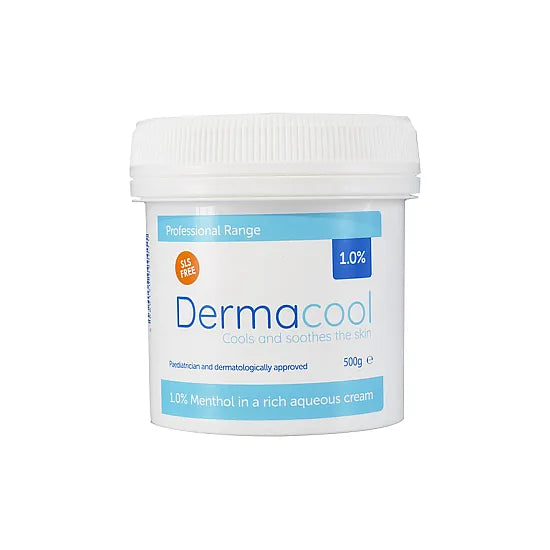
Dermacool 1% Menthol Aqueous Cream Tub - 500g
Dermacool 1% Menthol Aqueous Cream Tub - 500g
- ✔️ Relieves itchy skin with a soothing 1% menthol formula
- ✔️ Steroid-free — safe for long-term daily emollient use
- ✔️ Cools and moisturises dry, irritated skin simultaneously
- ✔️ Suitable for eczema, heat rash, and insect bite relief
- ✔️ Large 500g tub ideal for whole-body or frequent application
Price Checker
 Lowest price guarantee
 Includes FREE private prescription


Couldn't load pickup availability
Is Dermacool 1% the Best Menthol Cream for Itching?
If itchy skin is keeping you up at night or making your day miserable, you are not alone. Itching — known medically as pruritus — is one of the most common skin complaints in the UK, affecting people of all ages and arising from conditions ranging from eczema and dry skin to insect bites and heat rash. Menthol cream for itching has long been used as a first-line topical option to calm that persistent urge to scratch, and Dermacool 1% Menthol Aqueous Cream is one of the most widely recognised products in this category. Available in a generous 500g tub, it offers a practical, cost-effective solution for households dealing with recurring skin irritation. You can explore a wider range of options in our skin care collection.
Dermacool contains 1% menthol dispersed in an aqueous (water-based) cream base. The aqueous cream acts as an emollient, helping to hydrate and soften the skin, while the menthol delivers that characteristic cooling sensation that most people find immediately soothing. It is available over the counter without a prescription, making it straightforward to access when you need relief quickly.
How Does Dermacool 1% Menthol Aqueous Cream Work?
The mechanism behind Dermacool is actually quite elegant. Menthol works by interacting with specific receptors in the skin rather than simply masking discomfort. Here is how it works step by step:
- Menthol binds to TRPM8 receptors — cold-sensitive ion channels found in sensory nerve endings in the skin.
- Activating these receptors triggers a cooling sensation, which competes with and temporarily overrides the itch signal being transmitted to the brain.
- This counter-stimulation effect reduces the perception of itch without numbing the skin entirely.
- The aqueous cream base simultaneously forms a light barrier on the skin surface, reducing transepidermal water loss and helping to restore the skin's natural moisture balance.
The result is a dual-action approach: cooling relief from the menthol and gentle moisturisation from the cream base. It does not treat the underlying cause of itching, but it can make symptoms significantly more manageable while you address the root issue.
Who Should Use Dermacool 1% Menthol Aqueous Cream?
Dermacool is suitable for a broad range of people experiencing itchy or dry skin. It is particularly useful for those who want a simple, non-medicated topical option that can be used regularly without the concerns associated with steroid-based creams. That said, it is not appropriate for everyone — always read the label and speak to a pharmacist if you are unsure.
It may be suitable for you if you experience:
- Dry, itchy skin associated with eczema or dermatitis (as an adjunct to prescribed treatment)
- Pruritus related to mild heat rash or prickly heat
- Itching caused by insect bites or minor skin irritation
- General dry skin conditions requiring regular emollient use
How Does Dermacool Compare to Other Itching Creams?
| Feature | Dermacool 1% Menthol Aqueous Cream | Hydrocortisone 1% Cream |
|---|---|---|
| Active ingredient | Menthol 1% | Hydrocortisone 1% |
| Mechanism | Counter-stimulation via TRPM8 receptors + emollient | Anti-inflammatory corticosteroid |
| Suitable for long-term use | Yes, as an emollient | No — limited to short courses |
| Steroid-free | Yes | No |
Is Dermacool Suitable for Sensitive Skin and How Should It Be Stored?
Dermacool is generally well tolerated, including by people with sensitive skin, though individual reactions can vary. Because it is steroid-free, it avoids the skin-thinning risks associated with prolonged corticosteroid use. However, if you have a known sensitivity to menthol or any of the excipients in the aqueous cream base, you should avoid this product and consult your pharmacist about alternatives. Our creams and ointments collection includes a variety of options for different skin types and sensitivities.
Store Dermacool below 25°C, away from direct sunlight and heat sources. Keep the lid firmly closed after use to prevent contamination and drying out of the cream. Keep out of reach and sight of children. Do not use after the expiry date printed on the tub.
This product is a medicine. Speak to your doctor or pharmacist before using if you have an underlying medical condition or are taking other medicines.
Dermacool 1% Menthol Aqueous Cream Tub - 500g specifications
| Treatment category | Emollient / Antipruritic |
| Mechanism of action | TRPM8 receptor activation (cooling/counter-stimulation) + skin hydration |
| Effective for | Itchy, dry, and irritated skin |
| Suitable for | Adults and children (seek pharmacist advice for young children) |
| Active ingredient | Menthol 1% |
| Pack size | 500g tub |
| Strength | 1% w/w menthol |
| UK classification | General Sale List (GSL) |
| Drug class | Emollient / Topical antipruritic |
| Preparation | Aqueous cream |
| Route of administration | Topical (applied to skin) |
Specifications of Dermacool 1% Menthol Aqueous Cream Tub - 500g
What Is Dermacool 1% Menthol Aqueous Cream and What Is It Used For?
Dermacool 1% Menthol Aqueous Cream is a topical emollient and antipruritic preparation used to relieve itching and soothe dry, irritated skin. It contains menthol at a concentration of 1% w/w in an aqueous cream base. The NHS recognises emollients as a cornerstone of managing dry skin conditions such as eczema, and menthol-containing preparations are widely used to provide symptomatic relief from pruritus. This product is available over the counter and does not require a prescription.
It is used for the symptomatic relief of itching associated with dry skin, eczema, dermatitis, heat rash, insect bites, and other minor skin irritations. It is not a cure for any underlying skin condition, but it can significantly reduce discomfort and the urge to scratch, which in turn helps prevent secondary skin damage caused by repeated scratching.
What Do You Need to Know Before Using Dermacool 1% Menthol Aqueous Cream?
Before using Dermacool, it is important to be aware of the following contraindications and warnings:
- Do not use if you are allergic to menthol or any other ingredient in the cream.
- Do not apply to broken, infected, or severely inflamed skin.
- Avoid contact with the eyes, mouth, and mucous membranes.
- Do not use on areas of skin affected by fungal or bacterial infections without seeking medical advice first.
- If you are pregnant or breastfeeding, consult your GP or pharmacist before use.
- Use with caution in young children and infants — seek pharmacist advice before applying.
- If your skin condition worsens or does not improve after two weeks of use, seek medical advice.
Known drug interactions with topical menthol cream are not well documented, but consider the following:
- Avoid using alongside other topical preparations on the same area of skin without pharmacist guidance, as interactions may affect absorption.
- If you are using prescribed topical treatments (e.g. corticosteroids), apply them separately and allow time between applications.
How Should You Use Dermacool 1% Menthol Aqueous Cream?
Using Dermacool correctly will help you get the most benefit from it. Follow these steps each time you apply the cream:
- Wash and dry your hands thoroughly before use.
- Open the tub and use a clean spatula or spoon to remove the required amount — avoid dipping fingers directly into the tub to prevent contamination.
- Apply a thin, even layer of cream to the affected area of skin.
- Gently smooth the cream in using downward strokes in the direction of hair growth — do not rub vigorously.
- Allow the cream to absorb before dressing or covering the area.
- Wash your hands after application unless your hands are the area being treated.
| Indication | Age Group | Dose | Frequency |
|---|---|---|---|
| Itchy, dry skin / eczema | Adults | Apply thin layer to affected area | As needed, several times daily |
| Itchy, dry skin / eczema | Children (seek advice) | Apply thin layer to affected area | As directed by pharmacist or GP |
| Heat rash / insect bites | Adults | Apply thin layer to affected area | As needed for symptomatic relief |
What Are the Possible Side Effects of Dermacool 1% Menthol Aqueous Cream?
Like all medicines, Dermacool can cause side effects, although not everyone experiences them. Most side effects are mild and localised to the area of application. If you experience a severe reaction, stop use immediately and seek medical advice.
Common side effects:
- Mild stinging or tingling sensation on application — this is usually transient
- Temporary redness at the application site
- A pronounced cooling sensation that some people find uncomfortable initially
Less common side effects:
- Contact dermatitis (allergic skin reaction) — characterised by increased redness, itching, or a rash
- Skin dryness or peeling if used excessively
- Sensitivity reactions in people with known menthol allergy
If you notice any signs of a serious allergic reaction — such as swelling of the face, lips, or throat, difficulty breathing, or widespread rash — stop using the product and seek emergency medical attention immediately. You can also find additional skin care support products in our skin care collection if you need to switch to an alternative.
How Should You Store Dermacool 1% Menthol Aqueous Cream?
Correct storage helps maintain the quality and safety of the cream throughout its shelf life. Follow these storage guidelines:
- Store below 25°C in a cool, dry place.
- Keep away from direct sunlight and heat sources such as radiators.
- Always replace the lid securely after use.
- Do not freeze.
- Keep out of the reach and sight of children.
- Do not use after the expiry date printed on the tub.
- Do not transfer the cream to another container.
If you are managing multiple skin conditions and need additional products, our creams and ointments collection offers a broad range of topical treatments to complement your skincare routine.
References
- https://www.nhs.uk/conditions/itchy-skin/
- https://www.nhs.uk/conditions/emollients/
- https://www.nhs.uk/conditions/eczema-atopic/treatment/
- https://www.nhs.uk/conditions/heat-rash-prickly-heat/
- https://www.nhs.uk/conditions/insect-bites-and-stings/
- https://bnf.nice.org.uk/drugs/emollient-and-barrier-preparations/
Written and reviewed by our qualified team
Your safety and success are our highest priorities. Our medical team rigorously evaluates every product and piece of advice we provide, ensuring you receive only the most effective, science-backed solutions available.
Frequently Asked Questions
Where can I buy Dermacool 1% Menthol Aqueous Cream online in the UK?
You can buy Dermacool 1% Menthol Aqueous Cream 500g directly from Cured Pharmacy, a GPhC-registered UK online pharmacy. It is available without a prescription as a General Sale List (GSL) medicine. Simply add it to your basket and choose your preferred delivery option at checkout.
How does Dermacool menthol cream work on itchy skin?
Dermacool works by activating TRPM8 cold-sensitive receptors in the skin's sensory nerve endings, producing a cooling sensation that temporarily overrides the itch signal travelling to the brain. This counter-stimulation effect reduces the perception of itch. At the same time, the aqueous cream base moisturises the skin, helping to address dryness that often contributes to itching.
How do I apply Dermacool 1% Menthol Aqueous Cream step by step?
Wash your hands before use, then use a clean spatula to scoop out a small amount of cream — avoid dipping fingers directly into the tub. Apply a thin layer to the affected area and smooth it in gently using downward strokes in the direction of hair growth. Wash your hands afterwards unless your hands are the area being treated.
How often can I use Dermacool menthol cream each day?
Dermacool can generally be applied several times daily as needed to relieve itching and dryness. There is no strict maximum number of applications for most adults, but you should follow the guidance on the product label. If you find you need to use it very frequently without improvement, speak to your pharmacist or GP about the underlying cause.
What are the side effects of Dermacool 1% Menthol Aqueous Cream?
Most people tolerate Dermacool well, but some may experience mild stinging, tingling, or temporary redness at the application site — these effects are usually short-lived. Less commonly, contact dermatitis or an allergic reaction may occur, particularly in people sensitive to menthol. If you notice swelling, widespread rash, or difficulty breathing, stop use immediately and seek medical attention.
Is Dermacool 1% Menthol Aqueous Cream safe for children?
Dermacool may be used in children, but you should always consult a pharmacist or GP before applying menthol-containing products to young children or infants, as their skin is more sensitive. The cooling sensation from menthol can be intense and potentially distressing for very young children. A healthcare professional can advise on the most appropriate emollient for your child's age and skin condition.
Can I use Dermacool menthol cream during pregnancy or breastfeeding?
Topical menthol is generally considered low-risk when applied to the skin in small amounts, but there is limited clinical data specifically on its use during pregnancy and breastfeeding. It is always best to speak to your GP or midwife before using any new product during pregnancy. If you are breastfeeding, avoid applying the cream to the breast area to prevent the baby coming into contact with menthol.
What skin conditions is Dermacool suitable for?
Dermacool is suitable for relieving itching and dryness associated with a range of conditions, including eczema, dermatitis, heat rash, prickly heat, insect bites, and general dry skin. It is not intended to treat infected skin or conditions requiring prescription medication. If your skin condition is severe or not responding to over-the-counter treatment, consult your GP.
What are the alternatives to Dermacool 1% Menthol Aqueous Cream?
Alternatives include other emollient creams such as Diprobase, Cetraben, or Doublebase for dry skin management, and antihistamine-based topical treatments for itch relief. For inflammatory conditions, a short course of hydrocortisone 1% cream may be appropriate under pharmacist guidance. You can browse a range of options in our creams and ointments collection.
How long can I use Dermacool 1% Menthol Aqueous Cream for?
As an emollient, Dermacool can be used long-term as part of a regular skincare routine for dry or itchy skin conditions. Unlike steroid creams, there is no restriction on duration of use for the emollient base. However, if your symptoms persist beyond two weeks without improvement, it is advisable to seek medical advice to identify and treat the underlying cause.
Can Dermacool be used on the face?
Dermacool can be applied to the face, but you must take care to avoid the eyes, mouth, and nostrils, as menthol can cause significant irritation to mucous membranes. If you are using it for facial eczema or dry skin, apply sparingly and keep well away from the eye area. Speak to your pharmacist if you are unsure whether it is appropriate for your specific facial skin concern.
Does Dermacool menthol cream help with eczema?
Dermacool can help manage the itch and dryness associated with eczema as part of a broader emollient regimen, which the NHS recommends as a key part of eczema management. It does not treat the underlying inflammation of eczema, so it is typically used alongside prescribed treatments such as topical corticosteroids. Always follow your GP's or dermatologist's advice regarding your eczema treatment plan.
What happens if I accidentally get Dermacool in my eyes?
If Dermacool comes into contact with your eyes, rinse immediately and thoroughly with clean, lukewarm water for several minutes. Menthol can cause significant irritation and a burning sensation in the eyes. If irritation persists after rinsing, seek advice from a pharmacist or visit your nearest eye care service — you can also browse our eye care collection for soothing eye products.
Is Dermacool 1% Menthol Aqueous Cream steroid-free?
Yes, Dermacool 1% Menthol Aqueous Cream is completely steroid-free. Its active ingredient is menthol 1%, which works via a cooling counter-stimulation mechanism rather than through anti-inflammatory pathways. This makes it a suitable option for people who need to avoid corticosteroids or who are looking for a long-term emollient they can use without the risks associated with steroid-based creams.
What are the latest findings on menthol cream for itching?
Research continues to support the role of menthol as an effective topical antipruritic agent, with studies confirming its action on TRPM8 receptors as the primary mechanism for itch relief. Clinical evidence also supports the use of emollients as a foundational treatment for chronic dry skin conditions such as atopic eczema, as highlighted in NHS and NICE guidance. If you are interested in exploring the full range of skin care options available, visit our skin care collection.
Written and reviewed by our qualified team

Reviewed by:
Tarun Kumar
Superintendent/ Clinical Lead
📖 Find out more about our team of medical content authors and how we ensure the accuracy of our content with our content guidelines.
Content last updated: 14 Sep 2026
Other popular options


We’re a safe and
regulated UK service

Lowest Price Guarantee

We're convinced you won't find your treatment cheaper, but if you do we'll refund the difference.
Find out more
100% discreet packaging

Discreet, unbranded packaging for every order.
Find out more

Need help?
Talk to our friendly experts now


How our service works

Service setup

Discreet packaging

Express delivery