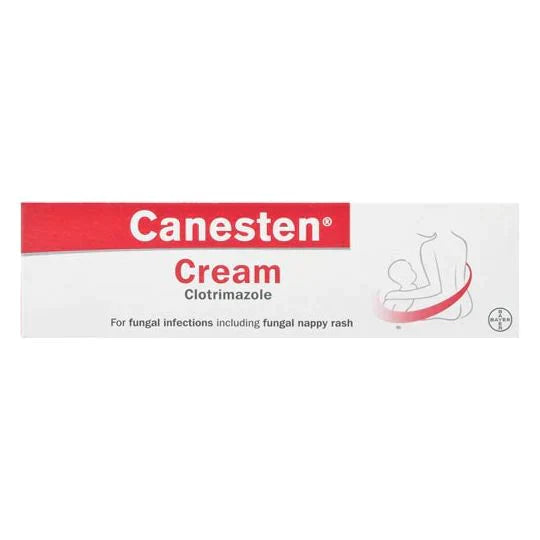
Canesten 1% Clotrimazole Cream - 20g (Fungal Nappy Rash)
- ✔️ Treats Candida fungal nappy rash with 1% clotrimazole
- ✔️ Visible improvement often seen within two to three days
- ✔️ Suitable for babies and infants with fungal nappy rash
- ✔️ Topical cream acts locally with minimal systemic absorption
- ✔️ Compact 20g tube ideal for nappy bag convenience
Price Checker
 Discreet, tracked delivery
 Includes FREE private prescription


Couldn't load pickup availability
Is Clotrimazole Cream for Nappy Rash Right for Your Baby?
Nappy rash is something almost every parent deals with at some point — but not all nappy rash is the same. When the usual barrier creams and nappy changes aren't making a difference, there's a good chance a fungal infection could be involved. Clotrimazole cream for nappy rash is a clinically recognised treatment for exactly this situation. Canesten 1% Clotrimazole Cream 20g contains the active antifungal ingredient clotrimazole, which targets the Candida yeast responsible for fungal nappy rash. It's available over the counter, making it easy to access without a GP appointment. You can browse our full range of baby and toddler products at Cured Pharmacy.
Fungal nappy rash tends to look different from ordinary nappy rash. It's often a vivid red, may have raised edges, and can feature small satellite spots spreading outward from the main rash. If your baby's rash has persisted for more than two or three days despite standard nappy care, it's worth considering whether a fungal cause might be at play. Canesten 1% Clotrimazole Cream is specifically formulated to address this.
How Does Canesten Clotrimazole Cream Work Against Fungal Infections?
Clotrimazole belongs to a group of medicines called azole antifungals. It works by interfering with the production of ergosterol, a key component of the fungal cell membrane. Without ergosterol, the cell membrane becomes leaky and unstable, ultimately causing the fungal cells to die. Here's a simplified breakdown of the mechanism:
- Clotrimazole inhibits the enzyme lanosterol 14α-demethylase, which is essential for ergosterol synthesis.
- Without ergosterol, the fungal cell membrane loses its structural integrity.
- The fungal cells can no longer function or replicate effectively.
- The Candida infection is cleared from the skin surface over the course of treatment.
This mechanism is well established and makes clotrimazole effective against a broad range of fungi, including the Candida species most commonly responsible for nappy rash in babies.
Who Should Use Canesten 1% Clotrimazole Cream?
This cream is suitable for treating fungal nappy rash in babies and infants. It's also used in older children and adults for other superficial fungal skin infections, though this particular product is specifically indicated for the nappy area. It's worth confirming the diagnosis with a pharmacist or GP before starting treatment, especially in very young babies.
- Babies and infants with a confirmed or suspected fungal nappy rash
- Parents whose baby's nappy rash has not responded to standard barrier creams
- Those whose baby's rash shows characteristic signs of Candida infection (satellite lesions, vivid redness)
- Caregivers advised by a pharmacist or GP to use an antifungal cream
How Does Canesten Clotrimazole Cream Compare to Other Antifungal Options?
| Feature | Canesten 1% Clotrimazole Cream | Miconazole Cream (e.g. Daktarin) |
|---|---|---|
| Active ingredient | Clotrimazole 1% | Miconazole 2% |
| Suitable for nappy rash | Yes | Yes (oral gel also available) |
| Application frequency | 2–3 times daily | Twice daily |
| OTC availability | Yes | Yes |
How Should You Store Canesten Clotrimazole Cream and Is It Clinically Suitable?
Store the cream below 25°C, away from direct heat and sunlight. Keep the tube tightly closed when not in use, and always keep it out of reach of children. Do not use the cream after the expiry date printed on the packaging. If you're looking for other athletes foot and fungal infection treatments, Cured Pharmacy stocks a wide selection.
Clotrimazole cream for nappy rash is not suitable for use near the eyes, inside the mouth, or on deeply broken or infected skin. If your baby's skin is severely broken, bleeding, or showing signs of a bacterial infection (such as pus or crusting), seek medical advice before applying any topical treatment. Always speak to your pharmacist if you're unsure whether this product is appropriate.
This product is a medicine. Speak to your doctor or pharmacist before using if you have an underlying medical condition or are taking other medicines.
Canesten 1% Clotrimazole Cream 20g (Fungal Nappy Rash) specifications
| Treatment category | Antifungal / Fungal Nappy Rash |
| Active ingredient | Clotrimazole 1% |
| Mechanism of action | Inhibits ergosterol synthesis in fungal cell membranes |
| Effective against | Candida species (fungal nappy rash) |
| Suitable for | Babies, infants, and children with fungal nappy rash |
| Pack size | 20g |
| Strength | 1% w/w |
| UK classification | P (Pharmacy medicine) |
| Drug class | Azole antifungal |
| Preparation | Cream |
| Route of administration | Topical (cutaneous) |
Specifications of Canesten 1% Clotrimazole Cream 20g (Fungal Nappy Rash)
What Is Canesten 1% Clotrimazole Cream and What Is It Used For?
Canesten 1% Clotrimazole Cream is a topical antifungal medicine used to treat fungal nappy rash in babies and infants. The active ingredient, clotrimazole, targets Candida yeast — the organism most commonly responsible for fungal infections in the nappy area. Fungal nappy rash differs from ordinary nappy rash in that it does not respond to standard barrier creams and requires a specific antifungal treatment to clear. The cream is applied directly to the affected skin and works locally, meaning very little is absorbed into the body.
What Do You Need to Know Before Using Canesten Clotrimazole Cream?
Before applying this cream to your baby, there are some important things to be aware of. Do not use this product if any of the following apply:
- Your baby is allergic to clotrimazole or any other ingredient in the cream
- The skin in the nappy area is severely broken, bleeding, or showing signs of bacterial infection
- You are unsure whether the rash is fungal in origin — always confirm with a pharmacist or GP first
- The rash is near your baby's eyes or mouth
There are no significant drug interactions associated with topical clotrimazole at this concentration. However, if your baby is already using another topical preparation in the same area, check with your pharmacist before combining treatments. If you are also managing other skin concerns, our skin care collection may be helpful.
How Should You Use Canesten Clotrimazole Cream Correctly?
Using the cream correctly gives your baby the best chance of a quick recovery. Follow these steps each time you apply it:
- Wash your hands thoroughly before and after application.
- Clean the nappy area gently with warm water and pat dry — do not rub.
- Apply a thin layer of cream to the affected area only.
- Gently smooth the cream into the skin — do not rub vigorously.
- Allow the cream to absorb slightly before putting on a clean nappy.
- Apply 2–3 times daily, or as directed by your pharmacist or GP.
- Continue treatment for the full recommended course, even if the rash appears to clear up early.
| Indication | Age Group | Dose | Frequency |
|---|---|---|---|
| Fungal nappy rash | Babies and infants | Thin layer applied to affected area | 2–3 times daily for up to 4 weeks |
| Fungal nappy rash | Children (older) | Thin layer applied to affected area | 2–3 times daily for up to 4 weeks |
What Are the Possible Side Effects of Canesten Clotrimazole Cream?
Like all medicines, Canesten 1% Clotrimazole Cream can cause side effects, although not everyone experiences them. Most side effects are mild and localised to the area of application.
Common side effects:
- Mild skin irritation at the application site
- Slight redness or warmth of the skin
- Temporary stinging or burning sensation after application
Less common side effects:
- Skin peeling or flaking around the treated area
- Blistering or swelling — stop use immediately and seek medical advice if this occurs
- Allergic contact dermatitis (rare) — characterised by worsening redness, itching, or a new rash
If you notice any signs of a serious allergic reaction — such as significant swelling, difficulty breathing, or widespread rash — stop using the cream immediately and seek urgent medical attention. You can also find further information on managing skin reactions through our creams and ointments section.
How Should You Store Canesten Clotrimazole Cream Safely?
- Store below 25°C in a cool, dry place
- Keep away from direct sunlight and heat sources
- Keep the tube tightly closed when not in use
- Keep out of the reach and sight of children at all times
- Do not use after the expiry date printed on the tube or carton
- Do not freeze
- Do not dispose of medicines via wastewater or household waste — return unused medicine to your pharmacist
References
Written and reviewed by our qualified team
Your safety and success are our highest priorities. Our medical team rigorously evaluates every product and piece of advice we provide, ensuring you receive only the most effective, science-backed solutions available.
Frequently Asked Questions
Where can I buy Canesten 1% Clotrimazole Cream for fungal nappy rash online in the UK?
You can buy Canesten 1% Clotrimazole Cream 20g directly from Cured Pharmacy, a UK GPhC-registered online pharmacy, for just £4.18. It is available without a prescription as an over-the-counter pharmacy medicine. Simply add it to your basket and it will be dispatched quickly to your door.
How does clotrimazole cream work on fungal nappy rash?
Clotrimazole works by blocking the production of ergosterol, a substance that fungal cells need to maintain their cell membranes. Without it, the Candida yeast responsible for fungal nappy rash cannot survive or replicate. The cream acts locally on the skin, so very little is absorbed into your baby's bloodstream.
How do I apply Canesten clotrimazole cream to my baby step by step?
Start by washing your hands, then gently clean and thoroughly dry the nappy area. Apply a thin layer of cream to the affected skin two to three times daily, smoothing it in gently without rubbing hard. Allow it to absorb slightly before fastening a clean nappy.
How long does it take for clotrimazole cream to clear fungal nappy rash?
Many parents notice an improvement within two to three days of starting treatment, though the full course can last up to four weeks. It's important to continue applying the cream for at least a week after the rash appears to have cleared, to prevent it from returning. If there is no improvement after seven days, consult your GP or pharmacist.
Can I use Canesten clotrimazole cream on a newborn baby?
Canesten 1% Clotrimazole Cream can be used on babies, but you should always speak to your GP or pharmacist before applying any medicine to a newborn. A healthcare professional can confirm whether the rash is fungal in origin and advise on the safest course of action. Never self-diagnose in very young infants.
What does fungal nappy rash look like compared to ordinary nappy rash?
Fungal nappy rash caused by Candida typically appears as a vivid, bright red rash with well-defined edges and small satellite spots spreading outward from the main area. Ordinary nappy rash tends to be pinkish, less defined, and usually responds to barrier creams and frequent nappy changes. If the rash has satellite spots or hasn't improved with standard care, a fungal cause is more likely.
What are the side effects of clotrimazole cream in babies?
Side effects are uncommon but can include mild skin irritation, redness, or a brief stinging sensation at the application site. Rarely, some babies may experience an allergic reaction with blistering or significant swelling — if this happens, stop using the cream and seek medical advice promptly. Most babies tolerate the cream well with no adverse effects.
What is the correct dose of Canesten clotrimazole cream for nappy rash?
Apply a thin layer of the cream to the affected area two to three times daily. There is no specific measured dose — the key is to use enough to cover the rash with a thin, even layer. Do not apply more than directed, as this will not speed up recovery and may increase the risk of irritation.
What happens if I miss an application of Canesten clotrimazole cream?
If you miss an application, simply apply the cream as soon as you remember and then continue with your usual routine. Do not apply a double amount to make up for a missed dose. Consistency is important for effective treatment, so try to apply the cream at regular intervals throughout the day.
How long can I use Canesten clotrimazole cream on my baby?
Treatment should continue for up to four weeks, or as directed by your pharmacist or GP. You should continue applying the cream for at least one week after the rash has visibly cleared to ensure the infection is fully resolved. If symptoms persist beyond four weeks, seek medical advice rather than continuing to self-treat.
What are the alternatives to Canesten clotrimazole cream for fungal nappy rash?
Alternative antifungal creams include those containing miconazole (such as Daktarin) or nystatin, which may be prescribed by a GP for more persistent cases. You can explore our full range of athletes foot and fungal infection treatments for other antifungal options. Your pharmacist can help you choose the most appropriate product for your baby's needs.
Is Canesten clotrimazole cream safe to use with other nappy rash products?
You should check with your pharmacist before combining Canesten clotrimazole cream with other topical products in the same area. Some barrier creams can be used alongside antifungal treatment, but applying too many products at once may reduce the effectiveness of the clotrimazole or cause additional irritation. Your pharmacist can advise on the safest combination.
Who is eligible to buy Canesten 1% Clotrimazole Cream without a prescription?
Canesten 1% Clotrimazole Cream is classified as a Pharmacy (P) medicine in the UK, meaning it can be purchased without a prescription from a registered pharmacy. It is suitable for use in babies and infants with fungal nappy rash, though a pharmacist consultation is recommended to confirm the diagnosis. You can purchase it easily through our baby and toddler section at Cured Pharmacy.
Can fungal nappy rash come back after treatment with clotrimazole cream?
Yes, fungal nappy rash can recur, particularly if the underlying conditions that allowed the Candida overgrowth — such as prolonged moisture or antibiotic use — are not addressed. Completing the full course of treatment and maintaining good nappy hygiene significantly reduces the risk of recurrence. If the rash keeps returning, speak to your GP about possible underlying causes.
What is the latest guidance on treating fungal nappy rash in babies?
Current NHS guidance recommends topical antifungal creams such as clotrimazole as the first-line treatment for Candida-related nappy rash in babies. Good nappy hygiene — including frequent changes, gentle cleaning, and allowing the skin to air dry — remains an important part of management alongside antifungal treatment. If the infection is severe or does not respond to topical treatment, a GP may consider oral antifungal therapy.
Written and reviewed by our qualified team

Reviewed by:
Tarun Kumar
Superintendent/ Clinical Lead
📖 Find out more about our team of medical content authors and how we ensure the accuracy of our content with our content guidelines.
Content last updated: 14 Sep 2026
Other popular options


We’re a safe and
regulated UK service

100% discreet packaging

Discreet, unbranded packaging for every order.

Need help?
Talk to our friendly experts now


How our service works

Service setup

Discreet packaging

Express delivery