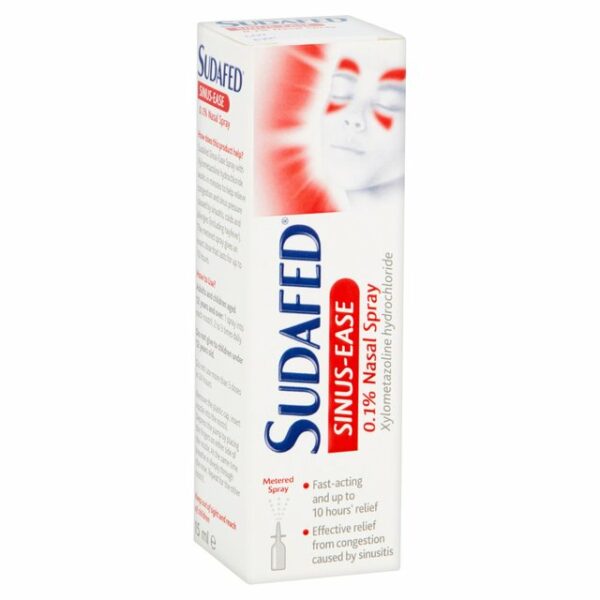
Sudafed Sinus Ease 0.1% Nasal Spray - 15ml
Sudafed Sinus Ease 0.1% Nasal Spray - 15ml
- ✔️ Relieves blocked nose and sinus congestion fast
- ✔️ Contains xylometazoline 0.1% for targeted nasal relief
- ✔️ Works within minutes to restore nasal airflow
- ✔️ Suitable for adults and children aged 12 and over
- ✔️ Larger 15ml bottle provides extended course of treatment
Price Checker
 Lowest price guarantee
 Includes FREE private prescription


Couldn't load pickup availability
What Is Sudafed Nasal Spray and How Does It Help?
If you've ever had a cold that left you unable to breathe through your nose, you'll know just how miserable it can be. Sudafed nasal spray — specifically the Sudafed Sinus Ease 0.1% Nasal Spray — is a fast-acting, over-the-counter decongestant designed to relieve that blocked, stuffy feeling quickly. It contains xylometazoline hydrochloride at a 0.1% concentration, which is the standard adult-strength formulation. Available for just £4.79 at Cured Pharmacy, it's a practical option when congestion is getting in the way of daily life. If you're also dealing with other cold and flu symptoms, you can browse our full range of cold and flu remedies alongside this product.
Nasal congestion happens when the blood vessels inside your nasal passages become inflamed and swollen — usually as a result of a cold, sinusitis, or allergic rhinitis. The result is that familiar blocked, pressured feeling that makes breathing, sleeping, and even concentrating feel like hard work. Sudafed Sinus Ease targets this directly at the source, rather than just masking symptoms.
How Does Sudafed Sinus Ease 0.1% Nasal Spray Work?
The active ingredient, xylometazoline hydrochloride, belongs to a class of medicines called sympathomimetic decongestants. It works by stimulating alpha-adrenergic receptors in the nasal mucosa, causing the blood vessels to constrict. When those vessels narrow, the swollen tissue shrinks, and airflow through the nasal passages improves — often within minutes.
- Xylometazoline binds to alpha-adrenergic receptors in nasal blood vessels
- Blood vessels constrict, reducing swelling of the nasal lining
- Mucus secretion decreases, easing that blocked sensation
- Relief typically begins within 2–5 minutes and can last several hours
Who Should Use Sudafed Sinus Ease Nasal Spray?
This spray is intended for adults and children aged 12 and over who are experiencing nasal congestion. It's particularly useful when congestion is caused by a common cold, sinusitis, or allergic rhinitis. That said, it's not a long-term solution — it's designed for short-term symptom relief only.
It may be suitable for you if you:
- Have a blocked nose due to a cold or upper respiratory infection
- Are experiencing sinus pressure or congestion from sinusitis
- Have nasal congestion triggered by allergic rhinitis or hay fever
- Need fast, temporary relief to sleep or function more comfortably
How Does Sudafed Sinus Ease Compare to Other Nasal Decongestants?
| Feature | Sudafed Sinus Ease 0.1% | Otrivine Adult 0.1% |
|---|---|---|
| Active ingredient | Xylometazoline HCl 0.1% | Xylometazoline HCl 0.1% |
| Pack size | 15ml | 10ml |
| Suitable age | 12 years and over | 12 years and over |
| Max duration of use | 7 consecutive days | 7 consecutive days |
Is Sudafed Sinus Ease Suitable for Everyone, and How Should It Be Stored?
Not everyone can use this spray safely. People with certain cardiovascular conditions, hyperthyroidism, narrow-angle glaucoma, or those taking monoamine oxidase inhibitors (MAOIs) should avoid it. Pregnant or breastfeeding women should speak to a pharmacist or GP before using any nasal decongestant. If you're managing multiple symptoms — for example, sinus pain alongside congestion — you might also want to explore our pain relief range for complementary options.
Store Sudafed Sinus Ease below 25°C, away from direct sunlight, and keep it out of reach of children. Do not share the spray with others, as this can spread infection. Once opened, check the product packaging for any in-use expiry guidance. This Sudafed nasal spray is for nasal use only — never use it in the eyes or mouth.
This product is a medicine. Speak to your doctor or pharmacist before using if you have an underlying medical condition or are taking other medicines.
Sudafed Sinus Ease 0.1% Nasal Spray 15ml specifications
| Treatment category | Nasal decongestant / Sinus congestion relief |
| Mechanism of action | Alpha-adrenergic agonist — constricts nasal blood vessels to reduce swelling |
| Effective for | Blocked nose, sinus congestion, nasal congestion from colds or allergic rhinitis |
| Suitable for | Adults and children aged 12 years and over |
| Active ingredient | Xylometazoline hydrochloride 0.1% |
| Pack size | 15ml |
| Strength | 0.1% w/v |
| UK classification | General Sale List (GSL) |
| Drug class | Sympathomimetic decongestant |
| Preparation | Nasal spray solution |
| Route of administration | Intranasal |
Specifications of Sudafed Sinus Ease 0.1% Nasal Spray 15ml
What Is Sudafed Sinus Ease 0.1% Nasal Spray and What Is It Used For?
Sudafed Sinus Ease 0.1% Nasal Spray is an over-the-counter nasal decongestant containing xylometazoline hydrochloride. It is used to relieve nasal congestion — that blocked, stuffy feeling in your nose and sinuses — caused by conditions such as the common cold, sinusitis, and allergic rhinitis. It works locally in the nasal passages and is not absorbed into the bloodstream in significant amounts when used correctly. The NHS recognises xylometazoline-based nasal sprays as a standard short-term treatment for nasal congestion.
What Do You Need to Know Before Using Sudafed Sinus Ease Nasal Spray?
Before using this spray, it's important to check whether it's appropriate for you. There are several conditions and medicines that may make it unsuitable.
Do not use this spray if you:
- Are allergic to xylometazoline hydrochloride or any other ingredient in the spray
- Have narrow-angle glaucoma
- Have had surgery on your pituitary gland (transsphenoidal hypophysectomy)
- Are under 12 years of age
- Have atrophic rhinitis (a condition causing thinning of the nasal lining)
Speak to your pharmacist or GP before use if you have:
- High blood pressure (hypertension) or heart disease
- Hyperthyroidism (overactive thyroid)
- Diabetes mellitus
- Phaeochromocytoma (a rare adrenal gland tumour)
- Enlarged prostate (benign prostatic hyperplasia)
Known drug interactions — do not use alongside:
- Monoamine oxidase inhibitors (MAOIs) — including those taken within the last 14 days
- Tricyclic antidepressants (e.g. amitriptyline)
- Other sympathomimetic medicines
If you are pregnant or breastfeeding, seek medical advice before using this product. You may also find it helpful to explore our ear, nose and throat range for additional products that may support your recovery.
How Should You Use Sudafed Sinus Ease Nasal Spray Correctly?
Always use this spray exactly as directed on the label. Do not exceed the recommended dose, and never use it for longer than 7 consecutive days without medical advice.
- Blow your nose gently to clear the nasal passages before use
- Remove the protective cap from the nozzle
- Tilt your head slightly forward
- Insert the nozzle carefully into one nostril
- Press the pump firmly once while breathing in gently through your nose
- Repeat in the other nostril if needed
- Replace the cap after use and wipe the nozzle clean
- Do not share the spray with anyone else
| Indication | Age Group | Dose | Frequency |
|---|---|---|---|
| Nasal congestion | Adults and children 12+ | 1–2 sprays per nostril | Up to 3 times daily |
| Nasal congestion | Under 12 years | Not recommended | Not applicable |
What Are the Possible Side Effects of Sudafed Sinus Ease Nasal Spray?
Like all medicines, this spray can cause side effects, although not everyone experiences them. Most side effects are mild and localised to the nasal area.
Common side effects:
- Temporary burning or stinging sensation in the nose
- Nasal dryness or irritation
- Sneezing shortly after application
- Increased nasal discharge
Less common side effects:
- Headache
- Nausea
- Palpitations or increased heart rate
- Rebound congestion (rhinitis medicamentosa) if used for more than 7 days
- Raised blood pressure in susceptible individuals
If you experience any severe or unexpected reactions — such as chest pain, difficulty breathing, or a significant rise in blood pressure — stop using the spray and seek medical attention immediately. The NHS advises that rebound congestion is a real risk with prolonged use of any decongestant nasal spray, so sticking to the 7-day limit is essential.
How Should You Store Sudafed Sinus Ease Nasal Spray?
Correct storage helps maintain the effectiveness and safety of the product. If you're also managing allergy-related congestion, our allergy and hay fever range includes additional products that may help alongside this spray.
- Store below 25°C in a cool, dry place
- Keep away from direct sunlight and heat sources
- Keep out of the sight and reach of children
- Do not use after the expiry date printed on the packaging
- Do not share the spray with other people — this can spread infection
- Dispose of any unused product safely — ask your pharmacist how
References
Written and reviewed by our qualified team
Your safety and success are our highest priorities. Our medical team rigorously evaluates every product and piece of advice we provide, ensuring you receive only the most effective, science-backed solutions available.
Frequently Asked Questions
Where can I buy Sudafed Sinus Ease nasal spray online in the UK?
You can buy Sudafed Sinus Ease 0.1% Nasal Spray online from Cured Pharmacy, a GPhC-registered UK online pharmacy, for just £4.79. It is available without a prescription as an over-the-counter medicine. Simply add it to your basket and it will be dispatched directly to your door.
How does Sudafed nasal spray work in the body?
Sudafed Sinus Ease contains xylometazoline hydrochloride, which acts as an alpha-adrenergic agonist. It constricts the blood vessels in the nasal lining, reducing swelling and allowing air to pass through more freely. The effect is localised to the nasal passages and typically begins within a few minutes of use.
How do I use Sudafed Sinus Ease nasal spray step by step?
Blow your nose gently before use to clear the passages. Insert the nozzle into one nostril, press the pump once while breathing in gently, then repeat in the other nostril if needed. Use up to two sprays per nostril, no more than three times a day, and always replace the cap after use.
How quickly does Sudafed Sinus Ease nasal spray start working?
Most people notice relief from nasal congestion within 2 to 5 minutes of applying the spray. The decongestant effect can last for several hours, making it useful before sleep or during the day when congestion is at its worst. Individual response times may vary slightly.
What is the correct dose of Sudafed Sinus Ease for adults?
The recommended dose for adults and children aged 12 and over is one to two sprays into each nostril, up to three times daily. Do not exceed this dose, and do not use the spray for more than 7 consecutive days. If symptoms persist beyond this period, speak to your pharmacist or GP.
Can children use Sudafed Sinus Ease 0.1% nasal spray?
No — Sudafed Sinus Ease 0.1% is not suitable for children under 12 years of age. A lower-strength formulation (0.05%) is available for younger children, but this should only be used under medical guidance. Always check the product label and consult a pharmacist if you are unsure which product is appropriate for your child.
What are the side effects of Sudafed Sinus Ease nasal spray?
Common side effects include temporary nasal burning, stinging, dryness, or sneezing after application. Less commonly, some people experience headache, nausea, or palpitations. Using the spray for longer than 7 days can cause rebound congestion, where the nose becomes more blocked than before — so always stick to the recommended duration.
How do I manage rebound congestion from nasal decongestant sprays?
Rebound congestion (rhinitis medicamentosa) occurs when a decongestant nasal spray is used for too long, causing the nasal passages to become dependent on it. To manage this, stop using the spray gradually and consider switching to a saline nasal rinse. Speak to your GP if the congestion does not improve — they may recommend a short course of nasal corticosteroids.
Who should not use Sudafed Sinus Ease nasal spray?
This spray is not suitable for children under 12, people with narrow-angle glaucoma, atrophic rhinitis, or those taking MAOIs or tricyclic antidepressants. People with high blood pressure, heart disease, hyperthyroidism, or diabetes should seek medical advice before use. Pregnant or breastfeeding women should also consult a healthcare professional first.
Can I use Sudafed nasal spray if I have high blood pressure?
If you have high blood pressure, you should speak to your GP or pharmacist before using Sudafed Sinus Ease. Xylometazoline can potentially raise blood pressure in susceptible individuals, particularly at higher doses. Your healthcare provider can advise on whether this product is safe for you or suggest an alternative.
What happens if I use Sudafed Sinus Ease for more than 7 days?
Using this spray for more than 7 consecutive days significantly increases the risk of rebound congestion, a condition where the nasal passages become more congested than before you started treatment. This can create a cycle of dependency on the spray. If you find you need it for longer, please speak to your pharmacist or GP for alternative management options.
What are the alternatives to Sudafed Sinus Ease nasal spray?
Alternatives include other xylometazoline-based sprays such as Otrivine, or oxymetazoline-based products like Vicks Sinex. Saline nasal sprays are a non-medicated option suitable for longer-term use and are safe for most people. You can also explore our ear, nose and throat range for a broader selection of nasal and sinus products.
Can I use Sudafed Sinus Ease alongside other cold and flu medicines?
You should be cautious about combining Sudafed Sinus Ease with other decongestant-containing products, as this can increase the risk of side effects such as raised blood pressure or palpitations. Always check the ingredients of any other cold and flu remedies you are taking. If you are unsure, ask your pharmacist before combining treatments — you can also browse our cold and flu range for guidance on suitable combinations.
Is Sudafed Sinus Ease nasal spray safe during pregnancy?
The safety of xylometazoline during pregnancy has not been fully established, and it is generally recommended that pregnant women avoid using decongestant nasal sprays unless advised by a doctor. If you are pregnant and suffering from nasal congestion, speak to your GP or midwife before using this product. Saline nasal rinses are often considered a safer first-line option during pregnancy.
What are the latest findings on xylometazoline nasal sprays?
Xylometazoline remains a well-established and widely used nasal decongestant, with its efficacy and safety profile supported by decades of clinical use. Current guidance from the NHS and BNF continues to recommend it for short-term relief of nasal congestion, with the key caveat that use should not exceed 7 consecutive days. No significant new safety concerns have emerged in recent published literature for adults using it as directed.
Written and reviewed by our qualified team

Reviewed by:
Tarun Kumar
Superintendent/ Clinical Lead
📖 Find out more about our team of medical content authors and how we ensure the accuracy of our content with our content guidelines.
Content last updated: 14 Sep 2026
Other popular options


We’re a safe and
regulated UK service

Lowest Price Guarantee

We're convinced you won't find your treatment cheaper, but if you do we'll refund the difference.
Find out more
100% discreet packaging

Discreet, unbranded packaging for every order.
Find out more

Need help?
Talk to our friendly experts now


How our service works

Service setup

Discreet packaging

Express delivery