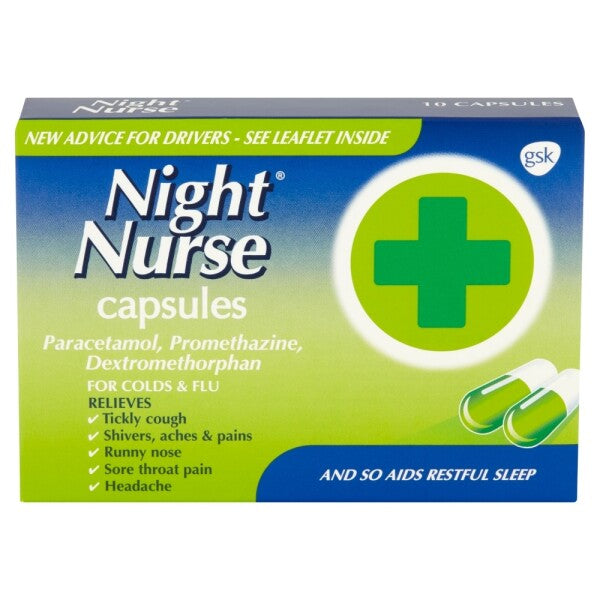
Night Nurse
- ✔️ Relieves cold and flu symptoms to help you sleep
- ✔️ Targets fever, cough, congestion and sore throat pain
- ✔️ Contains paracetamol, promethazine and dextromethorphan
- ✔️ Suitable for adults and young people aged 16 and over
- ✔️ Available as easy-to-take liquid or capsules
Price Checker
 Lowest price guarantee
 Includes FREE private prescription


Couldn't load pickup availability
What Is Night Nurse Cold and Flu Relief?
When a cold or flu hits at night, it can feel relentless. The coughing, the blocked nose, the aching limbs — all of it conspiring to keep you awake when your body needs rest most. Night Nurse cold and flu relief is a well-established, over-the-counter remedy designed specifically for night-time use, targeting multiple cold and flu symptoms at once so you can actually get some sleep. Available as both a liquid and capsules, it has been a trusted name in UK households for decades. You can browse our full range of cold and flu treatments if you want to compare your options before buying.
Night Nurse is manufactured by Haleon (formerly GSK Consumer Healthcare) and is classified as a pharmacy (P) medicine in the UK, meaning it is available without a prescription but should be purchased from a registered pharmacy. Each dose contains three active ingredients working together to tackle the most disruptive night-time symptoms.
How Does Night Nurse Work to Relieve Symptoms?
Night Nurse works through a combination of three active ingredients, each targeting a different symptom:
- Paracetamol (1,000 mg per dose): Reduces fever and relieves the aches and pains associated with colds and flu by acting on pain receptors in the brain and lowering the body's temperature set-point.
- Promethazine hydrochloride (20 mg per dose): An antihistamine that helps relieve a runny nose and congestion. It also causes sedation, which is intentional in a night-time formulation — helping you drift off despite your symptoms.
- Dextromethorphan hydrobromide (15 mg per dose): A cough suppressant that acts on the cough centre in the brain, reducing the urge to cough so you are not disturbed throughout the night.
Together, these three ingredients address fever, pain, congestion, and cough — the four symptoms most likely to disrupt your sleep when you have a cold or flu.
Who Is Night Nurse Suitable For?
Night Nurse is intended for adults and young people aged 16 and over who are experiencing cold or flu symptoms that are affecting their sleep. It is particularly useful if you have more than one symptom at the same time — for example, a cough alongside a fever and a blocked nose. That said, it is not appropriate for everyone.
Night Nurse may be suitable for you if:
- You are aged 16 or over
- You have cold or flu symptoms including cough, fever, sore throat, or congestion
- Your symptoms are disrupting your sleep
- You are not taking any other paracetamol-containing products
- You are not taking monoamine oxidase inhibitors (MAOIs) or other sedating medicines
How Does Night Nurse Compare to Day Nurse?
| Feature | Night Nurse | Day Nurse |
|---|---|---|
| Time of use | Bedtime only | During the day |
| Contains sedating antihistamine | Yes (promethazine) | No |
| Suitable for driving | No | Yes (if symptoms allow) |
| Cough suppressant | Yes (dextromethorphan) | Yes (pholcodine) |
| Paracetamol included | Yes (1,000 mg) | Yes (1,000 mg) |
How Should You Store Night Nurse and Is It Safe Long-Term?
Store Night Nurse below 25°C in a dry place, away from direct sunlight and out of reach of children. Do not use it after the expiry date printed on the packaging. The liquid formulation should be kept upright and the cap secured tightly after each use.
Night Nurse cold and flu relief is intended for short-term use only — typically no more than five consecutive nights. It is not a long-term solution. If your symptoms persist beyond this period, worsen, or you develop a high fever that does not respond to treatment, you should seek advice from your GP. If you are also looking for daytime symptom relief, our ear, nose and throat range includes a variety of options to help manage congestion and sore throat during the day.
This product is a medicine. Speak to your doctor or pharmacist before using if you have an underlying medical condition or are taking other medicines.
Night Nurse specifications
| Treatment category | Cold and flu relief (night-time) |
| Active ingredients | Paracetamol 1,000 mg, Promethazine hydrochloride 20 mg, Dextromethorphan hydrobromide 15 mg (per 20 ml dose) |
| Mechanism of action | Analgesic/antipyretic, sedating antihistamine, cough suppressant |
| Suitable for | Adults and young people aged 16 and over |
| Pack sizes | 160 ml liquid; 10 capsules |
| UK classification | Pharmacy (P) medicine |
| Drug class | Analgesic, antihistamine, antitussive combination |
| Preparation | Oral liquid; hard capsules |
| Route of administration | Oral |
| Effective for | Fever, pain, cough, congestion, sleeplessness due to cold/flu |
Specifications of Night Nurse
What Is Night Nurse and What Is It Used For?
Night Nurse is a combination over-the-counter medicine used to relieve the symptoms of colds and flu at night. It contains paracetamol to reduce fever and ease aches, promethazine hydrochloride to relieve a runny nose and help you sleep, and dextromethorphan hydrobromide to suppress a persistent cough. It is available as an oral liquid (taken as a 20 ml dose) or as capsules (two capsules per dose). Night Nurse cold and flu relief is only intended for use at bedtime — it is not suitable for daytime use because of its sedating effects.
What Do You Need to Know Before Using Night Nurse?
Before taking Night Nurse, it is important to check whether it is appropriate for you. There are several situations in which you should not take it, and a number of medicines it can interact with.
Do not take Night Nurse if you:
- Are under 16 years of age
- Are pregnant or breastfeeding
- Have severe liver or kidney disease
- Are taking or have taken monoamine oxidase inhibitors (MAOIs) within the last 14 days
- Are allergic to paracetamol, promethazine, dextromethorphan, or any other ingredient in the product
- Have a condition called phenylketonuria (the liquid contains aspartame)
- Have epilepsy or are prone to seizures
- Have glaucoma or an enlarged prostate
Night Nurse may interact with the following medicines:
- Other paracetamol-containing products (risk of overdose)
- Alcohol and other sedating medicines (increased drowsiness)
- Warfarin and other anticoagulants (paracetamol may affect INR at high doses)
- Antidepressants, including SSRIs and MAOIs
- Antiepileptic medicines such as carbamazepine and phenytoin
- Other antihistamines
Always tell your pharmacist about all medicines you are currently taking, including herbal remedies and supplements. If you are looking for non-drowsy daytime relief, our pain relief range includes paracetamol and ibuprofen options that will not affect your alertness.
How Should You Use Night Nurse?
Night Nurse should only be taken at bedtime. Never take it during the day or before driving. Follow these steps carefully:
- Check the expiry date on the packaging before use.
- For the liquid: shake the bottle gently, then measure exactly 20 ml using the graduated measuring cup provided.
- For capsules: swallow two capsules whole with a glass of water.
- Take your dose immediately before going to bed.
- Do not take a second dose within 24 hours.
- Do not take alongside any other paracetamol-containing product.
- Do not drink alcohol before or after taking Night Nurse.
| Formulation | Age Group | Dose | Frequency |
|---|---|---|---|
| Liquid | Adults and young people 16+ | 20 ml | Once at bedtime only |
| Capsules | Adults and young people 16+ | 2 capsules | Once at bedtime only |
| Liquid or capsules | Under 16 | Not suitable | Not applicable |
What Are the Possible Side Effects of Night Nurse?
Like all medicines, Night Nurse can cause side effects, although not everyone experiences them. The sedating effect of promethazine is intentional at night but can persist into the following morning in some people.
Common side effects:
- Drowsiness or grogginess the next morning
- Dry mouth
- Blurred vision
- Dizziness
Less common side effects:
- Urinary retention (difficulty passing urine)
- Constipation
- Headache
- Nausea
- Skin rash or sensitivity to sunlight (photosensitivity)
- Paradoxical excitability (more common in older adults)
Stop taking Night Nurse and seek immediate medical attention if you develop signs of a serious allergic reaction, such as swelling of the face, lips, or throat, difficulty breathing, or a severe skin rash. Paracetamol overdose is a medical emergency — never exceed the stated dose, and never combine Night Nurse with other paracetamol products. If you suspect an overdose, go to A&E immediately even if you feel well, as liver damage may not be apparent for several days.
How Should You Store Night Nurse?
- Store below 25°C in a cool, dry place away from direct sunlight.
- Keep the bottle or blister pack tightly closed when not in use.
- Keep out of the sight and reach of children at all times.
- Do not use after the expiry date printed on the carton or bottle.
- Do not store in a bathroom or near a sink — moisture can degrade the product.
- Do not freeze the liquid formulation.
- Dispose of any unused medicine safely — return it to your pharmacy rather than putting it in household waste or flushing it down the sink.
If you are managing multiple symptoms and need additional support, our sleep aid range may also be of interest for nights when congestion has cleared but sleep remains difficult.
References
- https://www.nhs.uk/conditions/cold/
- https://www.nhs.uk/conditions/flu/
- https://www.nhs.uk/medicines/paracetamol-for-adults/
- https://www.nhs.uk/conditions/sore-throat/
- https://www.nhs.uk/conditions/cough/
- https://www.nhs.uk/conditions/fever-in-adults/
- https://www.medicines.org.uk/emc/product/1416/smpc
Written and reviewed by our qualified team
Your safety and success are our highest priorities. Our medical team rigorously evaluates every product and piece of advice we provide, ensuring you receive only the most effective, science-backed solutions available.
Frequently Asked Questions
Where can I buy Night Nurse online in the UK?
You can buy Night Nurse online from Cured Pharmacy, a GPhC-registered UK online pharmacy. It is available without a prescription as a pharmacy (P) medicine. Simply add it to your basket and complete a short health questionnaire to confirm it is suitable for you.
How does Night Nurse work in the body?
Night Nurse cold and flu relief contains three active ingredients that work together. Paracetamol reduces fever and relieves pain, dextromethorphan suppresses the cough reflex in the brain, and promethazine acts as a sedating antihistamine to ease congestion and help you fall asleep. The combination targets multiple symptoms simultaneously rather than just one.
How do I use Night Nurse liquid step by step?
Shake the bottle gently, then measure exactly 20 ml using the graduated cup provided. Take the dose at bedtime only — never during the day. Do not take a second dose within 24 hours, and avoid alcohol before and after taking it.
What is the correct dose of Night Nurse for adults?
Adults and young people aged 16 and over should take 20 ml of Night Nurse liquid or two Night Nurse capsules at bedtime. This is a single dose and should not be repeated within 24 hours. Do not take more than the recommended amount — paracetamol overdose can cause serious liver damage.
Can I drive the morning after taking Night Nurse?
You should be cautious. Promethazine, the antihistamine in Night Nurse, can cause residual drowsiness that persists into the following morning in some people. Do not drive or operate machinery if you feel drowsy or unsteady. If in doubt, wait until you feel fully alert before getting behind the wheel.
Who should not take Night Nurse?
Night Nurse is not suitable for children under 16, pregnant or breastfeeding women, or people taking MAOIs. It should also be avoided by those with severe liver or kidney disease, glaucoma, an enlarged prostate, or epilepsy. Always speak to a pharmacist if you are unsure whether it is right for you.
Can I take Night Nurse if I am pregnant?
No. Night Nurse is not recommended during pregnancy. Promethazine and dextromethorphan are not considered safe in pregnancy, and you should speak to your GP or midwife before taking any cold or flu remedy. Your healthcare provider can advise on safer alternatives for managing your symptoms.
What are the side effects of Night Nurse?
Common side effects include drowsiness, dry mouth, blurred vision, and dizziness. Less commonly, some people experience nausea, constipation, urinary retention, or a skin rash. If you develop signs of a serious allergic reaction — such as swelling of the face or difficulty breathing — stop taking it and seek emergency medical help immediately.
Can I take Night Nurse with other cold and flu medicines?
No — you must not take Night Nurse alongside any other product containing paracetamol, as this significantly increases the risk of paracetamol overdose. You should also avoid combining it with other antihistamines, cough suppressants, or sedating medicines. Always check the ingredients of any other medicine you are taking before using Night Nurse.
How long can I take Night Nurse for?
Night Nurse is intended for short-term use only — generally no more than five consecutive nights. If your symptoms have not improved after this time, or if they worsen, you should consult your GP. Prolonged use of antihistamines and cough suppressants without medical supervision is not recommended. You can explore our cold and flu range for additional support products.
What happens if I miss a dose of Night Nurse?
Because Night Nurse is taken as a single bedtime dose rather than on a regular schedule, there is no "missed dose" in the traditional sense. Simply take it the following night if you still have symptoms. Never double up on doses to compensate — this could lead to paracetamol overdose.
What are the alternatives to Night Nurse?
Alternatives include Lemsip Max Night, Benylin Night Cough, or Sudafed Night-Time. You could also use individual products — paracetamol for fever and pain, a separate antihistamine for congestion, and a cough linctus for cough. Browse our ear, nose and throat collection for a wider selection of symptom-specific remedies.
Is Night Nurse liquid or capsules better?
Both formulations contain the same active ingredients at the same doses, so neither is clinically superior to the other. The liquid may act slightly faster as it does not need to dissolve, while capsules are more convenient for travel. Choose whichever you find easier to take at bedtime.
Can Night Nurse help with a sore throat?
Yes, indirectly. The paracetamol in Night Nurse cold and flu relief helps to relieve the pain associated with a sore throat by acting on pain receptors. However, it does not treat the underlying cause of a sore throat. If your sore throat is severe, lasts more than a week, or is accompanied by difficulty swallowing or breathing, see your GP.
What are the latest guidelines on treating cold and flu symptoms at night?
NHS guidance recommends rest, staying hydrated, and using over-the-counter remedies to manage symptoms while your immune system fights the infection. Combination night-time products like Night Nurse are considered appropriate for short-term symptom relief in adults. Antibiotics are not effective against viral infections such as colds and flu and should not be requested for these conditions.
Patient Information Leaflet
Important - Before taking any medication, it is always important to read the Patient Information Leaflet (PIL)
View Patient Information Leaflet (PDF)Written and reviewed by our qualified team

Reviewed by:
Tarun Kumar
Superintendent/ Clinical Lead
📖 Find out more about our team of medical content authors and how we ensure the accuracy of our content with our content guidelines.
Content last updated: 14 Sep 2026
Other popular options


We’re a safe and
regulated UK service

Lowest Price Guarantee

We're convinced you won't find your treatment cheaper, but if you do we'll refund the difference.
Find out more
100% discreet packaging

Discreet, unbranded packaging for every order.
Find out more

Need help?
Talk to our friendly experts now


How our service works

Service setup

Discreet packaging

Express delivery