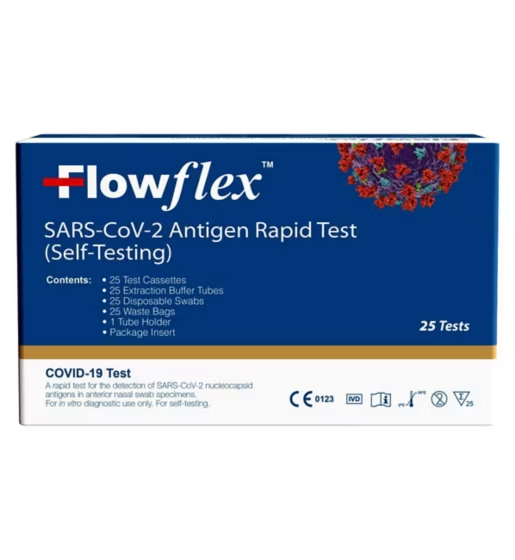
Flowflex Antigen Rapid Test Lateral Flow Self
- ✔️ Detects SARS-CoV-2 antigen from a simple nasal swab
- ✔️ Delivers a clear positive or negative result in 15 minutes
- ✔️ CE-marked for reliable at-home COVID-19 self-testing
- ✔️ Suitable for adults and children with adult supervision
- ✔️ Value bundle pack ideal for households and workplaces
Price Checker
 Lowest price guarantee
 Includes FREE private prescription


Couldn't load pickup availability
What Is a Lateral Flow Test and How Does the Flowflex Antigen Rapid Test Work?
If you've needed to check whether you have COVID-19 quickly and conveniently at home, you'll already know how useful a lateral flow test can be. The Flowflex Antigen Rapid Test Lateral Flow Self is a CE-marked, over-the-counter self-test designed to detect SARS-CoV-2 antigens from a simple nasal swab. It delivers a clear result in approximately 15 minutes — no laboratory, no waiting room, no fuss. At £34.99 for a value bundle, it's a practical option for households, workplaces, or anyone who needs reliable at-home testing. You can also explore our wider range of electrical health and diagnostic products if you're looking to build a more complete home health toolkit.
Rapid antigen testing plays an important role in identifying infectious individuals, particularly during periods of high community transmission. The NHS has used lateral flow devices extensively as part of its testing strategy, and the Flowflex test is among the devices that have been evaluated for this purpose. It's worth understanding exactly how the test works before you use it, so you can be confident in your result.
How Does the Flowflex Antigen Rapid Test Detect COVID-19?
The Flowflex test uses immunochromatographic technology — a method that relies on antibodies to detect specific proteins (antigens) from the SARS-CoV-2 virus. Here's a simplified breakdown of what happens inside the cassette:
- You collect a nasal swab sample and mix it with a buffer solution provided in the kit.
- Three drops of the mixture are applied to the sample well on the test cassette.
- The liquid migrates along a nitrocellulose membrane inside the cassette.
- If SARS-CoV-2 antigens are present, they bind to labelled antibodies and produce a visible coloured line at the test (T) position.
- A control (C) line always appears if the test has run correctly, confirming the result is valid.
Two lines — C and T — means a positive result. One line at C only means negative. No line at C means the test is invalid and should be repeated with a new kit.
Who Should Use the Flowflex Antigen Rapid Test?
This test is suitable for a wide range of people who need a quick, convenient way to check for COVID-19 infection. It's particularly useful if you're symptomatic and want to know whether you're likely to be infectious before attending work, visiting a vulnerable person, or travelling.
- Adults experiencing symptoms such as a new continuous cough, fever, or loss of taste or smell
- Individuals who have been in close contact with a confirmed COVID-19 case
- People who need to test regularly for work or care settings
- Households wanting a supply of tests on hand for peace of mind
Children can also be tested, though an adult should assist with or supervise the swabbing process for younger children. This test is not intended to replace clinical assessment by a healthcare professional where symptoms are severe.
How Does the Flowflex Test Compare to a PCR Test?
| Feature | Flowflex Lateral Flow Test | PCR Test |
|---|---|---|
| Result time | ~15 minutes | 24–72 hours |
| Setting | At home, self-administered | Laboratory |
| Sensitivity | High in symptomatic individuals | Very high (gold standard) |
| Cost | Available OTC | May require NHS referral |
How Should You Store the Flowflex Antigen Rapid Test?
Proper storage is essential to ensure your lateral flow test performs accurately when you need it. Store the kit below 30°C in a cool, dry place away from direct sunlight. Do not freeze the test components, as this can damage the reagents and affect the result. Keep the foil pouch sealed until you are ready to use the test, and always check the expiry date printed on the packaging before use.
If you're building a home health kit alongside your testing supplies, you might also find our first aid range useful for everyday preparedness. Always read the full instructions included in the pack before performing the test.
This product is a medicine. Speak to your doctor or pharmacist before using if you have an underlying medical condition or are taking other medicines.
Flowflex Antigen Rapid Test Lateral Flow Self specifications
| Treatment category | Diagnostic / Infectious disease testing |
| Mechanism of action | Immunochromatographic antigen detection |
| Effective against | SARS-CoV-2 (COVID-19) |
| Suitable for | Adults and children (adult supervision required for young children) |
| Active ingredient | SARS-CoV-2 antigen detection reagents |
| UK classification | Over-the-counter (OTC) medical device |
| Preparation | Nasal swab with buffer solution |
| Route of administration | Nasal swab (self-administered) |
| Result time | 15 minutes |
Specifications of Flowflex Antigen Rapid Test Lateral Flow Self
What Is the Flowflex Antigen Rapid Test and What Is It Used For?
The Flowflex Antigen Rapid Test Lateral Flow Self is a CE-marked in vitro diagnostic medical device used to detect the presence of SARS-CoV-2 antigens in nasal swab samples. It is intended for self-testing by individuals aged 18 and over, or for use on children under adult supervision. The test is used to identify whether a person is likely to be infectious with COVID-19, particularly when symptoms are present. It is not a substitute for a full clinical assessment and should not be used as the sole basis for diagnosis in a medical setting.
The NHS has provided guidance on when and how to use rapid lateral flow tests as part of managing COVID-19 in the community. If you test positive, you should follow current NHS advice regarding self-isolation and protecting others around you, especially those who are clinically vulnerable.
What Do You Need to Know Before Using the Flowflex Antigen Rapid Test?
Before using this test, read the following contraindications and warnings carefully:
- Do not use the test if the foil pouch is damaged or the expiry date has passed.
- Do not eat, drink, or smoke for at least 30 minutes before taking the test, as this may affect the result.
- Do not use nasal sprays or rinse your nose immediately before testing.
- This test is for in vitro diagnostic use only — do not ingest any components.
- A negative result does not completely rule out SARS-CoV-2 infection, particularly in asymptomatic individuals or those tested very early in the course of illness.
- Individuals with known nasal polyps or recent nasal surgery should seek advice from a healthcare professional before self-swabbing.
Regarding interactions — this is a diagnostic device, not a medicine, so there are no known drug interactions. However, certain nasal preparations used immediately before testing may theoretically affect the sample quality.
- No known drug interactions applicable to this diagnostic device.
How Should You Use the Flowflex Antigen Rapid Test?
Follow these steps carefully to ensure an accurate result. Incorrect technique is one of the most common reasons for invalid or misleading results.
- Wash your hands thoroughly with soap and water for at least 20 seconds, or use hand sanitiser.
- Open the foil pouch and remove the test cassette, swab, and extraction tube. Place the cassette on a flat, clean surface.
- Peel back the foil on the extraction tube and add the buffer solution as directed — typically 6 drops into the tube.
- Gently insert the swab approximately 2.5 cm into one nostril and rotate it five times against the nasal wall. Repeat in the other nostril using the same swab.
- Insert the swab into the extraction tube and rotate it at least 10 times while squeezing the tube sides. Leave for one minute.
- Remove the swab while squeezing the tube to extract as much liquid as possible. Attach the nozzle cap to the tube.
- Apply exactly three drops of the extracted liquid to the sample well (S) on the test cassette.
- Wait 15 minutes, then read the result. Do not read after 30 minutes.
| Indication | Age Group | Swab Depth | Frequency |
|---|---|---|---|
| Symptomatic COVID-19 testing | Adults (18+) | ~2.5 cm into each nostril | As needed; repeat if invalid result |
| Symptomatic COVID-19 testing | Children (with adult supervision) | Shallower insertion as tolerated | As needed; adult to assist |
What Are the Possible Side Effects of the Flowflex Antigen Rapid Test?
As a diagnostic device rather than a medicine, the Flowflex test does not cause systemic side effects. However, the physical process of nasal swabbing can occasionally cause minor discomfort. If you're managing other health concerns alongside testing, our cold and flu range may help with symptom relief while you await or act on your result.
Common side effects (related to swabbing):
- Mild nasal discomfort or tickling sensation during swab insertion
- Temporary sneezing triggered by nasal stimulation
- Minor nasal irritation immediately after swabbing
Less common side effects:
- Very minor bleeding from the nasal mucosa if swabbing is too forceful — always use gentle pressure
- Psychological distress from a positive or unexpected result — seek support from your GP or NHS 111 if needed
False positive or false negative results are a recognised limitation of all rapid antigen tests. A false negative may occur if the test is performed too early in the course of infection or if the swab technique is poor. A false positive is less common but possible. If your result does not match your symptoms, contact NHS 111 for further guidance.
How Should You Store the Flowflex Antigen Rapid Test?
- Store at 2°C to 30°C — do not freeze.
- Keep in a dry place away from direct sunlight and humidity.
- Keep the foil pouch sealed until immediately before use.
- Store out of reach of children.
- Do not use after the expiry date printed on the outer packaging.
- Dispose of used test components as clinical waste or in accordance with local authority guidance — do not place in general recycling.
If you're looking to keep a broader range of health essentials at home, browse our vitamins and supplements collection to support your general wellbeing alongside your testing routine.
References
- https://www.nhs.uk/conditions/coronavirus-covid-19/testing/get-tested-for-coronavirus/
- https://www.nhs.uk/conditions/coronavirus-covid-19/self-isolation-and-treatment/when-to-self-isolate-and-what-to-do/
- https://www.nhs.uk/conditions/coronavirus-covid-19/symptoms/main-symptoms/
- https://www.nhs.uk/conditions/coronavirus-covid-19/testing/regular-rapid-lateral-flow-tests/
- https://www.gov.uk/government/publications/covid-19-lateral-flow-antigen-test-evaluation-report
Written and reviewed by our qualified team
Your safety and success are our highest priorities. Our medical team rigorously evaluates every product and piece of advice we provide, ensuring you receive only the most effective, science-backed solutions available.
Frequently Asked Questions
Where can I buy the Flowflex lateral flow test online in the UK?
You can order the Flowflex Antigen Rapid Test Lateral Flow Self directly from Cured Pharmacy online, with no prescription required. It is available as an over-the-counter diagnostic device and is dispatched across the UK. Simply add it to your basket and check out — it's that straightforward.
How does the Flowflex antigen rapid test work in the body?
The Flowflex test doesn't work inside the body — it works on a nasal swab sample taken from your nostril. It uses immunochromatographic technology to detect SARS-CoV-2 antigens in the sample, producing a visible coloured line on the test cassette if the virus is present. The whole process takes around 15 minutes from swabbing to reading your result.
How do I use the Flowflex lateral flow test step by step?
Start by washing your hands, then insert the swab gently about 2.5 cm into each nostril and rotate it five times. Place the swab into the buffer-filled extraction tube, squeeze and rotate, then apply three drops to the sample well on the cassette. Read your result at exactly 15 minutes — not before, and not after 30 minutes.
How accurate is the Flowflex antigen test compared to a PCR test?
The Flowflex lateral flow test has demonstrated high sensitivity in symptomatic individuals, but PCR testing remains the gold standard for sensitivity and specificity. A negative lateral flow result does not completely rule out infection, especially if you test very early in the illness or have no symptoms. If your symptoms persist despite a negative result, contact NHS 111 for further advice.
How long does it take to get a result from the Flowflex test?
Results appear on the test cassette within 15 minutes of applying your sample. You should read the result at the 15-minute mark and not wait longer than 30 minutes, as lines may appear or fade after this point and give a misleading reading. Set a timer to be sure.
Can children use the Flowflex antigen rapid test?
Yes, children can be tested using the Flowflex kit, but an adult should perform or closely supervise the nasal swabbing for younger children to ensure correct technique and comfort. The swab should be inserted more shallowly for very young children. Always follow the instructions included in the pack for age-appropriate guidance.
What does a positive Flowflex lateral flow test result mean?
A positive result — two lines appearing at both the C and T positions — indicates the likely presence of SARS-CoV-2 antigen in your sample. You should follow current NHS guidance on protecting others and consider whether a confirmatory PCR test is needed, particularly if you are in a high-risk group or your result will affect clinical decisions. Do not dismiss a positive result even if you feel well.
What does a negative Flowflex test result mean?
A negative result — one line at C only — suggests SARS-CoV-2 antigen was not detected in your sample at the time of testing. However, this does not completely rule out infection, especially if you tested very early after exposure or have mild symptoms. If you remain symptomatic, consider retesting after 24–48 hours or seek advice from NHS 111.
What should I do if my Flowflex test result is invalid?
An invalid result occurs when no line appears at the C position, meaning the test has not run correctly. This can happen due to insufficient sample volume, incorrect technique, or a faulty test. Discard the used cassette safely and repeat the test using a new kit, following the instructions carefully.
Who is eligible to use the Flowflex antigen self-test?
The Flowflex test is suitable for adults and children who need to check for COVID-19 infection, whether symptomatic or as part of a regular testing routine. It is available over the counter without a prescription. People with nasal polyps, recent nasal surgery, or significant nasal conditions should speak to a healthcare professional before self-swabbing.
How often can I use the Flowflex lateral flow test?
There is no strict limit on how frequently you can test, and during periods of high transmission or regular workplace testing, some people test every two to three days. Each test in the pack is single-use only — never reuse a swab or cassette. If you need to test regularly, our value bundle pack at £34.99 offers a cost-effective supply. You can also browse our electrical health and diagnostic range for other monitoring tools.
What are the alternatives to the Flowflex lateral flow test?
Alternatives include other CE-marked rapid antigen lateral flow tests available from pharmacies, as well as laboratory-based PCR testing which offers higher sensitivity. For general health monitoring at home, you might also consider products from our electrical health and diagnostic collection. Your GP or NHS 111 can advise on the most appropriate testing option for your specific situation.
How should I dispose of the Flowflex test after use?
Used test components — including the swab, cassette, and extraction tube — should be placed in a sealed plastic bag before disposal. Do not place them in general recycling. Follow your local authority's guidance on disposing of clinical or household waste. The buffer solution contains a preservative, so handle it carefully and avoid skin contact.
What are the latest studies on rapid antigen lateral flow tests for COVID-19?
Published research and MHRA evaluations have consistently shown that rapid antigen lateral flow tests perform best in symptomatic individuals with higher viral loads, where sensitivity is substantially higher than in asymptomatic testing. Studies have also confirmed that sensitivity decreases when tests are performed very early or very late in the course of infection. The NHS and UKHSA continue to review evidence on lateral flow test performance as new variants emerge.
Can I use the Flowflex test if I have already had COVID-19 or been vaccinated?
Yes — prior infection or vaccination does not affect the accuracy of the Flowflex antigen test, as it detects viral antigen rather than antibodies. If you have been vaccinated or previously infected and develop new symptoms, you can still use this test to check for active infection. A positive result should still be taken seriously regardless of your vaccination status.
Written and reviewed by our qualified team

Reviewed by:
Tarun Kumar
Superintendent/ Clinical Lead
📖 Find out more about our team of medical content authors and how we ensure the accuracy of our content with our content guidelines.
Content last updated: 14 Sep 2026
Other popular options


We’re a safe and
regulated UK service

Lowest Price Guarantee

We're convinced you won't find your treatment cheaper, but if you do we'll refund the difference.
Find out more
100% discreet packaging

Discreet, unbranded packaging for every order.
Find out more

Need help?
Talk to our friendly experts now


How our service works

Service setup

Discreet packaging

Express delivery