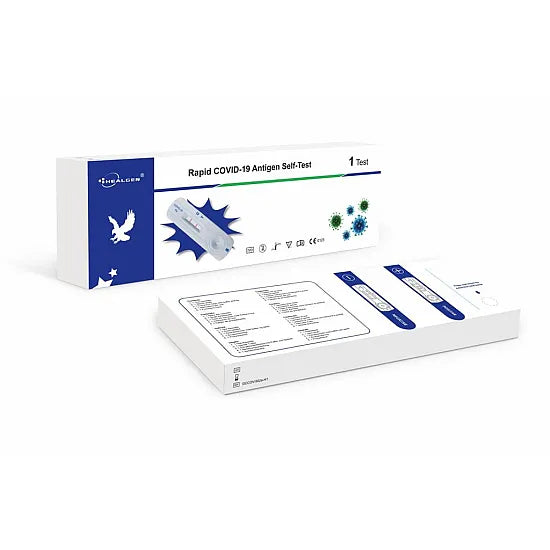
COVID-19 Rapid Antigen Self Test Kit - 1 Pack
- ✔️ Detects SARS-CoV-2 antigen from a simple nasal swab
- ✔️ Results ready in just 15–30 minutes at home
- ✔️ Most accurate during peak infectious days 1–5
- ✔️ Suitable for adults and children with adult supervision
- ✔️ Single-use lateral flow device, no lab equipment needed
Price Checker
 Lowest price guarantee
 Includes FREE private prescription


Couldn't load pickup availability
What Is a COVID-19 Rapid Antigen Test and How Can It Help You?
Knowing whether you have COVID-19 quickly can make a real difference — to your own health decisions and to protecting the people around you. The covid 19 rapid antigen test from Cured Pharmacy gives you a clear result from the comfort of your own home, usually within 15 to 30 minutes. At just £2.00 per pack, it's one of the most accessible ways to check your status without needing to visit a clinic or wait days for a laboratory result.
COVID-19, caused by the SARS-CoV-2 virus, continues to circulate in the UK. The NHS recommends testing if you develop symptoms such as a high temperature, a new continuous cough, or a loss or change to your sense of smell or taste. Rapid antigen testing remains a practical tool for identifying infection during the most infectious window. If you're also managing other health concerns alongside respiratory symptoms, our cold and flu range may offer additional support.
How Does a COVID-19 Rapid Antigen Self Test Kit Work?
This test uses lateral flow immunoassay technology to detect SARS-CoV-2 nucleocapsid proteins directly from a nasal swab sample. It doesn't require any laboratory equipment — the reaction happens on the test strip itself. Here's how the detection process works:
- You collect a sample from your nasal passages using the swab provided.
- The swab is placed into an extraction buffer solution, which releases any viral proteins present.
- A few drops of this solution are applied to the test cassette.
- Antibodies on the test strip bind to SARS-CoV-2 antigens if they are present, producing a visible coloured line.
- A control line confirms the test has worked correctly, regardless of the result.
The result is read visually — one line means negative, two lines means positive. It's straightforward, and the full instructions are included in the pack.
Who Should Use a COVID-19 Rapid Antigen Self Test Kit?
This test is suitable for most adults and children (with adult assistance for younger children). It's particularly useful if you want a fast, at-home result without waiting for a GP appointment or laboratory turnaround. You might consider testing if:
- You have developed symptoms associated with COVID-19, such as fever, cough, or fatigue.
- You have been in close contact with someone who has tested positive.
- You are planning to visit elderly or immunocompromised relatives and want to reduce risk.
- You need to confirm your status before returning to work or attending a healthcare setting.
It is not intended as a replacement for clinical assessment if your symptoms are severe. Always seek medical advice if you are concerned about your condition.
How Does a Rapid Antigen Test Compare to a PCR Test?
| Feature | COVID-19 Rapid Antigen Test (This Product) | PCR Test (Alternative) |
|---|---|---|
| Result time | 15–30 minutes | 24–72 hours |
| Location | At home, self-administered | Laboratory or clinic |
| Sensitivity | High during peak viral load (days 1–5) | Very high across all stages |
| Cost | £2.00 | Variable; often higher |
How Should You Store a COVID-19 Rapid Antigen Self Test Kit?
Store this kit below 30°C in a dry place, away from direct sunlight. Do not freeze the test components, as this can damage the reagents and affect accuracy. Keep it out of reach of children. Check the expiry date printed on the packaging before use — an expired covid 19 rapid antigen test may not give a reliable result.
Once opened, the test should be used immediately. Do not use a test cassette that has been removed from its sealed pouch for more than 30 minutes before use. If you're building a home health kit, you might also find our first aid collection useful for keeping essential supplies to hand.
This product is a medical device. Speak to your doctor or pharmacist before using if you have an underlying medical condition or are taking other medicines.
COVID-19 Rapid Antigen Self Test Kit - 1 Pack specifications
| Treatment category | Diagnostic / Infectious Disease Testing |
| Mechanism of action | Lateral flow immunoassay detecting SARS-CoV-2 nucleocapsid antigen |
| Effective | Results within 15–30 minutes |
| Suitable for | Adults and children (adult supervision required for young children) |
| Active ingredient | Anti-SARS-CoV-2 nucleocapsid protein antibody (detection reagent) |
| Pack sizes | 1 test per pack |
| UK classification | CE-marked medical device (IVD) |
| Preparation | Lateral flow test cassette with nasal swab and extraction buffer |
| Route of administration | Nasal swab (self-collected) |
Specifications of COVID-19 Rapid Antigen Self Test Kit - 1 Pack
What Is the COVID-19 Rapid Antigen Self Test Kit and What Is It Used For?
This is a rapid lateral flow antigen test designed to detect the presence of SARS-CoV-2 — the virus responsible for COVID-19 — from a self-collected nasal swab. It is an in vitro diagnostic (IVD) medical device intended for self-testing at home. The test is used to identify active COVID-19 infection, particularly during the period when viral load is highest and the risk of transmission to others is greatest.
The NHS advises that people with COVID-19 symptoms should consider testing to help manage their own health and reduce the risk of spreading the virus to others, especially those who are elderly or clinically vulnerable. This test does not treat COVID-19 — it is a diagnostic tool only.
What Do You Need to Know Before Using the COVID-19 Rapid Antigen Self Test Kit?
Before you use this test, read the following carefully. There are some situations where the test may not be appropriate or where you should seek additional guidance.
Do not use this test if:
- The packaging is damaged or the seal on the test pouch has been broken.
- The test has passed its expiry date.
- The test has been stored outside the recommended temperature range (below 30°C) or has been frozen.
- You have had nasal surgery recently — consult your GP before performing a nasal swab.
Important warnings:
- A negative result does not completely rule out COVID-19 infection. If symptoms persist or worsen, seek medical advice.
- This test is most accurate during the first five days of symptoms, when viral antigen levels are typically highest.
- Do not eat, drink, or smoke for at least 30 minutes before testing, as this may affect the result.
- Results should be interpreted within the timeframe stated in the instructions — usually 15–30 minutes. Reading results after this window may be inaccurate.
- This test is for in vitro diagnostic use only. Do not swallow any components.
Known interactions:
- No drug interactions are applicable to this diagnostic device.
- Certain nasal sprays or decongestants used immediately before testing may theoretically affect sample quality — allow time after use before swabbing.
How Should You Use the COVID-19 Rapid Antigen Self Test Kit?
Follow these steps carefully to ensure an accurate result. Incorrect technique is one of the most common reasons for a false negative on a lateral flow test.
- Wash your hands thoroughly with soap and water for at least 20 seconds, or use hand sanitiser.
- Open the test kit and lay all components on a clean, flat surface.
- Remove the swab from its packaging without touching the soft tip.
- Gently insert the swab approximately 2–3 cm into one nostril and rotate it five times against the inner wall.
- Repeat in the other nostril using the same swab.
- Place the swab into the extraction buffer tube and rotate it at least ten times, pressing the tip against the sides of the tube.
- Squeeze the tube to express the liquid, then attach the nozzle cap.
- Apply the specified number of drops (as stated in your pack instructions) to the sample well on the test cassette.
- Wait 15–30 minutes before reading the result. Do not read after 30 minutes.
- Dispose of all used components safely in your household waste — do not recycle.
| Indication | Age Group | Dose (Tests) | Frequency |
|---|---|---|---|
| Symptomatic COVID-19 screening | Adults and children | 1 test | Repeat after 24–48 hours if initial result is negative and symptoms persist |
| Asymptomatic contact screening | Adults and children | 1 test | As advised by current UK Health Security Agency guidance |
What Are the Possible Side Effects of the COVID-19 Rapid Antigen Self Test Kit?
As a diagnostic device rather than a medicine, this test does not cause systemic side effects. However, there are a small number of physical and psychological effects worth being aware of.
Common effects:
- Mild nasal discomfort or sneezing during or after swabbing.
- Temporary watering of the eyes if the swab is inserted too deeply.
- Anxiety or distress related to waiting for or interpreting the result.
Less common effects:
- Minor nasal bleeding (epistaxis) in individuals with sensitive nasal passages — apply gentle pressure and seek advice if bleeding does not stop.
- Skin irritation if the extraction buffer comes into contact with the skin — rinse with water.
If you experience significant nasal bleeding or any allergic reaction to the test components, stop use and seek medical advice promptly. You can also find general health monitoring tools in our electrical health and diagnostic collection.
How Should You Store the COVID-19 Rapid Antigen Self Test Kit?
- Store at room temperature, below 30°C.
- Keep away from direct sunlight, heat sources, and moisture.
- Do not freeze — freezing will damage the test reagents.
- Keep in the original sealed pouch until ready to use.
- Store out of reach of children and pets.
- Check the expiry date before use and do not use an expired test.
- Once opened, use the test immediately — do not store an opened cassette for later use.
If you are stocking up on health essentials at home, our vitamins and supplements range can help support your immune health alongside regular testing.
References
- https://www.nhs.uk/conditions/coronavirus-covid-19/
- https://www.nhs.uk/conditions/coronavirus-covid-19/testing/get-tested-for-coronavirus/
- https://www.nhs.uk/conditions/coronavirus-covid-19/symptoms/main-symptoms/
- https://www.nhs.uk/conditions/coronavirus-covid-19/self-isolation-and-treatment/when-to-self-isolate-and-what-to-do/
- https://www.gov.uk/government/publications/covid-19-lateral-flow-antigen-tests-for-rapid-detection-of-sars-cov-2
Written and reviewed by our qualified team
Your safety and success are our highest priorities. Our medical team rigorously evaluates every product and piece of advice we provide, ensuring you receive only the most effective, science-backed solutions available.
Frequently Asked Questions
Where can I buy a COVID-19 rapid antigen test online in the UK?
You can buy a COVID-19 rapid antigen self test kit directly from Cured Pharmacy online for just £2.00 per pack. It is dispatched from a UK GPhC-registered pharmacy, so you can be confident in the quality and legitimacy of the product. Simply add it to your basket and it will be delivered to your door.
How does a COVID-19 rapid antigen test work in the body?
The test doesn't work inside the body — it works on a sample collected from your nasal passages. It uses lateral flow immunoassay technology to detect SARS-CoV-2 nucleocapsid proteins in the sample. If those proteins are present, antibodies on the test strip bind to them and produce a visible coloured line within 15–30 minutes.
How do I use a COVID-19 rapid antigen self test kit step by step?
Wash your hands first, then insert the swab gently into each nostril and rotate it against the inner wall. Place the swab into the extraction buffer tube, rotate it, and apply the resulting drops to the test cassette sample well. Read the result after 15–30 minutes — one line is negative, two lines is positive.
How accurate is a COVID-19 rapid antigen test compared to a PCR test?
Rapid antigen tests are most accurate during the first five days of symptoms, when viral antigen levels are at their highest. PCR tests are more sensitive overall and can detect lower levels of virus, but they take much longer to return results. For quick, at-home screening, a covid 19 rapid antigen test is a practical and reliable option during the peak infectious window.
What does a positive COVID-19 rapid antigen test result mean?
A positive result means SARS-CoV-2 antigen was detected in your sample, indicating you are likely infectious. You should follow current NHS guidance, which may include staying at home and informing close contacts. If you feel very unwell or are in a high-risk group, contact your GP or NHS 111 for further advice.
What does a negative COVID-19 rapid antigen test result mean?
A negative result means SARS-CoV-2 antigen was not detected at the time of testing. However, a negative result does not completely rule out infection — particularly if you tested very early in the illness or have ongoing symptoms. The NHS recommends repeating the test after 24–48 hours if symptoms persist and the first result is negative.
Who is eligible to use a COVID-19 rapid antigen self test kit?
This test is suitable for most adults and children, though an adult should assist younger children with the nasal swab. It is particularly useful for anyone with COVID-19 symptoms, those who have been in close contact with a confirmed case, or people who need to check their status before visiting vulnerable individuals. There are no specific medical conditions that prevent use, but always read the instructions carefully.
Can children use a COVID-19 rapid antigen self test kit?
Yes, children can be tested using this kit, but a responsible adult should perform or closely supervise the nasal swab for younger children. The swabbing technique is the same as for adults, though you may need to be gentler. Always follow the manufacturer's age guidance included in the pack instructions.
What is the best time to use a COVID-19 rapid antigen test?
The test is most accurate when used during the first five days of symptoms, as this is when viral antigen levels are typically highest. Avoid eating, drinking, or smoking for at least 30 minutes before testing. Testing in the morning before eating or drinking is often recommended for the most reliable result.
How long does it take to get a result from a COVID-19 rapid antigen test?
Results are typically available within 15 to 30 minutes of applying the sample to the test cassette. Do not read the result before 15 minutes, as the reaction may not be complete. Equally, do not read the result after 30 minutes, as evaporation lines can appear and be mistaken for a positive result.
What are the alternatives to a COVID-19 rapid antigen test?
The main alternative is a PCR (polymerase chain reaction) test, which is processed in a laboratory and is more sensitive but takes 24–72 hours to return results. Some people also use loop-mediated isothermal amplification (LAMP) tests. For quick, convenient at-home screening, a rapid antigen lateral flow test remains the most practical option for most people.
Can I use a COVID-19 rapid antigen test if I have no symptoms?
Yes, you can use this test even if you have no symptoms — for example, if you have been in close contact with a confirmed case or before visiting someone who is clinically vulnerable. However, sensitivity is generally lower in asymptomatic individuals because viral antigen levels may be lower. Follow current UK Health Security Agency guidance on when and how often to test asymptomatically.
How should I dispose of a used COVID-19 rapid antigen test?
All used components — including the swab, extraction tube, and test cassette — should be placed in a sealed plastic bag and disposed of in your normal household waste bin. Do not recycle any part of the test kit. If you have tested positive, handle used components carefully and wash your hands thoroughly after disposal.
What are the latest studies on COVID-19 rapid antigen tests?
Research published in peer-reviewed journals has consistently shown that lateral flow antigen tests perform best during the peak infectious period, with sensitivity ranging from around 72% to 90% in symptomatic individuals when used correctly. The UK Health Security Agency has published ongoing evaluations of lateral flow devices used in the UK. For the most up-to-date guidance, refer to NHS.uk and UKHSA publications. You can also explore our electrical health and diagnostic range for other monitoring tools.
How long can I keep using COVID-19 rapid antigen tests?
You can use rapid antigen tests for as long as they remain within their expiry date and are stored correctly. There is no clinical limit on how many tests you can take over time — testing frequency should be guided by your symptoms, exposure history, and current public health recommendations. Keeping a supply at home means you can test promptly whenever needed, which is especially useful if you live with or care for babies and toddlers or other vulnerable individuals.
Written and reviewed by our qualified team

Reviewed by:
Tarun Kumar
Superintendent/ Clinical Lead
📖 Find out more about our team of medical content authors and how we ensure the accuracy of our content with our content guidelines.
Content last updated: 14 Sep 2026
Other popular options


We’re a safe and
regulated UK service

Lowest Price Guarantee

We're convinced you won't find your treatment cheaper, but if you do we'll refund the difference.
Find out more
100% discreet packaging

Discreet, unbranded packaging for every order.
Find out more

Need help?
Talk to our friendly experts now


How our service works

Service setup

Discreet packaging

Express delivery