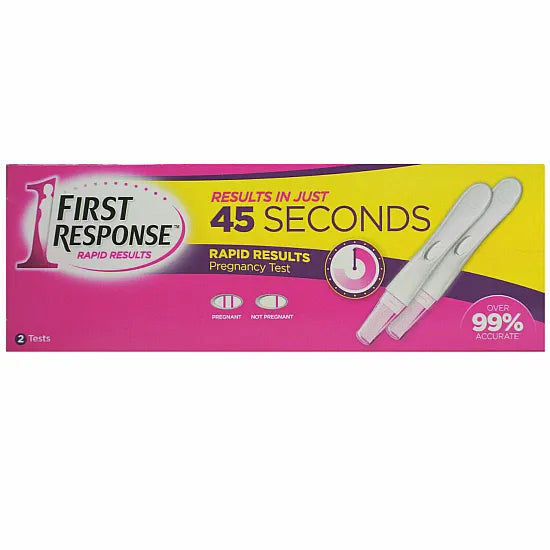
First Response Rapid Result Pregnancy Test - Pack of 2
First Response Rapid Result Pregnancy Test - Pack of 2
- ✔️ Detects hCG hormone from the first day of a missed period
- ✔️ Results appear clearly in just 3 minutes
- ✔️ Pack of two tests for initial and confirmatory testing
- ✔️ Over 99% accurate when used correctly at the right time
- ✔️ Suitable for use with midstream urine or collected sample
Price Checker
 Lowest price guarantee
 Includes FREE private prescription


Couldn't load pickup availability
Is the First Response Rapid Result Pregnancy Test Right for You?
Waiting to find out whether you are pregnant can feel like the longest few minutes of your life. The rapid pregnancy test from First Response is designed to give you a clear, reliable answer quickly — so you can stop wondering and start planning. Available as a pack of two from Cured Pharmacy for just £5.99, it offers real value whether you want to confirm a result or simply have a spare test to hand. If you are also thinking about your wider reproductive health, our women's health range covers a broad selection of products to support you at every stage.
Home pregnancy tests have become one of the most commonly used diagnostic tools in the UK. The NHS confirms that most tests can be used from the first day of a missed period, and many are sensitive enough to detect pregnancy hormones even earlier. Having two tests in a single pack means you can confirm an initial result a few days later — which is particularly useful if you test before your period is due.
How Does the First Response Rapid Result Pregnancy Test Work?
This test works by detecting human chorionic gonadotrophin (hCG) — a hormone your body begins producing shortly after a fertilised egg implants in the lining of the womb. hCG levels roughly double every 48 to 72 hours in early pregnancy, which is why testing a little later generally gives a clearer result. The mechanism is a lateral flow immunoassay, which is the same principle used in many clinical diagnostic tests.
- You place the absorbent tip in your urine stream or a collected urine sample.
- Urine travels along the test strip by capillary action.
- If hCG is present above the detection threshold, antibodies on the strip bind to it.
- This binding triggers a colour change, producing a visible line in the result window within 3 minutes.
- A control line confirms the test has worked correctly, regardless of the result.
Who Should Use the First Response Rapid Result Pregnancy Test?
This test is suitable for any woman who suspects she may be pregnant and wants a quick, private answer at home. It requires no specialist knowledge and is straightforward to use. That said, there are a few groups for whom the result should be interpreted with extra care.
- Women who have missed a period and want to confirm whether they are pregnant.
- Those who have had unprotected sex and are experiencing early pregnancy symptoms such as nausea, breast tenderness, or fatigue.
- Women who have recently had a miscarriage or ectopic pregnancy, as residual hCG may still be present.
- Anyone undergoing fertility treatment involving hCG injections — speak to your clinic before interpreting results.
How Does the First Response Rapid Result Test Compare to Other Home Pregnancy Tests?
| Feature | First Response Rapid Result (Pack of 2) | Standard Midstream Test (Single) |
|---|---|---|
| Result time | 3 minutes | 3–5 minutes |
| Tests per pack | 2 | 1 |
| Price (approx.) | £5.99 | £3.00–£6.00 |
| Suitable for early testing | Yes (from day of missed period) | Varies by brand |
How Should You Store the First Response Rapid Result Pregnancy Test?
Store the tests below 30°C, away from direct sunlight, moisture, and heat sources. Do not freeze them. Keep them in their original sealed foil pouches until you are ready to use them — exposure to air or humidity before use can affect the integrity of the test strip. Check the expiry date printed on the packaging before use; an expired rapid pregnancy test may not give an accurate result.
If you are pregnant and your result is confirmed, you may also want to explore our vitamins and supplements range, which includes folic acid — recommended by the NHS for all women in early pregnancy to support healthy foetal development.
This product is a medicine. Speak to your doctor or pharmacist before using if you have an underlying medical condition or are taking other medicines.
First Response Rapid Result Pregnancy Test - Pack of 2 specifications
| Treatment category | Pregnancy testing / diagnostics |
| Mechanism of action | Lateral flow immunoassay detecting urinary hCG |
| Effective | From the first day of a missed period |
| Suitable for | Adult women of reproductive age |
| Active ingredient | hCG-specific monoclonal antibody test strip |
| Pack sizes | Pack of 2 |
| UK classification | General Sale / Medical Device (CE marked) |
| Preparation | Lateral flow test strip (midstream) |
| Route of administration | Urine (midstream or collected sample) |
Specifications of First Response Rapid Result Pregnancy Test - Pack of 2
What Is the First Response Rapid Result Pregnancy Test and What Is It Used For?
The First Response Rapid Result Pregnancy Test is an over-the-counter home diagnostic device used to detect the presence of human chorionic gonadotrophin (hCG) in urine. hCG is produced by the placenta after a fertilised egg implants in the uterine wall, making it the earliest detectable marker of pregnancy. This test is used by women who want a quick, private, and reliable indication of whether they are pregnant — typically from the first day of a missed period.
Each pack contains two individual test sticks, giving you the option to confirm an initial result or to retest if your first result is unclear. The test is not a prescription medicine and does not contain any pharmacologically active substances — it is a medical device that works through an antibody-based detection system.
What Do You Need to Know Before Using the First Response Rapid Result Pregnancy Test?
Although this is a straightforward home test, there are some important points to be aware of before you use it. Certain situations can affect the reliability of your result.
Contraindications and warnings:
- Do not use the test after the expiry date printed on the packaging.
- Do not use a test stick that has been removed from its foil pouch for an extended period before use.
- Women who have recently been pregnant (including miscarriage or termination) may still have detectable hCG in their urine, which could produce a positive result even if they are not currently pregnant.
- If you have been diagnosed with a trophoblastic disease or certain rare ovarian cysts, hCG may be present without pregnancy.
- A negative result does not completely rule out pregnancy if tested before a missed period — the NHS advises retesting if your period does not arrive.
- This test cannot confirm a viable pregnancy or rule out an ectopic pregnancy; always seek medical advice if you have a positive result alongside pelvic pain or unusual bleeding.
Drug interactions:
- Most common medicines — including the contraceptive pill, antibiotics, and analgesics — do not interfere with the result.
- Fertility drugs containing hCG (such as Pregnyl or Ovitrelle) can cause a false positive result.
- Diuretics taken in large quantities may dilute urine and reduce test sensitivity — using first morning urine is recommended.
How Should You Use the First Response Rapid Result Pregnancy Test?
Using the test correctly is essential for an accurate result. The NHS recommends following the manufacturer's instructions carefully and using first morning urine where possible, as this contains the highest concentration of hCG.
- Remove the test stick from its sealed foil pouch immediately before use.
- Take off the cap to expose the absorbent tip.
- Hold the stick by the thumb grip with the tip pointing downward.
- Place the absorbent tip in your urine stream for exactly 5 seconds, or dip it into a collected urine sample for 5 seconds.
- Replace the cap and lay the test flat on a clean, dry surface.
- Read the result window after 3 minutes. Do not read the result after 10 minutes, as evaporation lines may appear and be mistaken for a positive result.
| Indication | Age Group | Number of Tests | Timing |
|---|---|---|---|
| Suspected pregnancy | Adult women (18+) | 1 test (confirm with 2nd if needed) | From first day of missed period |
| Early testing (before missed period) | Adult women (18+) | 1 test, repeat in 48–72 hours | At least 5 days before expected period |
What Are the Possible Side Effects of the First Response Rapid Result Pregnancy Test?
As a medical device rather than a pharmacological product, the First Response Rapid Result Pregnancy Test does not cause physical side effects in the traditional sense. However, there are some considerations worth noting.
Common considerations:
- Emotional distress following an unexpected positive or negative result.
- Anxiety or uncertainty if a faint line appears — this still indicates a positive result.
- Skin irritation is extremely rare but possible if you have a sensitivity to the plastic casing materials.
Less common considerations:
- Misinterpretation of an evaporation line (a colourless line that can appear after 10 minutes) as a positive result.
- A false negative result if the test is used too early or urine is too dilute.
If you receive a positive result and are unsure what to do next, the NHS has clear guidance on your next steps, including registering with a midwife and beginning antenatal care. You may also find it helpful to browse our baby and toddler range as you prepare for the months ahead.
How Should You Store the First Response Rapid Result Pregnancy Test?
- Store at room temperature, below 30°C.
- Keep away from direct sunlight, heat sources, and damp environments such as bathrooms with poor ventilation.
- Do not freeze the tests — freezing can damage the antibody-coated strip.
- Keep in the original sealed foil pouch until immediately before use.
- Store out of reach and sight of children.
- Do not use after the expiry date printed on the outer carton.
- Dispose of used test sticks in household waste — they are not sharps and do not require special disposal.
If you have any concerns about your result or your health during early pregnancy, contact your GP or call NHS 111. For ongoing support with your reproductive health, our condoms and sexual health collection offers a range of products to help you make informed choices.
References
- https://www.nhs.uk/pregnancy/trying-for-a-baby/pregnancy-tests/
- https://www.nhs.uk/pregnancy/finding-out/signs-and-symptoms-of-pregnancy/
- https://www.nhs.uk/pregnancy/trying-for-a-baby/how-to-get-pregnant/
- https://www.nhs.uk/vitamins-and-supplements/folic-acid/
- https://www.nhs.uk/conditions/ectopic-pregnancy/
- https://www.nhs.uk/conditions/miscarriage/
Written and reviewed by our qualified team
Your safety and success are our highest priorities. Our medical team rigorously evaluates every product and piece of advice we provide, ensuring you receive only the most effective, science-backed solutions available.
Frequently Asked Questions
Where can I buy the First Response Rapid Result Pregnancy Test online in the UK?
You can buy the First Response Rapid Result Pregnancy Test (pack of 2) directly from Cured Pharmacy online for just £5.99. It is available without a prescription and is dispatched discreetly to your door. No appointment or consultation is needed — simply add it to your basket and check out.
How does a rapid pregnancy test detect pregnancy?
A rapid pregnancy test works by detecting human chorionic gonadotrophin (hCG) in your urine — a hormone your body produces after a fertilised egg implants in the womb. The test strip contains antibodies that bind to hCG, triggering a visible colour change in the result window. If hCG is present above the detection threshold, a line appears within 3 minutes.
How early can I use the First Response Rapid Result Pregnancy Test?
The test is designed to be used from the first day of a missed period, when hCG levels are typically high enough to detect reliably. Testing earlier than this is possible but increases the risk of a false negative, as hCG may not yet have reached detectable levels. If you test early and get a negative result, repeat the test when your period is due.
How do I use the First Response Rapid Result Pregnancy Test step by step?
Using the test is straightforward. Follow these steps:
- Remove the test stick from its foil pouch immediately before use.
- Hold it by the thumb grip and place the absorbent tip in your urine stream for 5 seconds.
- Lay it flat and read the result window after 3 minutes, but no later than 10 minutes.
A line in the result window — even a faint one — indicates a positive result.
What does a faint line on the pregnancy test mean?
Any visible line in the test window, no matter how faint, is considered a positive result — it means hCG has been detected in your urine. Faint lines are common when testing early in pregnancy, when hCG levels are still rising. If you are unsure, repeat the test in 48 to 72 hours using first morning urine for a clearer result.
Is the First Response Rapid Result Pregnancy Test accurate?
When used correctly from the first day of a missed period, First Response Rapid Result tests are reported to be over 99% accurate. Accuracy can be reduced if the test is used too early, if urine is too dilute, or if the instructions are not followed precisely. Always use first morning urine for the most reliable result.
What is the best time of day to take a pregnancy test?
First morning urine is recommended because it contains the highest concentration of hCG, making it easier for the test to detect. If you test later in the day, drinking large amounts of fluid beforehand can dilute your urine and potentially reduce the sensitivity of the result. For the clearest outcome, test as soon as you wake up.
Can any medications affect the result of a home pregnancy test?
Most common medicines — including the contraceptive pill, antibiotics, antihistamines, and pain relief — do not interfere with the result of a home pregnancy test. However, fertility treatments that contain hCG (such as trigger shot injections) can cause a false positive result. If you are undergoing fertility treatment, speak to your clinic before interpreting your result.
What should I do after getting a positive pregnancy test result?
Contact your GP or midwife as soon as possible to register your pregnancy and begin antenatal care. The NHS recommends starting folic acid (400 micrograms daily) immediately if you have not already done so, to support healthy foetal development. You can find folic acid and other pregnancy-related supplements in our vitamins and supplements collection.
What should I do if I get a negative result but still think I might be pregnant?
A negative result is most likely accurate when tested from the first day of a missed period, but it is not infallible. If your period does not arrive within a few days, repeat the test — the pack of two makes this easy and cost-effective. If you continue to experience pregnancy symptoms despite a negative result, speak to your GP for a blood test, which can detect lower levels of hCG.
Who is eligible to use the First Response Rapid Result Pregnancy Test?
This test is suitable for any adult woman of reproductive age who suspects she may be pregnant. It does not require a prescription and can be purchased over the counter or online. Women who have recently had a miscarriage, termination, or ectopic pregnancy should be aware that residual hCG may still be present and could affect the result.
Can I use the pregnancy test if I have an irregular cycle?
Yes, you can still use the test if your cycle is irregular, but timing it correctly is more challenging. If you are unsure when your period was due, test at least 21 days after unprotected sex, as this allows enough time for hCG to reach detectable levels. If the result is negative and you remain unsure, repeat the test a week later or speak to your GP.
What are the alternatives to the First Response Rapid Result Pregnancy Test?
Other home pregnancy tests available in the UK include Clearblue Digital (which displays "Pregnant" or "Not Pregnant" in words), own-brand pharmacy tests, and strip tests. A GP can also arrange a blood test to measure hCG levels, which is more sensitive than a urine test. For a broader range of women's health products, visit our women's health collection.
How long does it take to get a result from the First Response Rapid Result Pregnancy Test?
Results appear in the result window within 3 minutes of taking the test. You should not read the result after 10 minutes have passed, as evaporation lines can sometimes appear and be mistaken for a positive result. The control line confirms the test has functioned correctly, regardless of whether the result is positive or negative.
Are there any latest studies or research on the accuracy of home pregnancy tests?
Research published in clinical literature consistently shows that modern lateral flow immunoassay pregnancy tests are highly accurate when used correctly from the first day of a missed period. Studies have noted that user error — such as testing too early or reading results outside the recommended time window — is the most common cause of inaccurate results. The NHS advises following the manufacturer's instructions precisely to maximise reliability.
Written and reviewed by our qualified team

Reviewed by:
Tarun Kumar
Superintendent/ Clinical Lead
📖 Find out more about our team of medical content authors and how we ensure the accuracy of our content with our content guidelines.
Content last updated: 14 Sep 2026
Other popular options


We’re a safe and
regulated UK service

Lowest Price Guarantee

We're convinced you won't find your treatment cheaper, but if you do we'll refund the difference.
Find out more
100% discreet packaging

Discreet, unbranded packaging for every order.
Find out more

Need help?
Talk to our friendly experts now


How our service works

Service setup

Discreet packaging

Express delivery