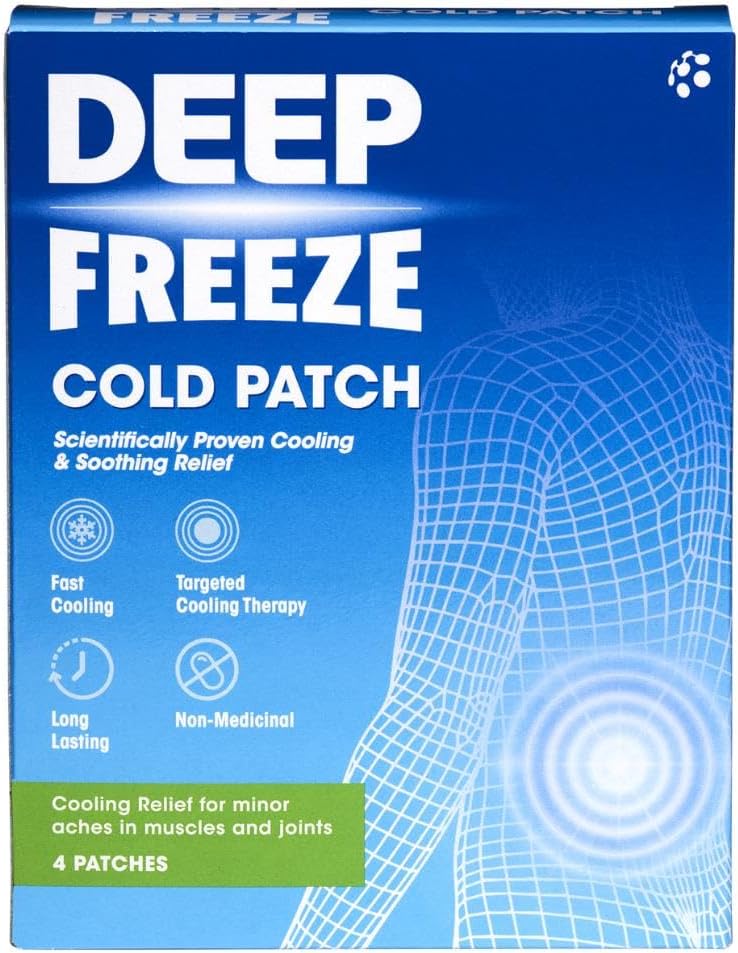
Deep Freeze Cold Patches Pack of 4
Deep Freeze Cold Patches Pack of 4
- ✔️ Provides targeted cooling relief for muscle and joint pain
- ✔️ Drug-free levomenthol formula — no oral medication needed
- ✔️ Each patch delivers up to 8 hours of continuous relief
- ✔️ Discreet, flexible design stays in place during daily activity
- ✔️ Suitable for sports injuries, back pain, and neck stiffness
Price Checker
 Lowest price guarantee
 Includes FREE private prescription


Couldn't load pickup availability
What Are Deep Freeze Cold Patches and How Do They Relieve Pain?
If you've ever reached for an ice pack after a muscle strain or a long day on your feet, you'll understand the instinct to cool things down. Deep freeze cold patches offer a convenient, hands-free alternative — a discreet adhesive patch that delivers a sustained cooling sensation directly to the painful area. Each pack contains four patches, making it easy to keep them in your bag, desk drawer, or medicine cabinet for whenever you need them. At just £9.46, they're an accessible option for everyday aches and pains.
Muscle and joint pain is incredibly common in the UK. Whether it's a sports injury, a stiff neck from sitting at a desk, or general back pain, many people are looking for drug-free ways to manage discomfort. If you're exploring your options, our pain relief collection includes a wide range of topical and oral products to suit different needs and preferences.
How Do Deep Freeze Cold Patches Work on Muscle Pain?
The patches work through a process called counter-irritation. The active ingredient, levomenthol, stimulates cold-sensitive thermoreceptors (specifically TRPM8 receptors) in the skin. This creates a cooling sensation that temporarily overrides pain signals travelling to the brain — a mechanism sometimes described as the "gate control" theory of pain. It's not numbing the tissue itself; it's essentially distracting the nervous system.
- Levomenthol activates TRPM8 cold receptors in the skin
- Cold sensation competes with pain signals at the spinal cord level
- Localised cooling reduces the subjective perception of pain
- No systemic absorption — the effect stays where you apply it
Because there's no drug entering your bloodstream, the risk profile is low compared to oral analgesics. That said, this is still a medicine — speak to your pharmacist if you have any concerns before use.
Who Should Use Deep Freeze Cold Patches?
These patches are suitable for adults and children aged 12 and over who are experiencing localised muscle or joint pain. They're particularly useful for people who prefer to avoid oral pain relief, or who need targeted relief in a specific area without affecting the rest of the body.
- Adults with minor sports injuries such as sprains or strains
- People with back pain or neck stiffness from prolonged sitting
- Those who prefer drug-free or non-oral pain management
- Individuals needing discreet, on-the-go pain relief during the day
They are not suitable for use on broken, inflamed, or damaged skin, and should not be applied near the eyes or mucous membranes. If you have a known sensitivity to menthol or adhesive patches, check with your pharmacist first.
How Do Deep Freeze Cold Patches Compare to Heat Patches?
| Feature | Deep Freeze Cold Patches | Heat Patches |
|---|---|---|
| Mechanism | Cooling via levomenthol (TRPM8 activation) | Warmth via iron oxidation or capsaicin |
| Best for | Acute injuries, inflammation, sprains | Chronic stiffness, muscle tension |
| Drug-free | Yes | Varies by product |
| Wear time | Up to 8 hours | Typically 8–12 hours |
Are Deep Freeze Cold Patches Suitable for Long-Term Use?
Cold therapy patches are generally intended for short-term use to manage acute pain episodes. If your pain persists beyond a few days, or keeps returning, it's worth speaking to your GP to rule out an underlying cause. Persistent musculoskeletal pain can sometimes indicate conditions that need further investigation or a different treatment approach. You might also find it helpful to explore our first aid collection for complementary products to support recovery.
Store the patches below 25°C, away from direct sunlight and out of reach of children. Do not use patches that appear damaged or where the seal has been broken before purchase.
This product is a medicine. Speak to your doctor or pharmacist before using if you have an underlying medical condition or are taking other medicines.
Deep Freeze Cold Patches Pack of 4 specifications
| Treatment category | Topical pain relief |
| Mechanism of action | Counter-irritation via TRPM8 cold receptor activation |
| Effective for | Muscle pain, joint pain, minor sprains and strains |
| Suitable for | Adults and children aged 12 and over |
| Active ingredient | Levomenthol |
| Pack size | 4 patches |
| UK classification | General Sale List (GSL) |
| Drug class | Topical analgesic / counter-irritant |
| Preparation | Medicated adhesive patch |
| Route of administration | Topical (cutaneous) |
Specifications of Deep Freeze Cold Patches Pack of 4
What Are Deep Freeze Cold Patches and What Are They Used For?
Deep Freeze Cold Patches are topical, drug-free adhesive patches containing levomenthol as the active ingredient. They are used to provide temporary relief from localised muscle and joint pain, including minor sports injuries, back pain, neck stiffness, and general muscular aches. The patches are applied directly to the skin over the painful area and work by producing a sustained cooling sensation that helps reduce the perception of pain. They are available over the counter without a prescription and are classified as a General Sale List (GSL) medicine in the UK.
What Do You Need to Know Before Using Deep Freeze Cold Patches?
Before applying these patches, it's important to check that they are appropriate for you. Do not use them if any of the following apply:
- You are allergic to levomenthol, menthol, or any other ingredient in the patch
- The skin in the area is broken, cut, inflamed, sunburned, or affected by a skin condition such as eczema or psoriasis
- You are under 12 years of age
- You are pregnant or breastfeeding — consult your doctor or pharmacist first
- You have poor circulation or reduced skin sensation in the area
- You intend to apply the patch near the eyes, mouth, or other mucous membranes
There are no well-documented drug interactions with topical levomenthol patches at standard doses. However, if you are using other topical medicines on the same area of skin, speak to your pharmacist before combining them. Avoid using alongside other topical counter-irritants on the same site.
- No significant systemic drug interactions are currently documented for topical levomenthol at this dose
- Do not use alongside other topical analgesics on the same skin area
How Should You Use Deep Freeze Cold Patches?
Using the patches correctly ensures you get the most benefit while minimising any risk of skin irritation. Follow these steps carefully:
- Wash and thoroughly dry the skin where you plan to apply the patch
- Open the sachet and remove the patch
- Peel away the protective backing film
- Apply the adhesive side firmly to the painful area, smoothing out any air bubbles
- Wash your hands immediately after application
- Leave the patch in place for up to 8 hours — do not exceed this
- Remove gently and dispose of safely, away from children and pets
- Do not reapply a used patch
| Indication | Age Group | Dose | Frequency |
|---|---|---|---|
| Muscle and joint pain | Adults and children 12+ | 1 patch per area | Up to once per 8-hour period |
| Minor sports injuries | Adults and children 12+ | 1 patch per area | Up to once per 8-hour period |
| Children under 12 | Not suitable | — | — |
If you are managing a broader range of symptoms alongside pain — for example, muscle cramps — you may also find our IBS and cramps collection useful for complementary products.
What Are the Possible Side Effects of Deep Freeze Cold Patches?
Side effects with topical levomenthol patches are generally mild and localised to the application site. Most people tolerate them well. However, as with any topical product, reactions can occur.
Common side effects:
- Mild skin redness at the application site
- Tingling or burning sensation on first application
- Temporary skin irritation after patch removal
Less common side effects:
- Contact dermatitis (allergic skin reaction)
- Blistering or more pronounced redness
- Prolonged skin discolouration at the application site
If you notice a severe skin reaction, difficulty breathing, or swelling of the face or throat after applying the patch, remove it immediately and seek urgent medical attention. These could indicate a rare allergic reaction.
How Should You Store Deep Freeze Cold Patches?
Correct storage helps maintain the effectiveness of the patches and ensures they remain safe to use. Follow these guidelines:
- Store below 25°C in a cool, dry place
- Keep away from direct sunlight and sources of heat
- Store in the original packaging until ready to use
- Keep out of the reach and sight of children
- Do not use after the expiry date printed on the packaging
- Do not freeze the patches
- Dispose of used patches safely — fold adhesive side inward before discarding
If you're building a home medicine cabinet, it's worth knowing that many everyday health products — from pain relief to vitamins and supplements — benefit from similar cool, dry storage conditions to maintain their quality.
References
Written and reviewed by our qualified team
Your safety and success are our highest priorities. Our medical team rigorously evaluates every product and piece of advice we provide, ensuring you receive only the most effective, science-backed solutions available.
Frequently Asked Questions
Where can I buy Deep Freeze Cold Patches online in the UK?
You can buy Deep Freeze Cold Patches Pack of 4 directly from Cured Pharmacy, a GPhC-registered online pharmacy, for just £9.46. They are available without a prescription and can be delivered to your door across the UK. Browse our full pain relief collection for more options.
How do Deep Freeze Cold Patches work in the body?
The patches contain levomenthol, which activates TRPM8 cold-sensitive receptors in the skin, producing a cooling sensation that temporarily reduces the perception of pain. This counter-irritation effect works locally at the application site without entering the bloodstream. No systemic absorption means the effect is targeted and the risk of whole-body side effects is very low.
How do I apply Deep Freeze Cold Patches step by step?
Clean and dry the skin thoroughly before application. Peel off the backing film and press the patch firmly onto the painful area, smoothing out any air bubbles. Wash your hands after applying, and leave the patch in place for up to 8 hours before removing.
How long can I wear a Deep Freeze Cold Patch at one time?
Each patch should be worn for a maximum of 8 hours at a time. Do not apply a new patch to the same area immediately after removal — allow the skin to rest first. Using patches for longer than recommended may increase the risk of skin irritation.
What is the correct dose of Deep Freeze Cold Patches?
Apply one patch to the affected area per 8-hour period. Do not apply more than one patch to the same area at the same time. Adults and children aged 12 and over may use the patches; they are not suitable for children under 12.
Are Deep Freeze Cold Patches safe for children?
Deep Freeze Cold Patches are not recommended for children under 12 years of age. For children aged 12 and over, adult guidance applies, but it is always advisable to consult a pharmacist before use. If you need pain relief options for younger children, speak to your GP or pharmacist for age-appropriate alternatives.
Can I use Deep Freeze Cold Patches during pregnancy or breastfeeding?
If you are pregnant or breastfeeding, you should consult your doctor or pharmacist before using Deep Freeze Cold Patches. Topical menthol products should be used with caution during pregnancy, particularly in the first trimester. Your healthcare professional can advise on the safest pain management options for your situation.
What are the side effects of Deep Freeze Cold Patches?
Most people tolerate the patches well, but mild skin redness, tingling, or irritation at the application site can occur. Less commonly, contact dermatitis or blistering may develop. If you experience a severe allergic reaction — such as swelling, difficulty breathing, or widespread rash — remove the patch immediately and seek urgent medical attention.
Can I use Deep Freeze Cold Patches on my back?
Yes, the patches can be applied to the back as long as the skin is intact, unbroken, and free from inflammation or skin conditions. They are commonly used for lower back pain and muscle stiffness. Make sure the patch adheres fully and avoid applying it to the spine itself or any bony prominences.
Who is eligible to use Deep Freeze Cold Patches?
The patches are suitable for adults and young people aged 12 and over who have localised muscle or joint pain on intact skin. They are not suitable for people with known hypersensitivity to menthol or adhesive components, or those with broken, inflamed, or damaged skin at the application site. Pregnant or breastfeeding individuals should seek medical advice first.
What happens if I leave a Deep Freeze Cold Patch on too long?
Leaving the patch on for longer than 8 hours may increase the risk of skin irritation, redness, or contact dermatitis at the application site. If you notice any discomfort, remove the patch promptly and allow the skin to recover before reapplying. If irritation persists, consult your pharmacist.
What are alternatives to Deep Freeze Cold Patches for pain relief?
Alternatives include heat patches, ibuprofen gel, diclofenac gel, or oral analgesics such as paracetamol or ibuprofen tablets. Cold patches are generally preferred for acute injuries, while heat therapy may suit chronic muscle stiffness better. You can explore a range of options in our creams and ointments collection.
How long can I keep using Deep Freeze Cold Patches?
Deep Freeze Cold Patches are intended for short-term use to manage acute pain episodes. If your pain has not improved after a few days of use, or if it worsens, you should stop using the patches and consult your GP. Persistent or recurring pain may require further investigation and a different treatment approach.
Can I use Deep Freeze Cold Patches alongside other pain medicines?
There are no well-documented interactions between topical levomenthol patches and oral pain medicines such as paracetamol or ibuprofen. However, you should avoid applying other topical analgesics or counter-irritants to the same area of skin at the same time. Always inform your pharmacist of all medicines you are taking before starting a new product.
What does the latest research say about cold therapy patches for pain?
Research supports the use of topical menthol as a counter-irritant for localised pain relief, with studies indicating it activates TRPM8 receptors to modulate pain perception. Cold therapy in general is recognised by the NHS as a useful short-term measure for acute soft tissue injuries such as sprains and strains. While evidence for long-term efficacy is more limited, short-term use for acute pain is well-supported in clinical guidance.
Written and reviewed by our qualified team

Reviewed by:
Tarun Kumar
Superintendent/ Clinical Lead
📖 Find out more about our team of medical content authors and how we ensure the accuracy of our content with our content guidelines.
Content last updated: 14 Sep 2026
Other popular options


We’re a safe and
regulated UK service

Lowest Price Guarantee

We're convinced you won't find your treatment cheaper, but if you do we'll refund the difference.
Find out more
100% discreet packaging

Discreet, unbranded packaging for every order.
Find out more

Need help?
Talk to our friendly experts now


How our service works

Service setup

Discreet packaging

Express delivery