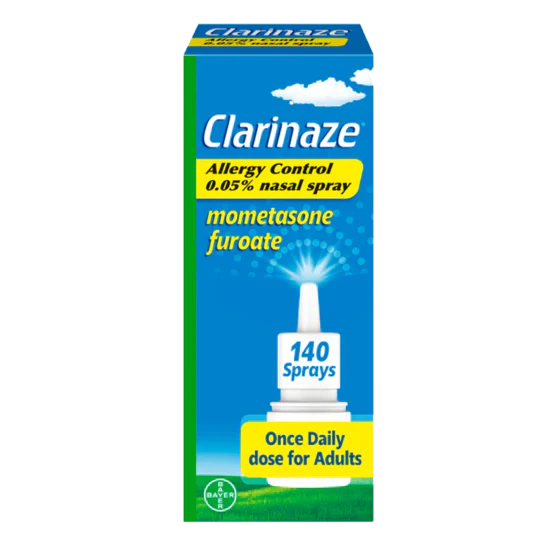
Clarinaze Allergy Nasal Spray 0.05% 140 Sprays
Clarinaze Allergy Nasal Spray 0.05% 140 Sprays
Price Checker
 Lowest price guarantee
 Includes FREE private prescription


Couldn't load pickup availability
Is Clarinaze Allergy Nasal Spray Right for You?
If hay fever or year-round nasal allergies are making your life miserable, you are far from alone. Allergic rhinitis affects around one in five people in the UK, causing sneezing, a blocked or runny nose, and that relentless itchy feeling that just will not quit. The clarinaze allergy nasal spray is a clinically established, once-daily treatment containing mometasone furoate 50 micrograms per actuation — a corticosteroid that targets nasal inflammation directly at the source. Available without a prescription for adults aged 18 and over, it offers a practical, pharmacy-led option for managing both seasonal and perennial allergic rhinitis. You can browse the full range of allergy and hay fever treatments at Cured Pharmacy's allergy and hay fever collection if you want to compare your options.
Each bottle contains 140 metered sprays, giving you a generous supply to see you through peak pollen season or a prolonged period of nasal symptoms. At £12.99, it sits comfortably within the OTC market and is backed by a well-established safety profile recognised by the NHS and MHRA.
How Does Clarinaze Nasal Spray Work in the Body?
Mometasone furoate belongs to the corticosteroid class of medicines. When you spray it into your nostrils, it acts locally on the nasal mucosa rather than being absorbed significantly into the bloodstream — which is one reason it is considered well-tolerated for regular use. Here is how it works step by step:
- Allergens such as pollen, dust mites, or animal dander trigger an immune response in the nasal lining.
- This response causes the release of inflammatory mediators — including histamine, prostaglandins, and leukotrienes — that produce swelling, mucus, and irritation.
- Mometasone furoate binds to glucocorticoid receptors in nasal tissue, suppressing the production of these inflammatory chemicals.
- The result is a reduction in nasal congestion, sneezing, rhinorrhoea (runny nose), and nasal itching.
- Because it works on the underlying inflammation rather than just masking symptoms, regular daily use tends to be more effective than using it only when symptoms peak.
It is worth noting that mometasone nasal spray does not provide instant relief in the way that a decongestant might. Most people notice meaningful improvement within a few days of consistent use, though some report a degree of benefit within 12 hours of the first dose.
Who Should Use Clarinaze Allergy Nasal Spray?
Clarinaze is suitable for adults aged 18 and over who experience nasal symptoms caused by allergic rhinitis — whether that is seasonal (triggered by pollen in spring and summer) or perennial (triggered year-round by dust mites, mould, or pet allergens). It is particularly useful for people who find antihistamine tablets alone do not adequately control their nasal congestion. It is well-suited to:
- Adults with seasonal allergic rhinitis (hay fever) whose main symptoms are nasal congestion, sneezing, and a runny nose.
- Adults with perennial allergic rhinitis who need consistent, daily nasal symptom control.
- People who have not responded adequately to oral antihistamines alone.
- Those who prefer a targeted, locally acting treatment with minimal systemic absorption.
It is not licensed for OTC use in children under 18. If a child is experiencing significant nasal allergy symptoms, a GP should be consulted for appropriate management.
How Does Clarinaze Compare to Other Nasal Sprays?
| Feature | Clarinaze 0.05% Nasal Spray | Beconase Nasal Spray (Beclometasone) |
|---|---|---|
| Active ingredient | Mometasone furoate 50 mcg/spray | Beclometasone dipropionate 50 mcg/spray |
| Dosing frequency | Once daily | Twice daily |
| OTC age suitability | 18 years and over | 18 years and over |
| Number of sprays per pack | 140 sprays | 200 sprays |
Is Clarinaze Suitable for Long-Term Use and How Should It Be Stored?
When used OTC, clarinaze allergy nasal spray should not be used for longer than three months without speaking to a doctor. If your symptoms are ongoing beyond this period, your GP may continue to prescribe it under supervision — mometasone nasal spray is widely used long-term for perennial allergic rhinitis in clinical practice. Store the bottle below 25°C, keep it upright, and do not freeze it. Keep it out of reach of children. If you also experience itchy, watery eyes alongside your nasal symptoms, it may be worth exploring eye care products designed for allergic conjunctivitis.
This product is a medicine. Speak to your doctor or pharmacist before using if you have an underlying medical condition or are taking other medicines.
Clarinaze Allergy Nasal Spray 0.05% 140 Sprays specifications
| Treatment category | Allergic rhinitis / Hay fever |
| Active ingredient | Mometasone furoate 50 micrograms per actuation |
| Strength | 0.05% w/w (50 mcg per spray) |
| Pack size | 140 metered sprays |
| Mechanism of action | Intranasal corticosteroid — reduces nasal mucosal inflammation |
| Route of administration | Intranasal (nasal spray) |
| Drug class | Corticosteroid |
| Preparation | Aqueous nasal suspension |
| UK classification | Pharmacy (P) medicine |
| Suitable for | Adults aged 18 years and over |
| Effective for | Seasonal and perennial allergic rhinitis |
Specifications of Clarinaze Allergy Nasal Spray 0.05% 140 Sprays
What Is Clarinaze Nasal Spray and What Is It Used For?
Clarinaze Allergy Nasal Spray 0.05% contains mometasone furoate, an intranasal corticosteroid used to relieve the nasal symptoms of allergic rhinitis. These symptoms include a blocked nose, runny nose, sneezing, and nasal itching caused by allergens such as grass pollen, tree pollen, house dust mites, and pet dander. It is licensed as an OTC medicine for adults aged 18 and over in the UK and is classified as a Pharmacy (P) medicine. The NHS recognises intranasal corticosteroids as a first-line treatment for allergic rhinitis because they address the underlying inflammation rather than simply suppressing individual symptoms.
What Do You Need to Know Before Using Clarinaze Nasal Spray?
Before using this spray, read the following carefully. There are situations where Clarinaze may not be appropriate, and it is important to be aware of them.
Do not use Clarinaze if you:
- Are under 18 years of age (OTC use only).
- Are allergic to mometasone furoate or any other ingredient in the formulation.
- Have a current nasal infection that has not been treated.
- Have recently had nasal surgery or a nasal injury — wait until healing is complete before using.
- Have tuberculosis (active or latent) or any other untreated systemic infection.
Speak to your doctor or pharmacist before use if you:
- Are pregnant or breastfeeding.
- Have glaucoma or cataracts, or a family history of glaucoma.
- Are taking any other corticosteroid medicines (inhaled, oral, or topical).
- Have liver problems, as mometasone is metabolised hepatically.
Known drug interactions:
- Strong CYP3A4 inhibitors such as ketoconazole, itraconazole, and ritonavir may increase plasma levels of mometasone furoate, potentially increasing the risk of systemic corticosteroid effects.
- Concurrent use of other corticosteroids (oral, inhaled, or topical) may increase the risk of adrenal suppression — discuss with your GP or pharmacist.
How Should You Use Clarinaze Allergy Nasal Spray Correctly?
Using the spray correctly makes a real difference to how well it works. Follow these steps each time:
- Blow your nose gently to clear the nasal passages before use.
- Shake the bottle gently.
- If using for the first time, or if not used for several days, prime the pump by pressing it down six times until a fine mist appears.
- Tilt your head slightly forward — do not tilt it back.
- Close one nostril with a finger. Insert the nozzle into the open nostril, angling it slightly away from the nasal septum (the central dividing wall).
- Press the pump once while breathing in gently through your nose.
- Breathe out through your mouth.
- Repeat in the other nostril.
- Wipe the nozzle clean after each use and replace the cap.
Dosage by age and indication:
| Indication | Age Group | Dose | Frequency |
|---|---|---|---|
| Seasonal allergic rhinitis | Adults 18+ | 2 sprays per nostril (200 mcg total) | Once daily |
| Perennial allergic rhinitis | Adults 18+ | 2 sprays per nostril (200 mcg total) | Once daily |
| Maintenance (once controlled) | Adults 18+ | 1 spray per nostril (100 mcg total) | Once daily |
| Children under 18 | Under 18 | Not recommended OTC | Consult GP |
What Are the Possible Side Effects of Clarinaze Nasal Spray?
Like all medicines, Clarinaze can cause side effects, although not everyone experiences them. Most side effects are mild and localised to the nose and throat. If you are also managing other allergy-related conditions, you might find it helpful to explore our ear, nose and throat range for complementary products.
Common side effects (may affect up to 1 in 10 people):
- Nasal irritation, stinging, or burning sensation inside the nose.
- Nosebleeds (epistaxis).
- Headache.
- Nasal dryness or crusting.
Less common side effects (may affect up to 1 in 100 people):
- Unpleasant taste or smell.
- Nasal ulceration.
- Throat irritation.
- Sneezing immediately after application.
Rarely, prolonged use of intranasal corticosteroids has been associated with nasal septal perforation and, in very rare cases, systemic corticosteroid effects such as adrenal suppression or raised intraocular pressure. If you notice any changes in your vision, persistent nosebleeds, or signs of a systemic reaction, stop using the spray and contact your GP promptly.
How Should You Store Clarinaze Nasal Spray?
Correct storage keeps the spray effective and safe throughout its shelf life. If you are managing multiple allergy products at home, it is worth keeping them all stored appropriately. You can also find a range of supporting products in our allergy and hay fever collection.
- Store below 25°C.
- Do not freeze the bottle.
- Keep the bottle upright at all times.
- Keep out of the sight and reach of children.
- Do not use after the expiry date printed on the label.
- Do not dispose of medicines via wastewater or household waste — return unused medicines to your pharmacy.
References
Written and reviewed by our qualified team
Your safety and success are our highest priorities. Our medical team rigorously evaluates every product and piece of advice we provide, ensuring you receive only the most effective, science-backed solutions available.
Frequently Asked Questions
Where can I buy Clarinaze Allergy Nasal Spray online in the UK?
You can buy Clarinaze Allergy Nasal Spray 0.05% 140 sprays directly from Cured Pharmacy, a GPhC-registered UK online pharmacy. It is available without a prescription for adults aged 18 and over. Browse our full allergy and hay fever collection for the complete range of nasal and antihistamine treatments available online.
How does Clarinaze Allergy Nasal Spray work in the body?
Clarinaze contains mometasone furoate, a corticosteroid that acts locally on the nasal lining to reduce inflammation caused by allergens. It blocks the release of inflammatory chemicals such as histamine and leukotrienes, which are responsible for nasal congestion, sneezing, and a runny nose. Because it works on the root cause of symptoms rather than just masking them, consistent daily use gives the best results.
How do I use Clarinaze Nasal Spray step by step?
Blow your nose gently, then shake the bottle and prime it if it is new or has not been used for several days. Tilt your head slightly forward, insert the nozzle into one nostril angled away from the septum, and press the pump once while breathing in gently through your nose. Repeat in the other nostril, then wipe the nozzle and replace the cap after each use.
What is the correct dose of Clarinaze Nasal Spray for adults?
The standard starting dose for adults aged 18 and over is two sprays into each nostril once daily, delivering a total of 200 micrograms of mometasone furoate per day. Once your symptoms are well controlled, the dose can often be reduced to one spray per nostril once daily as a maintenance dose. Do not exceed two sprays per nostril per day.
How long does Clarinaze Nasal Spray take to work?
Some people notice an improvement in nasal symptoms within 12 hours of their first dose, but it typically takes a few days of regular daily use to experience the full anti-inflammatory benefit. Unlike decongestant sprays, Clarinaze is not designed for immediate on-demand relief — it works best when used consistently every day throughout the allergy season or period of exposure.
What is the best time of day to use Clarinaze Nasal Spray?
There is no strict requirement to use Clarinaze at a specific time of day, but using it at the same time each day helps you build a consistent routine and maintain steady anti-inflammatory levels in the nasal tissue. Many people find it convenient to use it in the morning before going outdoors, particularly during high pollen periods. The key is regularity rather than timing.
What are the side effects of Clarinaze Allergy Nasal Spray?
The most commonly reported side effects include nasal irritation, stinging or dryness inside the nose, nosebleeds, and headache. Less commonly, people experience an unpleasant taste or smell, throat irritation, or sneezing immediately after application. Serious side effects such as nasal septal perforation are rare but have been reported with prolonged use — contact your GP if you experience persistent nosebleeds or any changes in vision.
How do I manage a nosebleed caused by Clarinaze Nasal Spray?
If you experience a nosebleed, sit upright and lean slightly forward, pinching the soft part of your nose for 10 to 15 minutes. Make sure you are directing the spray nozzle away from the nasal septum when you use it, as this is the most common cause of spray-related nosebleeds. If nosebleeds are frequent or heavy, stop using the spray and speak to your pharmacist or GP.
Can I use Clarinaze Nasal Spray during pregnancy?
You should consult your doctor or pharmacist before using Clarinaze if you are pregnant or breastfeeding. Although mometasone furoate has low systemic absorption when used intranasally, it is important that a healthcare professional assesses whether the benefits outweigh any potential risks for you and your baby. Do not self-treat with this spray during pregnancy without professional guidance.
Is Clarinaze Nasal Spray suitable for children?
Clarinaze Allergy Nasal Spray is not licensed for OTC use in children under 18 years of age. If a child is experiencing significant nasal allergy symptoms, a GP should be consulted, as mometasone nasal spray may be prescribed for children aged 3 and over under medical supervision. Do not give this OTC product to anyone under 18 without a doctor's advice.
What happens if I miss a dose of Clarinaze Nasal Spray?
If you forget to use your spray, use it as soon as you remember — unless it is almost time for your next scheduled dose, in which case simply skip the missed dose and carry on as normal. Do not use a double dose to make up for a missed one. Missing the occasional dose is unlikely to significantly affect your symptom control, but try to use it consistently for the best results.
How long can you use Clarinaze Nasal Spray for?
When purchased OTC, Clarinaze should not be used for more than three months without consulting a doctor. If your symptoms persist beyond this period, your GP may continue to prescribe it under medical supervision for longer-term management of perennial allergic rhinitis. Regular review by a healthcare professional is recommended for anyone using intranasal corticosteroids on an ongoing basis.
What are the alternatives to Clarinaze Allergy Nasal Spray?
Other intranasal corticosteroid sprays available OTC in the UK include Beconase (beclometasone dipropionate), which requires twice-daily dosing, and Pirinase Hayfever Relief (fluticasone propionate). Oral antihistamines such as cetirizine or loratadine can also help with sneezing and itching but are generally less effective for nasal congestion. You can explore the full range of options in our ear, nose and throat collection.
Can I use Clarinaze Nasal Spray alongside antihistamine tablets?
Yes, using Clarinaze alongside an oral antihistamine is a common and clinically recognised approach for managing moderate-to-severe allergic rhinitis. The nasal spray targets nasal inflammation and congestion, while antihistamines help with sneezing, itching, and eye symptoms. Always check with your pharmacist if you are unsure about combining treatments, particularly if you are taking other medicines.
What are the latest findings on mometasone nasal spray for hay fever?
Mometasone furoate nasal spray has been extensively studied and is consistently recommended as a first-line treatment for allergic rhinitis by clinical guidelines, including those from NICE and the NHS. Research continues to confirm its favourable safety profile, particularly its low systemic bioavailability (less than 1% when administered intranasally), which makes it suitable for regular use. It remains one of the most widely used and well-evidenced intranasal corticosteroids available in the UK.
Written and reviewed by our qualified team

Reviewed by:
Tarun Kumar
Superintendent/ Clinical Lead
📖 Find out more about our team of medical content authors and how we ensure the accuracy of our content with our content guidelines.
Content last updated: 14 Sep 2026
Other popular options


We’re a safe and
regulated UK service

Lowest Price Guarantee

We're convinced you won't find your treatment cheaper, but if you do we'll refund the difference.
Find out more
100% discreet packaging

Discreet, unbranded packaging for every order.
Find out more

Need help?
Talk to our friendly experts now


How our service works

Service setup

Discreet packaging

Express delivery