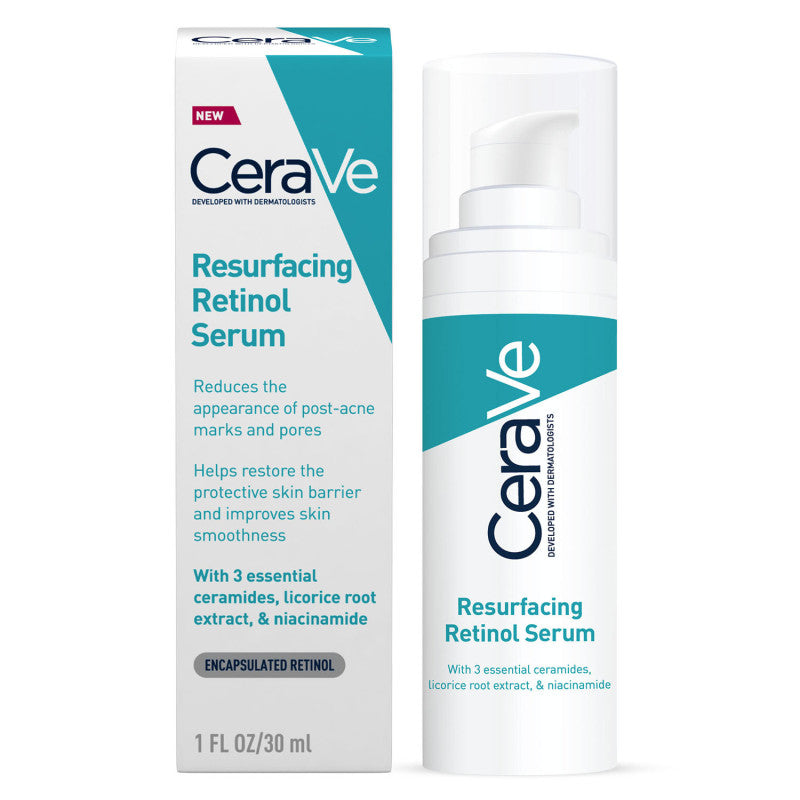
CeraVe Resurfacing Retinol Serum for Blemish-Prone Skin30ml
Price Checker
Not approved? Full refund
Includes FREE private prescription
Couldn't load pickup availability
How Should You Use CeraVe Resurfacing Retinol Serum?
Using this serum correctly from the start will help your skin adjust to retinol with minimal disruption. Always apply to clean, dry skin in the evening — never to damp skin, as this can increase the rate of absorption and the likelihood of irritation.
What Is the Correct Dose of CeraVe Resurfacing Retinol Serum?
A pea-sized amount is sufficient to cover the entire face. Using more than this does not improve results and significantly increases the risk of irritation, dryness, and peeling — so resist the temptation to apply a thicker layer.
When Is the Best Time to Use CeraVe Resurfacing Retinol Serum?
Evening application is essential with this product. Retinol is photosensitive — it can break down when exposed to UV light, reducing its effectiveness — and it also makes your skin more vulnerable to sun damage during the day. Applying it at night allows the active ingredients to work at their most stable and effective, while you sleep and your skin undergoes its natural repair cycle.
If you are new to retinol, consider starting on alternate evenings for the first two to four weeks. This gives your skin time to build tolerance before you move to nightly use.
How Long Can You Use CeraVe Resurfacing Retinol Serum For?
There is no defined maximum duration for using this serum. Many people incorporate retinol into their long-term skincare routine as a maintenance step, continuing to benefit from its skin-renewing properties over months and years. If you experience persistent irritation, take a break for one to two weeks and reintroduce at a lower frequency.
Reassess your routine if your circumstances change — for example, if you become pregnant, develop a new skin condition, or are prescribed a topical medication that may interact with retinol. In those cases, always seek advice from your pharmacist or GP before continuing.
Do not exceed the recommended dose. If in doubt, speak to your pharmacist.
Understanding Potential Side Effects of Retinol Treatment
Like all medicines, CeraVe Resurfacing Retinol Serum can have side effects, although not everyone will experience them. When starting retinol treatment, you may notice some initial skin adjustment reactions as your skin adapts to the active ingredient.
The most common side effects occur during the first few weeks of use and typically diminish as your skin becomes accustomed to the treatment. These effects are generally mild and temporary, particularly when you follow the recommended application guidelines and introduce the product gradually into your skincare routine .
Possible side effects may include:
- Mild skin dryness or flaking
- Temporary redness or irritation
- Slight burning or stinging sensation upon application
- Increased skin sensitivity to sunlight
- Peeling or scaling of the skin
- Temporary worsening of acne (purging phase)
- Skin tightness or feeling of dryness
- Mild itching or tingling
- Temporary changes in skin pigmentation
- Contact dermatitis in sensitive individuals
- Photosensitivity reactions if adequate sun protection isn't used
- Allergic reactions in rare cases
If you experience these or any other side effects, speak to your doctor or pharmacist right away. For more information about reporting side effects please see the MHRA Yellow Card Scheme.
Written and reviewed by our qualified team
Reviewed by:
Tarun Kumar
Superintendent/ Clinical Lead
📖 Find out more about our team of medical content authors.
Content last reviewed: 11 November 2026
★ Other popular options
100% discreet packaging
Discreet, unbranded packaging for every order.
Need help?
Talk to our friendly experts now
How our service works
Service setup
Discreet packaging
Express delivery
Medically reviewed by
Tarun Kumar, Superintendent Pharmacist & Clinical Lead (GPhC 2233073)
Last updated on 11 November 2026.
Review History
Our experts continually monitor new findings in health and medicine, and we update our articles when new information becomes available.
Why this page was updated on 11 November 2026
Content checked and updated as part of our periodic review, to ensure accuracy and currentness.
Current version (11 November 2026)
Edited by: The Editorial Team
Medically reviewed by:
Tarun Kumar, GPhC No. 2233073, Superintendent Pharmacist & Clinical Lead
How we source info.
When we present you with stats, data, opinion or a consensus, we'll tell you where this came from.