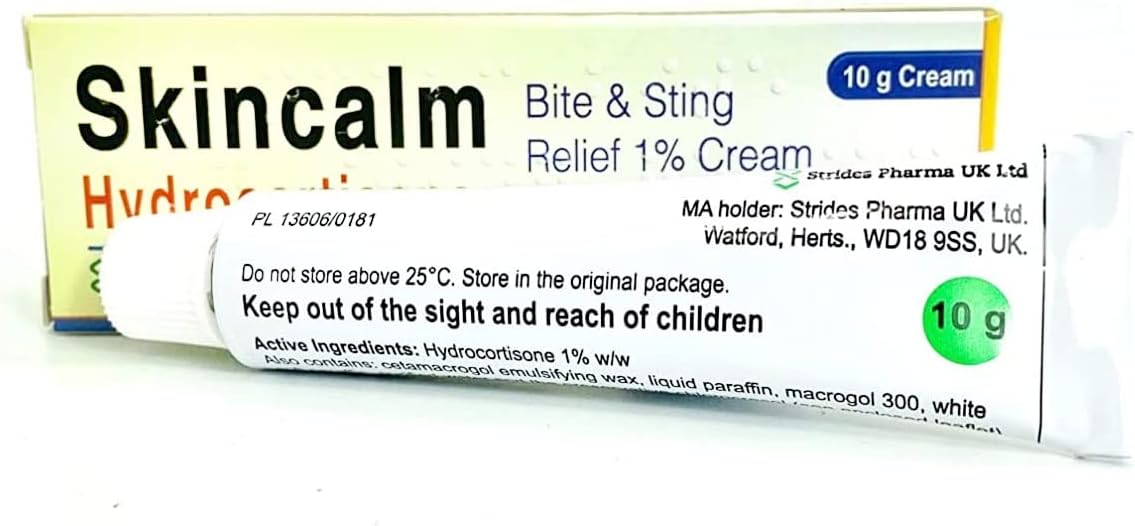
Skincalm 10g Bite and Sting Relief 1% Cream (BRAND MAY VARY)
Skincalm 10g Bite and Sting Relief 1% Cream (BRAND MAY VARY)
- ✔️ Relieves insect bite itching and redness quickly
- ✔️ Contains 1% hydrocortisone for targeted inflammation relief
- ✔️ Compact 10g tube ideal for travel first aid kits
- ✔️ Suitable for adults and children aged 10 and over
- ✔️ Effective against mosquito, wasp, and bee sting reactions
Price Checker
 Lowest price guarantee
 Includes FREE private prescription


Couldn't load pickup availability
What Is Bite and Sting Relief Cream and How Can It Help You?
If you have ever been caught out by a mosquito on holiday or a wasp in the garden, you will know how quickly a bite or sting can turn into an itchy, swollen nuisance. Bite and sting relief cream containing 1% hydrocortisone is a well-established over-the-counter treatment that tackles that irritation at the source. Skincalm 10g Bite and Sting Relief 1% Cream is a compact, affordable option — priced at just £1.99 — making it a sensible addition to any medicine cabinet or travel kit. You can browse our wider range of travel health products if you are preparing for a trip abroad.
Insect bites and stings trigger a localised inflammatory response in the skin. The result? Redness, swelling, and that maddening urge to scratch. Hydrocortisone 1% is a mild topical corticosteroid licensed in the UK for exactly this purpose, and it has a long safety record when used as directed.
How Does Skincalm Bite and Sting Cream Work?
Hydrocortisone belongs to a class of medicines called corticosteroids. When applied to the skin, it works by reducing the activity of inflammatory mediators — the chemicals your immune system releases in response to a bite or sting. This dampens down the redness, heat, and swelling that make bites so uncomfortable.
- Hydrocortisone binds to glucocorticoid receptors within skin cells.
- This reduces the production of pro-inflammatory cytokines and prostaglandins.
- Blood vessel dilation in the affected area decreases, reducing redness and swelling.
- Nerve endings become less sensitised, which relieves the itch sensation.
Because it is applied directly to the skin rather than taken orally, the systemic absorption is minimal when used correctly. That is what makes it suitable for short-term, targeted use.
Who Should Use Skincalm Bite and Sting Relief Cream?
This cream is suitable for adults and children aged 10 and over who are experiencing localised skin reactions from insect bites or stings. It is particularly useful for:
- Mosquito, midge, or gnat bites causing persistent itching.
- Wasp or bee stings where the initial pain has settled but inflammation remains.
- Nettle stings or other minor contact irritations.
- Travellers heading to areas with high insect activity.
It is not suitable for everyone, though. People with skin infections, broken skin at the bite site, or known hypersensitivity to hydrocortisone should avoid this product. Always read the label carefully before use.
How Does Skincalm Compare to Other Insect Bite Treatments?
| Feature | Skincalm 1% Hydrocortisone Cream | Antihistamine Cream (e.g. Mepyramine) |
|---|---|---|
| Active ingredient | Hydrocortisone 1% | Mepyramine maleate |
| Mechanism | Reduces inflammation via corticosteroid action | Blocks histamine H1 receptors locally |
| Suitable for children under 10 | No (without medical advice) | Check individual product labelling |
| Use on face | With caution, short-term only | Generally avoid near eyes |
Is Skincalm Safe to Store and Use on Holiday?
The 10g tube is compact enough to slip into a washbag or first aid kit without taking up much space. Store it below 25°C, away from direct sunlight and out of reach of children — standard advice for most topical medicines. If you are travelling somewhere warm, keep it in a cool part of your luggage rather than leaving it in a hot car or direct sun.
For anyone building a travel health kit, it is worth pairing this with other essentials from our first aid collection. This bite and sting relief cream is a medicine — speak to your doctor or pharmacist before using it if you have an underlying medical condition or are taking other medicines.
This product is a medicine. Speak to your doctor or pharmacist before using if you have an underlying medical condition or are taking other medicines.
Skincalm 10g Bite and Sting Relief 1% Cream specifications
| Treatment category | Insect bite and sting relief |
| Active ingredient | Hydrocortisone 1% |
| Mechanism of action | Topical corticosteroid — reduces localised inflammation |
| Strengths | 1% w/w hydrocortisone |
| Pack size | 10g tube |
| Suitable for | Adults and children aged 10 and over |
| UK classification | Pharmacy (P) medicine |
| Drug class | Mild topical corticosteroid |
| Preparation | Cream |
| Route of administration | Topical (cutaneous) |
Specifications of Skincalm 10g Bite and Sting Relief 1% Cream
What Is Skincalm Bite and Sting Relief Cream and What Is It Used For?
Skincalm 10g Bite and Sting Relief 1% Cream contains hydrocortisone 1% as its active ingredient. It is a mild topical corticosteroid used to relieve the itching, redness, and swelling associated with insect bites and stings. It is available over the counter in the UK without a prescription for adults and children aged 10 and over. The NHS recognises hydrocortisone skin cream as an effective short-term treatment for inflammatory skin reactions, including those caused by insect bites.
What Do You Need to Know Before Using Skincalm Bite and Sting Cream?
Before applying this cream, make sure it is appropriate for you. There are some situations where you should not use it, and others where you should seek advice first.
Do not use Skincalm if you:
- Are allergic to hydrocortisone or any other ingredient in the cream.
- Have a skin infection (bacterial, fungal, or viral) at the affected site.
- Have broken or weeping skin at the area you intend to treat.
- Are applying it to a child under 10 years of age without medical supervision.
- Have acne, rosacea, or perioral dermatitis in the area to be treated.
Warnings and precautions:
- Avoid contact with eyes and mucous membranes.
- Do not use under occlusive dressings unless directed by a healthcare professional.
- Do not use for longer than seven days without seeking medical advice.
- Use with caution on the face — only for short periods and in small amounts.
- If you are pregnant or breastfeeding, speak to your pharmacist or GP before use.
Drug interactions:
- No significant interactions are expected with topical hydrocortisone at 1% strength when used as directed.
- If you are using other topical medicines on the same area, speak to your pharmacist to avoid potential interactions.
How Should You Use Skincalm Bite and Sting Cream?
Using this cream correctly is straightforward, but it is worth following the steps below to get the most benefit and minimise any risk of side effects.
- Wash and dry the affected area gently before applying the cream.
- Squeeze a small amount of cream — roughly the size of a fingertip — onto a clean finger.
- Apply a thin layer directly to the bite or sting site.
- Rub in gently until absorbed. Do not cover with a bandage unless advised by a healthcare professional.
- Wash your hands thoroughly after application.
- Apply up to twice daily for a maximum of seven days.
| Indication | Age Group | Dose | Frequency |
|---|---|---|---|
| Insect bite / sting | Adults and children 10+ | Thin layer to affected area | Up to twice daily |
| Insect bite / sting | Children under 10 | Not recommended without medical advice | — |
If you are also dealing with a more widespread allergic reaction — such as hives or swelling beyond the bite site — you may benefit from looking at our allergy and hay fever treatments for additional options.
What Are the Possible Side Effects of Skincalm Bite and Sting Cream?
Like all medicines, hydrocortisone 1% cream can cause side effects, although not everyone experiences them. Using it correctly — in small amounts, for short periods — significantly reduces the risk.
Common side effects:
- Mild burning or stinging sensation immediately after application.
- Temporary skin redness at the application site.
- Mild itching or irritation (distinct from the original bite reaction).
Less common side effects:
- Skin thinning (atrophy) — more likely with prolonged or excessive use.
- Changes in skin pigmentation at the treated area.
- Contact dermatitis — a reaction to one of the cream's ingredients.
- Stretch marks (striae) if used over large areas for extended periods.
Stop using the cream and seek medical advice if you notice any worsening of your skin condition, signs of infection, or an unexpected allergic reaction such as rash, swelling, or difficulty breathing.
How Should You Store Skincalm Bite and Sting Cream?
Proper storage keeps the cream effective and safe to use. Follow these simple guidelines:
- Store below 25°C in a cool, dry place.
- Keep away from direct sunlight and heat sources.
- Keep the tube tightly closed when not in use.
- Keep out of the sight and reach of children.
- Do not use after the expiry date printed on the tube or packaging.
- Do not dispose of medicines via wastewater or household waste — return unused medicines to your pharmacy.
If you are looking for other topical treatments for skin conditions, our creams and ointments collection has a wide range of options to suit different needs.
References
Written and reviewed by our qualified team
Your safety and success are our highest priorities. Our medical team rigorously evaluates every product and piece of advice we provide, ensuring you receive only the most effective, science-backed solutions available.
Frequently Asked Questions
Where can I buy bite and sting relief cream online in the UK?
You can buy Skincalm Bite and Sting Relief 1% Cream online from Cured Pharmacy for just £1.99, with no prescription required. It is dispatched quickly across the UK and is ideal to order ahead of a holiday or outdoor event. Browse our travel health collection for other useful products to take away with you.
How does hydrocortisone 1% cream work on insect bites and stings?
Hydrocortisone 1% is a mild corticosteroid that reduces the inflammatory response your skin produces after a bite or sting. It works by suppressing the release of inflammatory chemicals such as prostaglandins and cytokines, which in turn reduces redness, swelling, and itching. It does not treat infection — only the inflammatory reaction itself.
How do I apply Skincalm bite and sting cream step by step?
Clean and dry the affected area first, then apply a thin layer of cream directly to the bite or sting site using a clean fingertip. Rub it in gently, wash your hands afterwards, and repeat up to twice daily for no more than seven days. Avoid applying to broken skin, infected areas, or near the eyes.
How quickly does bite and sting relief cream start working?
Many people notice a reduction in itching within a few hours of the first application. Redness and swelling typically begin to settle within 24 to 48 hours of regular use. If your symptoms are not improving after a few days, or if they are getting worse, speak to your pharmacist or GP.
Can children use Skincalm bite and sting cream?
Skincalm 1% hydrocortisone cream is suitable for children aged 10 and over when used under adult supervision and according to the instructions. It is not recommended for children under 10 without specific medical advice from a GP or pharmacist. Always use the smallest effective amount for the shortest time necessary.
What are the side effects of hydrocortisone bite and sting cream?
Side effects are uncommon when the cream is used correctly and for short periods. The most common ones include mild burning, stinging, or temporary redness at the application site. Prolonged or excessive use can cause skin thinning, so stick to the recommended seven-day maximum.
Can I use bite and sting cream on my face?
You can use hydrocortisone 1% cream on the face for short periods, but you should do so with caution and avoid the area around the eyes entirely. Facial skin is thinner and more sensitive, so use the smallest amount possible and do not apply for more than a few days. If you are unsure, ask your pharmacist before applying it to your face.
Is Skincalm cream suitable for use during pregnancy or breastfeeding?
If you are pregnant or breastfeeding, you should speak to your GP or pharmacist before using any hydrocortisone cream, including Skincalm. While topical hydrocortisone at 1% is considered low risk when used sparingly, it is always best to get personalised advice during pregnancy or whilst nursing. Do not apply it to the breast area if you are breastfeeding.
Who is eligible to use Skincalm bite and sting relief cream?
This cream is suitable for adults and young people aged 10 and over who have localised itching, redness, or swelling from insect bites or stings. It is not suitable for people with skin infections, broken skin at the site, or known allergy to hydrocortisone. Those with certain skin conditions such as rosacea or perioral dermatitis should also avoid it.
What happens if I accidentally use too much of the cream?
Applying slightly more than needed on a single occasion is unlikely to cause harm, but you should not make a habit of using large amounts. If you accidentally apply a large quantity or use it over a wide area repeatedly, contact your pharmacist for advice. Systemic side effects from topical hydrocortisone 1% are rare but more likely with excessive or prolonged use.
What are the alternatives to hydrocortisone bite and sting cream?
Alternatives include antihistamine creams such as mepyramine maleate, which block histamine receptors locally, or calamine lotion for mild itching. Oral antihistamines may be more appropriate if you have multiple bites or a more widespread reaction — you can find options in our allergy and hay fever section. Cold compresses can also help reduce swelling in the short term.
How long can I use Skincalm bite and sting cream for?
You should not use this cream for more than seven days continuously without seeking medical advice. Most insect bite reactions resolve well within this timeframe. If your symptoms persist beyond a week, or if the area looks infected — with increasing warmth, pus, or spreading redness — see your GP.
Can I use Skincalm cream on multiple bites at the same time?
You can apply the cream to several bite sites, but be mindful of the total amount you are using. Applying hydrocortisone over large areas of skin increases the risk of systemic absorption and side effects. If you have many bites across a wide area, speak to your pharmacist about whether an oral antihistamine might be a more suitable option.
What is the latest guidance on treating insect bites in the UK?
The NHS advises that most insect bites and stings can be treated at home with simple measures such as cleaning the area, applying a cold compress, and using a mild hydrocortisone cream to reduce inflammation and itching. Seek urgent medical attention if you develop signs of a severe allergic reaction (anaphylaxis), such as swelling of the face or throat, difficulty breathing, or dizziness. The NHS guidance on insect bites and stings is regularly reviewed and updated.
Can I use bite and sting cream alongside other skin treatments?
If you are using other topical products on the same area — such as moisturisers, antiseptic creams, or other medicated preparations — speak to your pharmacist first to make sure there are no compatibility concerns. For a broader range of skin care options, take a look at our skin care collection. Generally, apply hydrocortisone cream first and allow it to absorb before applying anything else.
Written and reviewed by our qualified team

Reviewed by:
Tarun Kumar
Superintendent/ Clinical Lead
📖 Find out more about our team of medical content authors and how we ensure the accuracy of our content with our content guidelines.
Content last updated: 14 Sep 2026
Other popular options


We’re a safe and
regulated UK service

Lowest Price Guarantee

We're convinced you won't find your treatment cheaper, but if you do we'll refund the difference.
Find out more
100% discreet packaging

Discreet, unbranded packaging for every order.
Find out more

Need help?
Talk to our friendly experts now


How our service works

Service setup

Discreet packaging

Express delivery