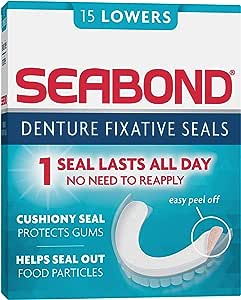
Seabond Denture Fixative Seals 15 Lowers
Seabond Denture Fixative Seals 15 Lowers
- ✔️ Secures lower dentures firmly throughout the day
- ✔️ Pre-cut wafer shape designed specifically for lower plates
- ✔️ Zinc-free formula — safe for daily long-term use
- ✔️ No messy creams — clean, simple one-step application
- ✔️ Each pack provides 15 days of reliable denture hold
Price Checker
 Lowest price guarantee
 Includes FREE private prescription


Couldn't load pickup availability
Are Denture Fixative Seals Lower the Neatest Way to Secure Your Denture?
If you wear a lower denture, you'll know how frustrating it can be when it shifts at the wrong moment — mid-conversation, mid-meal, or just when you least expect it. Seabond Denture Fixative Seals 15 Lowers are pre-cut adhesive wafers designed specifically for lower plates, offering a clean, fuss-free alternative to messy creams and pastes. Each pack contains 15 individually shaped seals, giving you a fortnight's worth of reliable hold at an accessible price. You can find this product and other dental products at Cured Pharmacy, delivered discreetly to your door.
Lower dentures are notoriously harder to keep in place than upper ones — the tongue, saliva flow, and jaw movement all work against a stable fit. That's exactly why a product shaped and sized for the lower arch makes a real difference. Denture fixative seals lower in design, Seabond's wafers conform to the contours of your gum ridge, providing a cushioned, secure layer between the denture base and your gum tissue throughout the day.
How Do Seabond Denture Fixative Seals Actually Work?
The mechanism is straightforward but effective. Seabond seals are made from karaya gum and sodium alginate — two naturally derived gelling agents that absorb moisture and swell slightly when wet. This swelling action fills the microscopic gaps between your denture and gum, creating a cushioned seal that resists movement. There are no zinc-containing ingredients, which is worth noting given historical concerns about zinc in some denture adhesives.
- Moisten the seal briefly under cold water
- Shake off any excess water
- Press the seal firmly onto the clean, dry fitting surface of your lower denture
- Insert the denture and bite down gently to activate the seal
- The seal softens and conforms to your gum shape within minutes
Because the seal is pre-cut to fit a lower denture, there's no trimming, no squeezing from a tube, and no guesswork about how much to apply. It's a one-step process that takes seconds.
Who Should Consider Using Seabond Lower Denture Seals?
These seals are suitable for most adults who wear a full lower denture and want a reliable, no-mess fixative option. They're particularly useful if you've found adhesive creams difficult to apply evenly, or if you've experienced oozing or taste issues with paste-based products. That said, they are not a solution for dentures that are broken, cracked, or significantly ill-fitting — in those cases, a visit to your dentist is the right first step.
- Adults wearing a full lower denture who want all-day hold
- People who find cream or powder adhesives messy or inconvenient
- Those with mild gum ridge resorption causing minor denture movement
- Individuals looking for a zinc-free adhesive option
How Do Seabond Seals Compare to Denture Adhesive Creams?
| Feature | Seabond Fixative Seals (Lowers) | Denture Adhesive Cream |
|---|---|---|
| Application method | Pre-cut wafer — wet and press | Squeeze from tube onto denture |
| Mess factor | Minimal — no oozing | Can ooze if over-applied |
| Zinc content | Zinc-free | Varies by brand — check label |
| Duration per application | Up to one full day | Up to one full day |
| Suitable for lower dentures | Yes — specifically shaped | Yes — but not shaped |
Are Seabond Seals Safe to Use Every Day, and How Should You Store Them?
Seabond seals are intended for daily use — one fresh seal per day is the recommended approach. They are generally well tolerated, but if you notice persistent gum soreness or irritation, stop using them and speak to your dentist. Denture fixative seals lower in zinc content than older adhesive formulations, making them a reassuring choice for long-term daily users. Store the pack below 25°C in a dry place, away from direct sunlight and out of reach of children. Do not use past the printed expiry date.
If you're managing other aspects of your oral health alongside denture care, our oral health collection includes a range of complementary products to support your routine.
This product is a medicine. Speak to your doctor or pharmacist before using if you have an underlying medical condition or are taking other medicines.
Seabond Denture Fixative Seals 15 Lowers specifications
| Treatment category | Dental — denture fixation |
| Mechanism of action | Karaya gum and sodium alginate absorb moisture and swell to create a cushioned adhesive seal between denture and gum |
| Effective for | Securing lower full dentures throughout the day |
| Suitable for | Adults wearing full lower dentures |
| Active ingredient | Karaya gum, sodium alginate |
| Pack size | 15 seals |
| UK classification | General Sale List (GSL) |
| Preparation | Adhesive wafer/seal |
| Route of administration | Oral (dental application — not swallowed) |
Specifications of Seabond Denture Fixative Seals 15 Lowers
What Is Seabond Denture Fixative Seals 15 Lowers and What Is It Used For?
Seabond Denture Fixative Seals 15 Lowers are pre-shaped adhesive wafers used to hold a full lower denture securely in place during daily wear. They are an over-the-counter (OTC) dental product available without a prescription. The seals are designed to sit between the fitting surface of your lower denture and your gum tissue, creating a cushioned, stable layer that reduces movement and improves comfort throughout the day. They are not a treatment for any medical condition — their purpose is purely mechanical: to help your denture stay where it should.
Denture wearers often find that lower plates are more prone to movement than upper ones, due to the action of the tongue and the smaller surface area available for suction. These seals address that specific challenge with a product shaped for the lower arch.
What Do You Need to Know Before Using Seabond Denture Fixative Seals?
Before using these seals, read the following carefully. They are intended for use with well-fitting, intact dentures only.
Do not use if:
- Your dentures are cracked, broken, or significantly ill-fitting
- You have open sores, ulcers, or active infection in your mouth
- You are allergic to karaya gum, sodium alginate, or any other listed ingredient
- You are using the product on upper dentures (this pack is shaped for lower dentures only)
Warnings and precautions:
- Do not use as a substitute for a properly fitted denture — see your dentist if your denture feels persistently loose
- Keep out of reach of children
- Do not swallow the seal — remove before eating if the seal becomes dislodged
- If gum irritation develops, discontinue use and consult your dentist or pharmacist
- Do not use past the printed expiry date
Known drug interactions:
- No clinically significant drug interactions are known for topically applied karaya gum or sodium alginate in this context
How Should You Use Seabond Denture Fixative Seals Correctly?
Using Seabond seals correctly takes only a few seconds once you've done it a couple of times. Follow these steps each morning after cleaning your denture:
- Clean your lower denture thoroughly and pat it dry
- Remove one seal from the pack
- Hold the seal under cold running water for one to two seconds
- Shake off any excess water — the seal should be damp, not dripping
- Press the seal firmly onto the fitting surface (the inner, gum-facing side) of your lower denture
- Insert the denture into your mouth and bite down gently for a few seconds
- The seal will soften and conform to your gum shape within a few minutes
- Remove and discard the seal at the end of the day before cleaning your denture
| Indication | Age Group | Dose | Frequency |
|---|---|---|---|
| Lower denture fixation | Adults (18+) | One seal per lower denture | Once daily (replace each morning) |
Not recommended for use in children. If you are unsure whether this product is right for you, speak to your pharmacist or dentist before use. You may also find it helpful to browse our pain relief range if you experience any associated mouth discomfort.
What Are the Possible Side Effects of Seabond Denture Fixative Seals?
Seabond seals are generally well tolerated. Side effects are uncommon, but as with any product applied inside the mouth, some people may notice mild reactions — particularly during the first few days of use.
Common side effects:
- Mild gum irritation or redness at the contact site
- Temporary altered taste sensation
- Slight increase in saliva production initially
Less common side effects:
- Localised soreness if the seal is applied to an area of existing gum sensitivity
- Difficulty removing the seal if left in place too long
If you experience a skin rash, swelling of the mouth or throat, or any sign of an allergic reaction, stop using the product immediately and seek medical advice. These reactions are rare but should be taken seriously.
How Should You Store Seabond Denture Fixative Seals?
- Store below 25°C in a cool, dry place
- Keep away from direct sunlight and sources of heat
- Do not store in a bathroom cabinet where humidity is high
- Keep the pack sealed between uses to prevent the seals from drying out prematurely
- Keep out of reach and sight of children
- Do not use after the expiry date printed on the packaging
- Do not freeze
For a broader range of products supporting your everyday health, explore our first aid collection at Cured Pharmacy.
References
- https://www.nhs.uk/live-well/healthy-teeth-and-gums/denture-care/
- https://www.nhs.uk/live-well/healthy-teeth-and-gums/how-to-keep-your-teeth-clean/
- https://www.nhs.uk/conditions/mouth-ulcers/
- https://www.nhs.uk/live-well/healthy-teeth-and-gums/dental-treatments/
- https://www.nhs.uk/conditions/allergies/
- https://www.medicines.org.uk/emc
Written and reviewed by our qualified team
Your safety and success are our highest priorities. Our medical team rigorously evaluates every product and piece of advice we provide, ensuring you receive only the most effective, science-backed solutions available.
Frequently Asked Questions
Where can I buy Seabond Denture Fixative Seals 15 Lowers online in the UK?
You can buy Seabond Denture Fixative Seals 15 Lowers directly from Cured Pharmacy online for just £3.99, with no prescription required. They are classified as a General Sale List (GSL) product, meaning they are available over the counter. Ordering online is a convenient option if you'd prefer not to visit a pharmacy in person.
How do Seabond denture fixative seals work in the mouth?
Seabond seals contain karaya gum and sodium alginate, which absorb moisture from saliva and swell slightly to fill the gap between your denture and gum tissue. This creates a cushioned, adhesive layer that holds the denture in place without the need for creams or pastes. The seal softens and conforms to your individual gum shape within a few minutes of insertion.
How do I use Seabond Denture Fixative Seals step by step?
Using Seabond seals is a simple process:
- Clean and dry your lower denture
- Briefly wet one seal under cold water
- Shake off excess water and press the seal onto the fitting surface of the denture
- Insert the denture and bite down gently to secure
Replace the seal each morning with a fresh one. Never reuse a seal from the previous day.
How long do Seabond lower denture seals last throughout the day?
Each Seabond seal is designed to provide hold for one full day of normal wear. The seal gradually softens and may begin to break down towards the end of the day, which is entirely normal. You should remove and discard the seal each evening before cleaning your denture overnight.
What is the best time to apply Seabond denture fixative seals?
The best time to apply a Seabond seal is in the morning, immediately after cleaning and drying your lower denture. Applying the seal to a clean, dry surface ensures the best possible adhesion. Avoid applying the seal to a wet or soaking-wet denture, as excess moisture can reduce the effectiveness of the hold.
What are the side effects of Seabond denture fixative seals?
Side effects are uncommon but can include mild gum irritation, temporary changes in taste, or slightly increased saliva production when you first start using the seals. These effects usually settle within a few days. If you experience persistent soreness, swelling, or any sign of an allergic reaction, stop using the product and speak to your dentist or pharmacist.
How do I manage gum irritation caused by denture fixative seals?
If you notice mild gum irritation, try removing the seal earlier in the day and rinsing your mouth with warm water. Give your gums a rest for a day or two before trying again. If irritation continues, it may indicate that your denture itself needs adjustment — in which case, a visit to your dentist is the right course of action.
Who is eligible to use Seabond Denture Fixative Seals 15 Lowers?
These seals are suitable for adults aged 18 and over who wear a full lower denture that fits reasonably well. They are not suitable for children, for use with partial dentures, or for dentures that are cracked or significantly ill-fitting. If you have open sores or active mouth infections, wait until these have resolved before using the product.
Can I use Seabond seals if my lower denture is ill-fitting?
Seabond seals are not designed to compensate for a poorly fitting denture. If your denture is significantly loose, uncomfortable, or causing sore spots, you should see your dentist for a professional assessment and possible reline or replacement. Using adhesive products on an ill-fitting denture can mask problems that need proper dental attention.
What happens if I accidentally swallow a Seabond denture seal?
The ingredients in Seabond seals — karaya gum and sodium alginate — are derived from natural sources and are not considered toxic if accidentally swallowed in small amounts. However, the seals are not intended to be swallowed, and you should take care to remove any dislodged seal before eating. If you are concerned after accidental ingestion, contact NHS 111 for advice.
What are the alternatives to Seabond denture fixative seals?
Alternatives to Seabond seals include denture adhesive creams (such as Fixodent or Poligrip), adhesive powders, and cushion strips. Creams and powders can be effective but may feel messier to apply. Seabond seals offer a pre-cut, no-mess option that many users find more convenient for daily use. You can explore our dental products range for more options.
How long can I keep using Seabond denture fixative seals?
There is no set maximum duration for using Seabond seals — they can be used daily as part of your regular denture routine for as long as needed. However, if you find yourself relying on them more heavily over time because your denture feels increasingly loose, this is a sign that your denture may need professional attention. Regular dental check-ups are recommended even for denture wearers.
Are Seabond denture seals zinc-free?
Yes, Seabond denture fixative seals do not contain zinc. This is reassuring for people who use denture adhesives daily, as concerns have previously been raised about excessive zinc intake from some adhesive products used over long periods. The active ingredients — karaya gum and sodium alginate — are naturally derived and zinc-free.
Can I eat and drink normally while wearing Seabond lower denture seals?
Yes, Seabond seals are designed to remain in place during normal eating and drinking. However, very hot drinks or foods may soften the seal more quickly, potentially reducing its hold towards the end of the day. It is advisable to avoid extremely hard or sticky foods regardless of which denture fixative you use, as these can dislodge any denture.
What does the latest guidance say about denture adhesive use?
NHS guidance on denture care recommends that adhesives should only be used as a short-term measure or as a supplement to a well-fitting denture — not as a long-term fix for a poorly fitting one. Regular dental reviews are advised to ensure your denture continues to fit correctly as your gum shape changes over time. For broader oral health support, visit our oral health collection.
Written and reviewed by our qualified team

Reviewed by:
Tarun Kumar
Superintendent/ Clinical Lead
📖 Find out more about our team of medical content authors and how we ensure the accuracy of our content with our content guidelines.
Content last updated: 14 Sep 2026
Other popular options


We’re a safe and
regulated UK service

Lowest Price Guarantee

We're convinced you won't find your treatment cheaper, but if you do we'll refund the difference.
Find out more
100% discreet packaging

Discreet, unbranded packaging for every order.
Find out more

Need help?
Talk to our friendly experts now


How our service works

Service setup

Discreet packaging

Express delivery