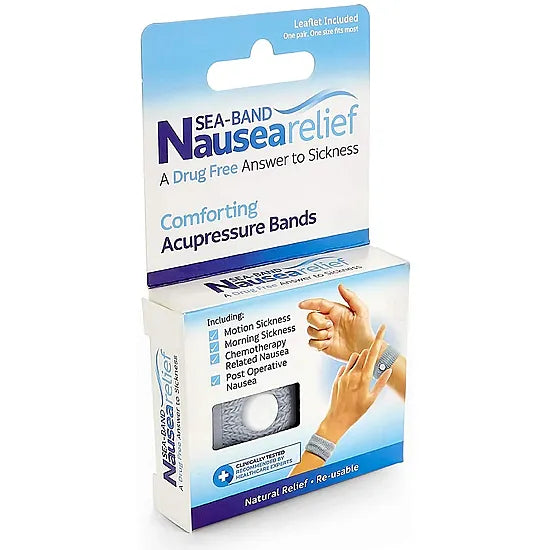
Sea-Band Original Drug Free Nausea Relief Wristband
Sea-Band Original Drug Free Nausea Relief Wristband
- ✔️ Drug-free acupressure targets the P6 wrist point for nausea
- ✔️ Relieves travel sickness, morning sickness and chemotherapy nausea
- ✔️ Suitable for adults and children aged three and over
- ✔️ Reusable and washable for repeated, long-term use
- ✔️ Causes no drowsiness — safe for drivers and pregnant women
Price Checker
 Lowest price guarantee
 Includes FREE private prescription


Couldn't load pickup availability
Is an Acupressure Wristband for Nausea Right for You?
Nausea can strike at the worst possible moments — on a long car journey, mid-flight, or during the first trimester of pregnancy. If you'd rather avoid medication, the Sea-Band Original Drug Free Nausea Relief Wristband offers a simple, clinically recognised alternative. It works without tablets, patches, or any active pharmaceutical ingredient, making it one of the most accessible options available over the counter. You can browse our full range of sickness and nausea products if you're looking for additional support alongside this wristband.
Sea-Band has been used for decades across the UK and is recommended by many healthcare professionals for mild to moderate nausea. Each pack contains two wristbands — one for each wrist — and they're reusable, washable, and suitable for adults and children alike. At just £6.99, they represent a cost-effective first-line option before reaching for stronger remedies.
How Does the Sea-Band Wristband Work?
The mechanism behind Sea-Band is rooted in traditional acupressure. Each band features a small, firm plastic stud that sits directly over the P6 (Nei-Kuan) acupressure point on the inner wrist. Sustained pressure on this point is thought to modulate nausea signals travelling along the vagus nerve to the brain's vomiting centre — the area postrema.
- The plastic stud applies constant, targeted pressure to the P6 point
- This pressure is believed to influence neurotransmitter activity linked to nausea
- Both wristbands must be worn simultaneously for the effect to be consistent
- No drugs, chemicals, or electrical components are involved
Clinical studies have explored P6 acupressure for nausea in various contexts, including postoperative nausea, chemotherapy-induced nausea, and pregnancy-related morning sickness. While evidence varies in quality, the NHS acknowledges acupressure as a complementary approach some people find helpful for nausea.
Who Should Consider Using Sea-Band Wristbands?
Sea-Band is suitable for a wide range of people. Because it contains no active drug, it avoids many of the contraindications associated with antihistamine-based travel sickness tablets — such as drowsiness, dry mouth, or interactions with other medicines. That said, it's always worth checking with your pharmacist if you have any concerns.
- Adults and children aged 3 and over experiencing travel or motion sickness
- Pregnant women seeking drug-free relief from morning sickness
- People undergoing chemotherapy who experience treatment-related nausea
- Individuals who cannot tolerate or prefer to avoid antihistamine medications
How Does Sea-Band Compare to Other Nausea Remedies?
| Feature | Sea-Band Original Wristband | Antihistamine Travel Sickness Tablet (e.g. Promethazine) |
|---|---|---|
| Drug-free | Yes | No |
| Causes drowsiness | No | Yes — common side effect |
| Suitable in pregnancy | Generally yes | Seek medical advice first |
| Reusable | Yes — washable | No — single dose |
| Suitable for children (3+) | Yes | Age restrictions apply |
Is the Sea-Band Wristband Clinically Suitable and How Should It Be Stored?
The acupressure wristband for nausea is not a licensed medicine, so it does not carry the same clinical classification as pharmaceutical products. However, it is a CE-marked medical device, meaning it has met European safety and performance standards. It is suitable for most people, but those with circulatory conditions affecting the wrist, or skin conditions that may be aggravated by sustained pressure, should seek advice before use. If you're travelling and want to prepare a broader health kit, our travel health collection includes a range of complementary products.
Store Sea-Band wristbands at room temperature, away from direct sunlight and excessive moisture. Keep them out of reach of young children when not in use. They can be hand-washed and air-dried between uses.
This product is a medical device. Speak to your doctor or pharmacist before using if you have an underlying medical condition or are taking other medicines.
Sea-Band Original Drug Free Nausea Relief Wristband specifications
| Treatment category | Nausea and vomiting relief |
| Mechanism of action | Acupressure on P6 (Nei-Kuan) wrist point |
| Effective for | Travel sickness, morning sickness, chemotherapy-induced nausea, postoperative nausea |
| Suitable for | Adults and children aged 3 and over; pregnant women |
| Active ingredient | None — drug-free device |
| Pack size | 1 pair (2 wristbands) |
| UK classification | CE-marked medical device (not a licensed medicine) |
| Preparation | Elasticated fabric wristband with plastic acupressure stud |
| Route of administration | Topical — worn on the wrist |
Specifications of Sea-Band Original Drug Free Nausea Relief Wristband
What Is Sea-Band Original and What Is It Used For?
Sea-Band Original is a drug-free, elasticated wristband designed to relieve nausea and vomiting without the use of any medication. It is a CE-marked medical device that works by applying continuous acupressure to the P6 (Nei-Kuan) point on the inner wrist. It is used for a variety of nausea-related conditions, including travel sickness, morning sickness during pregnancy, chemotherapy-induced nausea, and postoperative nausea. Because it contains no active pharmaceutical ingredient, it is available without a prescription and is suitable for most adults and children aged 3 and over.
The NHS recognises acupressure as a complementary approach that some people find helpful for managing nausea, particularly in the context of morning sickness. Sea-Band is one of the most widely used acupressure devices in the UK and is stocked in pharmacies nationwide.
What Do You Need to Know Before Using Sea-Band?
Sea-Band is generally very safe, but there are some situations where you should take extra care or seek advice before use.
Do not use Sea-Band if:
- You have a known circulatory disorder affecting the wrists or hands
- You have a skin condition such as eczema or psoriasis at the site of application that could be worsened by sustained pressure
- The wristband causes significant pain or numbness — remove immediately if this occurs
Take care and speak to your pharmacist or GP if:
- You are pregnant and your nausea is severe or accompanied by vomiting that prevents you from keeping fluids down (hyperemesis gravidarum requires medical assessment)
- Your nausea is unexplained and persistent — this may require investigation
- You are using Sea-Band alongside other nausea treatments
Drug interactions:
- No known drug interactions — Sea-Band contains no active pharmaceutical ingredient
- It can be used alongside antiemetic medicines if advised by a healthcare professional
How Should You Use Sea-Band Correctly?
Correct positioning is essential for Sea-Band to work effectively. The plastic stud must sit precisely over the P6 acupressure point — if it's even slightly off, you may not get the full benefit. Follow these steps carefully.
- Hold your left hand with your palm facing upward
- Place your first three fingers across the inner wrist, starting at the crease
- The P6 point is located just beneath your third finger, between the two central tendons
- Slide the Sea-Band onto your wrist so the plastic stud sits directly on this point
- Repeat on the right wrist — both bands must be worn simultaneously
- Check that the stud feels firm but not painfully tight
| Indication | Age Group | Number of Bands | Timing |
|---|---|---|---|
| Travel / motion sickness | Adults & children 3+ | One on each wrist | Apply before journey begins |
| Morning sickness | Pregnant adults | One on each wrist | Apply before getting out of bed if possible |
| Chemotherapy-induced nausea | Adults | One on each wrist | Apply before treatment session |
| Postoperative nausea | Adults | One on each wrist | As directed by healthcare team |
If you're also managing digestive discomfort alongside nausea, you may find our indigestion range helpful for complementary relief.
What Are the Possible Side Effects of Sea-Band?
Because Sea-Band is drug-free, it has a very favourable safety profile. Side effects are uncommon and generally mild. However, as with any device worn against the skin, some people do experience minor issues.
Common side effects:
- Mild pressure discomfort at the P6 point, particularly during initial use
- Temporary redness or indentation of the skin beneath the stud
Less common side effects:
- Skin irritation or contact dermatitis in people with sensitive skin
- Numbness or tingling in the hand if the band is worn too tightly
- Localised swelling if the elasticated band restricts circulation
If you experience numbness, significant pain, or any signs of restricted blood flow, remove the wristband immediately. These effects are typically caused by incorrect positioning or the band being too tight rather than an adverse reaction to the device itself.
How Should You Store Sea-Band Wristbands?
Proper storage keeps your Sea-Band wristbands in good condition for repeated use. They are washable and reusable, which makes them a practical long-term option for frequent travellers or those managing ongoing nausea. You'll find more travel-ready health essentials in our travel health collection.
- Store at room temperature — avoid extreme heat or cold
- Keep away from direct sunlight, which can degrade the elastic over time
- Hand wash with mild soap and warm water; do not machine wash
- Air dry thoroughly before storing or reusing
- Keep out of reach of children when not in use
- Inspect the plastic stud regularly — replace if cracked or dislodged
References
Written and reviewed by our qualified team
Your safety and success are our highest priorities. Our medical team rigorously evaluates every product and piece of advice we provide, ensuring you receive only the most effective, science-backed solutions available.
Frequently Asked Questions
Where can I buy Sea-Band Original wristbands online in the UK?
You can buy Sea-Band Original wristbands online from Cured Pharmacy for just £6.99 with fast UK delivery. They are also available in many high street pharmacies and supermarkets across the UK. Ordering online is convenient if you want them delivered ahead of a trip or holiday.
How does the Sea-Band acupressure wristband work in the body?
Sea-Band works by applying constant pressure to the P6 (Nei-Kuan) acupressure point on the inner wrist via a small plastic stud. This pressure is thought to modulate nausea signals travelling along the vagus nerve to the brain's vomiting centre. It is a drug-free mechanism, so there are no chemicals entering your body.
How do I put on a Sea-Band wristband correctly step by step?
Place three fingers across your inner wrist starting from the crease, then locate the P6 point just beneath your third finger between the two central tendons. Slide the wristband on so the plastic stud sits directly on this point, and repeat on the other wrist. Both bands must be worn at the same time for consistent results.
When is the best time to put on Sea-Band before travelling?
It is best to put Sea-Band on before your journey starts, ideally a few minutes before you begin travelling. Applying the bands before nausea develops tends to be more effective than waiting until symptoms are already present. For morning sickness, try putting them on before you get out of bed.
Are there any side effects from wearing Sea-Band wristbands?
Sea-Band is generally very well tolerated because it contains no active drug. Some people experience mild pressure discomfort, temporary skin redness, or slight indentation at the stud site, particularly with prolonged wear. If you notice numbness or tingling in your hand, loosen or remove the band immediately as it may be positioned too tightly.
Can pregnant women use Sea-Band for morning sickness?
Yes, Sea-Band is widely used by pregnant women to help manage morning sickness and is considered safe during pregnancy as it is entirely drug-free. The NHS lists acupressure as one of the self-help approaches that some women find useful for nausea in pregnancy. Always speak to your midwife or GP if your symptoms are severe or you are unable to keep fluids down.
Is Sea-Band suitable for children?
Sea-Band Original is suitable for children aged 3 and over — there is also a specific Sea-Band child size available for smaller wrists. Because it is drug-free, it avoids the age restrictions and sedation risks associated with antihistamine travel sickness tablets. Always supervise young children when wearing the bands and ensure the fit is comfortable and not too tight.
How does Sea-Band compare to travel sickness tablets?
Sea-Band is drug-free and does not cause drowsiness, making it suitable for drivers and those who need to stay alert during travel. Antihistamine-based travel sickness tablets such as promethazine or cinnarizine can be more effective for severe motion sickness but commonly cause sedation and have more contraindications. You can explore additional options in our sickness and nausea collection to find the right approach for you.
How long can you wear Sea-Band wristbands at a time?
There is no strict maximum duration for wearing Sea-Band — many people wear them throughout an entire journey or throughout the day during periods of morning sickness. You should remove them if you experience significant discomfort, numbness, or skin irritation. Taking short breaks from wearing them can help prevent localised skin pressure marks.
Can Sea-Band be used for chemotherapy-induced nausea?
Yes, Sea-Band is used by some patients undergoing chemotherapy to help manage treatment-related nausea, often alongside prescribed antiemetic medicines. The NHS notes that nausea and vomiting are common side effects of chemotherapy, and complementary approaches like acupressure may provide additional comfort. Always discuss any complementary therapies with your oncology team before starting them.
Are Sea-Band wristbands reusable and washable?
Yes, Sea-Band wristbands are fully reusable and can be hand-washed with mild soap and warm water. Allow them to air dry completely before wearing again. This makes them a cost-effective and environmentally friendly option compared to single-use remedies.
What happens if Sea-Band does not relieve my nausea?
If Sea-Band does not provide sufficient relief, first check that the plastic stud is correctly positioned over the P6 point — incorrect placement is the most common reason for reduced effectiveness. If nausea persists despite correct use, speak to your pharmacist about alternative options such as antiemetic tablets or ginger-based remedies. Persistent unexplained nausea should always be assessed by a GP.
Who should not use Sea-Band wristbands?
Sea-Band is not recommended for people with circulatory disorders affecting the wrists or hands, or those with active skin conditions such as eczema or psoriasis at the site of application. If you are unsure whether Sea-Band is appropriate for you, speak to your pharmacist before use. People with severe or unexplained nausea should seek medical advice rather than relying solely on a wristband.
What are the alternatives to Sea-Band for nausea relief?
Alternatives include antihistamine tablets (such as cinnarizine or promethazine), hyoscine patches, ginger supplements, and prescription antiemetics for more severe cases. If you're also experiencing digestive discomfort, our indigestion range may offer complementary support. The right choice depends on the cause and severity of your nausea, so speak to your pharmacist if you're unsure.
What does the latest research say about acupressure wristbands for nausea?
Research into P6 acupressure for nausea has shown mixed but generally positive results, particularly for postoperative nausea and pregnancy-related morning sickness. A Cochrane review found that P6 acupressure may reduce nausea compared to sham acupressure in some settings, though evidence quality varies. The NHS acknowledges acupressure as a complementary approach that some people find helpful, and it is considered safe to try alongside conventional treatments.
Written and reviewed by our qualified team

Reviewed by:
Tarun Kumar
Superintendent/ Clinical Lead
📖 Find out more about our team of medical content authors and how we ensure the accuracy of our content with our content guidelines.
Content last updated: 14 Sep 2026
Other popular options


We’re a safe and
regulated UK service

Lowest Price Guarantee

We're convinced you won't find your treatment cheaper, but if you do we'll refund the difference.
Find out more
100% discreet packaging

Discreet, unbranded packaging for every order.
Find out more

Need help?
Talk to our friendly experts now


How our service works

Service setup

Discreet packaging

Express delivery