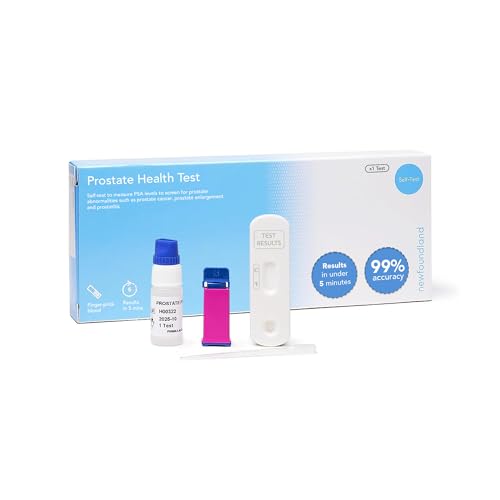
Prostate Health Test
Prostate Health Test
- ✔️ Detects raised PSA levels linked to prostate conditions
- ✔️ Results visible in just 10 minutes at home
- ✔️ Suitable for men aged 45 and over at higher risk
- ✔️ No prescription required — discreet and convenient
- ✔️ Includes lancet, pipette, buffer, and full instructions
Price Checker
 Lowest price guarantee
 Includes FREE private prescription


Couldn't load pickup availability
What Is a Prostate Health Test and How Can It Help You?
Prostate problems are more common than many men realise. In fact, prostate cancer is the most common cancer in men in the UK, with around 52,000 new cases diagnosed every year according to the NHS. Keeping an eye on your prostate health doesn't have to mean a trip to the GP every time — the prostate health test from Newfoundland lets you check your PSA (Prostate-Specific Antigen) levels from the comfort of home, quickly and discreetly. At just £12.99, it's an accessible first step in understanding what's happening with your prostate. If you're already managing other aspects of your health at home, you might also find our diabetes monitoring range useful alongside routine health checks.
PSA is a protein produced by the prostate gland. Elevated levels in the blood can be a sign of prostate enlargement (benign prostatic hyperplasia), prostatitis, or — in some cases — prostate cancer. This test gives you an early indication of whether your PSA level may be raised, so you can take the right next steps with your GP.
How Does the Newfoundland Prostate Health Test Work?
The test uses a lateral flow immunoassay — the same technology used in many rapid diagnostic tests. Here's how the process works:
- A small fingerprick blood sample is collected using the lancet provided in the kit.
- The blood sample is applied to the test cassette along with the buffer solution included.
- Antibodies within the test strip bind to PSA molecules present in the sample.
- A visible line appears on the cassette within 10 minutes, indicating whether PSA is detected above the threshold level.
- Results are read visually — no laboratory equipment or specialist training is needed.
It's worth noting that this is a qualitative test, meaning it tells you whether PSA appears raised rather than giving you an exact numerical value. For a precise PSA measurement, a laboratory blood test arranged through your GP remains the gold standard.
Who Should Consider Using a Prostate Health Test?
This test is suitable for men who want to take a proactive approach to monitoring their prostate health. You don't need symptoms to use it — in fact, early-stage prostate issues often cause no symptoms at all, which is exactly why screening matters.
- Men aged 50 and over who have not had a recent PSA check.
- Men aged 45 and over who are of Black African or Black Caribbean heritage, as this group carries a higher risk.
- Men with a first-degree relative (father or brother) who has had prostate cancer.
- Men experiencing urinary symptoms such as difficulty starting urination, weak flow, or frequent night-time urination.
If you fall into any of these groups, a home prostate health test is a sensible, low-barrier way to stay informed. Always follow up any result — positive or negative — with your GP, particularly if you have symptoms or risk factors.
How Does the Newfoundland Prostate Health Test Compare to a GP PSA Test?
| Feature | Newfoundland Prostate Health Test | GP Laboratory PSA Test |
|---|---|---|
| Location | At home | GP surgery or clinic |
| Result type | Qualitative (raised / not raised) | Quantitative (exact ng/mL value) |
| Result time | 10 minutes | Several days |
| Cost | £12.99 | Free on NHS |
| Prescription needed | No | No (but GP referral required) |
Is the Prostate Health Test Suitable for Everyone, and How Should It Be Stored?
The prostate health test is intended for adult men only and is not suitable for use by women or children. It should not be used as a substitute for professional medical advice or a formal diagnostic workup. Men who are already under investigation for prostate conditions should continue to follow their clinician's guidance rather than relying solely on a home test result.
Store the kit below 30°C in a cool, dry place away from direct sunlight and out of reach of children. Do not use the test after the expiry date printed on the packaging. For men interested in broader health monitoring, our men's health range includes a variety of products to support overall wellbeing.
This product is a medicine. Speak to your doctor or pharmacist before using if you have an underlying medical condition or are taking other medicines.
Prostate Health Test specifications
| Treatment category | Diagnostic test kit |
| Mechanism of action | Lateral flow immunoassay detecting PSA in blood |
| Effective for | Indicating raised PSA levels associated with prostate conditions |
| Suitable for | Adult men aged 45 and over |
| Active ingredient | Anti-PSA antibody lateral flow strip |
| Pack size | 1 test per kit |
| UK classification | General Sale / OTC diagnostic device |
| Preparation | Lateral flow cassette with lancet and buffer |
| Route of administration | Fingerprick blood sample |
Specifications of Prostate Health Test
What Is the Newfoundland Prostate Health Test and What Is It Used For?
The Newfoundland Prostate Health Test is an over-the-counter lateral flow test designed to detect elevated levels of Prostate-Specific Antigen (PSA) in a fingerprick blood sample. PSA is a protein produced naturally by the prostate gland, and raised levels can be associated with benign prostatic hyperplasia (BPH), prostatitis, or prostate cancer. The test is intended as a screening aid — a way to flag whether further investigation with a healthcare professional may be warranted. It is not a diagnostic tool and cannot confirm or rule out any specific condition on its own.
The NHS notes that PSA testing is not currently part of a national screening programme in the UK, partly because raised PSA can have many causes beyond cancer. However, men who are concerned about their prostate health, or who fall into higher-risk groups, may find a home test a useful starting point before speaking to their GP.
What Do You Need to Know Before Using the Prostate Health Test?
Before using this test, read the following carefully. Certain factors can affect PSA levels and may influence your result.
Do not use this test if:
- You are female or under 18 years of age.
- The packaging is damaged or the expiry date has passed.
- You have had ejaculation, vigorous exercise, or a urinary tract infection within the past 48 hours, as these can temporarily raise PSA levels.
- You have had a prostate biopsy or cystoscopy within the past six weeks.
- You have had a digital rectal examination (DRE) within the past week.
Speak to your GP before testing if:
- You are currently taking 5-alpha reductase inhibitors (such as finasteride or dutasteride), as these medicines can artificially lower PSA levels.
- You are taking any medicines that may affect prostate function or hormone levels.
- You are already under investigation or treatment for a prostate condition.
There are no known direct drug interactions with the test itself, but the medicines listed above can affect the accuracy of your PSA reading.
How Should You Use the Prostate Health Test?
Follow these steps carefully to get the most reliable result. Read the full instruction leaflet included in your kit before you begin.
- Wash your hands thoroughly with soap and warm water, then dry them completely.
- Allow your hand to hang down briefly to encourage blood flow to your fingertip.
- Use the lancet provided to prick the side of your fingertip with a quick, firm motion.
- Wipe away the first drop of blood with the swab provided.
- Gently squeeze your finger to produce a small blood sample and collect it using the pipette or collection device in the kit.
- Apply the blood sample to the designated well on the test cassette.
- Add the correct number of drops of buffer solution to the buffer well as directed.
- Wait 10 minutes before reading the result — do not read after 15 minutes.
- Interpret the result according to the diagram in the instruction leaflet.
- Record your result and contact your GP if the result indicates a raised PSA level.
| Indication | Age Group | Recommended Action | Frequency |
|---|---|---|---|
| Routine prostate monitoring | Men 50+ | Use one test; follow up with GP if raised | As advised by GP |
| Higher-risk monitoring | Men 45+ (Black heritage or family history) | Use one test; discuss results with GP | As advised by GP |
| Symptomatic men | Any adult male with urinary symptoms | Use one test; seek GP review promptly | Single use; GP to advise further |
What Are the Possible Side Effects of the Prostate Health Test?
Because this is a diagnostic test kit rather than a medicine, it does not cause systemic side effects. However, the fingerprick collection process may cause minor localised effects. If you are concerned about any reaction, contact your pharmacist or GP.
Common side effects (related to fingerprick):
- Brief stinging or discomfort at the lancet site.
- Minor bleeding that usually stops within a few minutes.
- Small bruise or mark at the puncture site.
Less common side effects:
- Localised redness or swelling at the fingertip — usually resolves quickly.
- Lightheadedness in individuals who are sensitive to blood or needles — sit down before testing if this applies to you.
Psychological distress following an unexpected result is also worth acknowledging. If your result indicates a raised PSA level, try not to panic — many things can cause a raised PSA that are not cancer. Speak to your GP as soon as possible for context and next steps. You may also find it helpful to explore our men's health section for further support products.
How Should You Store the Prostate Health Test?
- Store at room temperature, below 30°C.
- Keep in a cool, dry place away from direct sunlight and moisture.
- Do not refrigerate or freeze the test kit.
- Keep out of reach and sight of children.
- Do not use after the expiry date printed on the outer packaging.
- Once opened, use the test immediately — do not store a partially used kit.
- Dispose of used lancets and test components safely in accordance with your local household waste guidelines.
If you're building a home health monitoring routine, our electrical health and diagnostic range includes blood pressure monitors, pulse oximeters, and other tools to help you stay on top of your health between GP appointments.
References
Written and reviewed by our qualified team
Your safety and success are our highest priorities. Our medical team rigorously evaluates every product and piece of advice we provide, ensuring you receive only the most effective, science-backed solutions available.
Frequently Asked Questions
Where can I buy a prostate health test online in the UK?
You can buy the Newfoundland Prostate Health Test directly from Cured Pharmacy online for £12.99, with no prescription required. It's dispatched discreetly to your home across the UK. Simply add it to your basket and check out — it's that straightforward.
How does the Prostate Health Test detect PSA in the blood?
The test uses a lateral flow immunoassay — antibodies on the test strip bind to PSA molecules in your blood sample, producing a visible line if PSA is detected above the threshold. It's the same core technology used in many rapid diagnostic tests. The result appears within 10 minutes and is read visually from the cassette window.
How do I use the Newfoundland Prostate Health Test step by step?
Wash and dry your hands, then use the lancet to prick the side of your fingertip. Collect the blood sample using the pipette, apply it to the test cassette, add the buffer solution, and wait 10 minutes before reading the result. Full illustrated instructions are included in every kit — read them carefully before you start.
What PSA level is considered raised on a home prostate test?
The Newfoundland test is a qualitative test, so it indicates whether PSA appears raised rather than giving an exact number. The NHS generally considers a PSA above 3 ng/mL as potentially raised in men over 50, though the threshold varies with age. If your result is positive, speak to your GP for a laboratory PSA test to get a precise reading.
Can a home prostate health test diagnose prostate cancer?
No — this test cannot diagnose prostate cancer or any other prostate condition. It can only indicate whether your PSA level appears elevated, which may prompt your GP to arrange further investigations such as a laboratory PSA test, digital rectal examination, or MRI scan. Always treat a positive result as a reason to seek medical advice, not a diagnosis.
Who is eligible to use a home prostate health test?
The test is suitable for adult men, particularly those aged 50 and over, or men aged 45 and over who are of Black African or Black Caribbean heritage or have a close family history of prostate cancer. Men with urinary symptoms such as a weak stream, frequent urination, or difficulty starting to urinate may also benefit from testing. It is not suitable for women or anyone under 18.
What factors can affect the accuracy of a PSA home test?
Several things can temporarily raise PSA levels and affect your result, including ejaculation, vigorous exercise, urinary tract infections, and recent prostate procedures such as a biopsy or cystoscopy. Medicines such as finasteride and dutasteride can artificially lower PSA. For the most reliable result, avoid these factors for at least 48 hours before testing and follow the kit instructions precisely.
What should I do if my prostate health test result is positive?
A positive result means your PSA level appears raised — but this does not automatically mean you have prostate cancer. Many conditions, including benign prostatic hyperplasia and prostatitis, can raise PSA. Contact your GP as soon as possible to arrange a laboratory PSA test and discuss your result in context. Try not to delay, but equally try not to panic.
What are the alternatives to a home prostate health test?
The main alternative is a PSA blood test carried out at your GP surgery, which is processed in a laboratory and provides an exact PSA value in ng/mL. Your GP can also perform a digital rectal examination (DRE) to assess the size and texture of the prostate. For men who want to monitor multiple health markers at home, our electrical health and diagnostic range offers additional monitoring tools.
How accurate is the Newfoundland Prostate Health Test?
Lateral flow PSA tests are designed as screening aids and are not as precise as laboratory analysis. False positives and false negatives can occur, which is why any result should be followed up with your GP rather than acted upon in isolation. The test is a useful first step, not a definitive answer.
How long does it take to get a result from the Prostate Health Test?
Results are visible within 10 minutes of applying the blood sample and buffer solution to the test cassette. Do not read the result after 15 minutes, as the lines may change and give a misleading reading. The process from start to finish — including sample collection — typically takes around 15 to 20 minutes.
Is the Prostate Health Test painful to use?
The lancet prick may cause a brief, sharp sting, but most people find it very tolerable — similar to a standard blood glucose fingerprick test. Any discomfort passes within seconds. If you are particularly sensitive to needles or the sight of blood, sit down before testing and take your time.
How often should I use a home prostate health test?
There is no universally agreed frequency for home PSA testing, and the NHS does not currently run a national prostate screening programme. Your GP is best placed to advise how often you should monitor your PSA based on your age, risk factors, and previous results. Many men in higher-risk groups choose to test annually and discuss results with their doctor. You can also explore our broader men's health range for complementary health products.
What are the latest research findings on PSA home testing?
Research continues to explore the role of PSA testing in early prostate cancer detection. NICE guidance (NG131) acknowledges that PSA testing has limitations but supports its use in men who are informed about its benefits and risks. Ongoing studies are investigating more specific biomarkers to improve the accuracy of prostate cancer screening beyond PSA alone. Always discuss the latest evidence with your GP when making decisions about testing.
Can I use the Prostate Health Test if I am already taking prostate medication?
If you are taking 5-alpha reductase inhibitors such as finasteride or dutasteride, these medicines can significantly lower your PSA level, which may cause the test to show a falsely negative result. You should inform your GP of any medication you are taking when discussing your PSA results. Always speak to your pharmacist or doctor before interpreting a home PSA result if you are on any prostate-related treatment.
Written and reviewed by our qualified team

Reviewed by:
Tarun Kumar
Superintendent/ Clinical Lead
📖 Find out more about our team of medical content authors and how we ensure the accuracy of our content with our content guidelines.
Content last updated: 14 Sep 2026
Other popular options


We’re a safe and
regulated UK service

Lowest Price Guarantee

We're convinced you won't find your treatment cheaper, but if you do we'll refund the difference.
Find out more
100% discreet packaging

Discreet, unbranded packaging for every order.
Find out more

Need help?
Talk to our friendly experts now


How our service works

Service setup

Discreet packaging

Express delivery