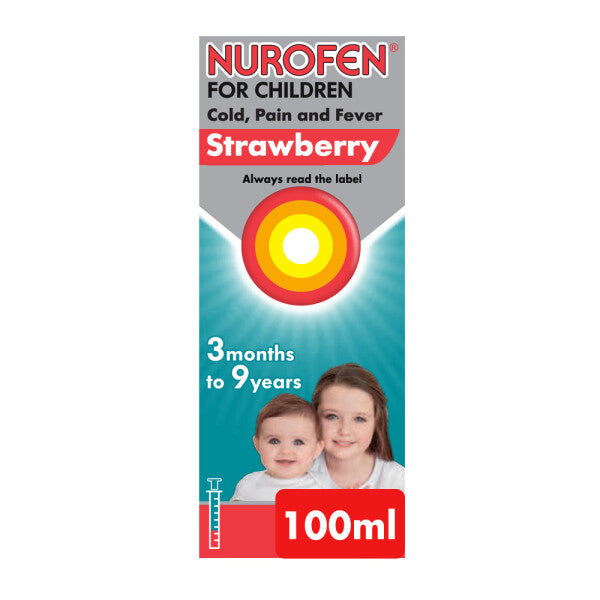
Nurofen For Children Cold, Pain, Fever Strawberry Flavour - 100ml
Nurofen For Children Cold, Pain, Fever Strawberry Flavour - 100ml
- ✔️ Relieves fever, pain, and cold symptoms in children
- ✔️ Suitable for children aged 3 months to 12 years
- ✔️ Sugar-free strawberry flavour for easy administration
- ✔️ Works within 15–30 minutes, lasts up to 8 hours
- ✔️ Includes oral syringe for accurate dose measurement
Price Checker
 Lowest price guarantee
 Includes FREE private prescription


Couldn't load pickup availability
Is Nurofen For Children Right for Your Child's Cold and Fever?
When your child is miserable with a high temperature, a runny nose, or the aches that come with a cold, you want something that works — and works quickly. Ibuprofen for children cold and fever is one of the most widely recommended OTC options by UK pharmacists and GPs alike. Nurofen For Children Cold, Pain, Fever Strawberry Flavour 100ml is an oral ibuprofen suspension containing 100mg of ibuprofen per 5ml, formulated specifically for children aged 3 months to 12 years. It's sugar-free, with a strawberry flavour that makes it easier to give to reluctant little ones. You can browse our full range of baby and toddler health products if you're stocking up on essentials.
Ibuprofen belongs to a class of medicines called non-steroidal anti-inflammatory drugs (NSAIDs). It's been used safely in children for decades and is recommended by the NHS for reducing fever and relieving mild to moderate pain. This 100ml bottle comes with a measuring syringe to help you give the right dose every time — no guesswork involved.
How Does Nurofen For Children Work to Reduce Fever and Pain?
Ibuprofen works by inhibiting enzymes called cyclooxygenase-1 (COX-1) and cyclooxygenase-2 (COX-2). These enzymes are responsible for producing prostaglandins — chemical messengers that trigger inflammation, raise body temperature, and amplify pain signals. By reducing prostaglandin production, ibuprofen tackles the root cause of your child's discomfort rather than just masking it.
- Reduces fever by acting on the hypothalamus, the brain's temperature-regulating centre
- Relieves mild to moderate pain, including headache, earache, sore throat, and teething pain
- Reduces inflammation associated with colds and minor infections
- Begins to work within 15–30 minutes of administration, with effects lasting up to 8 hours
Who Should Use Nurofen For Children Strawberry Suspension?
This suspension is designed for children, not adults. It's suitable for a fairly wide age range, which makes it a practical medicine cabinet staple for families with young children. That said, it's not appropriate for every child — age, weight, and medical history all matter.
- Children aged 3 months to 12 years weighing at least 5kg
- Children with fever, cold symptoms, earache, sore throat, or teething pain
- Children who need post-immunisation fever relief (from 2 months, under medical guidance)
- Children who struggle to swallow tablets and need a liquid formulation
It is not suitable for children under 3 months, those with a known allergy to ibuprofen or aspirin, or children with certain kidney, liver, or stomach conditions. Always read the label carefully before use.
How Does Nurofen For Children Compare to Paracetamol Suspension?
| Feature | Nurofen For Children (Ibuprofen) | Calpol (Paracetamol) |
|---|---|---|
| Active ingredient | Ibuprofen 100mg/5ml | Paracetamol 120mg/5ml or 250mg/5ml |
| Anti-inflammatory action | Yes (NSAID) | No |
| Minimum age | 3 months (≥5kg) | 2 months (≥4kg) |
| Dosing interval | Every 6–8 hours (max 3 doses/24hrs) | Every 4–6 hours (max 4 doses/24hrs) |
How Should You Store Nurofen For Children and Is It Suitable for All Children?
Store this suspension below 25°C, away from direct sunlight. Do not refrigerate — cold temperatures can affect the consistency of the liquid. Once opened, use within 6 months and always keep the bottle tightly closed between doses. Keep it out of reach and sight of children, as with all medicines.
Not every child can safely take ibuprofen for children cold and fever. Children with asthma, inflammatory bowel disease, kidney problems, or a history of stomach ulcers should not use this product without first speaking to a GP or pharmacist. If your child is already taking other medicines — including other NSAIDs or blood thinners — check with a healthcare professional before giving this suspension. You might also find our cold and flu collection helpful for managing wider family illness.
This product is a medicine. Speak to your doctor or pharmacist before using if you have an underlying medical condition or are taking other medicines.
Nurofen For Children Cold, Pain, Fever Strawberry Flavour 100ml specifications
| Treatment category | Pain relief, fever reduction, cold symptom relief |
| Mechanism of action | COX-1 and COX-2 inhibitor (NSAID) |
| Effective for | Fever, mild to moderate pain, cold symptoms, teething, earache, sore throat |
| Suitable for | Children aged 3 months to 12 years (≥5kg) |
| Active ingredient | Ibuprofen 100mg/5ml |
| Pack size | 100ml |
| UK classification | General Sale List (GSL) |
| Drug class | Non-steroidal anti-inflammatory drug (NSAID) |
| Preparation | Oral suspension |
| Route of administration | Oral |
Specifications of Nurofen For Children Cold, Pain, Fever Strawberry Flavour 100ml
What Is Nurofen For Children and What Is It Used For?
Nurofen For Children Cold, Pain, Fever Strawberry Flavour is an oral ibuprofen suspension containing 100mg of ibuprofen per 5ml. It is used to relieve mild to moderate pain and reduce fever in children aged 3 months to 12 years. Common uses include relief of cold and flu symptoms, teething pain, earache, sore throat, headache, and post-immunisation fever. It is also used to ease the discomfort of minor injuries and sprains in older children. The strawberry flavour and liquid format make it easier to administer than tablets, particularly for younger children.
What Do You Need to Know Before Using Nurofen For Children?
Before giving this medicine to your child, read the following carefully. There are situations where ibuprofen should not be used, and others where caution is needed.
Do not use if your child:
- Is under 3 months of age or weighs less than 5kg
- Has a known allergy to ibuprofen, aspirin, or any other NSAID
- Has a history of stomach ulcers or gastrointestinal bleeding
- Has severe kidney, liver, or heart failure
- Has chickenpox (ibuprofen may increase the risk of serious skin infections in this case)
Use with caution and speak to a pharmacist or GP if your child:
- Has asthma — ibuprofen can trigger bronchospasm in some children
- Has inflammatory bowel disease (Crohn's disease or ulcerative colitis)
- Has a bleeding disorder or is taking anticoagulant medicines
- Is dehydrated or has been vomiting repeatedly
Known drug interactions — do not use alongside:
- Other NSAIDs (e.g. aspirin, naproxen)
- Anticoagulants (e.g. warfarin)
- Corticosteroids (e.g. prednisolone)
- Certain antidepressants (SSRIs)
- Methotrexate
How Should You Use Nurofen For Children Correctly?
Always use the oral syringe provided in the pack to measure the dose accurately. Shake the bottle well before each use. Give the suspension by mouth — it can be given directly or mixed with a small amount of cool water or juice if your child refuses it plain.
- Shake the bottle well before opening
- Remove the child-resistant cap by pressing down and turning
- Insert the oral syringe into the bottle adaptor
- Draw up the correct dose for your child's weight or age
- Administer slowly into the side of your child's mouth
- Replace the cap securely after use
| Age Group | Weight | Dose (5ml = 100mg) | Frequency |
|---|---|---|---|
| 3–6 months | 5–7.6kg | 2.5ml | Up to 3 times in 24 hours |
| 6–12 months | 7.7–9kg | 2.5ml | Up to 3 times in 24 hours |
| 1–3 years | 10–15kg | 5ml | Up to 3 times in 24 hours |
| 4–6 years | 16–20kg | 7.5ml | Up to 3 times in 24 hours |
| 7–9 years | 21–28kg | 10ml | Up to 3 times in 24 hours |
| 10–12 years | 29–40kg | 15ml | Up to 3 times in 24 hours |
Do not give more than 3 doses in 24 hours. Leave at least 6 hours between doses. If your child's symptoms do not improve within 24 hours (for fever) or 3 days (for pain), consult a GP. You can also explore our pain relief collection for additional options suitable for older children and adults.
What Are the Possible Side Effects of Nurofen For Children?
Like all medicines, ibuprofen suspension can cause side effects, although not every child will experience them. Most side effects are mild and resolve on their own.
Common side effects:
- Stomach upset or abdominal pain
- Nausea or vomiting
- Diarrhoea
- Indigestion
Less common side effects:
- Headache or dizziness
- Skin rash or itching
- Fluid retention (swelling of hands or feet)
- Worsening of asthma symptoms
Stop giving the medicine and seek urgent medical attention if your child develops difficulty breathing, facial swelling, a severe rash, or signs of a serious allergic reaction (anaphylaxis). These reactions are rare but require immediate care.
How Should You Store Nurofen For Children Suspension?
- Store below 25°C — do not refrigerate
- Keep away from direct sunlight and heat sources
- Keep the bottle tightly closed when not in use
- Store out of reach and sight of children
- Discard any remaining suspension 6 months after first opening
- Do not use after the expiry date printed on the label
- Do not dispose of medicines via wastewater or household waste — return to your pharmacy
If you're looking for other products to support your child's health during illness, our first aid collection includes a range of essentials for home use.
References
Written and reviewed by our qualified team
Your safety and success are our highest priorities. Our medical team rigorously evaluates every product and piece of advice we provide, ensuring you receive only the most effective, science-backed solutions available.
Frequently Asked Questions
Where can I buy Nurofen For Children Cold, Pain, Fever Strawberry 100ml online in the UK?
You can buy Nurofen For Children Cold, Pain, Fever Strawberry Flavour 100ml directly from Cured Pharmacy, a GPhC-registered UK online pharmacy. It is available without a prescription as an over-the-counter medicine. Simply add it to your basket and it will be dispatched promptly to your door.
How does ibuprofen for children cold and fever actually work in the body?
Ibuprofen works by blocking COX-1 and COX-2 enzymes, which are responsible for producing prostaglandins — the chemicals that cause fever, pain, and inflammation. By reducing prostaglandin levels, ibuprofen lowers your child's temperature and eases discomfort. It typically begins to work within 15 to 30 minutes of being given.
What age can children take Nurofen For Children Strawberry suspension?
Nurofen For Children is suitable for children aged 3 months to 12 years, provided they weigh at least 5kg. Children under 3 months should not be given ibuprofen unless specifically directed by a doctor. Always check the dosage table on the packaging and use the oral syringe provided to measure accurately.
How often can I give my child Nurofen For Children in 24 hours?
You can give Nurofen For Children every 6 to 8 hours, with a maximum of 3 doses in any 24-hour period. Always leave at least 6 hours between doses. If your child's fever or pain does not improve after 24 hours, contact your GP or call NHS 111.
Can I give my child Nurofen For Children and paracetamol at the same time?
Yes, ibuprofen and paracetamol can generally be used together or alternated in children, as they work through different mechanisms and do not interact with each other. This approach is sometimes recommended by healthcare professionals for managing high or persistent fever. Always follow the correct dose for each medicine separately and consult your pharmacist if you are unsure.
What are the side effects of children's ibuprofen suspension?
Common side effects include stomach upset, nausea, diarrhoea, and indigestion. Less commonly, children may experience headache, skin rash, or worsening of asthma symptoms. Stop use and seek urgent medical advice if your child develops difficulty breathing, facial swelling, or signs of a severe allergic reaction.
Is Nurofen For Children safe for children with asthma?
Ibuprofen can trigger bronchospasm in some children with asthma, so it should be used with caution in this group. The NHS advises that children with asthma should only take ibuprofen if recommended by a doctor. If your child has asthma, speak to your GP or pharmacist before giving this medicine.
What happens if I accidentally give my child too much ibuprofen?
Giving too much ibuprofen can cause stomach pain, nausea, vomiting, and in serious cases, kidney problems or drowsiness. If you think your child has received an overdose, contact NHS 111 immediately or take them to your nearest A&E. Always bring the medicine bottle with you so healthcare staff can see exactly what was taken.
Who is not eligible to take Nurofen For Children?
This medicine is not suitable for children under 3 months, those weighing less than 5kg, or children with a known allergy to ibuprofen, aspirin, or other NSAIDs. It should also be avoided in children with severe kidney, liver, or heart conditions, active stomach ulcers, or chickenpox. Always read the full patient information leaflet before use.
What are the alternatives to Nurofen For Children for fever relief?
The main alternative to ibuprofen suspension for children is paracetamol suspension (such as Calpol), which is suitable from 2 months of age and does not carry the same NSAID-related risks. For children who cannot take either medicine, speak to your GP about appropriate alternatives. You can also explore our baby and toddler range for other supportive products.
How long can my child take Nurofen For Children for?
For fever, do not use for more than 3 days without consulting a GP. For pain relief, do not use for more than 3 days in children under 12 without medical advice. If symptoms persist or worsen, always seek professional guidance rather than continuing to self-treat.
How should I store Nurofen For Children Strawberry Flavour?
Store the suspension below 25°C, away from direct sunlight and heat. Do not refrigerate, as cold temperatures can affect the liquid. Once opened, use within 6 months and always keep the bottle tightly closed and out of reach of children.
Can Nurofen For Children be used for teething pain?
Yes, Nurofen For Children can be used to relieve the mild to moderate pain associated with teething in children aged 3 months and over, provided they weigh at least 5kg. It is one of the options recommended by the NHS for teething discomfort alongside teething rings and gentle gum massage. Always use the correct dose for your child's age and weight.
Does Nurofen For Children contain sugar or artificial colours?
Nurofen For Children Strawberry Flavour is sugar-free, making it suitable for children who need to limit their sugar intake or who are at risk of dental decay. It does contain some excipients including maltitol liquid and sodium saccharin for sweetness. If your child has any known sensitivities to these ingredients, check the full list of excipients on the packaging or patient information leaflet.
What is the latest guidance on using ibuprofen for children cold and fever in the UK?
Current NHS guidance supports the use of ibuprofen as a first-line option for reducing fever and relieving pain in children aged 3 months and over, where paracetamol alone has not been effective or where anti-inflammatory action is needed. The NHS also advises that both ibuprofen and paracetamol should not be used simultaneously purely to prevent fever returning — only use them together if one medicine alone is not controlling symptoms. Always follow the most up-to-date advice from your GP or pharmacist, and check our cold and flu collection for further support products.
Written and reviewed by our qualified team

Reviewed by:
Tarun Kumar
Superintendent/ Clinical Lead
📖 Find out more about our team of medical content authors and how we ensure the accuracy of our content with our content guidelines.
Content last updated: 14 Sep 2026
Other popular options


We’re a safe and
regulated UK service

Lowest Price Guarantee

We're convinced you won't find your treatment cheaper, but if you do we'll refund the difference.
Find out more
100% discreet packaging

Discreet, unbranded packaging for every order.
Find out more

Need help?
Talk to our friendly experts now


How our service works

Service setup

Discreet packaging

Express delivery