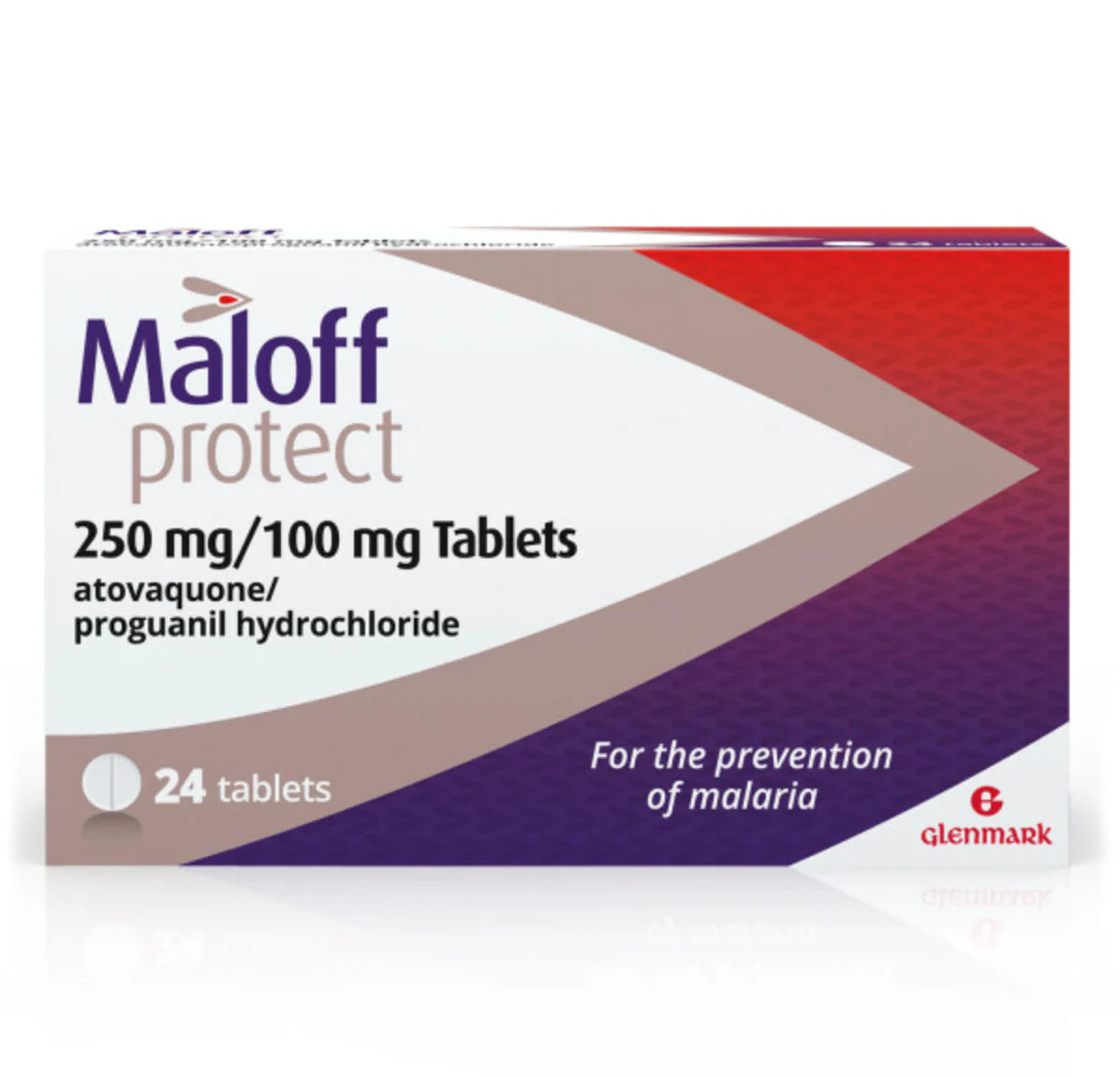
Maloff Protect 250mg/100mg
- ✔️ Prevents Plasmodium falciparum malaria in adults travelling abroad
- ✔️ Start just 1–2 days before entering a malaria-risk area
- ✔️ Only 7 days post-travel dosing required — shorter than alternatives
- ✔️ Available OTC without a prescription for adults aged 18+
- ✔️ Dual-action formula targets malaria parasite at two life-cycle stages
Price Checker
 Discreet, tracked delivery
 Includes FREE private prescription


Couldn't load pickup availability
What Are Malaria Tablets and How Does Maloff Protect Help?
Planning a trip to a malaria-risk destination? Protecting yourself before you go is essential. Malaria tablets are one of the most reliable tools available for preventing malaria infection, and Maloff Protect 250mg/100mg is a UK-licensed, over-the-counter option that makes that protection accessible without needing a GP appointment. Each tablet contains two active ingredients — atovaquone 250mg and proguanil hydrochloride 100mg — working together to guard against the most dangerous malaria parasite, Plasmodium falciparum. If you're heading to sub-Saharan Africa, South Asia, or other high-risk regions, this is a treatment worth knowing about. You can also browse our travel health collection for other essentials before you depart.
Maloff Protect is the only atovaquone/proguanil combination tablet currently licensed for OTC sale in the UK. It's approved by the MHRA and is suitable for adults aged 18 and over. At £53.99, it offers a straightforward, clinically validated option for travellers who need reliable malaria prevention without the delays of a prescription.
How Does Maloff Protect Work Against Malaria?
Maloff Protect uses a dual-action mechanism that targets the malaria parasite at two separate biological points, making it harder for the parasite to develop resistance. Here's how it works:
- Atovaquone selectively inhibits mitochondrial electron transport in the malaria parasite, collapsing its ability to generate energy and survive inside red blood cells.
- Proguanil hydrochloride is converted in the body to cycloguanil, which inhibits dihydrofolate reductase — an enzyme the parasite needs to synthesise folate and replicate its DNA.
- Together, these two actions create a synergistic effect, disrupting both energy production and cell division in Plasmodium falciparum.
- The combination also acts on the liver stage of the parasite's life cycle, providing causal prophylactic activity — meaning it can prevent the infection from establishing itself in the first place.
This causal activity is one reason Maloff Protect only needs to be continued for 7 days after leaving a malaria-risk area, rather than the 4 weeks required by some other antimalarials.
Who Is Maloff Protect Suitable For?
Maloff Protect is designed for adults aged 18 and over who are travelling to areas where malaria — particularly Plasmodium falciparum — is present. It is not a treatment for active malaria infection; it is a preventative medicine. Before purchasing, consider whether you fall into one of the following suitable groups:
- Adults aged 18 or over travelling to malaria-endemic regions in Africa, Asia, or the Americas
- Travellers who need a short-course antimalarial (only 7 days post-travel continuation required)
- People who cannot tolerate mefloquine or doxycycline due to side effects or contraindications
- Those seeking an OTC option without a prescription, following a pharmacist consultation
It is not suitable for children under 18, people with severe kidney impairment, or those who are pregnant or breastfeeding without specific medical advice. Always speak to a pharmacist before purchasing if you have any underlying health conditions.
How Does Maloff Protect Compare to Other Antimalarial Options?
| Feature | Maloff Protect (Atovaquone/Proguanil) | Doxycycline | Mefloquine |
|---|---|---|---|
| Start before travel | 1–2 days before | 1–2 days before | 2–3 weeks before |
| Continue after travel | 7 days | 4 weeks | 4 weeks |
| Prescription required? | No (OTC for adults) | Yes | Yes |
| Notable concerns | Cost; renal caution | Photosensitivity; GI upset | Neuropsychiatric effects |
How Should You Store Maloff Protect and Is It Clinically Appropriate for You?
Store Maloff Protect below 25°C in a dry place, away from direct sunlight and out of reach of children. Do not use the tablets after the expiry date printed on the packaging. If you're unsure whether malaria tablets are right for your specific travel destination or health profile, the NHS Fit for Travel service and your local pharmacist are excellent starting points for personalised advice. You might also find it useful to check our vitamins and supplements range for additional travel health support.
This product is a medicine. Speak to your doctor or pharmacist before using if you have an underlying medical condition or are taking other medicines.
Maloff Protect 250mg/100mg specifications
| Treatment category | Antimalarial / Malaria prophylaxis |
| Active ingredient | Atovaquone 250mg, Proguanil hydrochloride 100mg |
| Mechanism of action | Inhibits mitochondrial electron transport (atovaquone) and dihydrofolate reductase (proguanil) |
| Effective against | Plasmodium falciparum malaria |
| Suitable for | Adults aged 18 and over |
| Pack sizes | 12 tablets |
| Strengths | Atovaquone 250mg / Proguanil hydrochloride 100mg |
| UK classification | Pharmacy (P) medicine |
| Drug class | Antiprotozoal / Antimalarial |
| Preparation | Film-coated tablet |
| Route of administration | Oral |
Specifications of Maloff Protect 250mg/100mg
What Is Maloff Protect and What Is It Used For?
Maloff Protect 250mg/100mg is an OTC antimalarial medicine containing atovaquone and proguanil hydrochloride. It is used to prevent malaria caused by Plasmodium falciparum in adults aged 18 and over who are travelling to areas where this parasite is present. Malaria is a serious, potentially life-threatening disease transmitted through the bites of infected Anopheles mosquitoes. According to the NHS, malaria is found in more than 100 countries, including large areas of Africa, Asia, Central and South America, and the Pacific islands. Taking an appropriate antimalarial before, during, and after travel is a key part of malaria prevention alongside mosquito bite avoidance measures.
What Do You Need to Know Before Using Maloff Protect?
Do not take Maloff Protect if any of the following apply to you:
- You are allergic to atovaquone, proguanil hydrochloride, or any other ingredient in the tablet
- You have severe kidney problems (creatinine clearance below 30 mL/min)
- You are under 18 years of age
- You are pregnant — use only if your doctor advises the benefit outweighs the risk
- You are breastfeeding — proguanil passes into breast milk; seek medical advice first
Speak to your pharmacist or GP before taking Maloff Protect if you have mild to moderate kidney problems, liver problems, or if you are taking any other medicines. The following medicines are known to interact with Maloff Protect:
- Rifampicin or rifabutin — significantly reduce atovaquone blood levels
- Tetracycline — may reduce atovaquone plasma concentrations by approximately 40%
- Metoclopramide — reduces bioavailability of atovaquone
- Warfarin and other anticoagulants — proguanil may enhance anticoagulant effects; INR monitoring may be needed
- Indinavir — concurrent use may reduce indinavir trough levels
How Should You Use Maloff Protect?
Always use Maloff Protect exactly as directed by your pharmacist. Taking it correctly is essential for it to work. Follow these steps:
- Start taking Maloff Protect 1 to 2 days before you enter a malaria-risk area.
- Take one tablet once daily, at the same time each day.
- Swallow the tablet whole with food or a milky drink — this improves absorption and reduces stomach upset.
- Continue taking one tablet every day throughout your stay in the risk area.
- After leaving the malaria-risk area, continue taking one tablet daily for a further 7 days.
- If you vomit within one hour of taking a tablet, take another dose immediately.
| Indication | Age Group | Dose | Frequency |
|---|---|---|---|
| Malaria prophylaxis | Adults (18+) | 1 tablet (atovaquone 250mg / proguanil 100mg) | Once daily with food or milk |
| Children under 18 | Under 18 | Not applicable — Maloff Protect OTC is not licensed for under-18s | Seek prescription advice |
Maloff Protect is not a substitute for mosquito bite prevention. Use insect repellent, wear long-sleeved clothing, and sleep under a mosquito net where appropriate. For other travel health essentials, explore our first aid collection.
What Are the Possible Side Effects of Maloff Protect?
Like all medicines, Maloff Protect can cause side effects, although not everyone gets them. Taking the tablet with food or a milky drink can help reduce gastrointestinal effects.
Common side effects (may affect up to 1 in 10 people):
- Nausea
- Headache
- Abdominal pain or discomfort
- Diarrhoea
- Dizziness
- Vomiting
Less common side effects (may affect up to 1 in 100 people):
- Mouth ulcers
- Raised liver enzymes (detected on blood tests)
- Skin rash or itching
- Hair loss (rare)
- Vivid or unusual dreams
- Depression or anxiety (rare; seek medical advice promptly)
Stop taking Maloff Protect and seek immediate medical attention if you develop signs of a serious allergic reaction, such as swelling of the face, lips, or throat, difficulty breathing, or a severe skin rash. If you experience any symptoms of malaria — including fever, chills, or flu-like illness — during or after travel, seek urgent medical attention even if you have been taking your antimalarial correctly. If you need support managing nausea during travel, our sickness and nausea range may help.
How Should You Store Maloff Protect?
- Store below 25°C in a dry place
- Keep away from direct sunlight and moisture
- Keep out of the sight and reach of children
- Do not use after the expiry date printed on the packaging
- Do not dispose of medicines via wastewater or household waste — return unused tablets to your pharmacy
References
Written and reviewed by our qualified team
Your safety and success are our highest priorities. Our medical team rigorously evaluates every product and piece of advice we provide, ensuring you receive only the most effective, science-backed solutions available.
Frequently Asked Questions
Where can I buy Maloff Protect online in the UK?
You can buy Maloff Protect 250mg/100mg directly from Cured Pharmacy, a GPhC-registered online pharmacy. It is available as an OTC Pharmacy (P) medicine for adults aged 18 and over, meaning no prescription is needed. A short pharmacist consultation is required to ensure it is appropriate for your travel destination and health profile.
How does Maloff Protect work in the body?
Maloff Protect contains two active ingredients — atovaquone and proguanil hydrochloride — that attack the malaria parasite at two different points in its life cycle. Atovaquone disrupts the parasite's mitochondrial energy production, while proguanil (converted to cycloguanil in the body) blocks folate synthesis needed for DNA replication. This dual action makes it effective against Plasmodium falciparum, including at the liver stage before the parasite enters the bloodstream.
When should I start taking Maloff Protect before travelling?
You should start taking Maloff Protect 1 to 2 days before entering a malaria-risk area. This is one of its advantages over alternatives like mefloquine, which must be started 2 to 3 weeks before travel. Starting early allows the medicine to reach effective levels in your body before you are exposed to any risk.
What is the correct dose of Maloff Protect for adults?
The recommended dose for adults aged 18 and over is one tablet (atovaquone 250mg / proguanil hydrochloride 100mg) taken once daily. Take it at the same time each day with food or a milky drink to improve absorption and reduce the chance of stomach upset. Do not take more than one tablet per day.
How long do I need to take Maloff Protect after leaving a malaria-risk area?
You must continue taking Maloff Protect for 7 days after leaving the malaria-risk area. This is shorter than doxycycline or mefloquine, which both require 4 weeks of post-travel dosing. The shorter course is possible because atovaquone/proguanil acts on the liver stage of the parasite's life cycle, eliminating it before it can establish a blood-stage infection.
What are the most common side effects of Maloff Protect?
The most commonly reported side effects include nausea, headache, abdominal pain, diarrhoea, and dizziness. These are generally mild and often improve after the first few days of use. Taking the tablet with food or a milky drink significantly reduces the likelihood of gastrointestinal side effects.
How do I manage side effects of Maloff Protect?
The most effective way to reduce side effects is to take each tablet with a meal or a milky drink, as this improves absorption and reduces stomach irritation. If nausea persists, you may find products from our sickness and nausea range helpful alongside your antimalarial. If side effects are severe or do not improve, speak to your pharmacist or GP promptly.
Who should not take Maloff Protect?
Maloff Protect is not suitable for adults with severe kidney impairment (creatinine clearance below 30 mL/min), children under 18, or people with a known allergy to atovaquone or proguanil. Pregnant or breastfeeding women should only use it on medical advice, as safety data in these groups is limited. Always complete the pharmacist consultation honestly to ensure it is safe for you.
What happens if I miss a dose of Maloff Protect?
If you miss a dose, take it as soon as you remember and then continue your regular daily schedule. Do not take a double dose to make up for a missed one. If you vomit within one hour of taking a tablet, take another dose straight away, as the medicine may not have been fully absorbed.
Can I take Maloff Protect if I am on other medicines?
Maloff Protect can interact with several medicines, including rifampicin, tetracycline, metoclopramide, and warfarin. If you are taking any regular prescription or OTC medicines, always inform your pharmacist before starting Maloff Protect. Interactions can reduce the effectiveness of the antimalarial or affect the levels of your other medicines.
How does Maloff Protect compare to doxycycline and mefloquine?
Maloff Protect requires only 1–2 days' lead time before travel and just 7 days post-travel, compared to 4 weeks for both doxycycline and mefloquine. It does not cause the photosensitivity associated with doxycycline or the neuropsychiatric side effects linked to mefloquine. However, it is generally more expensive and is only licensed OTC for adults, whereas the others require a prescription.
Is Maloff Protect suitable for long-term or repeated travel?
Maloff Protect can be used for repeated trips to malaria-risk areas, but it is not typically recommended for continuous long-term use beyond approximately 28 days without medical review. If you travel frequently to malaria-endemic regions, speak to a travel health specialist or GP about the most appropriate ongoing prevention strategy for your situation.
Does Maloff Protect protect against all types of malaria?
Maloff Protect is specifically licensed for the prevention of Plasmodium falciparum malaria, which is the most dangerous and most common type in sub-Saharan Africa. It may have some activity against other Plasmodium species, but it is not the first-line choice for all malaria types in all regions. Always check the specific malaria risk and recommended prophylaxis for your destination with a pharmacist or travel health clinic.
What are the latest studies on atovaquone/proguanil for malaria prevention?
Atovaquone/proguanil has been extensively studied since its introduction and remains one of the most well-tolerated and effective antimalarial prophylaxis options for travellers. Published clinical data consistently supports its efficacy against P. falciparum, with a favourable side effect profile compared to older agents. For the most current guidance, the NHS Fit for Travel and Public Health England resources are regularly updated with evidence-based recommendations.
Can I buy malaria tablets without a prescription in the UK?
Yes — Maloff Protect is one of the few malaria tablets available without a prescription in the UK, classified as a Pharmacy (P) medicine. You can purchase it from a registered pharmacy, including online pharmacies like Cured Pharmacy, following a pharmacist consultation. For other travel health products and essentials, browse our travel health collection.
Written and reviewed by our qualified team

Reviewed by:
Tarun Kumar
Superintendent/ Clinical Lead
📖 Find out more about our team of medical content authors and how we ensure the accuracy of our content with our content guidelines.
Content last updated: 14 Sep 2026
Other popular options


We’re a safe and
regulated UK service

100% discreet packaging

Discreet, unbranded packaging for every order.

Need help?
Talk to our friendly experts now


How our service works

Service setup

Discreet packaging

Express delivery