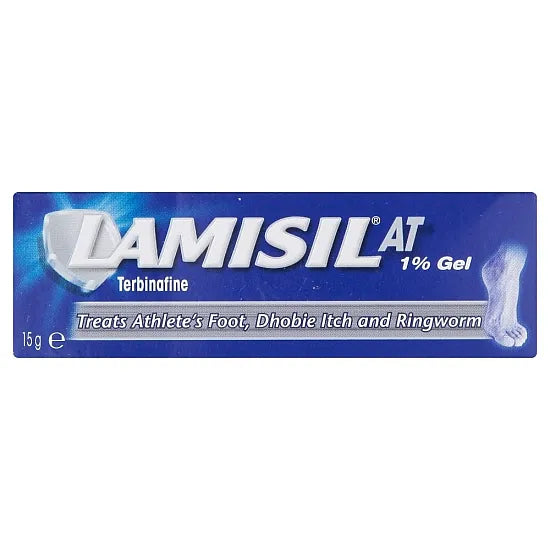
Lamisil AT 1% Gel - 15g
Lamisil AT 1% Gel - 15g
- ✔️ Kills athlete's foot fungus in just one week
- ✔️ Terbinafine 1% acts directly on fungal cell membranes
- ✔️ Lightweight gel absorbs quickly between the toes
- ✔️ Treats tinea pedis, ringworm, and jock itch
- ✔️ Suitable for adults and young people aged 12 and over
Price Checker
 Lowest price guarantee
 Includes FREE private prescription


Couldn't load pickup availability
What Is Lamisil AT 1% Gel — the Athlete's Foot Gel That Works?
Athlete's foot is more common than you might think. According to the NHS, it affects roughly one in six people in the UK at any given time, causing itching, flaking, and soreness between the toes and on the soles of the feet. If you've been dealing with that persistent itch, athlete's foot gel like Lamisil AT 1% Gel could be exactly what you need. This 15g tube contains terbinafine hydrochloride 1%, a well-established antifungal active ingredient that targets the root cause of the infection rather than just masking the symptoms. You can browse the full range of treatments in our athletes foot and fungal infections collection.
Lamisil AT is a trusted, clinically recognised brand available over the counter in the UK. It's classified as a P (Pharmacy) medicine, meaning it's available without a prescription but should be used in line with the guidance provided. The gel formulation is lightweight and absorbs quickly — particularly useful if you find heavier creams uncomfortable between the toes.
How Does Lamisil AT 1% Gel Work Against Fungal Infections?
Terbinafine, the active ingredient in Lamisil AT, works by targeting a specific enzyme in fungal cells called squalene epoxidase. Blocking this enzyme disrupts the production of ergosterol — a substance that fungi need to maintain healthy cell membranes. Without it, the fungal cells become structurally compromised and die off. This is known as a fungicidal action, meaning it actively kills the fungus rather than simply stopping it from growing.
- Terbinafine inhibits squalene epoxidase in the fungal cell
- Ergosterol production is blocked, weakening the cell membrane
- Fungal cells die, clearing the infection from the skin surface
- The gel base allows rapid skin absorption with minimal residue
Who Should Use Lamisil AT 1% Gel?
This product is suitable for adults and children aged 12 and over who are experiencing symptoms of athlete's foot (tinea pedis). It's particularly well suited to people who prefer a gel texture over a cream or spray. If you're prone to recurrent fungal infections or spend a lot of time in communal changing areas, swimming pools, or gyms, this is a practical option to keep to hand.
- Adults and young people aged 12 and over
- Those with itching, scaling, or soreness between the toes
- People who prefer a non-greasy, fast-absorbing topical treatment
- Anyone seeking a short, one-week treatment course
How Does Lamisil AT 1% Gel Compare to Other Antifungal Treatments?
| Feature | Lamisil AT 1% Gel | Canesten Cream (Clotrimazole 1%) |
|---|---|---|
| Active ingredient | Terbinafine hydrochloride 1% | Clotrimazole 1% |
| Action type | Fungicidal (kills fungus) | Fungistatic (stops growth) |
| Treatment duration (athlete's foot) | 1 week (once daily) | 2–4 weeks (twice daily) |
| Formulation | Lightweight gel | Cream |
Is Lamisil AT 1% Gel Suitable for Sensitive Skin?
Most people tolerate this athlete's foot gel well, but it's worth being aware that some individuals may experience mild irritation at the application site. If you have particularly sensitive skin, do a small patch test before applying to a larger area. Avoid using the gel on broken, blistered, or severely inflamed skin, and keep it away from your eyes, mouth, and mucous membranes.
Store the tube below 25°C and keep it out of reach of children. If you're looking for complementary skin health products, our skin care collection has a range of options to support your skin between treatments.
This product is a medicine. Speak to your doctor or pharmacist before using if you have an underlying medical condition or are taking other medicines.
Lamisil AT 1% Gel 15g specifications
| Treatment category | Antifungal / Foot Care |
| Active ingredient | Terbinafine hydrochloride 1% |
| Mechanism of action | Inhibits squalene epoxidase, disrupting fungal cell membrane synthesis |
| Effective against | Tinea pedis (athlete's foot), tinea corporis, tinea cruris |
| Suitable for | Adults and children aged 12 and over |
| Pack size | 15g |
| Strength | 1% w/w terbinafine hydrochloride |
| UK classification | Pharmacy (P) medicine |
| Drug class | Allylamine antifungal |
| Preparation | Topical gel |
| Route of administration | Topical (external use only) |
Specifications of Lamisil AT 1% Gel 15g
What Is Lamisil AT 1% Gel and What Is It Used For?
Lamisil AT 1% Gel is a topical antifungal medicine containing terbinafine hydrochloride 1% w/w. It is used to treat fungal skin infections, most commonly athlete's foot (tinea pedis) — a condition caused by dermatophyte fungi that thrive in warm, moist environments. The NHS notes that athlete's foot typically causes itching, scaling, and cracked skin, particularly between the toes. Lamisil AT can also be used to treat ringworm of the body (tinea corporis) and jock itch (tinea cruris) when directed by a healthcare professional.
What Do You Need to Know Before Using Lamisil AT 1% Gel?
Before you start using this product, it's important to check whether it's appropriate for you. Do not use Lamisil AT 1% Gel if any of the following apply:
- You are allergic to terbinafine or any other ingredient in the gel
- You are under 12 years of age (unless advised by a doctor)
- The skin is broken, blistered, or severely inflamed
- You are pregnant or breastfeeding — seek medical advice first
- You have a known liver condition (relevant mainly for oral terbinafine, but worth flagging)
There are no significant drug interactions known for topical terbinafine at this concentration. However, if you are using other topical medicines on the same area, speak to your pharmacist before combining treatments.
- No clinically significant interactions with topical use have been identified
- Avoid applying alongside other topical products on the same skin area without advice
How Should You Use Lamisil AT 1% Gel?
Using this gel correctly gives you the best chance of clearing the infection quickly. Follow these steps each time you apply it:
- Wash the affected area with soap and water, then dry thoroughly — especially between the toes
- Apply a thin layer of gel to the affected skin and a small margin of surrounding skin
- Gently rub in until absorbed
- Wash your hands after application
- Allow the area to air dry before putting on socks or footwear
| Indication | Age Group | Dose | Frequency |
|---|---|---|---|
| Athlete's foot (tinea pedis) | Adults & children 12+ | Thin layer to affected area | Once daily for 1 week |
| Ringworm / jock itch | Adults & children 12+ | Thin layer to affected area | Once or twice daily for 1–2 weeks |
If symptoms have not improved after the recommended treatment period, stop use and consult your pharmacist or GP. You can also explore our wider foot care collection for additional products to support foot health.
What Are the Possible Side Effects of Lamisil AT 1% Gel?
Like all medicines, Lamisil AT 1% Gel can cause side effects, although not everyone experiences them. Most side effects are localised to the skin where the gel is applied and tend to be mild.
Common side effects:
- Mild burning or stinging sensation on application
- Skin redness (erythema) at the treated area
- Itching or dryness of the skin
Less common side effects:
- Skin peeling or flaking beyond the infected area
- Contact dermatitis (allergic skin reaction)
- Blistering or worsening of skin irritation
If you develop signs of a serious allergic reaction — such as widespread rash, swelling of the face or throat, or difficulty breathing — stop using the product immediately and seek urgent medical attention. These reactions are rare but require prompt care.
How Should You Store Lamisil AT 1% Gel?
Correct storage helps maintain the effectiveness of the gel throughout its shelf life. If you're also managing other skin conditions, our creams and ointments collection includes a range of topical treatments stored under similar conditions.
- Store below 25°C in a cool, dry place
- Do not freeze
- Keep the tube tightly closed when not in use
- Keep out of reach and sight of children
- Do not use after the expiry date printed on the tube and carton
- Do not dispose of medicines via wastewater or household waste — return unused product to your pharmacy
References
Written and reviewed by our qualified team
Your safety and success are our highest priorities. Our medical team rigorously evaluates every product and piece of advice we provide, ensuring you receive only the most effective, science-backed solutions available.
Frequently Asked Questions
Where can I buy Lamisil AT 1% Gel online in the UK?
You can buy Lamisil AT 1% Gel directly from Cured Pharmacy, a GPhC-registered UK online pharmacy. It is available without a prescription as an over-the-counter Pharmacy (P) medicine. Simply add it to your basket and it will be dispatched to your door.
How does Lamisil AT 1% Gel work in the body?
Lamisil AT contains terbinafine hydrochloride, which inhibits an enzyme called squalene epoxidase found in fungal cells. This blocks the production of ergosterol, a key component of the fungal cell membrane, causing the fungus to die. Because it kills the fungus directly rather than just stopping it from growing, it tends to work quickly.
How do I apply Lamisil AT 1% Gel step by step?
Start by washing and thoroughly drying the affected area, paying close attention to the spaces between your toes. Apply a thin layer of gel to the infected skin and a small border of surrounding skin, then gently rub it in. Wash your hands afterwards and allow the area to dry before putting on socks or shoes.
How long does Lamisil AT 1% Gel take to work?
Many people notice an improvement in symptoms such as itching and scaling within a few days of starting treatment. The standard course for athlete's foot is one week with once-daily application. Even if symptoms improve sooner, complete the full course to ensure the infection is fully cleared.
What is the correct dose of Lamisil AT 1% Gel for athlete's foot?
For athlete's foot in adults and young people aged 12 and over, apply a thin layer of the gel to the affected area once daily for one week. For ringworm or jock itch, once or twice daily application for one to two weeks may be recommended. Always follow the instructions in the patient information leaflet.
What are the side effects of Lamisil AT 1% Gel?
The most common side effects are mild and localised to the skin, including a brief burning or stinging sensation, redness, and itching at the application site. Less commonly, some people experience skin peeling or a contact dermatitis reaction. If you develop a widespread rash or swelling, stop use immediately and seek medical advice.
Can I use Lamisil AT 1% Gel on children?
Lamisil AT 1% Gel is not recommended for children under 12 years of age without specific medical advice. If your child is 12 or older and has athlete's foot, it can be used following the standard adult dosage instructions. For younger children, always consult your GP or pharmacist before using any antifungal treatment.
Is Lamisil AT 1% Gel safe to use during pregnancy?
If you are pregnant or breastfeeding, you should seek medical advice before using Lamisil AT 1% Gel. While topical absorption is minimal, it is always best to consult your GP or midwife before using any medicine during pregnancy. They can advise on the safest option for your situation.
What is the difference between Lamisil AT Gel and Lamisil AT Cream?
Both formulations contain terbinafine hydrochloride 1% and are used to treat the same fungal infections. The gel has a lighter, non-greasy texture that absorbs quickly and is often preferred for use between the toes where moisture can be an issue. The cream may suit people with drier or more cracked skin on the soles of the feet.
What are the alternatives to Lamisil AT 1% Gel?
Common alternatives include clotrimazole-based products such as Canesten cream, which is a fungistatic treatment requiring a longer course of two to four weeks. Miconazole and econazole creams are also available. You can compare options in our athletes foot and fungal infections collection to find the right treatment for you.
How long can you use Lamisil AT 1% Gel for?
For athlete's foot, the recommended treatment duration is one week with once-daily application. Do not use the gel for longer than the recommended period without speaking to a pharmacist or GP. If your symptoms have not resolved after completing the course, seek professional advice as a different treatment may be needed.
What happens if I miss an application of Lamisil AT 1% Gel?
If you forget to apply the gel at your usual time, apply it as soon as you remember. However, if it is almost time for your next application, simply skip the missed dose and continue as normal. Do not apply a double amount to make up for a missed application.
Can Lamisil AT 1% Gel be used on other parts of the body?
Yes — terbinafine gel can also be used to treat ringworm of the body (tinea corporis) and jock itch (tinea cruris) in adults and young people aged 12 and over. It should not be applied to the face, scalp, nails, or mucous membranes. For nail fungal infections, a different formulation or treatment is required.
Does Lamisil AT 1% Gel interact with other medicines?
No clinically significant drug interactions have been identified with topical terbinafine at this concentration. However, if you are using other topical products on the same area of skin, it is worth checking with your pharmacist before combining them. For general skin health support, our skin care collection offers a range of complementary products.
What are the latest studies on terbinafine for athlete's foot?
Terbinafine remains one of the most studied and clinically supported topical antifungals for dermatophyte infections. Published evidence consistently shows that one-week terbinafine treatment achieves higher mycological cure rates compared to longer courses of azole antifungals such as clotrimazole. The NHS and BNF both recognise terbinafine as a first-line topical option for tinea pedis.
Written and reviewed by our qualified team

Reviewed by:
Tarun Kumar
Superintendent/ Clinical Lead
📖 Find out more about our team of medical content authors and how we ensure the accuracy of our content with our content guidelines.
Content last updated: 14 Sep 2026
Other popular options


We’re a safe and
regulated UK service

Lowest Price Guarantee

We're convinced you won't find your treatment cheaper, but if you do we'll refund the difference.
Find out more
100% discreet packaging

Discreet, unbranded packaging for every order.
Find out more

Need help?
Talk to our friendly experts now


How our service works

Service setup

Discreet packaging

Express delivery