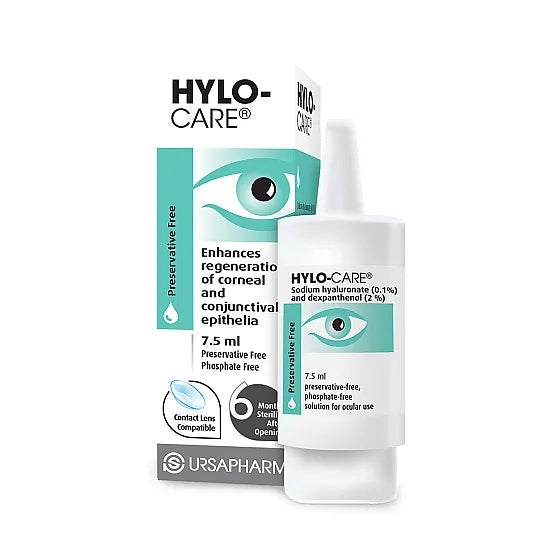
Hylo-Care Treatment For Corneal Damage Eye Drops - 10ml
Hylo-Care Treatment For Corneal Damage Eye Drops - 10ml
- ✔️ Lubricates and repairs the corneal surface with dual-action formula
- ✔️ Preservative-free — safe for sensitive and post-operative eyes
- ✔️ Sodium hyaluronate stabilises the tear film and reduces dryness
- ✔️ Dexpanthenol actively supports corneal epithelial cell regeneration
- ✔️ COMOD® system delivers precise, sterile drops for 6 months
Price Checker
 Lowest price guarantee
 Includes FREE private prescription


Couldn't load pickup availability
What Are Hylo-Care Eye Drops and How Do They Help Corneal Damage?
If your eyes feel persistently dry, gritty, or uncomfortable — especially after surgery or illness — you are not alone. Dry eye disease affects millions of people in the UK, and when the corneal surface becomes damaged or compromised, standard lubricating drops may not be enough. Hylo care eye drops are specifically formulated to go a step further, combining lubrication with active corneal support. Available from our eye care collection at Cured Pharmacy, this 10ml bottle offers a preservative-free solution designed for sensitive and damaged eyes.
Hylo-Care contains two active ingredients: sodium hyaluronate (0.1%) and dexpanthenol (2%). Sodium hyaluronate is a naturally occurring substance found in the eye's own tissues, and it has a well-established role in retaining moisture on the ocular surface. Dexpanthenol — a provitamin B5 derivative — supports the regeneration of corneal epithelial cells, making this product particularly suited to eyes recovering from damage, irritation, or surgical procedures. The drops are preservative-free, which matters enormously if you use eye drops frequently or have sensitive eyes.
How Do Hylo-Care Eye Drops Work to Repair and Lubricate the Eye?
The mechanism behind Hylo-Care is straightforward but clinically meaningful. Here is how it works:
- Sodium hyaluronate forms a stable, long-lasting film over the corneal surface, reducing friction between the eyelid and the eye with every blink.
- Dexpanthenol penetrates the corneal epithelium and promotes cell regeneration, helping to repair minor surface damage more effectively than lubrication alone.
- The preservative-free formula is delivered via a patented COMOD® multi-dose system, which keeps the solution sterile without the need for chemical preservatives that can themselves irritate the eye.
- Each drop spreads evenly across the tear film, stabilising it and reducing the rate of evaporation — a key factor in dry eye disease.
The COMOD® bottle system is worth mentioning separately. It delivers a precise, consistent drop every time and remains sterile throughout its 6-month use period after opening. That means no wasted drops and no contamination risk — a genuine practical advantage for daily users.
Who Should Use Hylo-Care Eye Drops?
Hylo-Care is suitable for adults and children who experience dry, irritated, or damaged eyes. It is particularly well-suited to people whose eyes need more than basic lubrication. You might benefit from this product if you:
- Have been diagnosed with dry eye syndrome (keratoconjunctivitis sicca)
- Are recovering from eye surgery, including cataract or LASIK procedures
- Experience corneal damage caused by environmental factors, contact lens wear, or illness
- Have sensitive eyes that react badly to preserved eye drops
- Spend long hours in front of screens and suffer from digital eye strain
It is not suitable for people with known hypersensitivity to any of the ingredients. Always read the label carefully before use.
How Does Hylo-Care Compare to Other Eye Drops?
| Feature | Hylo-Care (This Product) | Standard Hylo-Fresh |
|---|---|---|
| Active ingredients | Sodium hyaluronate 0.1% + Dexpanthenol 2% | Sodium hyaluronate 0.03% |
| Corneal repair support | Yes — dexpanthenol promotes epithelial regeneration | No — lubrication only |
| Preservative-free | Yes | Yes |
| Suitable for post-operative use | Yes | Limited — lower concentration |
How Should You Store Hylo-Care Eye Drops and Are They Clinically Suitable for You?
Store Hylo-Care below 25°C and keep it out of direct sunlight. Do not refrigerate. Once opened, the bottle should be discarded after 6 months — the COMOD® system maintains sterility throughout this period without preservatives. Keep out of reach of children. Hylo care eye drops are not intended for injection and must only be used in the eye.
If you wear soft contact lenses, remove them before instilling the drops and wait at least 15 minutes before reinserting. If you are pregnant, breastfeeding, or using any other eye medications, speak to your pharmacist or GP before starting treatment. This product is a medicine. Speak to your doctor or pharmacist before using if you have an underlying medical condition or are taking other medicines.
Hylo-Care Treatment For Corneal Damage Eye Drops 10ml specifications
| Treatment category | Dry eye / Corneal surface repair |
| Active ingredients | Sodium hyaluronate 0.1%, Dexpanthenol 2% |
| Mechanism of action | Lubricates the ocular surface and supports corneal epithelial regeneration |
| Suitable for | Adults and children with dry, irritated, or damaged eyes |
| Pack size | 10ml |
| UK classification | General Sale (GSL) |
| Drug class | Ocular lubricant / Corneal protectant |
| Preparation | Sterile, preservative-free eye drops solution |
| Route of administration | Ophthalmic (topical instillation into the eye) |
| Delivery system | COMOD® multi-dose preservative-free bottle |
Specifications of Hylo-Care Treatment For Corneal Damage Eye Drops 10ml
What Is Hylo-Care and What Is It Used For?
Hylo-Care Treatment For Corneal Damage Eye Drops is a sterile, preservative-free ophthalmic solution used to relieve the symptoms of dry eye disease and to support the healing of the corneal surface. It contains two active ingredients — sodium hyaluronate and dexpanthenol — which work together to lubricate the eye and promote the regeneration of corneal epithelial cells. It is used in adults and children who experience dryness, irritation, or surface damage to the eye, including those recovering from eye surgery or suffering from chronic dry eye conditions. You can explore the full range of products for eye health in our eye care collection.
What Do You Need to Know Before Using Hylo-Care Eye Drops?
Before using Hylo-Care, it is important to be aware of the following contraindications and warnings:
- Do not use if you are allergic to sodium hyaluronate, dexpanthenol, or any other ingredient in the formulation
- Remove soft contact lenses before instilling the drops; wait at least 15 minutes before reinserting
- Do not use the drops if the bottle seal is broken before first use
- Discard the bottle 6 months after first opening, even if solution remains
- If you experience worsening eye pain, sudden vision changes, or increased redness, stop use and seek medical advice promptly
- Consult your GP or ophthalmologist before use if you have had recent eye surgery or have a diagnosed eye condition
Regarding drug interactions, no significant interactions with other ophthalmic or systemic medicines have been identified for this product. However, if you are using other eye drops or ointments, observe the following:
- Allow at least 5 minutes between instilling different eye drops
- If using an eye ointment, apply Hylo-Care first and the ointment last
- Inform your prescriber or pharmacist of all eye medications you are currently using
How Should You Use Hylo-Care Eye Drops?
Using Hylo-Care correctly ensures you get the most benefit from each dose. Follow these steps carefully:
- Wash your hands thoroughly with soap and water before handling the bottle
- Remove soft contact lenses if you wear them
- Tilt your head back slightly and gently pull down your lower eyelid to create a small pocket
- Hold the COMOD® bottle upside down and press the base once to release a single drop into the eye
- Blink gently to spread the drop evenly across the eye surface
- Repeat in the other eye if required
- Replace the cap after use and store the bottle upright below 25°C
The COMOD® system is designed to deliver one precise drop per press. Do not press the bottle more than once per eye per dose. Avoid touching the tip of the bottle to your eye, eyelid, or any other surface to prevent contamination.
| Indication | Age Group | Dose | Frequency |
|---|---|---|---|
| Dry eye / corneal irritation | Adults and children | 1 drop per affected eye | 3 times daily, or as directed |
| Post-operative eye care | Adults | 1 drop per affected eye | As directed by your ophthalmologist |
What Are the Possible Side Effects of Hylo-Care Eye Drops?
Like all medicines, Hylo-Care can cause side effects, although not everyone experiences them. Most side effects are mild and temporary.
Common side effects (may affect up to 1 in 10 people):
- Temporary blurred vision immediately after instillation — this usually clears within a few minutes
- Mild burning or stinging sensation upon application
- Transient eye discomfort or a feeling of something in the eye
Less common side effects (may affect up to 1 in 100 people):
- Eye redness or conjunctival irritation
- Eyelid swelling or itching
- Hypersensitivity reactions — stop use immediately and seek medical advice if this occurs
If you notice any side effect not listed here, or if a listed side effect becomes severe or persistent, contact your pharmacist or GP. You can also report side effects directly to the MHRA via the Yellow Card scheme at yellowcard.mhra.gov.uk.
How Should You Store Hylo-Care Eye Drops?
Correct storage keeps the drops safe and effective throughout their use period. Follow these instructions:
- Store below 25°C — do not refrigerate or freeze
- Keep away from direct sunlight and heat sources
- Keep the bottle tightly closed when not in use
- Discard the bottle 6 months after first opening, regardless of remaining contents
- Keep out of the sight and reach of children
- Do not use after the expiry date printed on the bottle and carton
If you are managing multiple health products at home, it is worth keeping a note of the date you first opened the bottle. For other health essentials, you may also find useful products in our first aid collection.
References
Written and reviewed by our qualified team
Your safety and success are our highest priorities. Our medical team rigorously evaluates every product and piece of advice we provide, ensuring you receive only the most effective, science-backed solutions available.
Frequently Asked Questions
Where can I buy Hylo-Care eye drops online in the UK?
You can buy Hylo-Care Treatment For Corneal Damage Eye Drops 10ml directly from Cured Pharmacy, a GPhC-registered UK online pharmacy. No prescription is required as it is an over-the-counter product available for general sale. Simply add it to your basket and choose your preferred delivery option at checkout.
How do Hylo-Care eye drops work in the eye?
Hylo-Care works through a dual mechanism: sodium hyaluronate forms a stable, moisture-retaining film over the corneal surface, while dexpanthenol actively supports the regeneration of corneal epithelial cells. This combination means the drops do more than simply lubricate — they help the eye surface recover from damage. The preservative-free COMOD® delivery system ensures each drop is sterile and precisely dosed.
How do I use Hylo-Care eye drops step by step?
Wash your hands first, then tilt your head back and gently pull down your lower eyelid. Hold the COMOD® bottle upside down and press the base once to release a single drop into the eye, then blink gently to spread it. Avoid touching the bottle tip to your eye or any surface, and replace the cap securely after each use.
How many times a day should I use Hylo-Care eye drops?
The standard recommended frequency is one drop instilled into each affected eye three times daily. Your GP or ophthalmologist may advise a different frequency depending on the severity of your condition. Do not use more frequently than directed without professional guidance.
What are the side effects of Hylo-Care eye drops?
Side effects are uncommon but can include temporary blurred vision immediately after instillation, a mild burning or stinging sensation, and transient eye discomfort. Less commonly, some people experience eye redness, eyelid itching, or a hypersensitivity reaction. If any side effect is severe or persistent, stop use and speak to your pharmacist or GP.
Can I use Hylo-Care eye drops with contact lenses?
You should remove soft contact lenses before instilling Hylo-Care eye drops and wait at least 15 minutes before reinserting them. Hard or rigid gas-permeable lenses should also be removed prior to use. If you are unsure about contact lens compatibility, ask your optometrist or pharmacist for advice.
What happens if I miss a dose of Hylo-Care eye drops?
If you forget to use your drops at the scheduled time, simply apply them as soon as you remember. Do not double up by using two doses close together to make up for a missed one. Consistent use throughout the day gives the best results for managing dry or damaged eyes.
How long can I use Hylo-Care eye drops for?
Hylo-Care can be used for as long as your symptoms require, but the bottle must be discarded 6 months after first opening regardless of how much solution remains. If your symptoms have not improved after several weeks of regular use, consult your GP or an ophthalmologist. Long-term use is generally considered safe given the preservative-free formulation.
Who is eligible to use Hylo-Care eye drops?
Hylo-Care is suitable for adults and children who experience dry, irritated, or damaged eyes, including those recovering from eye surgery such as cataract or LASIK procedures. It is not suitable for anyone with a known allergy to sodium hyaluronate, dexpanthenol, or any other ingredient. If you are pregnant or breastfeeding, speak to your GP or pharmacist before use.
What are the alternatives to Hylo-Care eye drops?
Alternatives include other sodium hyaluronate-based drops such as Hylo-Forte (0.2% concentration for more severe dry eye) or Hylo-Fresh (0.03% for mild symptoms), as well as carbomer-based gels like Viscotears. The right choice depends on the severity of your symptoms and whether corneal repair support is needed. Browse our eye care collection to compare available options.
Is Hylo-Care suitable for use after cataract surgery?
Hylo-Care is commonly used to support recovery after cataract surgery, as the corneal surface can become dry and irritated following the procedure. However, you should always follow your ophthalmologist's specific post-operative instructions, as they may prescribe additional medicated drops alongside a lubricant. Do not use any eye drop after surgery without confirming it is appropriate with your surgical team.
Does Hylo-Care contain preservatives?
No — Hylo-Care is completely preservative-free. It uses the patented COMOD® multi-dose bottle system, which maintains sterility throughout the 6-month use period without the need for chemical preservatives. This makes it particularly suitable for people with sensitive eyes or those who need to use eye drops frequently throughout the day.
Can I use Hylo-Care eye drops if I am pregnant or breastfeeding?
There is limited clinical data on the use of Hylo-Care during pregnancy and breastfeeding, so you should consult your GP or midwife before starting treatment. The ingredients are not known to be harmful, but professional guidance is always recommended during these periods. Your pharmacist can also advise you on the most appropriate eye care options.
What is the latest research on sodium hyaluronate eye drops for dry eye?
Sodium hyaluronate has been extensively studied as an ocular lubricant and is well-established in clinical practice for the management of dry eye disease. Research supports its ability to stabilise the tear film and reduce ocular surface damage scores compared to some other lubricants. Dexpanthenol's role in corneal epithelial repair is also supported by published ophthalmic literature, making the combination in hylo care eye drops clinically rational.
How should I manage side effects of Hylo-Care eye drops?
Most side effects, such as temporary blurring or mild stinging, resolve within a few minutes of instillation and do not require treatment. If you experience persistent redness, swelling, or signs of an allergic reaction such as itching or hives around the eye, stop using the drops immediately and contact your GP or pharmacist. You can also report adverse reactions to the MHRA via the Yellow Card scheme. For general health support, you may find our allergy and hay fever collection helpful if you suspect an allergic component to your eye symptoms.
Written and reviewed by our qualified team

Reviewed by:
Tarun Kumar
Superintendent/ Clinical Lead
📖 Find out more about our team of medical content authors and how we ensure the accuracy of our content with our content guidelines.
Content last updated: 14 Sep 2026
Other popular options


We’re a safe and
regulated UK service

Lowest Price Guarantee

We're convinced you won't find your treatment cheaper, but if you do we'll refund the difference.
Find out more
100% discreet packaging

Discreet, unbranded packaging for every order.
Find out more

Need help?
Talk to our friendly experts now


How our service works

Service setup

Discreet packaging

Express delivery