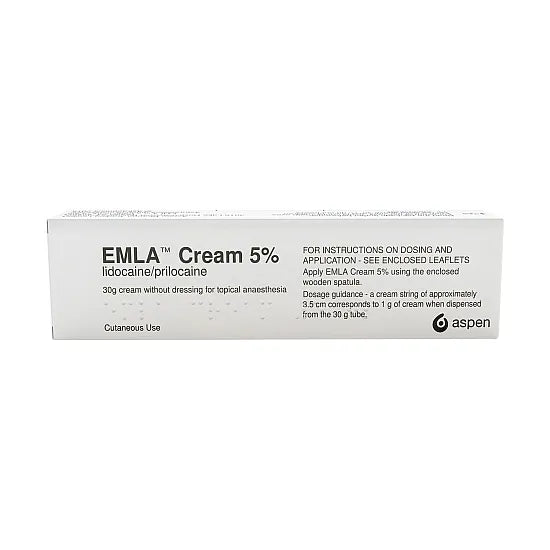
EMLA Cream
- ✔️ Numbs skin within 60 minutes before injections or blood tests
- ✔️ Contains lidocaine and prilocaine for dual anaesthetic action
- ✔️ Suitable for adults and children from 37 weeks gestational age
- ✔️ Reduces needle pain and procedure-related anxiety effectively
- ✔️ Clinically established topical anaesthetic for minor skin procedures
Price Checker
 Discreet, tracked delivery
 Includes FREE private prescription


Couldn't load pickup availability
What Is EMLA Cream and How Does It Numb Skin?
EMLA cream is a topical anaesthetic containing two active ingredients — lidocaine 2.5% and prilocaine 2.5% — that work together to temporarily numb the surface of the skin. It is widely used before procedures such as blood tests, cannula insertion, vaccinations, and minor skin surgery, making these experiences significantly more comfortable. If you or your child dread needles, this cream can genuinely take the edge off. You can find it alongside other first aid essentials at Cured Pharmacy.
EMLA is a well-established product that has been used in clinical settings for decades. It is available over the counter in the UK for adults and children, though specific age-related guidance applies — more on that below.
How Does EMLA Cream Work on the Skin?
The two local anaesthetics in EMLA cream penetrate the outer layers of intact skin and act on the nerve endings beneath. Here is what happens step by step:
- Lidocaine and prilocaine are released from the cream's oil-in-water emulsion base.
- Both agents diffuse through the epidermis and into the dermis.
- They block voltage-gated sodium channels in sensory nerve fibres.
- This prevents the nerve from generating or transmitting pain signals to the brain.
- The result is a localised, temporary loss of sensation in the treated area.
The numbing effect typically begins within 45–60 minutes of application under an occlusive dressing and can last for one to two hours after the cream is removed. The depth of anaesthesia increases with longer application times, up to a maximum of two hours for most indications.
Who Is EMLA Cream Suitable For?
EMLA cream is suitable for a broad range of people, from young children to older adults. It is particularly helpful for anyone who experiences anxiety around needles or minor procedures. That said, it is not appropriate for everyone — always read the patient information leaflet carefully.
- Adults requiring skin numbing before injections, blood draws, or cannulation.
- Children aged 37 weeks gestational age or older (with age-appropriate dosing).
- Patients undergoing minor dermatological procedures such as laser treatment or superficial skin surgery.
- Individuals with needle phobia who need a reliable, clinically tested numbing option.
It is not suitable for use on broken or inflamed skin, the eyes, or mucous membranes. People with known hypersensitivity to amide-type local anaesthetics should also avoid it.
How Does EMLA Cream Compare to Ametop Gel?
| Feature | EMLA Cream | Ametop Gel (Tetracaine 4%) |
|---|---|---|
| Active ingredient(s) | Lidocaine 2.5% + Prilocaine 2.5% | Tetracaine 4% |
| Onset of action | 45–60 minutes | 30–45 minutes |
| Duration of effect | Up to 2 hours post-removal | Up to 4–6 hours post-removal |
| Suitable for neonates | Yes (≥37 weeks gestational age) | Not recommended under 1 month |
| OTC availability in UK | Yes | Yes |
How Should EMLA Cream Be Stored and Who Should Avoid It?
Store EMLA cream below 25°C and do not freeze it. Keep the tube tightly closed and out of the reach of children. Once opened, use within the period indicated on the packaging. Storing it correctly ensures the active ingredients remain stable and effective when you need them.
Certain groups should exercise caution or avoid use altogether. People taking antiarrhythmic drugs, other local anaesthetics, or medicines known to cause methaemoglobinaemia (such as some antimalarials or sulphonamides) should speak to a pharmacist or GP before using this cream. If you are browsing pain relief options and are unsure whether EMLA cream is right for you, our pharmacist team is here to help.
This product is a medicine. Speak to your doctor or pharmacist before using if you have an underlying medical condition or are taking other medicines.
EMLA Cream specifications
| Treatment category | Topical anaesthesia / Pain prevention |
| Active ingredient | Lidocaine 2.5%, Prilocaine 2.5% |
| Mechanism of action | Sodium channel blockade in sensory nerve fibres |
| Strengths | Lidocaine 25 mg/g + Prilocaine 25 mg/g |
| Preparation | Cream (oil-in-water emulsion) |
| Route of administration | Topical (intact skin only) |
| UK classification | Pharmacy (P) medicine |
| Drug class | Amide-type local anaesthetic |
| Suitable for | Adults and children ≥37 weeks gestational age |
| Pack sizes | 5 g tube |
| Effective | Within 45–60 minutes under occlusive dressing |
Specifications of EMLA Cream
What Is EMLA Cream and What Is It Used For?
EMLA cream is a topical local anaesthetic used to numb intact skin before painful procedures. It contains two active substances — lidocaine 2.5% and prilocaine 2.5% — which work together to reduce or eliminate the sensation of pain at the application site. It is commonly used before venepuncture (blood tests), intravenous cannulation, vaccination, minor skin surgery, and certain dermatological laser treatments.
In children, it is particularly valued for reducing the distress associated with needle procedures. It can also be used in adults undergoing split skin grafting from donor sites, though this requires a longer application time and should be done under clinical supervision.
What Do You Need to Know Before Using EMLA Cream?
Do not use EMLA cream if any of the following apply to you:
- You are allergic to lidocaine, prilocaine, or any other amide-type local anaesthetic.
- You are allergic to any other ingredient in the cream.
- Your baby was born before 37 weeks gestational age (premature infants).
- You have congenital or idiopathic methaemoglobinaemia.
- You need to apply it to broken, infected, or inflamed skin.
- You need to apply it near the eyes or on mucous membranes.
The following medicines may interact with EMLA cream. Tell your pharmacist or doctor if you are taking:
- Antiarrhythmic drugs (e.g. mexiletine, amiodarone) — risk of additive cardiac effects.
- Other local anaesthetics — cumulative toxicity risk.
- Medicines that can cause methaemoglobinaemia, such as sulphonamides, dapsone, or certain antimalarials.
- Cimetidine or beta-blockers — may increase plasma levels of lidocaine.
How Should You Use EMLA Cream Correctly?
Always use EMLA cream exactly as described in the patient information leaflet or as directed by your pharmacist. Do not apply more than the recommended amount, and never leave it on for longer than advised.
- Identify the area of intact skin where the procedure will take place.
- Apply a thick layer of cream — do not rub it in.
- Cover the cream with the occlusive dressing provided (or a suitable alternative such as Tegaderm).
- Leave in place for at least 60 minutes (or up to 2 hours for deeper anaesthesia).
- Remove the dressing and wipe away the cream just before the procedure.
- Dispose of the dressing safely and wash your hands after handling the cream.
| Indication | Age Group | Dose | Application Time |
|---|---|---|---|
| Venepuncture / cannulation | Adults | 1.5–2 g per site | 60 minutes minimum |
| Venepuncture / cannulation | Children (≥37 weeks–3 months) | 0.5–1 g per site (max 1 g) | 60 minutes maximum |
| Venepuncture / cannulation | Children (3–12 months) | Up to 2 g per site | 60 minutes |
| Minor skin surgery | Adults | 1.5–2 g per 10 cm² | 60–120 minutes |
If you are looking for other skin care products to support recovery after minor procedures, Cured Pharmacy stocks a wide range of options.
What Are the Possible Side Effects of EMLA Cream?
Like all medicines, EMLA cream can cause side effects, although not everyone experiences them. Most side effects are mild, localised to the application site, and resolve on their own shortly after the cream is removed.
Common side effects (may affect up to 1 in 10 people):
- Temporary paleness (blanching) of the skin at the application site.
- Redness (erythema) after the cream is removed.
- Mild swelling or oedema at the treated area.
- Burning or itching sensation during application.
Less common side effects (may affect up to 1 in 100 people):
- Methaemoglobinaemia — particularly in infants or with excessive doses; causes bluish skin discolouration and requires urgent medical attention.
- Allergic reactions, including rash, urticaria, or in rare cases anaphylaxis.
- Eye irritation if cream accidentally contacts the eye.
How Should You Store EMLA Cream?
- Store below 25°C.
- Do not freeze — freezing can damage the emulsion and reduce effectiveness.
- Keep the tube tightly closed when not in use.
- Keep out of the sight and reach of children.
- Do not use after the expiry date printed on the tube and carton.
- Do not dispose of medicines via wastewater or household waste — return unused cream to your pharmacist.
For more products to support your family's health at home, explore our baby and toddler range at Cured Pharmacy.
References
Written and reviewed by our qualified team
Your safety and success are our highest priorities. Our medical team rigorously evaluates every product and piece of advice we provide, ensuring you receive only the most effective, science-backed solutions available.
Frequently Asked Questions
Where can I buy EMLA cream online in the UK?
You can buy EMLA cream online from Cured Pharmacy, a GPhC-registered UK online pharmacy, without a prescription. It is classified as a Pharmacy (P) medicine, meaning it is available over the counter but should be purchased from a registered pharmacy. Browse our first aid collection for EMLA cream and related products.
How does EMLA cream work in the body?
EMLA cream contains lidocaine and prilocaine, two amide-type local anaesthetics that penetrate intact skin and block voltage-gated sodium channels in sensory nerve endings. This prevents pain signals from being generated and transmitted to the brain, producing temporary localised numbness. The effect is confined to the area of application and does not affect the rest of the body.
How long does EMLA cream take to work?
EMLA cream typically takes 60 minutes under an occlusive dressing to produce adequate skin numbing for procedures such as blood tests or cannula insertion. For deeper anaesthesia — for example before minor skin surgery — an application time of up to 2 hours may be needed. Do not apply for longer than 2 hours unless directed by a healthcare professional.
How do I apply EMLA cream step by step?
Apply a thick layer of EMLA cream to the intact skin area where the procedure will take place — do not rub it in. Cover the cream with an occlusive dressing and leave it in place for at least 60 minutes. Remove the dressing and wipe away the cream just before the procedure begins, then wash your hands thoroughly.
What is the correct dose of EMLA cream for adults?
For most procedures such as venepuncture or cannulation, adults should apply approximately 1.5–2 g of EMLA cream per site under an occlusive dressing for at least 60 minutes. For minor skin surgery, up to 2 g per 10 cm² of skin may be used, with an application time of 60–120 minutes. Always follow the patient information leaflet or your pharmacist's guidance.
Can EMLA cream be used on children?
Yes, EMLA cream can be used on children born at 37 weeks gestational age or later, but the dose must be carefully adjusted based on the child's age and weight. For infants aged up to 3 months, the maximum dose is 1 g applied to a single site for no longer than 60 minutes. Always consult a pharmacist or GP before using EMLA cream on a young child.
What are the most common side effects of EMLA cream?
The most common side effects are localised to the application site and include temporary skin paleness (blanching), redness after removal, mild swelling, and a brief burning or itching sensation. These effects are generally short-lived and resolve without treatment once the cream is removed. If you experience more severe reactions such as difficulty breathing or widespread rash, seek medical attention immediately.
Is EMLA cream safe to use during pregnancy?
EMLA cream should only be used during pregnancy if clearly necessary and under the guidance of a doctor or midwife, as both lidocaine and prilocaine can cross the placenta. There is limited clinical data on its use in pregnancy, so a risk-benefit assessment by a healthcare professional is important. Do not self-medicate with EMLA cream during pregnancy without medical advice.
Who should not use EMLA cream?
EMLA cream should not be used by people who are allergic to lidocaine, prilocaine, or any other amide-type local anaesthetic. It is also contraindicated in premature infants born before 37 weeks gestational age and in people with congenital or idiopathic methaemoglobinaemia. It must never be applied to broken, infected, or inflamed skin, or near the eyes.
What medicines interact with EMLA cream?
EMLA cream can interact with antiarrhythmic drugs such as mexiletine and amiodarone, other local anaesthetics, and medicines that can cause methaemoglobinaemia such as dapsone, sulphonamides, and certain antimalarials. Cimetidine and beta-blockers may also increase plasma levels of lidocaine. Always tell your pharmacist about all medicines you are taking before using EMLA cream.
What are the alternatives to EMLA cream?
The main alternative to EMLA cream available in the UK is Ametop gel, which contains tetracaine 4% and may act slightly faster (within 30–45 minutes) with a longer duration of effect after removal. However, Ametop is not recommended for infants under one month of age, whereas EMLA cream can be used from 37 weeks gestational age. Your pharmacist can help you decide which option is most appropriate for your situation. You can also explore our pain relief range for other options.
How long does the numbing effect of EMLA cream last?
After the cream and dressing are removed, the numbing effect typically lasts for one to two hours, depending on how long the cream was applied. The longer the application time (up to the maximum of 2 hours), the deeper and more prolonged the anaesthesia. Plan your procedure accordingly so the cream is removed just before it is needed.
Can EMLA cream be used for tattoos or laser hair removal?
EMLA cream is sometimes used off-label to reduce discomfort during cosmetic procedures such as laser hair removal or tattooing, though it is not officially licensed for these uses in the UK. If you are considering using it for a cosmetic procedure, speak to your pharmacist or the practitioner performing the treatment first. Application to large areas of skin increases the risk of systemic absorption and side effects.
What happens if I accidentally get EMLA cream in my eyes?
If EMLA cream contacts the eyes, rinse immediately and thoroughly with clean water or saline and seek medical advice promptly. Eye contact can cause irritation and potential corneal damage. Always wash your hands carefully after applying the cream to avoid accidental transfer to the eyes or mucous membranes.
How should EMLA cream be stored at home?
Store EMLA cream below 25°C in a cool, dry place away from direct sunlight, and never freeze it as this can damage the emulsion. Keep the tube tightly closed and out of the reach and sight of children at all times. Do not use the cream after the expiry date printed on the packaging, and return any unused cream to your local pharmacy for safe disposal.
Written and reviewed by our qualified team

Reviewed by:
Tarun Kumar
Superintendent/ Clinical Lead
📖 Find out more about our team of medical content authors and how we ensure the accuracy of our content with our content guidelines.
Content last updated: 14 Sep 2026
Other popular options


We’re a safe and
regulated UK service

100% discreet packaging

Discreet, unbranded packaging for every order.

Need help?
Talk to our friendly experts now


How our service works

Service setup

Discreet packaging

Express delivery