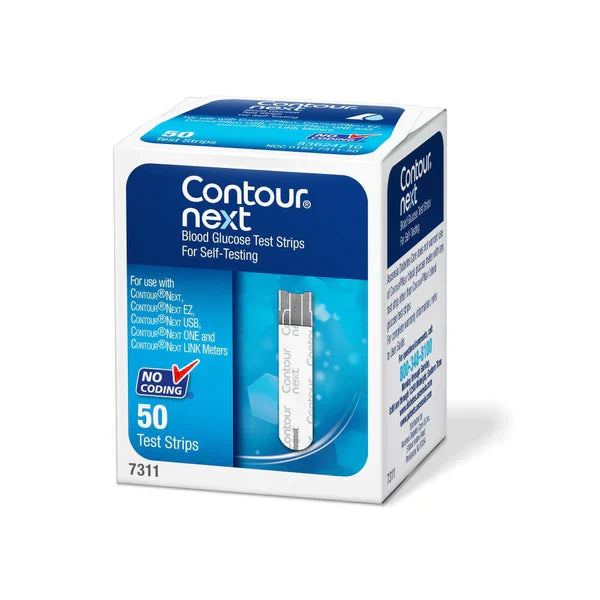
Managing diabetes day to day means keeping a close eye on your blood glucose levels — and having reliable test strips makes all the difference. Contour Next test strips are designed for use with Contour Next blood glucose meters and deliver fast, accurate readings from a tiny blood sample. Whether you have type 1 or type 2 diabetes, consistent self-monitoring helps you and your healthcare team make informed decisions about your diet, activity, and medication. The NHS recommends that people on insulin therapy in particular monitor their blood glucose regularly to reduce the risk of hypoglycaemia and hyperglycaemia. You can explore our full range of monitoring products in our diabetes monitoring collection.
Each pack contains 50 strips, giving you a practical supply for regular testing. At £18.99, it's a straightforward, cost-effective option for anyone who self-monitors at home. These strips are available without a prescription, so you can order them quickly and conveniently online.
How Do Contour Next Test Strips Work?
The strips use an electrochemical biosensor technology based on a glucose oxidase enzyme reaction. Here's what happens when you test:
You apply a small drop of capillary blood (from a fingertip lance) to the edge of the strip.
The strip draws the blood in automatically via capillary action — no smearing required.
Glucose in the blood reacts with the glucose oxidase enzyme on the strip's electrode.
This reaction generates an electrical current proportional to the glucose concentration.
The Contour Next meter reads this current and converts it into a mmol/L blood glucose value, displayed within approximately 5 seconds.
The strips meet ISO 15197:2013 accuracy standards, meaning at least 95% of results must fall within 0.83 mmol/L or 15% of a laboratory reference value. That level of precision matters when you're making decisions about insulin doses or food intake.
Who Should Use Contour Next Test Strips?
These strips are suitable for adults and children who self-monitor blood glucose as part of their diabetes management plan. Your GP or diabetes nurse will usually advise whether regular home testing is appropriate for you. They are particularly useful for:
People with type 1 diabetes who test multiple times daily.
People with type 2 diabetes on insulin or certain oral medications such as sulphonylureas.
Pregnant women with gestational diabetes who need frequent monitoring.
Anyone whose diabetes team has recommended structured self-monitoring of blood glucose.
They are not suitable for use with non-Contour Next meters. Always confirm compatibility with your specific device before purchasing. If you're unsure whether self-monitoring is right for your situation, speak to your GP or diabetes specialist nurse.
How Do Contour Next Test Strips Compare to Alternatives?
Feature
Contour Next Test Strips 50s
Accu-Chek Guide Strips 50s
Sample size required
0.6 µL
0.6 µL
Result time
~5 seconds
~4 seconds
ISO 15197:2013 compliant
Yes
Yes
Compatible meters
Contour Next range only
Accu-Chek Guide range only
How Should You Store Contour Next Test Strips?
Proper storage is essential to maintain accuracy. Keep the strips in their original container, tightly capped, at temperatures below 30°C. Avoid storing them in the bathroom or near a window — humidity and heat can degrade the enzyme coating and lead to inaccurate readings. Do not refrigerate them. Once the container is opened, use the strips within 6 months or before the printed expiry date, whichever comes first.
If you're building a broader diabetes care routine, it's worth considering other health essentials alongside your monitoring supplies. Our vitamins and supplements collection includes products that may support general wellbeing as part of a healthy lifestyle. Contour Next test strips are for in vitro diagnostic use only — they measure glucose in blood samples outside the body and are not implanted or ingested.
This product is a medicine. Speak to your doctor or pharmacist before using if you have an underlying medical condition or are taking other medicines.
Measuring capillary blood glucose concentration in mmol/L
Suitable for
Adults and children with diabetes using a compatible Contour Next meter
Active ingredient
Glucose oxidase enzyme electrode
Pack size
50 strips per pack
UK classification
In vitro diagnostic medical device (IVD)
Preparation
Disposable electrochemical test strip
Route of administration
Capillary blood sample (fingertip)
Specifications of Contour Next Test Strips 50s
What Are Contour Next Test Strips and What Are They Used For?
Contour Next Test Strips 50s are single-use, in vitro diagnostic (IVD) test strips used alongside a compatible Contour Next blood glucose meter to measure the concentration of glucose in a capillary blood sample. They are used by people with diabetes — including type 1, type 2, and gestational diabetes — to monitor their blood glucose levels at home. Regular self-monitoring helps you understand how food, exercise, illness, and medication affect your glucose levels, and supports better management of your condition. The NHS advises that people with type 1 diabetes should test their blood glucose levels regularly, and that those on insulin should test before meals and before bed as a minimum.
These strips are not a treatment in themselves — they are a monitoring tool. They do not replace clinical blood tests carried out by your GP or diabetes team. If your readings are consistently outside your target range, contact your healthcare provider promptly.
What Do You Need to Know Before Using Contour Next Test Strips?
Before you begin using these strips, there are some important points to be aware of. Do not use the strips if:
The expiry date printed on the container has passed.
The container has been left open or exposed to moisture or extreme heat.
The strips appear damaged, discoloured, or bent.
You are using a meter that is not a compatible Contour Next model.
You have not performed a quality control (QC) check as described in your meter's user guide.
Certain factors can affect the accuracy of your blood glucose readings. Be aware of the following:
Very high levels of ascorbic acid (vitamin C) in the blood may interfere with results.
Severely low haematocrit (anaemia) or very high haematocrit (polycythaemia) can affect readings.
Testing at altitudes above 3,048 metres may affect accuracy.
Contamination of the fingertip with sugary substances (e.g. fruit juice) can cause falsely elevated readings — always wash and dry hands thoroughly before testing.
Certain medications, including high-dose paracetamol, may affect results — check with your pharmacist if you are unsure.
How Should You Use Contour Next Test Strips?
Using the strips correctly ensures you get an accurate reading every time. Follow these steps carefully:
Wash your hands thoroughly with soap and warm water, then dry them completely.
Insert a fresh Contour Next test strip into your compatible Contour Next meter — the meter will switch on automatically.
Use a clean lancet to prick the side of your fingertip. Avoid the very tip, as this is more sensitive.
Gently squeeze your finger to produce a small, rounded drop of blood.
Touch the edge of the strip (not the top) to the blood drop — the strip will draw the sample in automatically.
Wait approximately 5 seconds for your result to appear on the meter screen in mmol/L.
Record your result in your diabetes diary or app, noting the time and any relevant context (e.g. before or after a meal).
Dispose of the used strip and lancet safely in a sharps bin.
Indication
Age Group
Recommended Testing Frequency
Typical Target Range (mmol/L)
Type 1 diabetes (on insulin)
Adults & children
At least 4 times daily (before meals & bed)
4–7 before meals; under 8.5 after meals
Type 2 diabetes (on insulin)
Adults
As directed by GP or diabetes nurse
4–7 before meals
Gestational diabetes
Adults
Fasting and 1 hour after meals
Under 5.3 fasting; under 7.8 after meals
Type 2 (diet-controlled only)
Adults
As agreed with healthcare team
As per individual care plan
Target ranges are individual — always follow the guidance given by your GP or diabetes specialist. If you're managing other aspects of your health alongside diabetes, our electrical health and diagnostic collection includes a range of monitoring devices that may complement your care routine.
What Are the Possible Side Effects of Contour Next Test Strips?
As an in vitro diagnostic device, the strips themselves do not cause systemic side effects. However, the process of blood glucose testing does involve lancing the skin, which can occasionally cause minor issues.
Common effects associated with fingertip lancing:
Mild soreness or tenderness at the lancing site.
Small bruise or mark at the fingertip.
Slight bleeding beyond the test drop if the lancet depth is set too deep.
Less common effects:
Skin calluses on frequently used fingertips with repeated testing over time.
Localised skin irritation or redness if you have a sensitivity to the strip materials.
Infection at the lancing site if proper hygiene is not maintained — always use a fresh lancet for each test.
If you notice persistent skin changes, unusual pain, or signs of infection (redness, swelling, warmth, or discharge) at the testing site, speak to your GP or practice nurse. Rotate your testing sites regularly to reduce the risk of callus formation.
How Should You Store Contour Next Test Strips?
Store in the original container with the cap tightly closed at all times.
Keep at temperatures between 4°C and 30°C — do not refrigerate or freeze.
Protect from direct sunlight, moisture, and humidity.
Do not store in a bathroom cabinet or near a kitchen sink.
Once opened, use within 6 months or before the expiry date printed on the container, whichever is sooner.
Keep out of reach and sight of children.
Do not use strips from a damaged or compromised container.
If you're looking for further support with your diabetes management, our diabetes monitoring collection includes meters, lancets, and other accessories to help you test safely and accurately at home.
Your safety and success are our highest priorities. Our medical team rigorously evaluates every product and piece of advice we provide, ensuring you receive only the most effective, science-backed solutions available.
Frequently Asked Questions
Where can I buy Contour Next test strips online in the UK?
You can buy Contour Next test strips online in the UK directly from Cured Pharmacy at £18.99 for a pack of 50. They are available without a prescription as an over-the-counter in vitro diagnostic device. You may also be eligible to receive them on NHS prescription if your GP has authorised home blood glucose monitoring as part of your diabetes care plan.
How do Contour Next test strips work in the body?
Contour Next test strips don't work inside the body — they are an in vitro diagnostic device, meaning they measure glucose in a blood sample outside the body. When a drop of capillary blood is applied to the strip, glucose reacts with the glucose oxidase enzyme on the electrode, generating an electrical current. The Contour Next meter reads this current and converts it into a blood glucose value displayed in mmol/L within approximately 5 seconds.
How do I use Contour Next test strips step by step?
Start by washing and drying your hands thoroughly, then insert a fresh strip into your Contour Next meter. Lance the side of your fingertip with a clean lancet, produce a small blood drop, and touch the edge of the strip to the drop — it draws the sample in automatically. Your result will appear on the meter screen in around 5 seconds; record it in your diabetes diary and dispose of the strip and lancet safely in a sharps bin.
What meters are compatible with Contour Next test strips?
Contour Next test strips are compatible with the Contour Next range of meters, including the Contour Next One, Contour Next EZ, and Contour Next Link 2.4. They are not compatible with older Contour or Contour TS meters, nor with meters from other brands such as Accu-Chek or FreeStyle. Always check your meter's user guide or contact the manufacturer to confirm compatibility before purchasing strips.
Are Contour Next test strips accurate enough for insulin dosing?
Contour Next test strips meet ISO 15197:2013 accuracy standards, which require that at least 95% of results fall within 0.83 mmol/L or 15% of a laboratory reference value — making them suitable for use in insulin dosing decisions when used correctly. However, accuracy depends on proper technique, correct storage, and using strips within their expiry date. Always follow your diabetes team's guidance on when and how to act on your readings.
Can I get Contour Next test strips on the NHS?
People with type 1 diabetes or those with type 2 diabetes on insulin therapy may be eligible to receive blood glucose test strips on NHS prescription, subject to their GP's or diabetes team's clinical judgement. NICE guidance recommends that self-monitoring of blood glucose should be agreed as part of an individual care plan. If you are not eligible for NHS strips, you can purchase Contour Next test strips over the counter from Cured Pharmacy.
What is the best time to test my blood glucose with these strips?
The best times to test depend on your diabetes type and treatment plan — your GP or diabetes nurse will advise you specifically. Generally, people on insulin test before meals and at bedtime as a minimum, while those with gestational diabetes typically test fasting and one hour after meals. The NHS provides target blood glucose ranges for different situations, so always refer to your individual care plan for guidance.
What should I do if I get an unexpected blood glucose reading?
If you get a reading that seems unusually high or low and you feel well, repeat the test with a fresh strip after washing and drying your hands again — contamination from food residue is a common cause of false readings. If the result is confirmed and you have symptoms of hypoglycaemia (shakiness, sweating, confusion) or hyperglycaemia (excessive thirst, frequent urination), follow your diabetes action plan or contact your GP. Never adjust your insulin dose based on a single unexpected reading without guidance from your healthcare team.
Who is eligible to use Contour Next test strips?
These strips are suitable for adults and children with diabetes who have been advised to self-monitor their blood glucose by a healthcare professional. They are particularly relevant for people with type 1 diabetes, those with type 2 diabetes on insulin or sulphonylureas, and women with gestational diabetes. They are not intended for use by people without diabetes for general health screening purposes. You can browse our full diabetes monitoring collection for compatible meters and accessories.
What are the side effects of using blood glucose test strips?
The strips themselves do not cause systemic side effects as they are used externally. The lancing process may cause mild fingertip soreness, small bruises, or occasional skin calluses with repeated testing over time. Maintaining good hygiene, using a fresh lancet each time, and rotating your testing sites will help minimise discomfort and reduce the risk of skin irritation or infection.
How should I store Contour Next test strips correctly?
Store the strips in their original container with the cap tightly closed, at temperatures between 4°C and 30°C. Avoid bathrooms, windowsills, or anywhere with high humidity or direct sunlight, as moisture and heat degrade the enzyme coating and can cause inaccurate readings. Once opened, use the strips within 6 months or before the printed expiry date, whichever comes first — and never use strips from a damaged container.
What are the alternatives to Contour Next test strips?
Alternatives include test strips designed for other blood glucose meters, such as Accu-Chek Guide strips, FreeStyle Lite strips, and OneTouch Verio strips — but these are only compatible with their respective meters and cannot be used interchangeably. Some people with diabetes may also be eligible for a flash glucose monitoring system such as the FreeStyle Libre, which measures interstitial glucose continuously without routine fingerprick testing. Speak to your diabetes team about which monitoring method is most appropriate for you.
How long can I keep using Contour Next test strips?
You can continue using Contour Next test strips for as long as your healthcare team recommends self-monitoring of blood glucose as part of your diabetes management. There is no clinical limit on long-term use of the strips themselves. However, always check the expiry date on each container and use strips within 6 months of opening — expired or improperly stored strips may give inaccurate results.
Can anything interfere with my Contour Next test strip results?
Yes — several factors can affect the accuracy of your readings. High levels of ascorbic acid (vitamin C) in the blood, severely abnormal haematocrit levels, and contamination of the fingertip with sugary substances can all cause inaccurate results. Testing at very high altitudes (above 3,048 metres) and certain medications, including high-dose paracetamol, may also affect readings. Always wash and dry your hands before testing, and consult your pharmacist if you are unsure whether any medication you take could interfere with your results.
What are the latest guidelines on blood glucose self-monitoring for people with diabetes?
NICE guideline NG17 (updated) recommends that adults with type 1 diabetes should be offered a flash glucose monitoring system as a first-line option, but that blood glucose self-monitoring with test strips remains appropriate for many people, particularly where flash monitoring is not suitable or accessible. For type 2 diabetes, NICE advises that self-monitoring should be agreed as part of an individual care plan and is most beneficial for those on insulin or at risk of hypoglycaemia. Always discuss your monitoring needs with your GP or diabetes specialist nurse to ensure your approach reflects current guidance. Our electrical health and diagnostic collection includes a range of devices to support your monitoring routine.
How Should You Use Contour Next Test Strips?
Using your Contour Next test strips correctly is essential for getting accurate, reliable blood glucose readings every time. Before you begin, always wash your hands with soap and warm water and dry them thoroughly — even trace amounts of food or lotion on your fingertips can affect your result. Follow these steps each time you test:
Rotate your testing sites regularly to prevent callus formation and maintain skin integrity over time.
What Is the Correct Dose of Contour Next Test Strips?
There is no "dose" for a diagnostic test strip in the pharmaceutical sense — instead, the relevant question is how frequently you should test. Your GP or diabetes specialist nurse will advise you on the appropriate testing frequency based on your individual care plan. The table below provides general guidance based on diabetes type and treatment, but always follow your healthcare team's specific recommendations.
When Is the Best Time to Use Contour Next Test Strips?
The best time to test your blood glucose depends on your diabetes type and treatment. For most people on insulin, testing before meals and at bedtime provides the most clinically useful information. If you have gestational diabetes, your midwife or diabetes team will usually ask you to test fasting (first thing in the morning before eating) and one hour after each meal. Testing at consistent times each day also helps you and your healthcare team identify patterns in your glucose levels over time, making it easier to adjust your management plan if needed.
If you feel unwell, experience symptoms of hypoglycaemia (shakiness, sweating, confusion) or hyperglycaemia (excessive thirst, frequent urination), test immediately regardless of your usual schedule and follow your diabetes action plan.
How Long Can You Use Contour Next Test Strips For?
You can continue using Contour Next test strips for as long as your healthcare team recommends self-monitoring of blood glucose as part of your diabetes management — there is no clinical time limit on their use. However, each individual container of strips must be used within 6 months of opening or before the printed expiry date, whichever comes first. Using expired or improperly stored strips may produce inaccurate readings, which could affect your diabetes management decisions. Always check the expiry date before testing and replace your supply regularly.
Do not exceed the recommended dose. If in doubt, speak to your pharmacist.
How Should You Use Contour Next Test Strips?
Using your Contour Next test strips correctly is essential for getting accurate, reliable blood glucose readings every time. Before you begin, always wash your hands with soap and warm water and dry them thoroughly — even trace amounts of food or lotion on your fingertips can affect your result. Follow these steps each time you test:
Rotate your testing sites regularly to prevent callus formation and maintain skin integrity over time.
What Is the Correct Dose of Contour Next Test Strips?
There is no "dose" for a diagnostic test strip in the pharmaceutical sense — instead, the relevant question is how frequently you should test. Your GP or diabetes specialist nurse will advise you on the appropriate testing frequency based on your individual care plan. The table below provides general guidance based on diabetes type and treatment, but always follow your healthcare team's specific recommendations.
When Is the Best Time to Use Contour Next Test Strips?
The best time to test your blood glucose depends on your diabetes type and treatment. For most people on insulin, testing before meals and at bedtime provides the most clinically useful information. If you have gestational diabetes, your midwife or diabetes team will usually ask you to test fasting (first thing in the morning before eating) and one hour after each meal. Testing at consistent times each day also helps you and your healthcare team identify patterns in your glucose levels over time, making it easier to adjust your management plan if needed.
If you feel unwell, experience symptoms of hypoglycaemia (shakiness, sweating, confusion) or hyperglycaemia (excessive thirst, frequent urination), test immediately regardless of your usual schedule and follow your diabetes action plan.
How Long Can You Use Contour Next Test Strips For?
You can continue using Contour Next test strips for as long as your healthcare team recommends self-monitoring of blood glucose as part of your diabetes management — there is no clinical time limit on their use. However, each individual container of strips must be used within 6 months of opening or before the printed expiry date, whichever comes first. Using expired or improperly stored strips may produce inaccurate readings, which could affect your diabetes management decisions. Always check the expiry date before testing and replace your supply regularly.
Do not exceed the recommended dose. If in doubt, speak to your pharmacist.
What Are the Most Common Side Effects of Using Contour Next Test Strips?
Contour Next test strips are an in vitro diagnostic device and do not enter the body, so they do not cause systemic side effects. However, the process of lancing your fingertip to obtain a blood sample can cause some minor, localised effects. These are generally mild and temporary.
Mild soreness or tenderness at the lancing site immediately after testing.
Small bruise or mark at the fingertip, particularly if the lancet depth is set too deep.
Minor bleeding beyond the test drop if excessive pressure is applied.
Slight discomfort when testing on the same fingertip repeatedly.
What Are the Less Common Side Effects of Using Contour Next Test Strips?
With regular, long-term testing, some people develop less common effects related to repeated skin puncture. These are not dangerous but can be uncomfortable if not managed proactively.
Skin calluses on frequently used fingertips, which can make lancing more difficult over time.
Localised skin irritation or redness if you have a sensitivity to the materials in the strip or lancet.
Numbness or reduced sensation in heavily tested fingertips with very frequent testing over months or years.
Rotating your testing sites — using different fingers and different areas of each fingertip — significantly reduces the risk of callus formation and skin changes. Your diabetes nurse can advise on the best technique for minimising discomfort.
What Are the Serious Side Effects of Using Contour Next Test Strips?
Serious side effects directly attributable to the test strips themselves are extremely rare. The most significant risk associated with the testing process is infection at the lancing site, which can occur if proper hygiene is not maintained. Always use a fresh, sterile lancet for each test — never reuse lancets, as this increases infection risk and causes unnecessary pain. If you notice signs of infection at a testing site — including persistent redness, swelling, warmth, pus, or increasing pain — contact your GP promptly. People with diabetes are at higher risk of skin infections and slower wound healing, so any skin concern should be taken seriously.
What Should You Do If You Experience Side Effects?
For minor soreness or bruising, no specific treatment is usually needed — the discomfort typically resolves within a day or two. Applying gentle pressure to the lancing site after testing and rotating your testing fingers will help. If you develop persistent skin irritation, calluses, or any signs of infection, speak to your GP or practice nurse. Do not ignore skin changes, particularly if you have reduced sensation in your feet or hands as a complication of diabetes. Your diabetes team can also review your lancing technique and device settings to help reduce discomfort.
Can Contour Next Test Strips Interact With Other Medicines?
The strips themselves do not interact with medicines in the pharmacological sense. However, certain substances can interfere with the accuracy of your blood glucose readings. High levels of ascorbic acid (vitamin C) in the blood — for example, from high-dose supplements — may affect results. High-dose paracetamol has also been reported to influence glucose oxidase-based test strip readings in some systems. If you are taking any regular medication or supplements and are concerned about potential interference with your readings, speak to your pharmacist for personalised advice before adjusting your testing routine.
If you are concerned about any side effects, contact your pharmacist or GP immediately.
Patient Information Leaflet
Important - Before taking any medication, it is always important to read the Patient Information Leaflet (PIL)
Choosing a selection results in a full page refresh.
Opens in a new window.
[{"id":649718137155,"handle":"diabetes-monitoring","updated_at":"2026-08-24T12:12:13+01:00","published_at":"2026-04-04T12:58:19+01:00","sort_order":"best-selling","template_suffix":"","published_scope":"global","title":"Diabetes Monitoring","body_html":"\u003cdiv class=\"cp-content\"\u003e\n\u003ch2\u003eWhat Is Diabetes Monitoring?\u003c\/h2\u003e\n\u003cp\u003eDiabetes monitoring refers to the regular process of measuring blood glucose levels to help manage diabetes effectively. For people living with Type 1 or Type 2 diabetes, keeping blood sugar within a target range is critical to long-term health. Devices such as blood glucose monitors, glucose meters with test strips, and continuous glucose monitor systems make it possible to check levels at home, at work, or on the go. Consistent monitoring supports better treatment decisions and can reduce the risk of serious diabetes-related complications.\u003c\/p\u003e\n\u003ch3\u003eType 1 Diabetes Monitoring\u003c\/h3\u003e\n\u003cp\u003ePeople with Type 1 diabetes typically need to monitor their blood glucose levels multiple times per day, as their bodies produce no insulin. A reliable blood glucose monitor or a continuous glucose monitor is often essential for managing insulin doses safely.\u003c\/p\u003e\n\u003ch3\u003eType 2 Diabetes Monitoring\u003c\/h3\u003e\n\u003cp\u003eThose with Type 2 diabetes may monitor less frequently, depending on their treatment plan. However, regular checking with a glucose meter with test strips remains an important tool, especially when adjusting diet, exercise, or medication.\u003c\/p\u003e\n\u003ch2\u003eWhy Is Regular Blood Glucose Monitoring Important?\u003c\/h2\u003e\n\u003cp\u003eKeeping track of blood sugar levels allows people with diabetes to understand how food, physical activity, illness, and medication affect their glucose readings. Without regular monitoring, dangerous episodes of hypoglycaemia (low blood sugar) or hyperglycaemia (high blood sugar) can go undetected. Key reasons to monitor regularly include:\u003c\/p\u003e\n\u003cul\u003e\n\u003cli\u003eDetecting blood sugar highs and lows before they become serious\u003c\/li\u003e\n\u003cli\u003eUnderstanding how meals and exercise affect glucose levels\u003c\/li\u003e\n\u003cli\u003eHelping healthcare professionals adjust medications appropriately\u003c\/li\u003e\n\u003cli\u003eReducing the long-term risk of complications such as nerve damage and kidney disease\u003c\/li\u003e\n\u003cli\u003eProviding peace of mind and greater confidence in day-to-day diabetes management\u003c\/li\u003e\n\u003c\/ul\u003e\n\u003ch2\u003eHow Do Diabetes Monitoring Devices Work?\u003c\/h2\u003e\n\u003cp\u003eMost diabetes monitoring products work by analysing a small sample of blood to measure the concentration of glucose present. Traditional devices use a lancet to obtain a tiny drop of blood from a fingertip, which is then applied to a diabetic testing strip inserted into a glucose meter. The meter provides a reading within seconds. More advanced systems offer continuous or flash monitoring without repeated finger-prick tests.\u003c\/p\u003e\n\u003ch3\u003eTraditional Blood Glucose Monitors\u003c\/h3\u003e\n\u003cp\u003eA standard glucose meter with test strips requires a small blood sample obtained via a finger-prick. These devices are straightforward to use, widely available, and compatible with a range of diabetic testing strips. Results are typically displayed in millimoles per litre (mmol\/L).\u003c\/p\u003e\n\u003ch3\u003eContinuous Glucose Monitors (CGM)\u003c\/h3\u003e\n\u003cp\u003eA continuous glucose monitor uses a small sensor placed under the skin to measure glucose levels in interstitial fluid throughout the day and night. Many CGM devices connect to a smartphone app, providing real-time data, trend arrows, and alerts. These are especially helpful for people who need frequent monitoring or wish to avoid repeated finger pricks.\u003c\/p\u003e\n\u003ch2\u003eAre There Any Side Effects or Risks?\u003c\/h2\u003e\n\u003cp\u003eDiabetes monitoring devices are generally very safe to use. Some people may experience minor soreness, bruising, or calluses at fingertip testing sites from repeated lancet use. Continuous glucose monitor sensors can occasionally cause mild skin irritation at the insertion site. If you experience persistent discomfort or skin reactions, speak to your pharmacist or GP for advice on alternative approaches.\u003c\/p\u003e\n\u003ch2\u003eWho Can Use Diabetes Monitoring Products?\u003c\/h2\u003e\n\u003cp\u003eDiabetes monitoring products are suitable for adults and children who have been diagnosed with Type 1 or Type 2 diabetes, as well as those with gestational diabetes or prediabetes who require regular glucose checks. Some devices are designed specifically for children or older adults. If you are pregnant, recently diagnosed, or managing a complex diabetes regimen, it is important to speak to your GP or diabetes care team before choosing a monitoring system to ensure it meets your individual needs.\u003c\/p\u003e\n\u003ch2\u003eChoosing the Right Diabetes Monitoring Product\u003c\/h2\u003e\n\u003cp\u003eWith many options available, selecting the right device can feel daunting. Consider the following factors when comparing products:\u003c\/p\u003e\n\u003col\u003e\n\u003cli\u003e\n\u003cstrong\u003eAccuracy:\u003c\/strong\u003e Look for devices that meet ISO 15197:2013 accuracy standards.\u003c\/li\u003e\n\u003cli\u003e\n\u003cstrong\u003eEase of use:\u003c\/strong\u003e Large displays and simple coding can make a significant difference, especially for older users.\u003c\/li\u003e\n\u003cli\u003e\n\u003cstrong\u003eStrip availability:\u003c\/strong\u003e Ensure diabetic testing strips are readily available and affordable for your chosen meter.\u003c\/li\u003e\n\u003cli\u003e\n\u003cstrong\u003eConnectivity:\u003c\/strong\u003e Some glucose meters with test strips sync with smartphone apps for easy record-keeping.\u003c\/li\u003e\n\u003cli\u003e\n\u003cstrong\u003eContinuous vs traditional:\u003c\/strong\u003e Decide whether a continuous glucose monitor or a standard monitor best suits your lifestyle and monitoring frequency.\u003c\/li\u003e\n\u003cli\u003e\n\u003cstrong\u003eCost:\u003c\/strong\u003e Factor in the ongoing cost of consumables such as lancets and testing strips alongside the initial device price.\u003c\/li\u003e\n\u003c\/ol\u003e\n\u003ch2\u003eWhy Choose Diabetes Monitoring Products from Cured Pharmacy?\u003c\/h2\u003e\n\u003cp\u003eWhen you buy diabetes monitoring products online in the UK from Cured Pharmacy, you benefit from a carefully selected range of trusted devices and accessories from reputable brands. Our qualified pharmacist team is available to answer your questions and help you find the right product for your needs. We offer fast, discreet UK delivery so you can get the supplies you need without delay. Whether you are looking for blood glucose monitors UK customers rely on, replacement diabetic testing strips, or a new continuous glucose monitor, Cured Pharmacy makes it simple and convenient to manage your diabetes with confidence. Our \u003ca href=\"https:\/\/curedpharmacy.com\/collections\/electrical-health-and-diagnostic\"\u003eelectrical health and diagnostic\u003c\/a\u003e collection features diagnostic devices for convenient health monitoring at home.\u003c\/p\u003e\n\u003c\/div\u003e\n\u003cdiv class=\"cp-sources\"\u003e\n \u003ch3\u003eSources\u003c\/h3\u003e\n \u003col class=\"cp-sources-list\"\u003e\n \u003cli\u003e\u003ca href=\"https:\/\/www.nhs.uk\/conditions\/type-1-diabetes\/\" target=\"_blank\" rel=\"noopener noreferrer\"\u003ehttps:\/\/www.nhs.uk\/conditions\/type-1-diabetes\/\u003c\/a\u003e\u003c\/li\u003e\n \u003cli\u003e\u003ca href=\"https:\/\/www.nhs.uk\/conditions\/type-2-diabetes\/\" target=\"_blank\" rel=\"noopener noreferrer\"\u003ehttps:\/\/www.nhs.uk\/conditions\/type-2-diabetes\/\u003c\/a\u003e\u003c\/li\u003e\n \u003cli\u003e\u003ca href=\"https:\/\/www.diabetes.org.uk\/\" target=\"_blank\" rel=\"noopener noreferrer\"\u003ehttps:\/\/www.diabetes.org.uk\/\u003c\/a\u003e\u003c\/li\u003e\n \u003cli\u003e\u003ca href=\"https:\/\/www.nice.org.uk\/guidance\/ng28\" target=\"_blank\" rel=\"noopener noreferrer\"\u003ehttps:\/\/www.nice.org.uk\/guidance\/ng28\u003c\/a\u003e\u003c\/li\u003e\n \u003cli\u003e\u003ca href=\"https:\/\/www.nhs.uk\/conditions\/gestational-diabetes\/\" target=\"_blank\" rel=\"noopener noreferrer\"\u003ehttps:\/\/www.nhs.uk\/conditions\/gestational-diabetes\/\u003c\/a\u003e\u003c\/li\u003e\n \u003cli\u003e\u003ca href=\"https:\/\/www.mayoclinic.org\/diseases-conditions\/diabetes\/symptoms-causes\/syc-20371444\" target=\"_blank\" rel=\"noopener noreferrer\"\u003ehttps:\/\/www.mayoclinic.org\/diseases-conditions\/diabetes\/symptoms-causes\/syc-20371444\u003c\/a\u003e\u003c\/li\u003e\n \u003c\/ol\u003e\n\u003c\/div\u003e\n\u003cdiv class=\"cp-reviewed\"\u003e\n \u003cdiv class=\"cp-reviewed-inner\"\u003e\n \u003cdiv class=\"cp-reviewed-icon\"\u003e✦\u003c\/div\u003e\n \u003cdiv class=\"cp-reviewed-text\"\u003e\n \u003cp class=\"cp-reviewed-title\"\u003eWritten and reviewed by our qualified team\u003c\/p\u003e\n \u003cp class=\"cp-reviewed-desc\"\u003eYour safety and success are our highest priorities. Our medical team rigorously evaluates every product and piece of advice we provide, ensuring you receive only the most effective, science-backed solutions available.\u003c\/p\u003e\n \u003c\/div\u003e\n \u003c\/div\u003e\n\u003c\/div\u003e\n\u003cstyle\u003e\n.cp-content h2 { color: #3d1a6e; font-size: 22px; font-weight: 700; margin: 40px 0 12px; }\n.cp-content h3 { color: #5b3a8e; font-size: 18px; font-weight: 700; margin: 28px 0 10px; }\n.cp-content p { margin: 0 0 16px; line-height: 1.8; color: #333; font-size: 15px; }\n.cp-content ul, .cp-content ol { margin: 0 0 16px 20px; line-height: 1.8; color: #333; font-size: 15px; }\n.cp-content li { margin-bottom: 8px; }\n.cp-content strong { color: #3d1a6e; }\n.cp-content a { color: #5b3a8e; text-decoration: underline; }\n.cp-sources { background: #f5f5f5; border-radius: 8px; padding: 24px 28px; margin-top: 40px; }\n.cp-sources h3 { color: #3d1a6e; font-size: 18px; font-weight: 700; margin: 0 0 14px; }\n.cp-sources-list { margin: 0; padding-left: 20px; }\n.cp-sources-list li { font-size: 13px; color: #555; margin-bottom: 8px; word-break: break-all; }\n.cp-sources-list li a { color: #5b3a8e; text-decoration: none; }\n.cp-sources-list li a:hover { text-decoration: underline; }\n.cp-reviewed { background: #f0ebf8; border-left: 4px solid #3d1a6e; border-radius: 8px; padding: 24px 28px; margin-top: 24px; }\n.cp-reviewed-inner { display: flex; align-items: flex-start; gap: 16px; }\n.cp-reviewed-icon { font-size: 28px; color: #3d1a6e; line-height: 1; flex-shrink: 0; margin-top: 2px; }\n.cp-reviewed-title { font-weight: 700; font-size: 16px; color: #3d1a6e; margin: 0 0 8px; }\n.cp-reviewed-desc { font-size: 14px; color: #555; line-height: 1.7; margin: 0; }\n\u003c\/style\u003e\u003cdiv class=\"cp-faq\"\u003e\n \u003cdetails class=\"cp-faq-item\"\u003e\n \u003csummary\u003eWhere can I buy diabetes monitoring products online in the UK?\u003c\/summary\u003e\n \u003cdiv class=\"cp-faq-answer\"\u003e\u003cp\u003eYou can buy diabetes monitoring products online in the UK from Cured Pharmacy. We stock a wide range of blood glucose monitors, diabetic testing strips, lancets, and continuous glucose monitor systems, all available with fast UK delivery direct to your door.\u003c\/p\u003e\u003c\/div\u003e\n \u003c\/details\u003e\n \u003cdetails class=\"cp-faq-item\"\u003e\n \u003csummary\u003eDo I need a prescription to buy a blood glucose monitor in the UK?\u003c\/summary\u003e\n \u003cdiv class=\"cp-faq-answer\"\u003e\u003cp\u003eNo, most blood glucose monitors and diabetic testing strips are available to buy without a prescription in the UK. However, some continuous glucose monitor systems may be available on NHS prescription for eligible patients. Speak to your GP or diabetes care team for further guidance.\u003c\/p\u003e\u003c\/div\u003e\n \u003c\/details\u003e\n \u003cdetails class=\"cp-faq-item\"\u003e\n \u003csummary\u003eWhich blood glucose monitor is best for Type 2 diabetes?\u003c\/summary\u003e\n \u003cdiv class=\"cp-faq-answer\"\u003e\u003cp\u003eThe best blood glucose monitor for Type 2 diabetes depends on your personal monitoring frequency and preferences. Many people find a standard glucose meter with test strips sufficient. Look for an accurate, easy-to-use device with affordable replacement strips. Your pharmacist can help you choose the right option.\u003c\/p\u003e\u003c\/div\u003e\n \u003c\/details\u003e\n \u003cdetails class=\"cp-faq-item\"\u003e\n \u003csummary\u003eHow often should I check my blood sugar levels?\u003c\/summary\u003e\n \u003cdiv class=\"cp-faq-answer\"\u003e\u003cp\u003eHow often you should check your blood sugar depends on your diabetes type and treatment plan. People with Type 1 diabetes often check several times daily, whilst those with Type 2 may check less frequently. Your GP or diabetes nurse will advise on the recommended testing schedule for your situation.\u003c\/p\u003e\u003c\/div\u003e\n \u003c\/details\u003e\n \u003cdetails class=\"cp-faq-item\"\u003e\n \u003csummary\u003eWhat is a continuous glucose monitor and how does it work?\u003c\/summary\u003e\n \u003cdiv class=\"cp-faq-answer\"\u003e\u003cp\u003eA continuous glucose monitor is a small wearable sensor that measures glucose levels in the fluid beneath the skin throughout the day and night. It sends readings to a receiver or smartphone app in real time, helping you track trends and receive alerts without needing frequent finger-prick tests.\u003c\/p\u003e\u003c\/div\u003e\n \u003c\/details\u003e\n \u003cdetails class=\"cp-faq-item\"\u003e\n \u003csummary\u003eAre diabetic testing strips compatible with all glucose meters?\u003c\/summary\u003e\n \u003cdiv class=\"cp-faq-answer\"\u003e\u003cp\u003eNo, diabetic testing strips are generally specific to the glucose meter they are designed for. Always check that the strips you purchase are compatible with your particular device. If you are unsure, our pharmacy team can help you identify the correct strips for your blood glucose monitor.\u003c\/p\u003e\u003c\/div\u003e\n \u003c\/details\u003e\n \u003cdetails class=\"cp-faq-item\"\u003e\n \u003csummary\u003eCan children use blood glucose monitors safely?\u003c\/summary\u003e\n \u003cdiv class=\"cp-faq-answer\"\u003e\u003cp\u003eYes, many blood glucose monitors are suitable for use in children, including those with Type 1 diabetes. Some devices are specifically designed with younger users in mind. Always follow the manufacturer's guidelines and consult your child's GP or paediatric diabetes team for personalised advice.\u003c\/p\u003e\u003c\/div\u003e\n \u003c\/details\u003e\n \u003cdetails class=\"cp-faq-item\"\u003e\n \u003csummary\u003eHow quickly will my diabetes monitoring products be delivered?\u003c\/summary\u003e\n \u003cdiv class=\"cp-faq-answer\"\u003e\u003cp\u003eCured Pharmacy offers fast UK delivery on all diabetes monitoring products. Standard and express delivery options are available at checkout. We aim to dispatch products promptly so you receive your blood glucose monitors, testing strips, or continuous glucose monitor supplies as quickly as possible.\u003c\/p\u003e\u003c\/div\u003e\n \u003c\/details\u003e\n\u003c\/div\u003e\n\u003cstyle\u003e\n.cp-faq { max-width: none; margin: 40px -9999px -40px; padding: 40px 9999px 40px; background: #f5f5f5; }\n.cp-faq-item { background: #ebebeb; border-radius: 4px; margin-bottom: 10px; overflow: hidden; max-width: 900px; margin-left: auto; margin-right: auto; }\n.cp-faq-item summary { list-style: none; cursor: pointer; padding: 18px 22px; font-weight: 700; font-size: 16px; color: #5b3a8e; display: flex; justify-content: space-between; align-items: center; }\n.cp-faq-item summary::-webkit-details-marker { display: none; }\n.cp-faq-item summary::after { content: '+'; font-size: 22px; font-weight: 400; color: #5b3a8e; margin-left: 16px; }\n.cp-faq-item[open] summary::after { content: '−'; }\n.cp-faq-answer { background: #fff; padding: 0 22px 20px; color: #333; line-height: 1.6; font-size: 15px; }\n.cp-faq-answer p { margin: 0; }\n\u003c\/style\u003e\u003cscript type=\"application\/ld+json\"\u003e{\"@context\":\"https:\/\/schema.org\",\"@type\":\"FAQPage\",\"mainEntity\":[{\"@type\":\"Question\",\"name\":\"Where can I buy diabetes monitoring products online in the UK?\",\"acceptedAnswer\":{\"@type\":\"Answer\",\"text\":\"You can buy diabetes monitoring products online in the UK from Cured Pharmacy. We stock a wide range of blood glucose monitors, diabetic testing strips, lancets, and continuous glucose monitor systems, all available with fast UK delivery direct to your door.\"}},{\"@type\":\"Question\",\"name\":\"Do I need a prescription to buy a blood glucose monitor in the UK?\",\"acceptedAnswer\":{\"@type\":\"Answer\",\"text\":\"No, most blood glucose monitors and diabetic testing strips are available to buy without a prescription in the UK. However, some continuous glucose monitor systems may be available on NHS prescription for eligible patients. Speak to your GP or diabetes care team for further guidance.\"}},{\"@type\":\"Question\",\"name\":\"Which blood glucose monitor is best for Type 2 diabetes?\",\"acceptedAnswer\":{\"@type\":\"Answer\",\"text\":\"The best blood glucose monitor for Type 2 diabetes depends on your personal monitoring frequency and preferences. Many people find a standard glucose meter with test strips sufficient. Look for an accurate, easy-to-use device with affordable replacement strips. Your pharmacist can help you choose the right option.\"}},{\"@type\":\"Question\",\"name\":\"How often should I check my blood sugar levels?\",\"acceptedAnswer\":{\"@type\":\"Answer\",\"text\":\"How often you should check your blood sugar depends on your diabetes type and treatment plan. People with Type 1 diabetes often check several times daily, whilst those with Type 2 may check less frequently. Your GP or diabetes nurse will advise on the recommended testing schedule for your situation.\"}},{\"@type\":\"Question\",\"name\":\"What is a continuous glucose monitor and how does it work?\",\"acceptedAnswer\":{\"@type\":\"Answer\",\"text\":\"A continuous glucose monitor is a small wearable sensor that measures glucose levels in the fluid beneath the skin throughout the day and night. It sends readings to a receiver or smartphone app in real time, helping you track trends and receive alerts without needing frequent finger-prick tests.\"}},{\"@type\":\"Question\",\"name\":\"Are diabetic testing strips compatible with all glucose meters?\",\"acceptedAnswer\":{\"@type\":\"Answer\",\"text\":\"No, diabetic testing strips are generally specific to the glucose meter they are designed for. Always check that the strips you purchase are compatible with your particular device. If you are unsure, our pharmacy team can help you identify the correct strips for your blood glucose monitor.\"}},{\"@type\":\"Question\",\"name\":\"Can children use blood glucose monitors safely?\",\"acceptedAnswer\":{\"@type\":\"Answer\",\"text\":\"Yes, many blood glucose monitors are suitable for use in children, including those with Type 1 diabetes. Some devices are specifically designed with younger users in mind. Always follow the manufacturer's guidelines and consult your child's GP or paediatric diabetes team for personalised advice.\"}},{\"@type\":\"Question\",\"name\":\"How quickly will my diabetes monitoring products be delivered?\",\"acceptedAnswer\":{\"@type\":\"Answer\",\"text\":\"Cured Pharmacy offers fast UK delivery on all diabetes monitoring products. Standard and express delivery options are available at checkout. We aim to dispatch products promptly so you receive your blood glucose monitors, testing strips, or continuous glucose monitor supplies as quickly as possible.\"}}]}\u003c\/script\u003e"},{"id":649655189827,"handle":"electrical-health-and-diagnostic","updated_at":"2026-09-11T12:14:46+01:00","published_at":"2026-03-29T12:36:11+01:00","sort_order":"best-selling","template_suffix":"","published_scope":"global","title":"Electrical Health and Diagnostic","body_html":"\u003cdiv class=\"cp-content\"\u003e\n\u003ch2\u003eWhat Are Electrical Health and Diagnostic Devices?\u003c\/h2\u003e\n\u003cp\u003eElectrical health and diagnostic devices are clinically designed tools that measure and monitor vital health indicators without the need for a clinical setting. From blood pressure monitors and pulse oximeters to digital thermometers and heart rate monitors, these home diagnostic devices UK customers rely on offer a convenient, non-invasive way to track your health. They are widely used by people managing conditions such as hypertension, diabetes, respiratory issues, and more, making self-monitoring a practical part of modern healthcare.\u003c\/p\u003e\n\u003ch3\u003eBlood Pressure Monitors\u003c\/h3\u003e\n\u003cp\u003eBlood pressure monitors measure the force of blood pushing against artery walls. Available as upper-arm or wrist-style devices, they are essential for anyone managing hypertension or cardiovascular health and are among the most popular home diagnostic devices in the UK.\u003c\/p\u003e\n\u003ch3\u003ePulse Oximeters\u003c\/h3\u003e\n\u003cp\u003eA pulse oximeter measures blood oxygen saturation levels and pulse rate using a small clip placed on the fingertip. They became widely used during the COVID-19 pandemic and remain a valuable tool for people with asthma, COPD, and other respiratory conditions.\u003c\/p\u003e\n\u003ch3\u003eDigital Thermometers\u003c\/h3\u003e\n\u003cp\u003eDigital thermometers provide accurate, fast temperature readings and are suitable for all ages. They are an essential household device for monitoring fevers in children and adults alike, offering a more reliable alternative to traditional mercury thermometers.\u003c\/p\u003e\n\u003ch2\u003eWhat Are the Signs You May Need a Diagnostic Device at Home?\u003c\/h2\u003e\n\u003cp\u003eMany people benefit from monitoring their health at home, particularly those with existing medical conditions or risk factors. Recognising when a home diagnostic device could help you stay on top of your health is an important step.\u003c\/p\u003e\n\u003cul\u003e\n\u003cli\u003eFrequent headaches or dizziness, which may indicate blood pressure changes\u003c\/li\u003e\n\u003cli\u003eShortness of breath or reduced exercise tolerance, suggesting a pulse oximeter may be helpful\u003c\/li\u003e\n\u003cli\u003eA persistent or recurring fever requiring accurate temperature monitoring\u003c\/li\u003e\n\u003cli\u003eA diagnosis of hypertension, diabetes, or a heart condition requiring regular self-monitoring\u003c\/li\u003e\n\u003cli\u003eRecovering from illness and needing to track vital signs at home\u003c\/li\u003e\n\u003cli\u003eA family history of cardiovascular disease or respiratory illness\u003c\/li\u003e\n\u003c\/ul\u003e\n\u003cp\u003eIf you experience any of these symptoms, speak to your GP before using a home monitor as your primary source of diagnosis.\u003c\/p\u003e\n\u003ch2\u003eHow Do Electrical Health and Diagnostic Devices Work?\u003c\/h2\u003e\n\u003cp\u003eMost electrical health monitors use sensors and microprocessors to detect physiological signals and convert them into readable data. The exact mechanism depends on the type of device, but all are designed to provide accurate, repeatable measurements with minimal user effort.\u003c\/p\u003e\n\u003ch3\u003eHow Blood Pressure Monitors Work\u003c\/h3\u003e\n\u003cp\u003eUpper-arm blood pressure monitors use an inflatable cuff that applies pressure to the brachial artery. Sensors detect the oscillations of blood flow as the cuff deflates, calculating systolic and diastolic pressure and pulse rate. Most modern devices store multiple readings, helping you track trends over time.\u003c\/p\u003e\n\u003ch3\u003eHow Pulse Oximeters Work\u003c\/h3\u003e\n\u003cp\u003ePulse oximeters shine two wavelengths of light through the skin of the fingertip. Oxygenated and deoxygenated haemoglobin absorb these wavelengths differently, allowing the device to calculate the proportion of oxygen in the blood — displayed as a SpO2 percentage alongside your heart rate monitor reading.\u003c\/p\u003e\n\u003ch3\u003eHow Digital Thermometers Work\u003c\/h3\u003e\n\u003cp\u003eDigital thermometers use a heat-sensitive electrical probe — typically a thermistor — that changes its resistance in response to temperature. This change is measured and converted into a digital readout, providing a fast and accurate body temperature measurement in seconds.\u003c\/p\u003e\n\u003ch2\u003eAre There Any Side Effects or Risks?\u003c\/h2\u003e\n\u003cp\u003eElectrical health and diagnostic devices are generally safe to use when operated according to manufacturer instructions. The cuff pressure from a blood pressure monitor may cause brief discomfort or temporary redness on the arm. Using devices incorrectly — such as incorrect cuff sizing or poor technique — can lead to inaccurate readings. It is important to consult a pharmacist or GP if you are unsure how to use a device correctly or if your readings seem unexpected.\u003c\/p\u003e\n\u003ch2\u003eWho Can Use Electrical Health and Diagnostic Devices?\u003c\/h2\u003e\n\u003cp\u003eThe majority of electrical health monitors are suitable for adults of all ages and are designed for straightforward home use. Many devices are also appropriate for use in older adults and those with long-term health conditions such as hypertension or respiratory illness. Some products, including certain digital thermometers, are specifically designed for infants and young children. If you are pregnant, have a cardiac device such as a pacemaker, or have circulatory conditions affecting the hands or arms, speak to a pharmacist before purchasing a home diagnostic device UK to ensure suitability.\u003c\/p\u003e\n\u003ch2\u003eBuying Electrical Health \u0026amp; Diagnostic Devices from Cured Pharmacy\u003c\/h2\u003e\n\u003cp\u003eWhen you buy health monitors online UK from Cured Pharmacy, you benefit from a curated range of clinically validated devices from trusted brands, all available with fast UK delivery. Our qualified pharmacy team is on hand to help you choose the right device for your needs, whether you are looking for a blood pressure monitor UK, a pulse oximeter, or a digital thermometer UK. We stock only quality-assured products, giving you confidence in the accuracy of your readings. Browse our full range of home diagnostic devices UK and enjoy the convenience of shopping from a registered online pharmacy. For blood glucose management, our \u003ca href=\"https:\/\/curedpharmacy.com\/collections\/diabetes-monitoring\"\u003ediabetes monitoring\u003c\/a\u003e range includes reliable monitoring supplies.\u003c\/p\u003e\n\u003c\/div\u003e\n\u003cdiv class=\"cp-sources\"\u003e\n \u003ch3\u003eSources\u003c\/h3\u003e\n \u003col class=\"cp-sources-list\"\u003e\n \u003cli\u003e\u003ca href=\"https:\/\/www.nhs.uk\/conditions\/blood-pressure-test\/\" target=\"_blank\" rel=\"noopener noreferrer\"\u003ehttps:\/\/www.nhs.uk\/conditions\/blood-pressure-test\/\u003c\/a\u003e\u003c\/li\u003e\n \u003cli\u003e\u003ca href=\"https:\/\/www.nhs.uk\/conditions\/pulse-oximetry\/\" target=\"_blank\" rel=\"noopener noreferrer\"\u003ehttps:\/\/www.nhs.uk\/conditions\/pulse-oximetry\/\u003c\/a\u003e\u003c\/li\u003e\n \u003cli\u003e\u003ca href=\"https:\/\/www.nhs.uk\/conditions\/fever\/\" target=\"_blank\" rel=\"noopener noreferrer\"\u003ehttps:\/\/www.nhs.uk\/conditions\/fever\/\u003c\/a\u003e\u003c\/li\u003e\n \u003cli\u003e\u003ca href=\"https:\/\/www.bhf.org.uk\/\" target=\"_blank\" rel=\"noopener noreferrer\"\u003ehttps:\/\/www.bhf.org.uk\/\u003c\/a\u003e\u003c\/li\u003e\n \u003cli\u003e\u003ca href=\"https:\/\/www.nice.org.uk\/guidance\/ng136\" target=\"_blank\" rel=\"noopener noreferrer\"\u003ehttps:\/\/www.nice.org.uk\/guidance\/ng136\u003c\/a\u003e\u003c\/li\u003e\n \u003cli\u003e\u003ca href=\"https:\/\/www.mayoclinic.org\/diseases-conditions\/high-blood-pressure\/symptoms-causes\/syc-20373410\" target=\"_blank\" rel=\"noopener noreferrer\"\u003ehttps:\/\/www.mayoclinic.org\/diseases-conditions\/high-blood-pressure\/symptoms-causes\/syc-20373410\u003c\/a\u003e\u003c\/li\u003e\n \u003c\/ol\u003e\n\u003c\/div\u003e\n\u003cdiv class=\"cp-reviewed\"\u003e\n \u003cdiv class=\"cp-reviewed-inner\"\u003e\n \u003cdiv class=\"cp-reviewed-icon\"\u003e✦\u003c\/div\u003e\n \u003cdiv class=\"cp-reviewed-text\"\u003e\n \u003cp class=\"cp-reviewed-title\"\u003eWritten and reviewed by our qualified team\u003c\/p\u003e\n \u003cp class=\"cp-reviewed-desc\"\u003eYour safety and success are our highest priorities. Our medical team rigorously evaluates every product and piece of advice we provide, ensuring you receive only the most effective, science-backed solutions available.\u003c\/p\u003e\n \u003c\/div\u003e\n \u003c\/div\u003e\n\u003c\/div\u003e\n\u003cstyle\u003e\n.cp-content h2 { color: #3d1a6e; font-size: 22px; font-weight: 700; margin: 40px 0 12px; }\n.cp-content h3 { color: #5b3a8e; font-size: 18px; font-weight: 700; margin: 28px 0 10px; }\n.cp-content p { margin: 0 0 16px; line-height: 1.8; color: #333; font-size: 15px; }\n.cp-content ul, .cp-content ol { margin: 0 0 16px 20px; line-height: 1.8; color: #333; font-size: 15px; }\n.cp-content li { margin-bottom: 8px; }\n.cp-content strong { color: #3d1a6e; }\n.cp-content a { color: #5b3a8e; text-decoration: underline; }\n.cp-sources { background: #f5f5f5; border-radius: 8px; padding: 24px 28px; margin-top: 40px; }\n.cp-sources h3 { color: #3d1a6e; font-size: 18px; font-weight: 700; margin: 0 0 14px; }\n.cp-sources-list { margin: 0; padding-left: 20px; }\n.cp-sources-list li { font-size: 13px; color: #555; margin-bottom: 8px; word-break: break-all; }\n.cp-sources-list li a { color: #5b3a8e; text-decoration: none; }\n.cp-sources-list li a:hover { text-decoration: underline; }\n.cp-reviewed { background: #f0ebf8; border-left: 4px solid #3d1a6e; border-radius: 8px; padding: 24px 28px; margin-top: 24px; }\n.cp-reviewed-inner { display: flex; align-items: flex-start; gap: 16px; }\n.cp-reviewed-icon { font-size: 28px; color: #3d1a6e; line-height: 1; flex-shrink: 0; margin-top: 2px; }\n.cp-reviewed-title { font-weight: 700; font-size: 16px; color: #3d1a6e; margin: 0 0 8px; }\n.cp-reviewed-desc { font-size: 14px; color: #555; line-height: 1.7; margin: 0; }\n\u003c\/style\u003e\u003cdiv class=\"cp-faq\"\u003e\n \u003cdetails class=\"cp-faq-item\"\u003e\n \u003csummary\u003eWhere can I buy health monitors online in the UK?\u003c\/summary\u003e\n \u003cdiv class=\"cp-faq-answer\"\u003e\u003cp\u003eYou can buy health monitors online UK from Cured Pharmacy. We offer a wide range of electrical health and diagnostic devices including blood pressure monitors, pulse oximeters, and digital thermometers, all available with fast UK delivery direct to your door.\u003c\/p\u003e\u003c\/div\u003e\n \u003c\/details\u003e\n \u003cdetails class=\"cp-faq-item\"\u003e\n \u003csummary\u003eDo I need a prescription to buy a blood pressure monitor in the UK?\u003c\/summary\u003e\n \u003cdiv class=\"cp-faq-answer\"\u003e\u003cp\u003eNo, you do not need a prescription to purchase a blood pressure monitor UK. These devices are available to buy over the counter. However, if your readings are consistently high or low, it is important to speak to your GP for further assessment and advice.\u003c\/p\u003e\u003c\/div\u003e\n \u003c\/details\u003e\n \u003cdetails class=\"cp-faq-item\"\u003e\n \u003csummary\u003eHow accurate are home blood pressure monitors?\u003c\/summary\u003e\n \u003cdiv class=\"cp-faq-answer\"\u003e\u003cp\u003eClinically validated home blood pressure monitors are generally very accurate when used correctly. Ensure you use the correct cuff size, sit quietly for five minutes before measuring, and take readings at the same time each day. Speak to a pharmacist if you have concerns about your readings.\u003c\/p\u003e\u003c\/div\u003e\n \u003c\/details\u003e\n \u003cdetails class=\"cp-faq-item\"\u003e\n \u003csummary\u003eWhat is a normal pulse oximeter reading?\u003c\/summary\u003e\n \u003cdiv class=\"cp-faq-answer\"\u003e\u003cp\u003eA normal blood oxygen saturation (SpO2) level measured by a pulse oximeter UK is typically between 95% and 100%. Readings below 95% may warrant medical attention. If you consistently record low readings, contact your GP or call NHS 111 promptly.\u003c\/p\u003e\u003c\/div\u003e\n \u003c\/details\u003e\n \u003cdetails class=\"cp-faq-item\"\u003e\n \u003csummary\u003eCan I use a digital thermometer for my baby or young child?\u003c\/summary\u003e\n \u003cdiv class=\"cp-faq-answer\"\u003e\u003cp\u003eYes, many digital thermometers UK are suitable for infants and children. Always choose a thermometer specifically designed for the age group. For babies under three months, seek urgent medical advice for any fever. Consult your pharmacist for guidance on the most suitable device for your child.\u003c\/p\u003e\u003c\/div\u003e\n \u003c\/details\u003e\n \u003cdetails class=\"cp-faq-item\"\u003e\n \u003csummary\u003eHow often should I check my blood pressure at home?\u003c\/summary\u003e\n \u003cdiv class=\"cp-faq-answer\"\u003e\u003cp\u003eIf you have been advised to monitor your blood pressure at home, your GP or pharmacist will usually recommend taking readings twice a day — morning and evening — for at least a week. This provides a reliable picture of your blood pressure to share with your healthcare team.\u003c\/p\u003e\u003c\/div\u003e\n \u003c\/details\u003e\n \u003cdetails class=\"cp-faq-item\"\u003e\n \u003csummary\u003eAre electrical health diagnostic devices suitable for elderly people?\u003c\/summary\u003e\n \u003cdiv class=\"cp-faq-answer\"\u003e\u003cp\u003eYes, most home diagnostic devices UK are designed with ease of use in mind and are suitable for elderly users. Large digital displays, simple one-button operation, and memory functions make devices such as blood pressure monitors and heart rate monitors accessible and straightforward for older adults.\u003c\/p\u003e\u003c\/div\u003e\n \u003c\/details\u003e\n \u003cdetails class=\"cp-faq-item\"\u003e\n \u003csummary\u003eHow quickly will my health monitor be delivered when I purchase from Cured Pharmacy?\u003c\/summary\u003e\n \u003cdiv class=\"cp-faq-answer\"\u003e\u003cp\u003eCured Pharmacy offers fast UK delivery on all electrical health and diagnostic devices. Standard and express delivery options are available at checkout. Most in-stock items are dispatched promptly so you can start monitoring your health as soon as possible.\u003c\/p\u003e\u003c\/div\u003e\n \u003c\/details\u003e\n\u003c\/div\u003e\n\u003cstyle\u003e\n.cp-faq { max-width: none; margin: 40px -9999px -40px; padding: 40px 9999px 40px; background: #f5f5f5; }\n.cp-faq-item { background: #ebebeb; border-radius: 4px; margin-bottom: 10px; overflow: hidden; max-width: 900px; margin-left: auto; margin-right: auto; }\n.cp-faq-item summary { list-style: none; cursor: pointer; padding: 18px 22px; font-weight: 700; font-size: 16px; color: #5b3a8e; display: flex; justify-content: space-between; align-items: center; }\n.cp-faq-item summary::-webkit-details-marker { display: none; }\n.cp-faq-item summary::after { content: '+'; font-size: 22px; font-weight: 400; color: #5b3a8e; margin-left: 16px; }\n.cp-faq-item[open] summary::after { content: '−'; }\n.cp-faq-answer { background: #fff; padding: 0 22px 20px; color: #333; line-height: 1.6; font-size: 15px; }\n.cp-faq-answer p { margin: 0; }\n\u003c\/style\u003e\u003cscript type=\"application\/ld+json\"\u003e{\"@context\":\"https:\/\/schema.org\",\"@type\":\"FAQPage\",\"mainEntity\":[{\"@type\":\"Question\",\"name\":\"Where can I buy health monitors online in the UK?\",\"acceptedAnswer\":{\"@type\":\"Answer\",\"text\":\"You can buy health monitors online UK from Cured Pharmacy. We offer a wide range of electrical health and diagnostic devices including blood pressure monitors, pulse oximeters, and digital thermometers, all available with fast UK delivery direct to your door.\"}},{\"@type\":\"Question\",\"name\":\"Do I need a prescription to buy a blood pressure monitor in the UK?\",\"acceptedAnswer\":{\"@type\":\"Answer\",\"text\":\"No, you do not need a prescription to purchase a blood pressure monitor UK. These devices are available to buy over the counter. However, if your readings are consistently high or low, it is important to speak to your GP for further assessment and advice.\"}},{\"@type\":\"Question\",\"name\":\"How accurate are home blood pressure monitors?\",\"acceptedAnswer\":{\"@type\":\"Answer\",\"text\":\"Clinically validated home blood pressure monitors are generally very accurate when used correctly. Ensure you use the correct cuff size, sit quietly for five minutes before measuring, and take readings at the same time each day. Speak to a pharmacist if you have concerns about your readings.\"}},{\"@type\":\"Question\",\"name\":\"What is a normal pulse oximeter reading?\",\"acceptedAnswer\":{\"@type\":\"Answer\",\"text\":\"A normal blood oxygen saturation (SpO2) level measured by a pulse oximeter UK is typically between 95% and 100%. Readings below 95% may warrant medical attention. If you consistently record low readings, contact your GP or call NHS 111 promptly.\"}},{\"@type\":\"Question\",\"name\":\"Can I use a digital thermometer for my baby or young child?\",\"acceptedAnswer\":{\"@type\":\"Answer\",\"text\":\"Yes, many digital thermometers UK are suitable for infants and children. Always choose a thermometer specifically designed for the age group. For babies under three months, seek urgent medical advice for any fever. Consult your pharmacist for guidance on the most suitable device for your child.\"}},{\"@type\":\"Question\",\"name\":\"How often should I check my blood pressure at home?\",\"acceptedAnswer\":{\"@type\":\"Answer\",\"text\":\"If you have been advised to monitor your blood pressure at home, your GP or pharmacist will usually recommend taking readings twice a day — morning and evening — for at least a week. This provides a reliable picture of your blood pressure to share with your healthcare team.\"}},{\"@type\":\"Question\",\"name\":\"Are electrical health diagnostic devices suitable for elderly people?\",\"acceptedAnswer\":{\"@type\":\"Answer\",\"text\":\"Yes, most home diagnostic devices UK are designed with ease of use in mind and are suitable for elderly users. Large digital displays, simple one-button operation, and memory functions make devices such as blood pressure monitors and heart rate monitors accessible and straightforward for older adults.\"}},{\"@type\":\"Question\",\"name\":\"How quickly will my health monitor be delivered when I purchase from Cured Pharmacy?\",\"acceptedAnswer\":{\"@type\":\"Answer\",\"text\":\"Cured Pharmacy offers fast UK delivery on all electrical health and diagnostic devices. Standard and express delivery options are available at checkout. Most in-stock items are dispatched promptly so you can start monitoring your health as soon as possible.\"}}]}\u003c\/script\u003e"}]