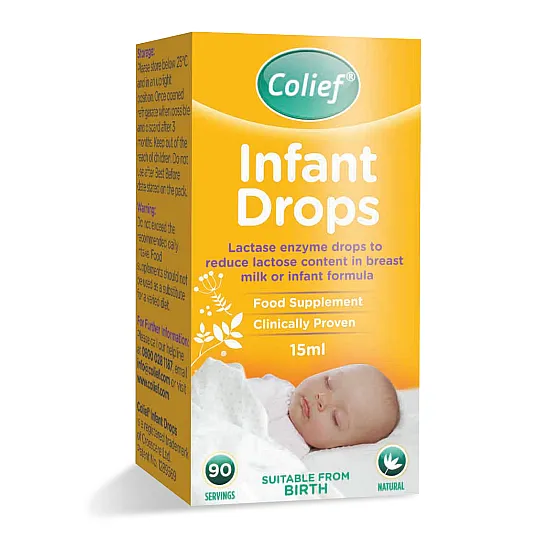
Colief Lactase Enzyme Infant Drops - 15ml
- ✔️ Breaks down lactose in milk before every feed
- ✔️ Targets colic caused by temporary lactose intolerance
- ✔️ Suitable for breastfed and formula-fed newborns
- ✔️ Works within 30 minutes when added to formula
- ✔️ Contains natural lactase enzyme with no artificial additives
Price Checker
 Discreet, tracked delivery
 Includes FREE private prescription


Couldn't load pickup availability
What Are Colief Infant Drops and How Do They Help Baby Colic?
If your baby cries inconsolably for hours and nothing seems to help, you are not alone. Infant colic affects roughly one in five babies in the UK, and it can be exhausting for the whole family. Colief infant drops are a clinically recognised option designed to help reduce colic symptoms that may be linked to temporary lactose intolerance. Each 15ml bottle contains lactase enzyme — a naturally occurring digestive enzyme — that helps your baby break down the lactose found in breast milk or formula before it reaches the gut. You can find this product and other essentials in our baby and toddler collection.
Colic is defined as episodes of crying lasting more than three hours a day, more than three days a week, for more than three weeks in an otherwise healthy infant. While the exact cause is not fully understood, one contributing factor in some babies is difficulty digesting lactose — the natural sugar found in all mammalian milk. Colief infant drops work by pre-digesting this lactose before your baby feeds, which may reduce the discomfort associated with colic.
How Do Colief Infant Drops Work in Your Baby's Digestive System?
The active ingredient in Colief is lactase enzyme, which mimics the enzyme your baby's gut naturally produces to digest lactose. In some infants, particularly newborns, lactase production can be temporarily insufficient, meaning lactose passes undigested into the large intestine. There, gut bacteria ferment it, producing gas and causing discomfort. Colief infant drops address this at the source.
- Lactase enzyme is added to expressed breast milk or formula before feeding.
- The enzyme begins breaking down lactose into simpler sugars — glucose and galactose — which are easier to absorb.
- For bottle feeds, this pre-digestion process takes at least 30 minutes at room temperature or 4 hours in the fridge.
- For breastfed babies, a small amount of expressed milk with drops added is given before the feed begins.
- The result is less undigested lactose reaching the large intestine, potentially reducing gas, bloating, and crying episodes.
Who Should Use Colief Infant Drops?
Colief infant drops are intended for babies who show signs of colic that may be related to temporary lactose intolerance. They are suitable for use from birth and can be used alongside both breastfeeding and formula feeding. That said, not all colic is caused by lactose intolerance, so it is worth speaking to your health visitor or GP if you are unsure whether this product is right for your baby.
- Newborns and infants with persistent, unexplained crying episodes.
- Babies showing signs of wind, bloating, or discomfort after feeds.
- Infants who are breastfed or formula-fed and suspected to have temporary lactose intolerance.
- Babies whose colic symptoms have not improved with other measures such as winding techniques.
Colief infant drops are not suitable for babies diagnosed with galactosaemia, a rare inherited metabolic disorder in which the body cannot process galactose. Always check with your pharmacist or GP before starting any new product for your baby.
How Do Colief Infant Drops Compare to Other Colic Remedies?
| Feature | Colief Infant Drops | Infacol (Simethicone) |
|---|---|---|
| Active ingredient | Lactase enzyme | Simethicone |
| Mechanism | Breaks down lactose before feeding | Reduces gas bubble surface tension |
| Suitable from birth | Yes | Yes |
| Added to milk before feed | Yes | No — given directly to baby |
| Targets lactose intolerance | Yes | No |
How Should You Store Colief Infant Drops and Are They Safe Long-Term?
Before opening, colief infant drops can be stored at room temperature below 25°C. Once opened, the bottle must be kept in the refrigerator between 2°C and 8°C and used within 30 days. Do not freeze. Always check the expiry date printed on the packaging before use, and keep the bottle tightly closed when not in use.
Colief infant drops are generally considered safe for short-term use in healthy infants. They contain no artificial colours, flavours, or preservatives. If your baby's colic symptoms do not improve after one to two weeks of consistent use, or if symptoms worsen, stop use and consult your GP or health visitor. For broader digestive health support for the whole family, you may also find our IBS and cramps collection useful.
This product is a medicine. Speak to your doctor or pharmacist before using if you have an underlying medical condition or are taking other medicines.
Colief Lactase Enzyme Infant Drops 15ml specifications
| Treatment category | Infant colic / digestive support |
| Mechanism of action | Lactase enzyme breaks down lactose in milk before feeding |
| Effective for | Colic symptoms associated with temporary lactose intolerance |
| Suitable for | Newborns and infants (breastfed or formula-fed) |
| Active ingredient | Lactase enzyme (50 ALU per drop) |
| Pack size | 15ml |
| UK classification | General Sale Medicine (GSL) |
| Drug class | Digestive enzyme supplement |
| Preparation | Oral drops (liquid) |
| Route of administration | Oral (added to milk) |
Specifications of Colief Lactase Enzyme Infant Drops 15ml
What Is Colief Lactase Enzyme Infant Drops and What Is It Used For?
Colief Lactase Enzyme Infant Drops is an over-the-counter digestive enzyme preparation used to help manage colic symptoms in babies that may be caused by temporary lactose intolerance. Lactose is the primary sugar in breast milk and most infant formulas. When a baby's gut does not produce enough lactase enzyme to digest it fully, the undigested lactose can ferment in the large intestine, producing gas and causing the cramping, bloating, and prolonged crying associated with colic.
The NHS notes that colic is common and usually resolves on its own by around three to four months of age. However, for parents dealing with it day and night, finding something that helps can make a real difference. Colief infant drops offer a targeted approach by supplementing the lactase enzyme your baby may be temporarily lacking, helping to reduce the lactose load before it causes discomfort.
What Do You Need to Know Before Using Colief Infant Drops?
Before using Colief infant drops, it is important to be aware of the following contraindications and precautions:
- Do not use in babies diagnosed with galactosaemia — a rare condition where the body cannot metabolise galactose, one of the sugars produced when lactase breaks down lactose.
- Do not use if your baby is allergic to any of the ingredients, including the lactase enzyme derived from Kluyveromyces lactis (a type of yeast).
- If your baby has been diagnosed with a cow's milk protein allergy (CMPA), Colief will not help — CMPA is a different condition to lactose intolerance and requires a different management approach.
- Always consult your GP or health visitor if you are unsure whether your baby's symptoms are caused by lactose intolerance or another condition.
- Do not add drops to hot milk — heat above 40°C will destroy the enzyme and render it ineffective.
Drug interactions:
- No significant drug interactions with Colief infant drops are currently known.
- If your baby is taking any prescribed medicines, speak to your pharmacist before use.
How Should You Use Colief Infant Drops?
Using Colief correctly is key to getting the best results. The drops must be added to milk — not given directly to your baby — and the milk needs time to allow the enzyme to work before feeding begins.
- Wash your hands thoroughly before handling the bottle.
- For bottle-fed babies: prepare the formula as usual and allow it to cool to body temperature (no hotter than 37°C). Add 4 drops of Colief to the bottle and mix gently.
- Leave the prepared bottle to stand for at least 30 minutes at room temperature or 4 hours in the refrigerator before feeding.
- For breastfed babies: express a small amount of breast milk (approximately 1 teaspoon / 5ml) into a sterilised container. Add 4 drops of Colief and stir gently.
- Offer this expressed milk to your baby using a sterilised spoon or dropper before putting them to the breast.
- Replace the bottle cap tightly after use and return to the refrigerator.
| Feeding Method | Age Group | Dose | Frequency |
|---|---|---|---|
| Formula feeding | Newborn and above | 4 drops per feed | Every feed |
| Breastfeeding | Newborn and above | 4 drops in expressed milk | Before every breastfeed |
What Are the Possible Side Effects of Colief Infant Drops?
Colief infant drops are well tolerated by most babies. Because the active ingredient is a naturally occurring digestive enzyme, adverse effects are uncommon. However, as with any product, it is worth knowing what to look out for.
Common side effects:
- Mild changes in stool consistency (slightly looser stools may occur as more lactose is digested)
- Increased frequency of bowel movements in some infants
Less common side effects:
- Mild skin reactions in babies with a known yeast sensitivity (the enzyme is derived from yeast)
- Temporary increase in wind as the digestive system adjusts
If you notice any signs of an allergic reaction — such as a rash, swelling, or difficulty breathing — stop use immediately and seek urgent medical attention. These reactions are rare but require prompt assessment.
How Should You Store Colief Infant Drops?
- Before opening: store below 25°C, away from direct sunlight and heat.
- After opening: refrigerate between 2°C and 8°C.
- Use within 30 days of opening.
- Do not freeze.
- Keep out of the reach and sight of children.
- Do not use after the expiry date printed on the carton and bottle.
Proper storage is essential to maintain the enzyme's effectiveness. If the drops have been left unrefrigerated for an extended period after opening, it is safest to discard them and open a new bottle. For other products to support your baby's health and wellbeing, browse our vitamins and supplements collection. If you are also managing digestive discomfort in older family members, our indigestion collection may be helpful.
References
- https://www.nhs.uk/conditions/colic/
- https://www.nhs.uk/conditions/baby/breastfeeding-and-bottle-feeding/breastfeeding/breastfeeding-problems/
- https://www.nhs.uk/conditions/lactose-intolerance/
- https://www.nhs.uk/conditions/baby/health/cows-milk-allergy-in-babies/
- https://www.nhs.uk/conditions/galactosaemia/
- https://bnf.nice.org.uk/drugs/lactase/
Written and reviewed by our qualified team
Your safety and success are our highest priorities. Our medical team rigorously evaluates every product and piece of advice we provide, ensuring you receive only the most effective, science-backed solutions available.
Frequently Asked Questions
Where can I buy Colief infant drops online in the UK?
You can buy Colief infant drops online in the UK from Cured Pharmacy for £12.89, with no prescription required. They are classified as a General Sale Medicine, so they are also available from supermarkets and high street pharmacies. Ordering online is a convenient option, especially when you need them quickly and cannot get to a shop easily.
How do Colief infant drops work in the body?
Colief infant drops contain lactase enzyme, which breaks down lactose — the natural sugar in breast milk and formula — into simpler sugars that are easier for your baby to absorb. This reduces the amount of undigested lactose reaching the large intestine, where it would otherwise be fermented by bacteria and cause gas and discomfort. The drops work in the milk before your baby feeds, not inside the baby's gut directly.
How do I use Colief infant drops step by step?
For bottle-fed babies, add 4 drops to cooled formula (no hotter than 37°C) and leave for at least 30 minutes before feeding. For breastfed babies, express around 5ml of breast milk, add 4 drops, and offer this to your baby before putting them to the breast. Always ensure the milk is not too hot, as heat destroys the enzyme and makes the drops ineffective.
What is the correct dose of Colief infant drops for my baby?
The recommended dose is 4 drops per feed, used at every feed for both breastfed and bottle-fed babies. There is no age-based dose variation — the same 4-drop dose applies from newborn onwards. Do not exceed this dose without speaking to your pharmacist or GP first.
When is the best time to use Colief infant drops?
Colief infant drops should be added to milk before every feed, not just when your baby seems uncomfortable. For bottle feeds, add the drops at least 30 minutes before you plan to feed your baby so the enzyme has time to break down the lactose. Consistency is important — using the drops at every feed gives the best chance of reducing colic symptoms over time.
Are there any side effects of Colief infant drops?
Colief infant drops are generally very well tolerated, and serious side effects are rare. Some babies may experience slightly looser stools or a temporary increase in wind as their digestive system adjusts to more fully digested lactose. If you notice any signs of an allergic reaction such as a rash or swelling, stop use immediately and contact your GP.
Who is eligible to use Colief infant drops?
Colief infant drops are suitable for newborns and infants of any age who are experiencing colic symptoms that may be linked to temporary lactose intolerance. They can be used by both breastfed and formula-fed babies. They are not suitable for babies with galactosaemia or a known allergy to yeast-derived products — always check with your pharmacist if you are unsure. You can find this and other baby products in our baby and toddler collection.
Can I use Colief infant drops if I am breastfeeding?
Yes, Colief infant drops are specifically designed to be used with breastfeeding. You express a small amount of breast milk (around one teaspoon), add 4 drops of Colief, and offer this to your baby before putting them to the breast. This allows the lactase enzyme to begin breaking down the lactose in the milk before your baby feeds, which may help reduce colic symptoms.
What happens if I miss a feed when using Colief infant drops?
If you forget to add Colief drops to one feed, simply resume using them at the next feed as normal — there is no need to double the dose. Missing an occasional feed is unlikely to cause harm, but consistent use at every feed is recommended for the best results. If you find it difficult to remember, try keeping the bottle next to your formula or feeding equipment as a visual reminder.
What are the alternatives to Colief infant drops for baby colic?
Common alternatives include Infacol (simethicone), which works by reducing gas bubbles rather than breaking down lactose, and Dentinox colic drops, which also use simethicone. If your baby's colic is not related to lactose intolerance, these alternatives may be more appropriate. Your pharmacist can help you decide which product is most suitable based on your baby's specific symptoms.
How long can you use Colief infant drops for?
Colief infant drops can be used for as long as your baby experiences colic symptoms, which typically resolve naturally by around three to four months of age as the gut matures and lactase production increases. If symptoms persist beyond four months or worsen at any point, speak to your GP or health visitor to rule out other causes. There is no strict maximum duration, but long-term use beyond the colic phase is generally unnecessary.
Can Colief infant drops be used with all types of formula?
Yes, Colief infant drops can be used with standard cow's milk-based infant formulas, as these contain lactose. They are not needed with lactose-free formulas, as these have already had the lactose removed. If your baby is on a specialist formula prescribed by a doctor, check with your GP or pharmacist before adding Colief drops.
Does Colief help with cow's milk protein allergy (CMPA)?
No — Colief infant drops are designed to help with lactose intolerance, not cow's milk protein allergy (CMPA). These are two distinct conditions. CMPA is an immune response to the proteins in cow's milk, whereas lactose intolerance is a digestive issue related to the sugar in milk. If you suspect CMPA, speak to your GP, as this requires a different management approach entirely.
What are the latest studies on lactase enzyme drops for infant colic?
Research into lactase enzyme supplementation for infant colic has shown promising results in some studies, with reductions in daily crying time reported in babies with suspected lactose intolerance. However, the NHS notes that the evidence base for colic treatments overall is mixed, and not all babies respond to the same intervention. Speaking to your health visitor or GP remains the best first step when managing colic. For broader digestive health support, see our IBS and cramps collection.
How should I store Colief infant drops after opening?
Once opened, Colief infant drops must be stored in the refrigerator at between 2°C and 8°C and used within 30 days. Do not freeze the drops, as this can damage the enzyme and reduce its effectiveness. Before opening, the bottle can be kept at room temperature below 25°C, away from direct sunlight and heat sources.
Written and reviewed by our qualified team

Reviewed by:
Tarun Kumar
Superintendent/ Clinical Lead
📖 Find out more about our team of medical content authors and how we ensure the accuracy of our content with our content guidelines.
Content last updated: 14 Sep 2026
Other popular options


We’re a safe and
regulated UK service

100% discreet packaging

Discreet, unbranded packaging for every order.

Need help?
Talk to our friendly experts now


How our service works

Service setup

Discreet packaging

Express delivery