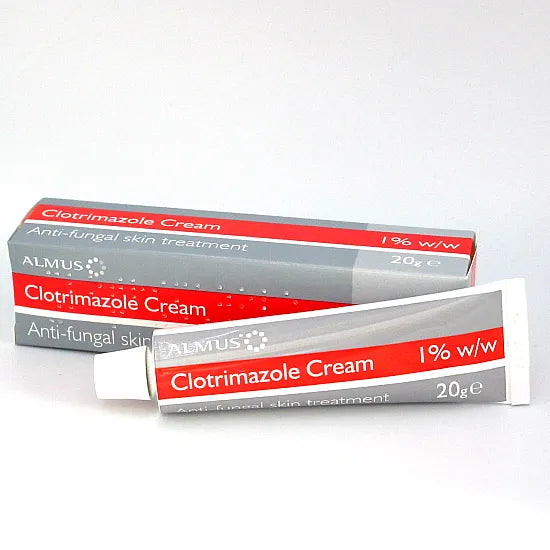
Clotrimazole Cream 1% Fungal Treatment 20g (Brand may vary)
Clotrimazole Cream 1% Fungal Treatment 20g (Brand may vary)
- ✔️ Treats athlete's foot, ringworm, and fungal skin infections
- ✔️ Kills fungal cells by disrupting their cell membrane
- ✔️ Symptoms often improve within days of first application
- ✔️ Suitable for adults and children with superficial fungal infections
- ✔️ Convenient 20g tube — easy to apply and carry
Price Checker
 Lowest price guarantee
 Includes FREE private prescription


Couldn't load pickup availability
What Is Clotrimazole Cream Used For?
Fungal skin infections are more common than you might think. Whether it's the persistent itch between your toes or an uncomfortable rash spreading across your skin, these infections can be stubborn — and they rarely go away on their own. Clotrimazole cream is a well-established, clinically proven topical antifungal that tackles a wide range of fungal and yeast infections directly at the source. Available over the counter without a prescription, this 20g tube from Almus offers an accessible and affordable treatment option at just £1.99. You can browse the full range of athlete's foot and fungal infection treatments at Cured Pharmacy if you'd like to compare your options.
Clotrimazole 1% cream is licensed in the UK for treating conditions including athlete's foot (tinea pedis), ringworm (tinea corporis), jock itch (tinea cruris), and external vulval thrush caused by Candida species. It's suitable for adults and children alike, making it a genuinely versatile product to keep in your medicine cabinet.
How Does Clotrimazole Cream Work Against Fungal Infections?
Clotrimazole belongs to the azole class of antifungal medicines. It works by interfering with the production of ergosterol — a key component of the fungal cell membrane. Without ergosterol, the membrane becomes unstable, causing the fungal cell to leak and ultimately die. Here's a simplified breakdown of the mechanism:
- Clotrimazole inhibits the enzyme lanosterol 14α-demethylase, which fungi need to synthesise ergosterol.
- Without ergosterol, the fungal cell membrane loses its structural integrity.
- The fungal cells become permeable, leak their contents, and die.
- This action is fungicidal at higher concentrations and fungistatic at lower ones, stopping both active infection and spread.
Importantly, clotrimazole acts locally — it stays on the skin surface and is not significantly absorbed into the bloodstream when used topically. This makes it a safe choice for most people.
Who Should Use Clotrimazole Cream 1%?
This cream is suitable for a broad range of patients. It's particularly useful if you've been diagnosed with — or strongly suspect — a superficial fungal skin infection. That said, it's always worth confirming the diagnosis with a pharmacist or GP if you're unsure, since some skin conditions can mimic fungal infections.
- Adults and children with athlete's foot, ringworm, or jock itch
- Women experiencing external vulval itching or soreness associated with thrush
- People with skin fold infections caused by Candida (e.g. under the breasts or in the groin)
- Those looking for an affordable, pharmacy-strength antifungal without a prescription
It is not suitable for use inside the vagina (a pessary is needed for that), near the eyes, or on severely broken or infected skin without medical advice.
How Does Clotrimazole Cream Compare to Other Antifungal Creams?
| Feature | Clotrimazole Cream 1% | Terbinafine Cream 1% |
|---|---|---|
| Active ingredient class | Azole antifungal | Allylamine antifungal |
| Effective against Candida (thrush)? | Yes | Limited activity |
| Effective against dermatophytes (athlete's foot)? | Yes | Yes — often faster |
| Typical treatment duration | 2–4 weeks | 1–2 weeks (athlete's foot) |
| Available OTC in UK? | Yes | Yes |
Is Clotrimazole Cream Suitable for Sensitive Skin and How Should It Be Stored?
Clotrimazole cream is generally well tolerated, even on sensitive skin. The formulation is water-miscible and non-greasy, which makes it comfortable to apply. If you have a known allergy to clotrimazole or any of the excipients listed in the patient information leaflet, you should not use this product. Those with very sensitive or eczema-prone skin should patch test first and speak to a pharmacist if they're unsure. You'll find a wider selection of topical treatments in our creams and ointments collection.
Store the cream below 25°C, away from direct heat and sunlight. Keep the tube tightly closed when not in use, and always keep medicines out of the reach and sight of children. Do not use after the expiry date printed on the packaging.
This product is a medicine. Speak to your doctor or pharmacist before using if you have an underlying medical condition or are taking other medicines.
Clotrimazole Cream 1% Fungal Treatment 20g specifications
| Treatment category | Antifungal / Dermatology |
| Mechanism of action | Inhibits ergosterol synthesis in fungal cell membranes |
| Effective against | Dermatophytes, Candida species, Malassezia |
| Suitable for | Adults and children |
| Active ingredient | Clotrimazole 1% w/w |
| Pack size | 20g tube |
| Strength | 1% w/w |
| UK classification | General Sale List (GSL) / Pharmacy (P) medicine |
| Drug class | Azole antifungal |
| Preparation | Topical cream |
| Route of administration | Topical (cutaneous) |
Specifications of Clotrimazole Cream 1% Fungal Treatment 20g
What Is Clotrimazole Cream 1% and What Is It Used For?
Clotrimazole cream 1% is a topical antifungal medicine used to treat infections of the skin caused by fungi and yeasts. It is applied directly to the affected area of skin and works locally without entering the bloodstream in significant amounts. The NHS recognises clotrimazole as a first-line treatment for a number of common fungal skin conditions.
It is used to treat:
- Athlete's foot (tinea pedis) — a fungal infection affecting the skin between the toes and on the soles of the feet
- Ringworm (tinea corporis) — a ring-shaped fungal rash that can appear anywhere on the body
- Jock itch (tinea cruris) — a fungal infection of the groin and inner thighs
- Candidal skin infections — including skin fold infections and external vulval thrush
- Pityriasis versicolor — a yeast infection causing patches of discoloured skin
What Do You Need to Know Before Using Clotrimazole Cream?
Before you start using this cream, there are a few important things to consider. Most people can use clotrimazole cream safely, but it's not right for everyone.
Do not use clotrimazole cream if you:
- Are allergic to clotrimazole or any of the other ingredients in the cream
- Have a known hypersensitivity to other azole antifungals
- Need to apply it near or in the eyes
- Have severely broken, raw, or infected skin (seek medical advice first)
Speak to your pharmacist or GP before using if you:
- Are pregnant or breastfeeding
- Are using this cream on a child under 12 (seek pharmacist advice)
- Have previously had an allergic reaction to any antifungal medicine
- Have diabetes, as fungal infections can be more persistent
Known drug interactions:
- Tacrolimus (an immunosuppressant) — topical clotrimazole may interact; seek pharmacist advice
- Warfarin — although topical absorption is minimal, report any unusual bruising to your GP
If you're also managing a related condition such as vaginal thrush, you may find it helpful to explore our thrush treatments collection for complementary options.
How Should You Use Clotrimazole Cream Correctly?
Always use this cream exactly as directed on the packaging or as advised by your pharmacist. Do not apply more than recommended, and do not stop treatment early even if your symptoms improve.
- Wash and thoroughly dry the affected area before applying the cream.
- Squeeze a small amount of cream (roughly the size of a pea) onto your fingertip.
- Apply a thin layer to the affected skin and the area immediately surrounding it.
- Rub in gently until the cream is absorbed.
- Wash your hands thoroughly after application (unless your hands are the area being treated).
- Allow the area to air dry if possible — avoid covering with tight clothing immediately after application.
| Indication | Age Group | Dose | Frequency |
|---|---|---|---|
| Athlete's foot | Adults & children | Thin layer | 2–3 times daily for 4 weeks |
| Ringworm / jock itch | Adults & children | Thin layer | 2–3 times daily for 2–4 weeks |
| External vulval thrush | Adults | Thin layer | 2–3 times daily for up to 2 weeks |
| Candidal skin fold infection | Adults | Thin layer | 2–3 times daily for 2–4 weeks |
What Are the Possible Side Effects of Clotrimazole Cream?
Like all medicines, clotrimazole cream can cause side effects, although not everyone experiences them. Most side effects are mild and localised to the area of application.
Common side effects:
- Mild burning or stinging sensation after application
- Temporary itching or irritation at the treated site
- Slight redness of the skin
Less common side effects:
- Skin peeling or flaking around the treated area
- Blistering or swelling of the skin
- Allergic contact dermatitis (rash, hives, or worsening irritation)
Stop using the cream and seek medical advice if you develop signs of a serious allergic reaction, such as widespread rash, swelling of the face or throat, or difficulty breathing. These reactions are rare but require prompt attention. Women using the cream for external thrush should also consider whether internal treatment is needed — our women's health collection includes a range of relevant options.
How Should You Store Clotrimazole Cream?
- Store below 25°C in a cool, dry place
- Do not refrigerate or freeze
- Keep the tube tightly closed when not in use
- Keep out of the reach and sight of children
- Do not use after the expiry date printed on the tube or carton
- Do not dispose of medicines via wastewater or household waste — return unused medicines to your pharmacy
References
Written and reviewed by our qualified team
Your safety and success are our highest priorities. Our medical team rigorously evaluates every product and piece of advice we provide, ensuring you receive only the most effective, science-backed solutions available.
Frequently Asked Questions
Where can I buy clotrimazole cream online in the UK?
You can buy clotrimazole cream 1% directly from Cured Pharmacy, a GPhC-registered UK online pharmacy, for just £1.99. It's available without a prescription and can be ordered quickly and discreetly. You'll find it alongside other treatments in our athlete's foot and fungal infections collection.
How does clotrimazole cream work in the body?
Clotrimazole works by blocking the production of ergosterol, a vital component of the fungal cell membrane. Without it, the membrane breaks down and the fungal cells die. It acts locally on the skin and is not significantly absorbed into the bloodstream when used topically.
How do I apply clotrimazole cream step by step?
Start by washing and thoroughly drying the affected area. Apply a thin layer of cream to the infected skin and the surrounding area, rubbing in gently. Wash your hands after application and repeat two to three times daily as directed.
How long does clotrimazole cream take to work?
Many people notice an improvement in symptoms — such as reduced itching and redness — within a few days of starting treatment. However, you should complete the full course, which is typically two to four weeks depending on the infection type. Stopping early increases the risk of the infection returning.
Can I use clotrimazole cream for vaginal thrush?
Clotrimazole cream 1% can be used to relieve external vulval symptoms of thrush, such as itching and soreness around the vaginal opening. It is not designed to treat internal vaginal thrush on its own — a clotrimazole pessary or oral fluconazole tablet is usually needed for that. Speak to your pharmacist for personalised advice.
Is clotrimazole cream safe to use during pregnancy?
Topical clotrimazole cream is generally considered safe during pregnancy when used as directed, as systemic absorption is minimal. However, you should always consult your GP or midwife before using any medicine during pregnancy. Clotrimazole pessaries should not be inserted during pregnancy without medical supervision.
What are the side effects of clotrimazole cream?
The most common side effects are mild and localised, including a temporary burning, stinging, or itching sensation at the application site. Less commonly, some people experience skin peeling, blistering, or an allergic skin reaction. If you develop severe irritation or signs of an allergic reaction, stop using the cream and seek medical advice promptly.
Who is eligible to use clotrimazole cream 1%?
Clotrimazole cream is suitable for most adults and children for the treatment of superficial fungal skin infections. It is not recommended for use near the eyes, on severely broken skin, or inside the vagina. People with known allergies to azole antifungals should avoid it and speak to a pharmacist about alternatives.
What happens if I miss an application of clotrimazole cream?
If you forget to apply the cream at your usual time, apply it as soon as you remember. If it's nearly time for your next application, simply skip the missed one and carry on with your regular schedule. Do not apply a double amount to make up for a missed dose.
What are the alternatives to clotrimazole cream?
Other topical antifungal creams available over the counter in the UK include terbinafine (Lamisil), miconazole (Daktarin), and ketoconazole. Terbinafine may work faster for athlete's foot, while miconazole is also effective against some bacteria. Your pharmacist can help you choose the right option based on your specific infection and medical history.
How long can you use clotrimazole cream for?
Treatment duration depends on the type of infection — athlete's foot typically requires four weeks, while ringworm and jock itch may clear in two to four weeks. If your symptoms have not improved after four weeks of consistent use, stop treatment and consult your GP. Prolonged use beyond the recommended period should only be done under medical supervision.
Can I use clotrimazole cream on my face?
Clotrimazole cream can be used on facial skin for fungal infections such as ringworm, but you should take care to avoid the eyes, mouth, and mucous membranes. Apply only a thin layer and seek pharmacist advice before using it on the face, particularly for children or those with sensitive skin conditions.
Can clotrimazole cream be used on children?
Clotrimazole cream can be used on children, but it's advisable to speak to a pharmacist or GP before treating children under 12. The cream should be applied carefully, avoiding the eyes and mouth, and parents should supervise application. For nappy rash caused by Candida, a pharmacist can advise on the most appropriate product.
Does clotrimazole cream treat nail fungus?
Clotrimazole cream is not effective for treating fungal nail infections (onychomycosis), as the cream cannot penetrate the nail plate sufficiently. Nail fungus typically requires a dedicated antifungal nail lacquer or, in more severe cases, oral antifungal tablets prescribed by a GP. You can explore relevant options in our skin care collection.
What are the latest studies on clotrimazole cream?
Clotrimazole has been in clinical use for over 50 years and remains one of the most widely studied topical antifungals. Current evidence continues to support its efficacy and safety for superficial fungal infections, and it remains a recommended first-line treatment in NHS guidelines. No significant new safety concerns have emerged from recent literature.
Written and reviewed by our qualified team

Reviewed by:
Tarun Kumar
Superintendent/ Clinical Lead
📖 Find out more about our team of medical content authors and how we ensure the accuracy of our content with our content guidelines.
Content last updated: 14 Sep 2026
Other popular options


We’re a safe and
regulated UK service

Lowest Price Guarantee

We're convinced you won't find your treatment cheaper, but if you do we'll refund the difference.
Find out more
100% discreet packaging

Discreet, unbranded packaging for every order.
Find out more

Need help?
Talk to our friendly experts now


How our service works

Service setup

Discreet packaging

Express delivery