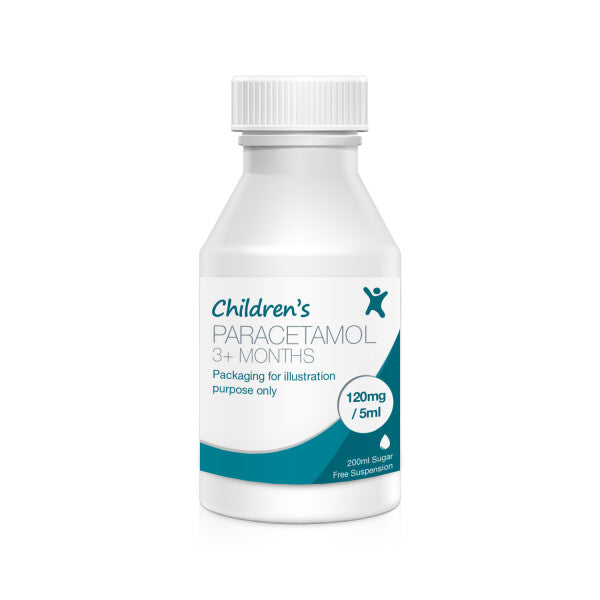
Children's Paracetamol Sugar Free Suspension 3 Months+ - 200ml (Flavours Vary)
Children's Paracetamol Sugar Free Suspension 3 Months+ - 200ml (Flavours Vary)
- ✔️ Relieves fever in children from just 3 months old
- ✔️ Sugar-free formula — kinder to developing baby teeth
- ✔️ Each 5ml dose delivers 120mg paracetamol for accurate dosing
- ✔️ Effective for teething pain, earache, and post-immunisation fever
- ✔️ 200ml bottle provides multiple doses for extended illness management
Price Checker
 Lowest price guarantee
 Includes FREE private prescription


Couldn't load pickup availability
What Is Children's Paracetamol Suspension and How Does It Help?
When your little one is burning up with a fever or crying from teething pain, you want something that works — and works safely. Children's paracetamol suspension is one of the most widely used and clinically established medicines for relieving mild to moderate pain and reducing high temperature in babies and young children. CuredPharmacy's sugar-free version is suitable from 3 months of age and comes in a 200ml bottle, making it a practical staple for any family medicine cabinet. You can browse our full range of baby and toddler health products alongside this suspension.
Each 5ml dose contains 120mg of paracetamol — the standard concentration for children's oral liquid paracetamol in the UK. Being sugar-free means it's kinder to developing teeth, which matters when you're giving a medicine repeatedly over several days. The flavour may vary between batches, but all variants are designed to be palatable for young children.
How Does Children's Paracetamol Suspension Work?
Paracetamol acts centrally in the brain and spinal cord to reduce the perception of pain and lower body temperature. Here's a simplified breakdown of how it works:
- It inhibits the enzyme cyclooxygenase (COX) in the central nervous system, reducing the production of prostaglandins — chemicals that signal pain and trigger fever.
- By lowering prostaglandin levels in the hypothalamus (the brain's temperature-regulating centre), it helps bring a raised temperature back down towards normal.
- Unlike ibuprofen, paracetamol does not have significant anti-inflammatory effects at standard doses, but it is generally better tolerated in the stomach.
- It is absorbed quickly from the gut, with effects typically felt within 30–60 minutes of taking a dose.
Importantly, paracetamol does not treat the underlying cause of a fever or infection — it simply helps your child feel more comfortable while their immune system does its job.
Who Should Use Children's Paracetamol Suspension?
This suspension is designed for children aged 3 months and over who need short-term relief from pain or fever. It's particularly useful for:
- Babies and toddlers with a high temperature (fever above 38°C)
- Children experiencing teething discomfort
- Post-immunisation fever (for babies aged 2 months and over, under medical guidance)
- Mild to moderate pain from earache, sore throat, or headache in young children
It is not suitable for children under 3 months unless specifically directed by a doctor. Children with known liver or kidney problems, or those who are underweight for their age, should be assessed by a healthcare professional before use.
How Does This Suspension Compare to Other Children's Pain Relievers?
| Feature | CuredPharmacy Paracetamol Suspension | Children's Ibuprofen Suspension |
|---|---|---|
| Minimum age | 3 months | 3 months (over 5kg body weight) |
| Active ingredient | Paracetamol 120mg/5ml | Ibuprofen 100mg/5ml |
| Anti-inflammatory action | No | Yes |
| Suitable for asthmatic children | Generally yes | Use with caution — may worsen asthma |
| Sugar-free | Yes | Varies by brand |
How Should You Store Children's Paracetamol Suspension?
Store this suspension below 25°C in a dry place, away from direct sunlight. Do not refrigerate — cold temperatures can affect the consistency of the liquid. Always keep the bottle tightly closed and well out of reach of children. Once opened, check the expiry date on the packaging and do not use the product beyond that date. If you're stocking up on children's health essentials, our first aid collection has everything you need to keep your family prepared.
This product is a medicine. Speak to your doctor or pharmacist before using if you have an underlying medical condition or are taking other medicines.
Children's Paracetamol Sugar Free Suspension 3 Months+ - 200ml specifications
| Treatment category | Children's pain relief and fever reduction |
| Active ingredient | Paracetamol 120mg/5ml |
| Mechanism of action | Central COX inhibition reducing prostaglandin synthesis |
| Suitable for | Children aged 3 months and over |
| Pack size | 200ml |
| Strengths | 120mg/5ml |
| UK classification | General Sale List (GSL) |
| Drug class | Analgesic / Antipyretic |
| Preparation | Oral suspension |
| Route of administration | Oral |
Specifications of Children's Paracetamol Sugar Free Suspension 3 Months+ - 200ml
What Is Children's Paracetamol Sugar Free Suspension and What Is It Used For?
CuredPharmacy Children's Paracetamol Sugar Free Suspension 3 Months+ is an oral liquid medicine containing paracetamol 120mg per 5ml. It is used to relieve mild to moderate pain — such as teething pain, earache, sore throat, and headache — and to reduce fever (high temperature) in children aged 3 months and over. It is a General Sale List (GSL) medicine, meaning it can be purchased without a prescription. The NHS recommends paracetamol as a first-line option for managing fever and pain in children when used at the correct dose.
What Do You Need to Know Before Using Children's Paracetamol Suspension?
Before giving this medicine to your child, read the following carefully. Do not use this suspension if your child:
- Is under 3 months of age (unless directed by a doctor)
- Has a known allergy to paracetamol or any other ingredient in the suspension
- Has severe liver disease or severe kidney impairment
- Is already taking another medicine containing paracetamol — always check labels carefully
Speak to your pharmacist or GP before use if your child has liver problems, kidney problems, or is malnourished or of low body weight. Take particular care with the following known interactions:
- Warfarin: Prolonged regular use of paracetamol may enhance the anticoagulant effect of warfarin — seek medical advice if your child is on anticoagulant therapy
- Other paracetamol-containing products: Never use alongside other medicines that contain paracetamol, as this significantly increases the risk of overdose
- Metoclopramide or domperidone: These medicines may increase the rate of paracetamol absorption
How Should You Use Children's Paracetamol Suspension?
Always use the oral syringe or measuring device provided with the bottle — never use a kitchen spoon, as this can lead to inaccurate dosing. Follow these steps:
- Shake the bottle well before each use.
- Use the oral syringe to draw up the correct dose for your child's age or weight.
- Administer the suspension directly into your child's mouth, aiming for the inside of the cheek.
- Do not mix with food or drink unless advised by a healthcare professional.
- Replace the cap securely after use and store below 25°C.
| Age Group | Dose (120mg/5ml suspension) | Frequency | Max doses in 24 hours |
|---|---|---|---|
| 3–6 months | 2.5ml (60mg) | Every 4–6 hours | 4 |
| 6–24 months | 5ml (120mg) | Every 4–6 hours | 4 |
| 2–4 years | 7.5ml (180mg) | Every 4–6 hours | 4 |
| 4–6 years | 10ml (240mg) | Every 4–6 hours | 4 |
If your child's fever does not improve within 24 hours, or their pain persists beyond 3 days, stop use and consult a GP. You may also find it helpful to explore our cold and flu range for additional supportive products during illness.
What Are the Possible Side Effects of Children's Paracetamol Suspension?
Paracetamol is well tolerated in the vast majority of children when used at the correct dose. However, side effects can occur. If your child experiences any serious reaction, stop use immediately and seek medical attention.
Common side effects (may affect up to 1 in 10 children):
- Nausea or stomach discomfort (uncommon at standard doses)
- Skin rash or itching
Less common or rare side effects:
- Allergic reaction — including swelling of the face, lips, tongue, or throat (angioedema)
- Serious skin reactions such as Stevens-Johnson syndrome (very rare)
- Blood disorders including thrombocytopenia (very rare, with prolonged use)
- Liver damage — only in cases of overdose or prolonged excessive use
If you suspect an overdose — even if your child seems well — go to A&E immediately or call 999. Paracetamol overdose can cause delayed but serious liver damage.
How Should You Store Children's Paracetamol Suspension?
- Store below 25°C in a dry place away from direct sunlight
- Do not refrigerate or freeze
- Keep the bottle tightly closed when not in use
- Keep out of the sight and reach of children at all times
- Do not use after the expiry date printed on the bottle or carton
- Do not dispose of medicines via wastewater or household waste — return unused medicine to your pharmacist
If you're building a well-stocked home medicine cabinet, our pain relief collection includes a wide range of options for the whole family.
References
- https://www.nhs.uk/medicines/paracetamol-for-children/
- https://www.nhs.uk/conditions/fever-in-children/
- https://www.nhs.uk/conditions/pain-in-children/
- https://www.nhs.uk/medicines/paracetamol-for-children/side-effects-of-paracetamol-for-children/
- https://www.nhs.uk/medicines/paracetamol-for-children/who-can-and-cannot-take-paracetamol-for-children/
- https://bnf.nice.org.uk/drugs/paracetamol/
Written and reviewed by our qualified team
Your safety and success are our highest priorities. Our medical team rigorously evaluates every product and piece of advice we provide, ensuring you receive only the most effective, science-backed solutions available.
Frequently Asked Questions
Where can I buy children's paracetamol suspension online in the UK?
You can order CuredPharmacy Children's Paracetamol Sugar Free Suspension 3 Months+ 200ml directly from Cured Pharmacy online for just £4.39. It is a General Sale List (GSL) medicine, so no prescription is needed. It's also available from pharmacies and supermarkets across the UK, but ordering online is a convenient option when you can't get to a shop.
How does children's paracetamol suspension work in the body?
Paracetamol works by inhibiting cyclooxygenase (COX) enzymes in the central nervous system, which reduces the production of prostaglandins — the chemicals responsible for pain signalling and raising body temperature. This is why it's effective at both relieving discomfort and bringing down a fever. It does not have significant anti-inflammatory effects at standard doses, unlike ibuprofen.
How do I give children's paracetamol suspension step by step?
Shake the bottle well, then use the oral syringe provided to draw up the correct dose for your child's age. Administer it gently into the inside of your child's cheek — not the back of the throat — and replace the cap securely afterwards. Never use a kitchen spoon to measure the dose, as this can lead to under- or over-dosing.
What is the correct dose of paracetamol suspension for my child?
The dose depends on your child's age: children aged 3–6 months receive 2.5ml (60mg), those aged 6 months to 2 years receive 5ml (120mg), children aged 2–4 years receive 7.5ml (180mg), and those aged 4–6 years receive 10ml (240mg). Always check the packaging and never give more than 4 doses in 24 hours. If you're unsure, ask your pharmacist.
How often can I give my child paracetamol suspension?
You can give a dose every 4–6 hours as needed, but no more than 4 doses in any 24-hour period. Always leave at least 4 hours between doses. If your child's symptoms are not improving after 24 hours of fever or 3 days of pain, speak to your GP.
Is this paracetamol suspension suitable for babies under 3 months?
No — this suspension is not recommended for babies under 3 months of age unless specifically directed by a doctor. If your baby is under 3 months and has a fever or seems unwell, you should seek medical advice promptly rather than giving any over-the-counter medicine. Fever in very young babies can be a sign of a serious infection.
What are the side effects of children's paracetamol suspension?
Side effects are uncommon when the suspension is used correctly and at the right dose. Rarely, children may develop a skin rash or, in very rare cases, a serious allergic reaction involving swelling of the face or throat. If you notice any signs of an allergic reaction, stop use immediately and call 999 or go to A&E.
Can I give my child paracetamol suspension and ibuprofen at the same time?
Paracetamol and ibuprofen are sometimes used together or alternated in children over 3 months, but you should always check with your pharmacist or GP before doing so. The NHS advises against giving both at the same time — instead, you can alternate them if one alone isn't providing enough relief. Never exceed the recommended dose of either medicine.
What should I do if I accidentally give my child too much paracetamol?
If you think your child has received too much paracetamol — even if they appear well — go to your nearest A&E or call 999 immediately. Do not wait for symptoms to appear, as paracetamol overdose can cause serious liver damage that may not be obvious for 24–72 hours. Take the medicine bottle with you so medical staff can assess the situation accurately.
Who is eligible to use children's paracetamol suspension?
This suspension is suitable for children aged 3 months and over who need relief from mild to moderate pain or fever. It is not suitable for children with known paracetamol allergy, severe liver disease, or those already taking another paracetamol-containing product. Children with liver or kidney conditions should be assessed by a doctor before use. You can find more products for young children in our baby and toddler collection.
What happens if I miss a dose of children's paracetamol suspension?
If you miss a dose and your child is still in pain or has a fever, you can give the next dose as soon as you remember — provided at least 4 hours have passed since the last dose. Never give a double dose to make up for a missed one. If your child seems comfortable and the fever has settled, you may not need to give another dose at all.
What are the alternatives to children's paracetamol suspension?
The main alternative for children aged 3 months and over (weighing more than 5kg) is children's ibuprofen suspension, which also reduces fever and relieves pain but additionally has anti-inflammatory properties. For children who cannot take ibuprofen — for example, those with asthma or kidney problems — paracetamol is usually the preferred option. Always consult your pharmacist if you're unsure which is more appropriate for your child.
How long can I use children's paracetamol suspension for?
For fever, the NHS advises seeking medical advice if your child's temperature has not improved within 24 hours of starting treatment. For pain, do not use for more than 3 days without consulting a GP or pharmacist. Paracetamol is not intended for long-term regular use in children without medical supervision.
Does children's paracetamol suspension interact with any other medicines?
The most important interaction to be aware of is with other medicines containing paracetamol — using two paracetamol-containing products at the same time can lead to overdose. Prolonged use alongside warfarin may also increase bleeding risk. If your child takes any regular medicines, check with your pharmacist before giving this suspension. You can also explore our pain relief collection for further guidance on suitable options.
What is the latest guidance on using paracetamol for children's fever?
Current NHS and NICE guidance recommends using paracetamol (or ibuprofen) to help a child feel more comfortable during a fever, rather than aiming to normalise the temperature at all costs. The focus is on your child's overall wellbeing — if they are drinking fluids, responsive, and not showing signs of serious illness, managing symptoms at home with children's paracetamol suspension is appropriate. Always seek urgent medical advice if your child has a fever and is under 3 months old, has a rash, is difficult to wake, or appears seriously unwell.
Written and reviewed by our qualified team

Reviewed by:
Tarun Kumar
Superintendent/ Clinical Lead
📖 Find out more about our team of medical content authors and how we ensure the accuracy of our content with our content guidelines.
Content last updated: 14 Sep 2026
Other popular options


We’re a safe and
regulated UK service

Lowest Price Guarantee

We're convinced you won't find your treatment cheaper, but if you do we'll refund the difference.
Find out more
100% discreet packaging

Discreet, unbranded packaging for every order.
Find out more

Need help?
Talk to our friendly experts now


How our service works

Service setup

Discreet packaging

Express delivery