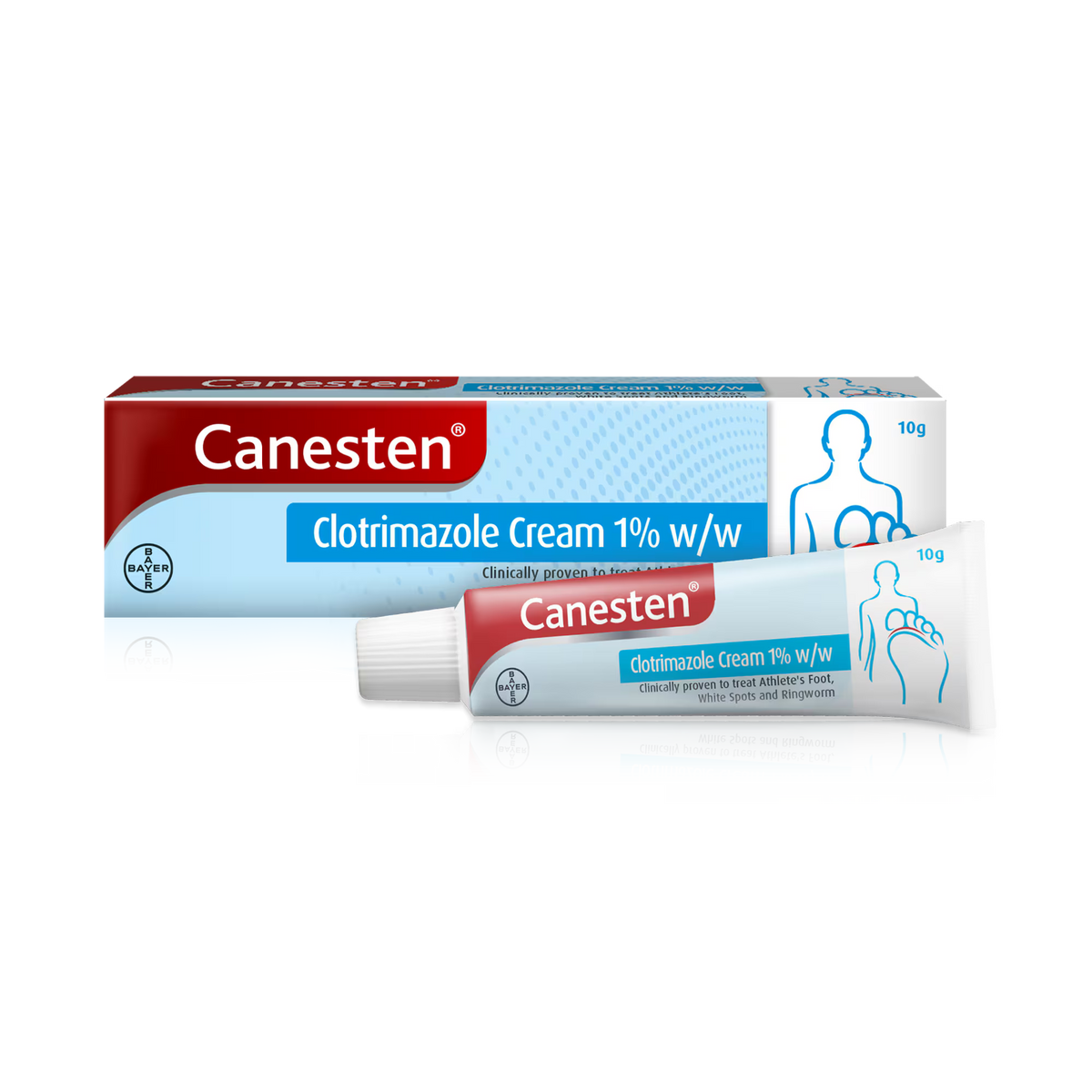
Canesten Athlete's Foot 1% Cream
Canesten Athlete's Foot 1% Cream
- ✔️ Treats athlete's foot caused by dermatophyte fungi effectively
- ✔️ Contains clotrimazole 1%, a clinically proven antifungal ingredient
- ✔️ Relieves itching, burning, and scaling between the toes
- ✔️ Suitable for adults and young people aged 12 and over
- ✔️ Compact 20g tube — easy to use at home or while travelling
Price Checker
 Lowest price guarantee
 Includes FREE private prescription


Couldn't load pickup availability
What Is Canesten Athletes Foot Cream?
Athlete's foot is one of the most common fungal skin infections in the UK. It affects the skin between the toes and on the soles of the feet, causing itching, burning, scaling, and sometimes cracking. If you've ever dealt with that persistent, maddening itch between your toes, you'll know how disruptive it can be. Canesten athletes foot cream is a trusted, clinically proven topical antifungal that tackles the root cause — not just the symptoms. You can browse the full range of athletes foot and fungal infection treatments at Cured Pharmacy to find the right option for you.
The active ingredient is clotrimazole 1%, a well-established imidazole antifungal. It's been used in the UK for decades and is recommended by NHS guidelines for the treatment of tinea pedis (the medical term for athlete's foot). This cream is available over the counter without a prescription, making it easy to access and start treatment quickly.
How Does Canesten Athlete's Foot Cream Work?
Clotrimazole works by interfering with the production of ergosterol — a vital component of the fungal cell membrane. Without ergosterol, the membrane becomes unstable, causing the fungal cell to leak and ultimately die. It's a targeted mechanism that affects fungi without significantly harming surrounding skin cells.
- Clotrimazole inhibits the enzyme lanosterol 14α-demethylase, blocking ergosterol synthesis
- Disruption of the fungal cell membrane leads to increased permeability
- Fungal cells lose essential contents and die (fungicidal at higher concentrations)
- The cream acts locally on the skin surface, minimising systemic absorption
Who Should Use Canesten Athlete's Foot Cream?
This cream is suitable for adults and children aged 12 and over who are experiencing symptoms of athlete's foot. It's particularly useful if you've noticed itching, peeling, or redness between the toes or on the soles of your feet. That said, it's worth confirming the diagnosis before starting treatment — not all foot rashes are fungal in origin.
- Adults and adolescents aged 12 years and over
- People with confirmed or suspected tinea pedis (athlete's foot)
- Those who have not responded to general hygiene measures alone
- Individuals looking for an OTC treatment without needing a GP appointment
It is not suitable for children under 12 without medical supervision, and you should avoid applying it to broken, blistered, or severely inflamed skin without first speaking to a pharmacist or GP.
How Does Canesten Athlete's Foot Cream Compare to Other Treatments?
| Feature | Canesten Athlete's Foot 1% Cream | Lamisil AT 1% Cream (Terbinafine) |
|---|---|---|
| Active ingredient | Clotrimazole 1% | Terbinafine 1% |
| Mechanism | Ergosterol synthesis inhibitor (fungistatic/fungicidal) | Squalene epoxidase inhibitor (fungicidal) |
| Treatment duration | 4 weeks, 2–3 times daily | 1–2 weeks, once or twice daily |
| OTC availability | Yes | Yes |
Is Canesten Athlete's Foot Cream Safe to Store at Home?
Yes — storage is straightforward. Keep the tube below 25°C, away from direct heat and sunlight. Do not freeze it. Always store it out of the reach and sight of children, and check the expiry date before each use. If you're also managing other skin concerns, our creams and ointments collection covers a wide range of topical treatments.
Canesten athletes foot cream should not be used after the expiry date printed on the packaging. Once opened, use within the period indicated on the tube. If the cream changes colour or consistency, do not use it.
This product is a medicine. Speak to your doctor or pharmacist before using if you have an underlying medical condition or are taking other medicines.
Canesten Athlete's Foot 1% Cream specifications
| Treatment category | Antifungal / Athlete's Foot |
| Mechanism of action | Ergosterol synthesis inhibition via lanosterol 14α-demethylase blockade |
| Effective against | Tinea pedis (athlete's foot), dermatophytes |
| Suitable for | Adults and children aged 12 and over |
| Active ingredient | Clotrimazole 1% |
| Pack sizes | 20g |
| Strength | 1% w/w |
| UK classification | General Sale List (GSL) |
| Drug class | Imidazole antifungal |
| Preparation | Cream |
| Route of administration | Topical (cutaneous) |
Specifications of Canesten Athlete's Foot 1% Cream
What Is Canesten Athlete's Foot 1% Cream and What Is It Used For?
Canesten Athlete's Foot 1% Cream is a topical antifungal medicine containing clotrimazole 1% w/w as its active ingredient. It is used to treat tinea pedis — commonly known as athlete's foot — a fungal infection of the skin on the feet caused by dermatophyte fungi such as Trichophyton rubrum and Trichophyton interdigitale. The NHS confirms that athlete's foot is very common and can affect anyone, though it tends to thrive in warm, moist environments like sweaty shoes and communal changing rooms.
Symptoms it treats include itching, burning, scaling, and cracking of the skin, particularly between the toes. It may also be used for other superficial fungal skin infections where clotrimazole is appropriate, though you should confirm this with a pharmacist first. If you're unsure whether your symptoms are fungal, our foot care collection includes a range of products to help you manage foot health.
What Do You Need to Know Before Using Canesten Athlete's Foot Cream?
Before applying this cream, read the following carefully. There are situations where this product may not be appropriate for you.
Do not use this cream if you:
- Are allergic to clotrimazole or any other ingredient in the formulation
- Are under 12 years of age (unless directed by a doctor)
- Have severely broken, blistered, or infected skin at the site of application
- Have previously had a hypersensitivity reaction to imidazole antifungals
Speak to your pharmacist or GP before use if you:
- Are pregnant or breastfeeding
- Have diabetes, as fungal infections can be more persistent
- Have a weakened immune system
- Have symptoms that have not improved after four weeks of treatment
Drug interactions:
- Topical clotrimazole has no clinically significant interactions when used on the skin
- Avoid using alongside other topical preparations on the same area without pharmacist advice
How Should You Use Canesten Athlete's Foot Cream?
Using this cream correctly makes a real difference to how quickly you recover. Follow these steps each time you apply it.
- Wash the affected area with mild soap and water
- Dry thoroughly, paying particular attention to the skin between the toes
- Squeeze a small amount of cream onto your fingertip
- Apply a thin layer to the affected skin and the surrounding area
- Rub in gently until absorbed
- Wash your hands after application (unless your hands are the area being treated)
| Indication | Age Group | Dose | Frequency |
|---|---|---|---|
| Athlete's foot (tinea pedis) | Adults & children 12+ | Thin layer to affected area | 2–3 times daily for 4 weeks |
| Other superficial fungal infections | Adults & children 12+ | Thin layer to affected area | 2–3 times daily (duration as directed) |
What Are the Possible Side Effects of Canesten Athlete's Foot Cream?
Like all medicines, this cream can cause side effects, although not everyone experiences them. Most side effects are mild and localised to the area of application.
Common side effects:
- Mild burning or stinging sensation after application
- Temporary redness of the skin
- Slight itching at the application site
Less common side effects:
- Skin rash or hives
- Blistering or peeling beyond the infected area
- Swelling or increased irritation
If you experience a severe allergic reaction — including swelling of the face, lips, or throat, or difficulty breathing — stop use immediately and seek emergency medical attention. This is rare but serious. You can also find additional skin care products at Cured Pharmacy if you need to soothe irritated skin alongside your antifungal treatment.
How Should You Store Canesten Athlete's Foot Cream?
- Store below 25°C in a cool, dry place
- Do not freeze
- Keep away from direct sunlight and heat sources
- Keep out of the reach and sight of children
- Do not use after the expiry date printed on the tube and carton
- Do not dispose of medicines via wastewater or household waste — return unused medicines to your pharmacy
References
Written and reviewed by our qualified team
Your safety and success are our highest priorities. Our medical team rigorously evaluates every product and piece of advice we provide, ensuring you receive only the most effective, science-backed solutions available.
Frequently Asked Questions
Where can I buy Canesten Athlete's Foot Cream online in the UK?
You can buy Canesten Athlete's Foot 1% Cream directly from Cured Pharmacy, a GPhC-registered UK online pharmacy, for just £4.49. It's available without a prescription and can be ordered quickly and discreetly. You can also browse our full athletes foot and fungal infections collection for additional treatment options.
How does Canesten Athlete's Foot Cream work in the body?
The active ingredient, clotrimazole 1%, works by blocking an enzyme called lanosterol 14α-demethylase, which fungi need to produce ergosterol — a key building block of their cell membranes. Without ergosterol, the fungal cell membrane breaks down, causing the cells to die. This action is targeted at the fungus and does not significantly affect your own skin cells.
How do I use Canesten Athlete's Foot Cream step by step?
Start by washing and thoroughly drying the affected area, especially between the toes. Apply a thin layer of cream two to three times daily, rubbing it in gently. Always wash your hands after application and continue the full four-week course even if symptoms clear up sooner.
How long does Canesten Athlete's Foot Cream take to work?
Many people notice a reduction in itching and discomfort within a few days of starting treatment. However, the fungal infection itself takes longer to fully clear, which is why the NHS recommends completing the full four-week course. Stopping early is one of the most common reasons athlete's foot comes back.
What are the side effects of Canesten Athlete's Foot Cream?
Side effects are uncommon and usually mild. You might experience a brief burning or stinging sensation, slight redness, or itching at the site of application. Rarely, some people develop a skin rash or blistering — if this happens, stop using the cream and speak to your pharmacist or GP.
Can I use Canesten Athlete's Foot Cream if I am pregnant?
Topical clotrimazole is generally considered to carry a low risk during pregnancy because very little is absorbed through the skin into the bloodstream. That said, you should always speak to your GP or midwife before using any medicine during pregnancy, particularly in the first trimester. Do not self-treat without professional guidance.
Is Canesten Athlete's Foot Cream suitable for children?
This cream is suitable for adults and young people aged 12 and over. It should not be used in children under 12 without the advice of a doctor or pharmacist. If your child has symptoms of athlete's foot, seek professional guidance before starting any treatment.
What is the difference between Canesten Athlete's Foot Cream and Lamisil AT?
Both are OTC antifungal creams for athlete's foot, but they contain different active ingredients. Canesten uses clotrimazole 1% and requires four weeks of treatment applied two to three times daily. Lamisil AT contains terbinafine 1% and typically works in one to two weeks with once or twice daily application. Your pharmacist can help you decide which suits you best.
How long can I use Canesten Athlete's Foot Cream for?
The recommended treatment course is four weeks, applied two to three times daily. If your symptoms have not improved after four weeks, you should stop using the cream and consult your GP, as you may need a different treatment or a formal diagnosis. Do not use this cream continuously beyond the recommended period without medical advice.
What happens if I miss an application of Canesten Athlete's Foot Cream?
If you forget to apply the cream at your usual time, apply it as soon as you remember. However, if it's nearly time for your next application, simply skip the missed one and carry on as normal. Do not apply a double amount to make up for a missed dose — just continue with your regular routine.
Can I use Canesten Athlete's Foot Cream on other parts of my body?
Clotrimazole cream can treat other superficial fungal skin infections such as ringworm (tinea corporis) and jock itch (tinea cruris), but you should confirm this with a pharmacist before using it on areas other than the feet. Avoid applying it near the eyes, mouth, or on mucous membranes. For genital fungal infections, a separately licensed product is more appropriate.
Does Canesten Athlete's Foot Cream interact with other medicines?
When used topically on the skin, clotrimazole has no clinically significant interactions with other medicines. This is because very little of the active ingredient is absorbed into the bloodstream. If you are using other topical preparations on the same area, check with your pharmacist to avoid any potential irritation.
How do I prevent athlete's foot from coming back after treatment?
Completing the full four-week course is the most important step. Beyond that, keep your feet clean and dry, change socks daily, wear breathable footwear, and avoid walking barefoot in communal areas like swimming pools and gym changing rooms. The NHS also recommends not sharing towels or footwear with others. Our foot care collection includes products to help maintain healthy feet long-term.
What are the alternatives to Canesten Athlete's Foot Cream?
Alternatives include other topical antifungals such as terbinafine (Lamisil AT), miconazole, and econazole creams. There are also antifungal powders and sprays that may be useful for prevention or mild cases. If OTC treatments have not worked after a full course, your GP may prescribe an oral antifungal such as terbinafine tablets.
What does the latest research say about clotrimazole for athlete's foot?
Clotrimazole remains a well-evidenced, first-line treatment for tinea pedis and is included in NHS clinical guidance for superficial fungal infections. It has been used safely and effectively for decades, and its efficacy against common dermatophytes is well established in published clinical literature. The BNF continues to list it as a recommended topical antifungal for this indication.
Written and reviewed by our qualified team

Reviewed by:
Tarun Kumar
Superintendent/ Clinical Lead
📖 Find out more about our team of medical content authors and how we ensure the accuracy of our content with our content guidelines.
Content last updated: 14 Sep 2026
Other popular options


We’re a safe and
regulated UK service

Lowest Price Guarantee

We're convinced you won't find your treatment cheaper, but if you do we'll refund the difference.
Find out more
100% discreet packaging

Discreet, unbranded packaging for every order.
Find out more

Need help?
Talk to our friendly experts now


How our service works

Service setup

Discreet packaging

Express delivery