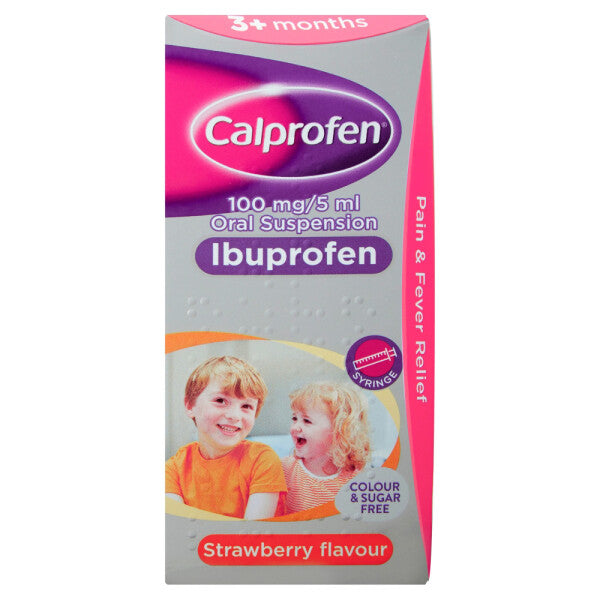
Calprofen Ibuprofen Oral Suspension +3 Months - 100ml
Calprofen Ibuprofen Oral Suspension +3 Months - 100ml
Price Checker
 Lowest price guarantee
 Includes FREE private prescription


Couldn't load pickup availability
Is Calprofen the Right Ibuprofen Suspension for Children?
When your little one is burning up with a fever or crying from teething pain, you want something that works — and works safely. Calprofen Ibuprofen Oral Suspension is a strawberry-flavoured liquid medicine containing ibuprofen 100mg per 5ml, specifically formulated for children aged 3 months and over. It's one of the most widely recognised children's medicines in the UK, trusted by parents and recommended by healthcare professionals for the short-term relief of mild to moderate pain and fever. You can find it alongside other essentials in our baby and toddler range.
Each 100ml bottle comes with a measuring device to help you give the right dose every time. Whether your child is suffering from a cold, earache, sore throat, teething discomfort, or a post-vaccination temperature, ibuprofen suspension for children offers targeted, age-appropriate relief without the need for a prescription.
How Does Calprofen Ibuprofen Suspension Work in the Body?
Ibuprofen belongs to a class of medicines called non-steroidal anti-inflammatory drugs, or NSAIDs. It works through a well-understood mechanism that targets the root cause of pain and fever rather than simply masking symptoms.
- Prostaglandin inhibition: Ibuprofen blocks the enzyme cyclo-oxygenase (COX), which the body uses to produce prostaglandins — chemicals that trigger inflammation, pain signals, and raised temperature.
- Antipyretic action: By reducing prostaglandin levels in the hypothalamus (the brain's temperature-regulating centre), ibuprofen helps bring a fever down.
- Analgesic effect: Lower prostaglandin activity at the site of injury or infection reduces the sensation of pain.
- Anti-inflammatory action: Swelling and redness associated with conditions like earache or sore throat are also reduced.
The liquid formulation means it's absorbed relatively quickly through the gastrointestinal tract, with effects typically noticeable within 20 to 30 minutes of administration.
Who Is Calprofen Ibuprofen Suspension Suitable For?
This suspension is designed for children, not adults. It's suitable for a specific age and weight range, so it's important to check before giving it to your child.
- Children aged 3 months and over
- Children weighing more than 5kg
- Children experiencing mild to moderate pain (e.g. teething, earache, sore throat, headache)
- Children with a fever, including post-immunisation fever
- Children with cold and flu symptoms requiring pain or temperature relief
It is not suitable for children under 3 months, those with a known allergy to ibuprofen or aspirin, or children with certain pre-existing conditions. Always read the label carefully and speak to your pharmacist if you're unsure.
How Does Calprofen Compare to Paracetamol Suspension for Children?
| Feature | Calprofen Ibuprofen Suspension | Paracetamol Suspension (e.g. Calpol) |
|---|---|---|
| Active ingredient | Ibuprofen 100mg/5ml | Paracetamol 120mg/5ml (infant) or 250mg/5ml (6+) |
| Minimum age | 3 months | 2 months (paracetamol infant suspension) |
| Anti-inflammatory action | Yes (NSAID) | No |
| Suitable for stomach conditions | Use with caution | Generally well tolerated |
How Should You Store Calprofen Ibuprofen Suspension?
Proper storage keeps the medicine safe and effective. Store Calprofen below 25°C in a dry place, away from direct sunlight. Do not refrigerate — cold temperatures can affect the consistency of the suspension. Always keep the bottle tightly closed and well out of reach of children.
Check the expiry date before each use. Once opened, use within the period stated on the packaging. If you're building a home medicine cabinet, you'll find our first aid collection has everything you need to be prepared. Discard any unused medicine safely — your local pharmacy can help with this.
This product is a medicine. Speak to your doctor or pharmacist before using if you have an underlying medical condition or are taking other medicines.
Calprofen Ibuprofen Oral Suspension +3 Months - 100ml specifications
| Treatment category | Children's pain relief, fever, cold and flu |
| Mechanism of action | NSAID — inhibits COX enzymes to reduce prostaglandin synthesis |
| Effective for | Mild to moderate pain, fever, post-immunisation temperature |
| Suitable for | Children aged 3 months and over, weighing more than 5kg |
| Active ingredient | Ibuprofen 100mg/5ml |
| Pack size | 100ml |
| Strength | 100mg/5ml |
| UK classification | General Sale List (GSL) |
| Drug class | Non-steroidal anti-inflammatory drug (NSAID) |
| Preparation | Oral suspension |
| Route of administration | Oral |
Specifications of Calprofen Ibuprofen Oral Suspension +3 Months - 100ml
What Is Calprofen Ibuprofen Suspension and What Is It Used For?
Calprofen Ibuprofen Oral Suspension contains ibuprofen 100mg per 5ml as its active ingredient. It is used to relieve mild to moderate pain and to reduce fever in children aged 3 months and over. Common reasons parents reach for this medicine include teething pain, earache, sore throat, headache, cold and flu symptoms, and temperatures following routine childhood vaccinations. It belongs to the NSAID class of medicines and is available over the counter without a prescription.
What Do You Need to Know Before Using Calprofen Ibuprofen Suspension?
Before giving this medicine to your child, read the following carefully. There are situations where ibuprofen suspension for children should not be used, and others where extra caution is needed.
Do not use Calprofen if your child:
- Is under 3 months of age or weighs less than 5kg
- Has a known allergy to ibuprofen, aspirin, or any other NSAID
- Has ever had an asthma attack, urticaria, or rhinitis triggered by aspirin or NSAIDs
- Has active or recurrent peptic ulcer or gastrointestinal bleeding
- Has severe kidney, liver, or heart failure
Use with caution and speak to a pharmacist or doctor if your child:
- Has a history of stomach problems or gastrointestinal disorders
- Has chickenpox — ibuprofen use during chickenpox has been associated with serious skin infections
- Is dehydrated or has been vomiting
- Has any kidney or liver condition
Known drug interactions — tell your pharmacist if your child is taking:
- Other NSAIDs or aspirin
- Anticoagulants (blood thinners) such as warfarin
- Corticosteroids (e.g. prednisolone)
- Diuretics (water tablets)
- Antihypertensive medicines (blood pressure treatments)
- Methotrexate
How Should You Use Calprofen Ibuprofen Suspension?
Always give this medicine exactly as described on the label or as directed by your pharmacist. Never exceed the recommended dose. If symptoms persist for more than 3 days (for fever) or 3 days (for pain), or if they worsen, seek medical advice.
- Shake the bottle well before each use.
- Use the oral syringe or measuring spoon provided — never use a household teaspoon.
- Measure the correct dose based on your child's age and weight (see table below).
- Give the suspension by mouth, directly or mixed with a small amount of water or juice if needed.
- Replace the cap securely after use.
- Give with or after food if stomach upset occurs.
| Age Group | Weight | Dose (Ibuprofen 100mg/5ml) | Frequency |
|---|---|---|---|
| 3–6 months | Over 5kg | 2.5ml (50mg) | Up to 3 times in 24 hours |
| 6–12 months | — | 2.5ml (50mg) | Up to 3 times in 24 hours |
| 1–3 years | — | 5ml (100mg) | Up to 3 times in 24 hours |
| 4–6 years | — | 7.5ml (150mg) | Up to 3 times in 24 hours |
| 7–9 years | — | 10ml (200mg) | Up to 3 times in 24 hours |
| 10–12 years | — | 15ml (300mg) | Up to 3 times in 24 hours |
Leave at least 6–8 hours between doses. Do not give more than 3 doses in any 24-hour period. If you're also managing other symptoms, our cold and flu range has additional products that may help.
What Are the Possible Side Effects of Calprofen Ibuprofen Suspension?
Like all medicines, ibuprofen can cause side effects, although not every child will experience them. Most side effects are mild and resolve on their own.
Common side effects:
- Stomach upset or abdominal discomfort
- Nausea
- Diarrhoea
- Vomiting
Less common side effects:
- Headache
- Dizziness
- Skin rash or itching
- Fluid retention (swelling)
Stop giving the medicine and seek immediate medical attention if your child develops signs of a serious allergic reaction, such as swelling of the face, lips, or throat, difficulty breathing, or a severe skin reaction. Serious gastrointestinal events such as bleeding or ulceration are rare but possible, particularly with prolonged use.
How Should You Store Calprofen Ibuprofen Suspension?
- Store below 25°C in a dry place
- Do not refrigerate
- Keep the bottle tightly closed when not in use
- Keep out of the sight and reach of children
- Do not use after the expiry date printed on the label
- Dispose of unused medicine via your local pharmacy — do not pour down the drain
If you're looking for other children's health essentials, browse our pain relief collection for a wider range of options suitable for different ages and needs.
References
- https://www.nhs.uk/medicines/ibuprofen-for-children/
- https://www.nhs.uk/conditions/fever-in-children/
- https://www.nhs.uk/conditions/vaccinations/vaccination-side-effects/
- https://www.nhs.uk/conditions/chickenpox/
- https://www.nhs.uk/conditions/pain-in-children/
- https://bnf.nice.org.uk/drugs/ibuprofen/
Written and reviewed by our qualified team
Your safety and success are our highest priorities. Our medical team rigorously evaluates every product and piece of advice we provide, ensuring you receive only the most effective, science-backed solutions available.
Frequently Asked Questions
Where can I buy Calprofen Ibuprofen Oral Suspension online in the UK?
You can buy Calprofen Ibuprofen Oral Suspension 100ml directly from Cured Pharmacy, a GPhC-registered UK online pharmacy, for just £4.19. It is available without a prescription as an over-the-counter medicine. Simply add it to your basket and it will be dispatched to your door quickly and discreetly.
How does ibuprofen suspension for children work in the body?
Ibuprofen is a non-steroidal anti-inflammatory drug (NSAID) that works by blocking cyclo-oxygenase (COX) enzymes, which the body uses to produce prostaglandins. Prostaglandins are chemicals responsible for triggering pain, inflammation, and fever. By reducing their production, ibuprofen helps lower your child's temperature and ease discomfort relatively quickly.
How do I give Calprofen Ibuprofen Suspension to my child step by step?
Shake the bottle well before each use, then use the oral syringe or measuring spoon provided to measure the correct dose — never use a household teaspoon as it won't be accurate enough. Give the suspension by mouth, and if your child finds the taste difficult, you can mix it with a small amount of water or juice. Always check the dosage table on the packaging based on your child's age and weight.
What is the correct dose of Calprofen for a child aged 3 to 6 months?
For children aged 3 to 6 months who weigh more than 5kg, the recommended dose is 2.5ml (equivalent to 50mg of ibuprofen), given up to three times in a 24-hour period. Leave at least 6 to 8 hours between each dose. Do not give more than 3 doses in 24 hours, and always consult your pharmacist or GP if you are unsure.
What is the best time to give Calprofen to a child?
There is no single "best" time — you should give Calprofen when your child is experiencing pain or fever that needs relief. Giving it with or after food can help reduce the chance of stomach upset. Space doses at least 6 to 8 hours apart and never exceed 3 doses in any 24-hour period.
What are the side effects of Calprofen Ibuprofen Suspension?
Common side effects include stomach upset, nausea, vomiting, and diarrhoea. Less commonly, children may experience headache, dizziness, or a skin rash. If your child develops any signs of a serious allergic reaction — such as swelling of the face or throat, difficulty breathing, or a severe rash — stop the medicine immediately and seek urgent medical attention.
How do I manage side effects of Calprofen in my child?
If your child experiences stomach discomfort, try giving the suspension with or after food or milk, as this can help reduce irritation. For mild rashes or headaches, monitor your child closely and contact your pharmacist for advice. Always stop the medicine and seek medical help if side effects are severe or if you are concerned.
Who should not be given Calprofen Ibuprofen Suspension?
Calprofen should not be given to children under 3 months of age or those weighing less than 5kg. It is also not suitable for children with a known allergy to ibuprofen, aspirin, or other NSAIDs, or those with active stomach ulcers, severe kidney or liver problems, or heart failure. Children with chickenpox should not be given ibuprofen unless advised by a doctor, as it has been associated with serious skin infections in this context.
What happens if I accidentally give my child too much Calprofen?
If you think you have given your child more than the recommended dose, contact NHS 111 or take your child to the nearest A&E immediately — do not wait for symptoms to develop. Bring the medicine packaging with you so healthcare staff can see exactly what was taken and how much. Overdose with ibuprofen can cause serious harm, including stomach bleeding and kidney problems.
Can I give Calprofen and Calpol (paracetamol) together?
Ibuprofen and paracetamol work differently and can sometimes be used together or alternated under pharmacist or GP guidance, particularly for high or persistent fevers. However, you should always seek advice from a healthcare professional before combining the two, and never exceed the recommended dose of either medicine. Do not give both at the same time without professional advice.
Is Calprofen suitable for children with asthma?
Ibuprofen can trigger bronchospasm in some children with asthma, particularly those who have previously reacted to aspirin or other NSAIDs. If your child has asthma, speak to your GP or pharmacist before giving any ibuprofen-containing medicine. Paracetamol suspension is often recommended as a safer alternative for children with asthma.
What are alternatives to Calprofen Ibuprofen Suspension for children?
The main alternative is paracetamol-based suspension (such as Calpol), which is suitable from 2 months of age and is generally well tolerated, including by children with asthma. You can explore our baby and toddler collection for a range of children's medicines. Your pharmacist can help you choose the most appropriate option based on your child's age, weight, and medical history.
How long can I give my child Calprofen for?
Calprofen should only be used for short-term relief. For fever, do not use for more than 3 days without seeking medical advice. For pain, do not use for more than 3 days in children under 12 without consulting a doctor or pharmacist. If symptoms persist or worsen, always seek professional guidance rather than continuing to self-treat.
Can Calprofen be used for post-vaccination fever in babies?
Yes — ibuprofen suspension for children can be used to manage fever and discomfort following routine childhood vaccinations, provided your child is at least 3 months old and weighs more than 5kg. The NHS advises that a mild fever after vaccination is normal and usually resolves within 48 hours. Always follow the dosage instructions and contact your GP if the fever is high or prolonged.
What are the latest guidelines on using ibuprofen for children's fever in the UK?
Current NHS guidance recommends ibuprofen or paracetamol as first-line options for managing fever and pain in children, but advises against routinely alternating the two without professional advice. The focus should be on keeping your child comfortable rather than targeting a specific temperature number. For up-to-date advice on managing children's illnesses, you can also browse our cold and flu range for additional support products.
Written and reviewed by our qualified team

Reviewed by:
Tarun Kumar
Superintendent/ Clinical Lead
📖 Find out more about our team of medical content authors and how we ensure the accuracy of our content with our content guidelines.
Content last updated: 14 Sep 2026
Other popular options


We’re a safe and
regulated UK service

Lowest Price Guarantee

We're convinced you won't find your treatment cheaper, but if you do we'll refund the difference.
Find out more
100% discreet packaging

Discreet, unbranded packaging for every order.
Find out more

Need help?
Talk to our friendly experts now


How our service works

Service setup

Discreet packaging

Express delivery