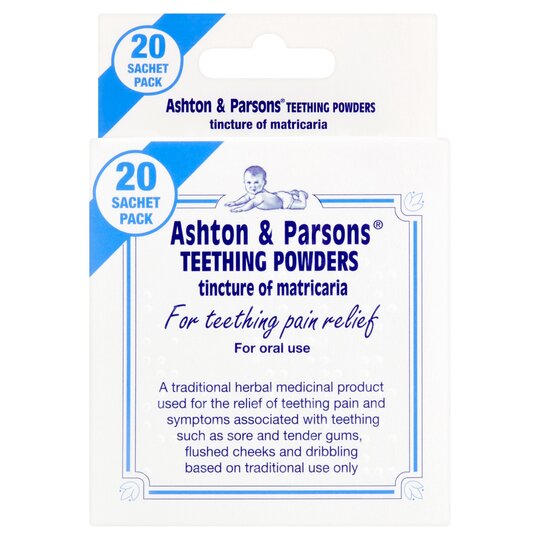
Ashton & Parsons Teething Powders 20 Sachet
Ashton & Parsons Teething Powders 20 Sachet
- ✔️ Soothes baby teething pain from 3 months onwards
- ✔️ Contains traditional chamomile to calm teething irritability
- ✔️ Sugar-free, lactose-free formula suitable for sensitive babies
- ✔️ MHRA-registered Traditional Herbal Registration (THR) product
- ✔️ 20 individual sachets for convenient on-the-go teething relief
Price Checker
 Lowest price guarantee
 Includes FREE private prescription


Couldn't load pickup availability
What Are Ashton and Parsons Teething Powders?
Teething is one of those milestones that every parent dreads a little. The sleepless nights, the constant dribbling, the inconsolable crying — it can feel relentless. Ashton and Parsons teething powders have been trusted by UK parents for generations, offering a traditional herbal approach to easing the discomfort that comes with a baby's first teeth breaking through. Each pack contains 20 individual sachets, making it easy to use at home or on the go. You can find them alongside other baby and toddler essentials at Cured Pharmacy.
Teething typically begins around 6 months of age, though some babies start as early as 3 months. The NHS notes that teething can cause sore and tender gums, and babies may become irritable or drool more than usual. These powders are designed specifically to address those symptoms in a gentle, easy-to-administer format.
How Do Ashton and Parsons Teething Powders Work?
The active ingredient in these powders is a tincture of Matricaria recutita — more commonly known as chamomile. Chamomile has a long history of traditional use for soothing irritability and mild discomfort. Here's how the product works in practice:
- The powder is poured directly onto the baby's tongue or dissolved in a small amount of cooled boiled water.
- The chamomile tincture is absorbed via the oral mucosa, acting locally to help calm the baby.
- The remedy works on a traditional herbal medicine basis — it is registered under the UK Traditional Herbal Registration (THR) scheme, meaning its safety and quality have been assessed by the MHRA.
- It does not contain any sugar, artificial colours, or lactose, making it suitable for a wide range of babies.
It's worth noting that this is a traditional herbal medicine. That means its efficacy is based on traditional use rather than clinical trial evidence. If your baby's symptoms are severe or you're concerned, always speak to your GP or health visitor.
Who Should Use Ashton and Parsons Teething Powders?
These powders are intended for babies and young children who are experiencing the typical signs of teething. They are not suitable for every child, so it's important to check suitability before use.
- Babies aged 3 months and over who are showing signs of teething discomfort.
- Parents looking for a sugar-free, herbal alternative to topical teething gels.
- Babies who have difficulty with topical gels applied to the gums.
- Families seeking a product with a long-established safety record in the UK.
These powders are not suitable for babies with a known allergy to chamomile or to plants in the Asteraceae/Compositae family (which includes daisies and ragweed). If your baby has any known plant allergies, consult your pharmacist or GP before use.
How Do Ashton and Parsons Teething Powders Compare to Alternatives?
| Feature | Ashton & Parsons Teething Powders | Teething Gel (e.g. Bonjela Once) |
|---|---|---|
| Active ingredient | Chamomile tincture (herbal) | Choline salicylate (analgesic) |
| Minimum age | 3 months | Varies — some not suitable under 16 (salicylate risk) |
| Administration | Oral powder on tongue | Topical gel applied to gums |
| Sugar-free | Yes | Varies by product |
| MHRA registered | Yes (THR) | Yes (licensed medicine) |
How Should You Store Ashton and Parsons Teething Powders?
Storage is straightforward. Keep the sachets in a cool, dry place below 25°C, away from direct sunlight and out of the reach and sight of children. Do not use any sachet past its expiry date, which is printed on the outer carton. Once a sachet is opened, use it immediately — do not store an opened sachet for later use.
If you're building up a medicine cabinet for your little one, it's worth exploring our range of dental products to support your child's oral health as their teeth come through. Keeping everything stored safely and checking expiry dates regularly is good practice for any family medicine cabinet.
This product is a medicine. Speak to your doctor or pharmacist before using if you have an underlying medical condition or are taking other medicines.
Ashton & Parsons Teething Powders 20 Sachet specifications
| Treatment category | Teething relief |
| Mechanism of action | Traditional herbal remedy — chamomile tincture to soothe teething discomfort |
| Effective for | Teething pain, irritability, and discomfort in babies |
| Suitable for | Babies aged 3 months and over |
| Active ingredient | Matricaria recutita (chamomile) tincture |
| Pack size | 20 sachets |
| UK classification | Traditional Herbal Registration (THR) |
| Drug class | Traditional herbal medicine |
| Preparation | Oral powder |
| Route of administration | Oral |
Specifications of Ashton & Parsons Teething Powders 20 Sachet
What Is Ashton & Parsons Teething Powders and What Is It Used For?
Ashton & Parsons Teething Powders is a traditional herbal medicinal product used to relieve the symptoms associated with teething in babies. These symptoms include sore and tender gums, excessive dribbling, irritability, and disturbed sleep. The product is registered under the UK Traditional Herbal Registration (THR) scheme, which means the MHRA has assessed its quality and safety, though efficacy is based on traditional use rather than modern clinical trials.
Teething is a normal developmental process. According to the NHS, most babies begin teething between 6 and 12 months, though it can start as early as 3 months. The lower front teeth usually appear first, followed by the upper front teeth. The process continues until all 20 primary (milk) teeth have come through, typically by the age of 3.
What Do You Need to Know Before Using Ashton & Parsons Teething Powders?
Before giving these powders to your baby, read the following carefully. There are some situations where this product should not be used.
Do not use if your baby:
- Is under 3 months of age.
- Has a known allergy to chamomile or any plant in the Asteraceae/Compositae family (e.g. daisies, ragweed, chrysanthemums).
- Has a known hypersensitivity to any of the other ingredients listed on the packaging.
- Has been diagnosed with a condition requiring medical supervision — always consult your GP first.
Warnings and precautions:
- If symptoms persist for more than 7 days, or if your baby develops a high temperature, rash, or diarrhoea, consult your GP — these may not be teething symptoms.
- Do not exceed the recommended dose.
- Keep all medicines out of the reach and sight of children.
- This product is a traditional herbal medicine. It is not a substitute for medical advice.
Known drug interactions:
- No clinically significant drug interactions have been identified for this product at the recommended dose.
- If your baby is taking any prescribed medicines, consult your pharmacist or GP before use.
How Should You Use Ashton & Parsons Teething Powders?
Always use this product exactly as described on the label or as directed by your pharmacist. Do not give more than the recommended number of sachets in any 24-hour period.
- Wash your hands thoroughly before handling the sachet.
- Tear open one sachet carefully along the perforated edge.
- Pour the entire contents of the sachet directly onto your baby's tongue.
- Alternatively, dissolve the powder in a small amount of cooled boiled water and give it to your baby using a spoon or feeding cup.
- Wait at least 30 minutes before giving another sachet if symptoms continue.
- Discard any unused portion of an opened sachet immediately.
Dosage table:
| Indication | Age Group | Dose | Frequency |
|---|---|---|---|
| Teething discomfort | 3 months – 3 years | 1 sachet | Up to 6 times daily, at least 30 minutes apart |
If you are also managing other aspects of your baby's health, our pain relief range includes infant paracetamol and ibuprofen options that your pharmacist can advise on alongside this product.
What Are the Possible Side Effects of Ashton & Parsons Teething Powders?
Side effects with this product are uncommon when used as directed. However, as with any medicine, reactions can occur. Stop use immediately and seek medical advice if you notice any of the following.
Common side effects:
- None commonly reported at the recommended dose.
Less common / rare side effects:
- Allergic reaction — including skin rash, itching, or hives.
- Swelling of the face, lips, tongue, or throat (angioedema) — seek emergency medical help immediately if this occurs.
- Breathing difficulties — call 999 immediately.
- Hypersensitivity reactions in babies with chamomile or Asteraceae plant allergies.
If you are ever unsure whether a symptom is related to teething or to the product itself, stop use and speak to your GP or pharmacist promptly.
How Should You Store Ashton & Parsons Teething Powders?
Correct storage helps maintain the quality and safety of the product throughout its shelf life. Follow these guidelines:
- Store below 25°C in a cool, dry place.
- Keep away from direct sunlight and moisture.
- Store out of the reach and sight of children at all times.
- Do not use after the expiry date printed on the carton.
- Once a sachet is opened, use it immediately and discard any remainder.
- Do not store in a bathroom cabinet where humidity may affect the powder.
For broader family health needs, you might also find our first aid collection useful — stocking up on essentials means you're always prepared when your little one needs care.
References
- https://www.nhs.uk/conditions/baby/babys-development/teething/teething-symptoms-and-remedies/
- https://www.nhs.uk/conditions/baby/babys-development/teething/when-do-babies-start-teething/
- https://www.nhs.uk/conditions/baby/babys-development/teething/how-to-help-a-teething-baby/
- https://www.nhs.uk/medicines/ibuprofen-for-children/
- https://www.gov.uk/guidance/traditional-herbal-registration-thr
Written and reviewed by our qualified team
Your safety and success are our highest priorities. Our medical team rigorously evaluates every product and piece of advice we provide, ensuring you receive only the most effective, science-backed solutions available.
Frequently Asked Questions
Where can I buy Ashton and Parsons teething powders online in the UK?
You can buy Ashton and Parsons teething powders directly from Cured Pharmacy, a GPhC-registered UK online pharmacy, for just £5.99 per pack of 20 sachets. They are also widely available in high street pharmacies and supermarkets across the UK. Ordering online is convenient and means you can have them delivered straight to your door without a trip out with a teething baby.
How do Ashton and Parsons teething powders work in the body?
The powders contain a tincture of Matricaria recutita (chamomile), a plant with a long history of traditional use for soothing irritability and mild discomfort. When poured onto the baby's tongue, the chamomile tincture is absorbed via the oral mucosa. This is a traditional herbal medicine, so its use is based on established traditional practice rather than modern clinical trial data.
How do I use Ashton and Parsons teething powders step by step?
Using the powders is simple and takes only a few seconds. Follow these steps:
- Wash your hands before handling the sachet.
- Tear open one sachet along the perforated edge.
- Pour the powder directly onto your baby's tongue, or dissolve it in a small amount of cooled boiled water.
- Wait at least 30 minutes before giving another sachet if needed.
Never give more than 6 sachets in any 24-hour period.
From what age can babies have Ashton and Parsons teething powders?
Ashton and Parsons teething powders are suitable for babies from 3 months of age. If your baby is younger than 3 months and showing signs of discomfort, speak to your GP or health visitor before using any teething remedy. Always check the packaging before use and consult your pharmacist if you have any doubts about suitability.
What is the correct dose of Ashton and Parsons teething powders?
The recommended dose is one sachet at a time, given up to six times per day, with at least 30 minutes between each dose. Do not exceed six sachets in any 24-hour period. There is no separate dosing for different age groups within the eligible range — one sachet per dose applies from 3 months onwards.
Are Ashton and Parsons teething powders safe for my baby?
When used as directed, these powders are considered safe for babies from 3 months of age. They are registered under the MHRA's Traditional Herbal Registration (THR) scheme, which means their quality and safety have been assessed. However, do not use them if your baby has a known allergy to chamomile or plants in the Asteraceae family, and always consult your GP if you have any concerns.
What are the side effects of Ashton and Parsons teething powders?
Side effects are rare at the recommended dose. The main risk is an allergic reaction in babies sensitive to chamomile. Signs to watch for include:
- Skin rash or hives
- Swelling of the face, lips, or tongue
- Difficulty breathing
If you notice any of these signs, stop use immediately and seek urgent medical attention. Call 999 if your baby has difficulty breathing.
Can I use Ashton and Parsons teething powders alongside infant paracetamol?
There are no known interactions between Ashton and Parsons teething powders and infant paracetamol or infant ibuprofen. Many parents use both together during particularly difficult teething episodes. That said, always check with your pharmacist before combining any medicines, and ensure you are following the correct dosing instructions for each product separately.
Do Ashton and Parsons teething powders contain sugar or artificial colours?
No — Ashton and Parsons teething powders are free from sugar, artificial colours, and lactose. This makes them a suitable choice for parents who want to avoid unnecessary additives in their baby's remedies. Always check the full ingredients list on the packaging if your baby has any known food sensitivities or allergies.
How long can I use Ashton and Parsons teething powders for?
You can use these powders throughout your baby's teething period, which typically runs from around 3 months until all 20 primary teeth have come through — usually by age 3. If symptoms persist beyond 7 days without improvement, or if your baby develops a fever, rash, or diarrhoea, consult your GP as these may not be teething-related symptoms.
What are the alternatives to Ashton and Parsons teething powders?
There are several alternatives available for teething relief, including:
- Chilled (not frozen) teething rings to soothe sore gums
- Infant paracetamol or ibuprofen for babies over the appropriate age and weight
- Teething gels — though note that some contain salicylates and are not suitable for young babies
- Gently rubbing the baby's gums with a clean finger
The NHS recommends a combination of approaches depending on your baby's age and the severity of symptoms. You can explore our baby and toddler range for more options.
Are Ashton and Parsons teething powders a licensed medicine?
Ashton and Parsons teething powders hold a Traditional Herbal Registration (THR) from the MHRA, which is a specific regulatory category for traditional herbal medicines in the UK. This is different from a full product licence — efficacy is based on traditional use rather than clinical trial evidence, but safety and quality standards have been assessed by the MHRA.
What happens if I accidentally give my baby too many sachets?
If you accidentally give your baby more than the recommended number of sachets, contact NHS 111 or your nearest A&E for advice. Take the packaging with you so healthcare professionals can see exactly what was given and how much. Do not wait for symptoms to appear before seeking guidance — it is always better to check promptly.
What is the latest research on herbal teething remedies like Ashton and Parsons?
Research specifically on Ashton and Parsons teething powders is limited, as is typical for traditional herbal medicines. The product's registration under the MHRA's THR scheme is based on its long history of traditional use rather than randomised controlled trial data. The NHS advises that teething gels and herbal remedies have limited evidence of effectiveness, and recommends combining them with non-medicinal approaches such as teething rings and gentle gum massage.
Can I use Ashton and Parsons teething powders if my baby has a milk allergy?
Ashton and Parsons teething powders do not contain lactose or dairy-derived ingredients, so they are generally considered suitable for babies with a cow's milk protein allergy or lactose intolerance. However, always read the full ingredients list on the current packaging before use, as formulations can occasionally change. If you are unsure, speak to your pharmacist or GP. You can also browse our oral health range for additional baby-friendly products.
Written and reviewed by our qualified team

Reviewed by:
Tarun Kumar
Superintendent/ Clinical Lead
📖 Find out more about our team of medical content authors and how we ensure the accuracy of our content with our content guidelines.
Content last updated: 14 Sep 2026
Other popular options


We’re a safe and
regulated UK service

Lowest Price Guarantee

We're convinced you won't find your treatment cheaper, but if you do we'll refund the difference.
Find out more
100% discreet packaging

Discreet, unbranded packaging for every order.
Find out more

Need help?
Talk to our friendly experts now


How our service works

Service setup

Discreet packaging

Express delivery