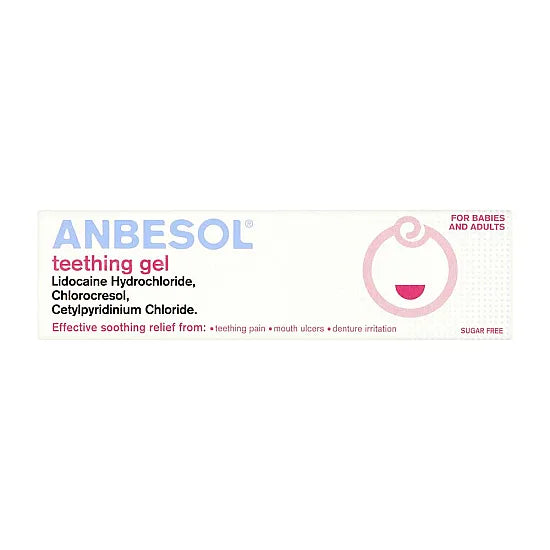
Anbesol Teething Gel - 10g
- ✔️ Temporarily numbs sore baby gums with lidocaine 1%
- ✔️ Suitable for babies aged 5 months and over
- ✔️ Contains antiseptic agents to support oral hygiene
- ✔️ Fast-acting topical relief during teething flare-ups
- ✔️ Up to 6 applications daily for all-day comfort
Price Checker
 Discreet, tracked delivery
 Includes FREE private prescription


Couldn't load pickup availability
What Is Anbesol Teething Gel and How Does It Help?
Teething is one of those milestones that sounds straightforward — until you're up at 2am with a distressed, drooling baby who simply won't settle. Anbesol teething gel is a trusted, over-the-counter topical gel designed to provide fast, localised relief from the gum pain and discomfort that teething causes in babies and young children. At just £3.49 for a 10g tube, it's an accessible option for parents looking for a clinically recognised solution. You can browse our full range of baby and toddler medicines if you need additional support products alongside this gel.
The gel is applied directly to the sore gum area, where it gets to work quickly. It's been used by parents in the UK for many years and remains one of the most recognisable names in infant dental comfort. That said, it's still a medicine — so understanding how it works and who it's suitable for really does matter.
How Does Anbesol Teething Gel Work on Sore Gums?
The gel works through a combination of local anaesthesia and antiseptic action. Here's what each active ingredient does:
- Lidocaine hydrochloride 1% — a local anaesthetic that temporarily blocks nerve signals in the gum tissue, reducing the sensation of pain at the site of application.
- Chlorocresol 0.1% — an antiseptic agent that helps reduce the risk of bacterial activity in the affected area.
- Cetylpyridinium chloride 0.02% — a further antiseptic that supports oral hygiene at the application site.
Together, these ingredients provide both symptomatic pain relief and a degree of antimicrobial protection. The numbing effect from lidocaine typically begins within a few minutes of application, which is why many parents find it particularly useful before feeds or bedtime when discomfort tends to peak.
Who Is Anbesol Teething Gel Suitable For?
This gel is specifically formulated for teething infants and young children. It is not a product intended for adults, though Anbesol does produce a separate adult liquid formulation. The teething gel version is appropriate for:
- Babies aged 5 months and over who are experiencing teething discomfort
- Infants showing signs of sore, swollen, or tender gums
- Children who are unsettled, drooling excessively, or chewing on objects due to teething
- Situations where non-medicated options (such as teething rings) haven't provided enough relief
It is not suitable for babies under 5 months of age. If your baby is under 5 months and appears to be in discomfort, speak to your GP or health visitor before using any teething product.
How Does Anbesol Teething Gel Compare to Other Teething Gels?
| Feature | Anbesol Teething Gel | Bonjela Teething Gel |
|---|---|---|
| Active ingredient | Lidocaine hydrochloride 1% | Choline salicylate 8.7% |
| Minimum age | 5 months | 16 months (teething version) |
| Mechanism | Local anaesthetic + antiseptic | Anti-inflammatory + mild anaesthetic |
| Max daily applications | 6 times (every 3 hours) | 6 times (every 3 hours) |
How Should You Store Anbesol Teething Gel and Is It Safe to Use Regularly?
Store the tube below 25°C and keep it out of direct sunlight. Do not refrigerate. Once opened, check the expiry date on the packaging and do not use beyond it. The tube should be kept out of reach of children at all times — which might sound obvious for a baby product, but older siblings can sometimes get hold of things they shouldn't.
Used as directed, anbesol teething gel is considered safe for short-term use in babies aged 5 months and over. If your child's teething symptoms persist beyond a few days or seem unusually severe, it's worth checking in with your GP or health visitor. For broader dental products suitable for the whole family, take a look at our dedicated collection.
This product is a medicine. Speak to your doctor or pharmacist before using if you have an underlying medical condition or are taking other medicines.
Anbesol Teething Gel 10g specifications
| Treatment category | Teething pain relief |
| Mechanism of action | Local anaesthetic and antiseptic |
| Effective for | Gum pain and discomfort associated with teething |
| Suitable for | Babies aged 5 months and over |
| Active ingredient | Lidocaine hydrochloride 1%, Chlorocresol 0.1%, Cetylpyridinium chloride 0.02% |
| Pack size | 10g |
| UK classification | General Sale List (GSL) |
| Drug class | Local anaesthetic / antiseptic |
| Preparation | Topical gel |
| Route of administration | Topical (applied to oral mucosa) |
Specifications of Anbesol Teething Gel 10g
What Is Anbesol Teething Gel and What Is It Used For?
Anbesol Teething Gel 10g is a topical, over-the-counter medicine used to relieve the pain and discomfort caused by teething in babies and young children. Teething typically begins around 6 months of age, though some babies start earlier — and the process of new teeth pushing through the gum tissue can cause significant soreness, irritability, and disturbed sleep. The NHS acknowledges that teething can be a difficult time for both babies and parents, and recommends a range of approaches to manage discomfort, including teething gels containing a local anaesthetic.
The gel contains lidocaine hydrochloride as its primary active ingredient, which works by temporarily numbing the gum surface. It also contains two antiseptic agents — chlorocresol and cetylpyridinium chloride — which help maintain oral hygiene at the site of application. This combination makes it a practical choice for parents managing acute teething episodes.
What Do You Need to Know Before Using Anbesol Teething Gel?
Before applying this gel to your baby's gums, please read the following carefully. There are some situations where it should not be used, and a few things to be aware of regarding interactions.
Do not use Anbesol Teething Gel if your baby:
- Is under 5 months of age
- Has a known allergy or hypersensitivity to lidocaine, any other local anaesthetic, or any other ingredient in the gel
- Has open sores, ulcers, or broken skin in the mouth (unless advised by a healthcare professional)
Use with caution and speak to a pharmacist or GP first if your baby:
- Has any known medical conditions affecting the liver or kidneys
- Is already taking other medicines, including other topical oral preparations
- Has previously had a reaction to any anaesthetic product
Drug interactions:
- No clinically significant interactions are expected at the recommended topical dose
- Avoid using alongside other lidocaine-containing products to prevent excessive absorption
- If your baby is on any prescribed medicines, check with your pharmacist before use
How Should You Use Anbesol Teething Gel Correctly?
Always follow the instructions on the packaging. Here is a step-by-step guide to applying the gel safely and effectively:
- Wash your hands thoroughly before and after application.
- Squeeze a small pea-sized amount of gel onto a clean fingertip or cotton bud.
- Gently massage the gel directly onto the sore or swollen gum area.
- Allow the gel to remain on the gum — do not rinse or wipe away immediately.
- Wait at least 3 hours before applying again if symptoms persist.
- Do not apply more than 6 times in any 24-hour period.
If you're also exploring other ways to support your baby's comfort, our pain relief collection includes age-appropriate options such as infant paracetamol and ibuprofen suspensions.
| Indication | Age Group | Dose | Frequency |
|---|---|---|---|
| Teething pain | 5 months and over | Small pea-sized amount applied to affected gum | Up to 6 times daily, at least 3 hours apart |
| Teething pain | Under 5 months | Not suitable — do not use | |
What Are the Possible Side Effects of Anbesol Teething Gel?
Like all medicines, Anbesol Teething Gel can cause side effects, although not everyone will experience them. Because the gel is applied topically in small amounts, systemic side effects are very unlikely when used as directed. However, it's important to know what to look out for.
Common side effects:
- Mild, temporary stinging or tingling at the application site
- Localised redness of the gum tissue
Less common side effects:
- Skin or mucosal irritation beyond the application site
- Hypersensitivity or allergic reaction — signs may include swelling, rash, or difficulty breathing. Stop use immediately and seek urgent medical attention if this occurs.
- Excessive numbness if too much gel is applied — always use the smallest effective amount
The NHS advises that if your baby shows any signs of an allergic reaction after using a teething product, you should stop use immediately and contact 999 or go to your nearest A&E if the reaction appears severe.
How Should You Store Anbesol Teething Gel Safely?
Correct storage helps maintain the gel's effectiveness and safety throughout its shelf life. Follow these guidelines:
- Store below 25°C in a cool, dry place
- Do not refrigerate or freeze
- Keep the cap tightly closed when not in use
- Keep out of the sight and reach of children
- Do not use after the expiry date printed on the tube and carton
- Do not dispose of medicines via wastewater or household waste — return unused medicines to your pharmacy
If you're looking for other products to support your little one's health and wellbeing, our oral health collection has a range of age-appropriate options for the whole family.
References
- https://www.nhs.uk/conditions/baby/babys-development/teething/teething-symptoms-and-remedies/
- https://www.nhs.uk/medicines/lidocaine-for-mouth-and-throat/
- https://www.nhs.uk/conditions/baby/babys-development/teething/how-to-soothe-a-teething-baby/
- https://www.nhs.uk/conditions/allergies/
- https://bnf.nice.org.uk/drugs/lidocaine-hydrochloride/
Written and reviewed by our qualified team
Your safety and success are our highest priorities. Our medical team rigorously evaluates every product and piece of advice we provide, ensuring you receive only the most effective, science-backed solutions available.
Frequently Asked Questions
Where can I buy Anbesol Teething Gel online in the UK?
You can buy Anbesol Teething Gel 10g directly from Cured Pharmacy, a GPhC-registered UK online pharmacy, for just £3.49. It's available without a prescription and can be ordered quickly and discreetly. It is also stocked in most UK high street pharmacies and larger supermarkets.
How does Anbesol Teething Gel work in the body?
The gel contains lidocaine hydrochloride, a local anaesthetic that temporarily blocks pain signals in the nerve endings of the gum tissue. It also contains two antiseptic agents — chlorocresol and cetylpyridinium chloride — which help keep the application area clean. The numbing effect typically begins within a few minutes of application.
How do I apply Anbesol Teething Gel step by step?
Wash your hands first, then squeeze a small pea-sized amount onto a clean fingertip or cotton bud. Gently massage the gel directly onto the sore gum area and allow it to sit — don't wipe it away. Repeat no more than every 3 hours, and no more than 6 times in 24 hours.
What age can babies start using Anbesol Teething Gel?
Anbesol Teething Gel is suitable for babies aged 5 months and over. It must not be used in babies younger than 5 months. If your baby is under 5 months and appears to be in discomfort, speak to your GP or health visitor for appropriate advice.
How often can I use Anbesol Teething Gel each day?
You can apply the gel up to 6 times per day, but you must leave at least 3 hours between each application. Never exceed this frequency, as overuse could lead to excessive lidocaine absorption. If symptoms are not improving after a few days, consult your pharmacist or GP.
What are the side effects of Anbesol Teething Gel?
Side effects are uncommon when the gel is used as directed. You may notice mild, temporary stinging or localised redness at the application site. Rarely, an allergic or hypersensitivity reaction can occur — if your baby develops swelling, a rash, or any breathing difficulty, stop use immediately and seek urgent medical attention.
Can I use Anbesol Teething Gel alongside infant paracetamol?
There are no known clinically significant interactions between Anbesol Teething Gel and infant paracetamol suspension when both are used at recommended doses. However, it's always sensible to check with your pharmacist before combining any medicines. You can find suitable pain relief options for babies in our dedicated collection.
Is Anbesol Teething Gel safe to swallow if my baby ingests some?
Small amounts of the gel that are incidentally swallowed during normal application are unlikely to cause harm, as the dose is very small. However, the gel is not intended to be swallowed deliberately, and you should always use the minimum amount needed. If you are concerned that your baby has ingested a large amount, contact NHS 111 or your nearest A&E immediately.
What are the alternatives to Anbesol Teething Gel?
Non-medicated alternatives include chilled (not frozen) teething rings and gentle gum massage. Medicated alternatives include infant paracetamol or ibuprofen suspension for babies of appropriate age and weight. Bonjela Teething Gel is another option, though it is only suitable from 16 months. Browse our baby and toddler range for more options.
How long can I keep using Anbesol Teething Gel?
Anbesol Teething Gel is intended for short-term use during active teething episodes. If your baby's symptoms persist for more than a few days without improvement, or if the discomfort seems unusually severe, speak to your GP or health visitor. Do not use the gel beyond the expiry date printed on the packaging.
Does Anbesol Teething Gel contain sugar or artificial colours?
Anbesol Teething Gel does not contain sugar, which makes it suitable for use without concern about dental decay from the product itself. Always check the full ingredients list on the packaging if your baby has known sensitivities or allergies to specific excipients.
Can I use Anbesol Teething Gel if my baby has a mouth ulcer?
You should not apply Anbesol Teething Gel to open sores or ulcers unless specifically advised to do so by a healthcare professional. If your baby has mouth ulcers alongside teething symptoms, speak to your GP or pharmacist before using any topical oral gel. Mouth ulcers in infants can sometimes indicate an underlying condition that needs assessment.
What is the difference between Anbesol Teething Gel and Anbesol Adult Strength Liquid?
Anbesol Teething Gel is specifically formulated for babies aged 5 months and over, with a lower concentration of active ingredients in a gel base suited to infant gum application. Anbesol Adult Strength Liquid is intended for adults and older children experiencing mouth ulcers, denture pain, or other oral discomfort — it is not appropriate for use in infants.
What are the latest guidelines on teething gels for babies?
The NHS advises that teething gels containing a local anaesthetic, such as lidocaine, can be used in babies from 5 months of age to help relieve teething pain. The NHS also recommends combining gel use with non-medicated approaches such as teething rings and gentle gum massage for best results. Always follow the dosage instructions and consult a pharmacist if you are unsure.
Is Anbesol Teething Gel available on prescription in the UK?
No — Anbesol Teething Gel is classified as a General Sale List (GSL) medicine in the UK, meaning it can be purchased without a prescription from pharmacies, supermarkets, and registered online pharmacies. You can order it easily from our dental products collection at Cured Pharmacy.
Written and reviewed by our qualified team

Reviewed by:
Tarun Kumar
Superintendent/ Clinical Lead
📖 Find out more about our team of medical content authors and how we ensure the accuracy of our content with our content guidelines.
Content last updated: 14 Sep 2026
Other popular options


We’re a safe and
regulated UK service

100% discreet packaging

Discreet, unbranded packaging for every order.

Need help?
Talk to our friendly experts now


How our service works

Service setup

Discreet packaging

Express delivery