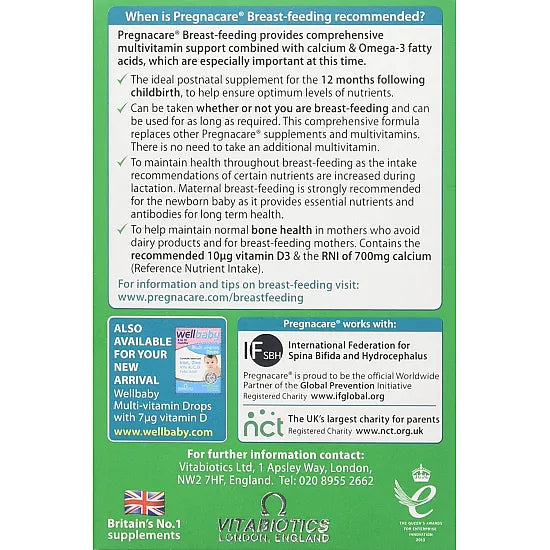
Vitabiotics Pregnacare Breast-Feeding Dual Pack - 84 Tablets/Capsules
Vitabiotics Pregnacare Breast-Feeding Dual Pack - 84 Tablets/Capsules
- ✔️ Provides NHS-recommended 10mcg vitamin D3 for breastfeeding mothers
- ✔️ Includes omega-3 DHA to support infant brain and eye development
- ✔️ Delivers iodine to support maternal thyroid function during lactation
- ✔️ Dual-pack format: one tablet plus one capsule, once daily
- ✔️ Formulated specifically for the nutritional demands of breastfeeding
Price Checker
 Lowest price guarantee
 Includes FREE private prescription


Couldn't load pickup availability
What Are Pregnacare Breastfeeding Vitamins and Why Do You Need Them?
Becoming a mother changes everything — including your nutritional needs. When you're breastfeeding, your body is working hard to produce milk that nourishes your baby, and that process draws on your own nutrient reserves. Pregnacare breastfeeding vitamins are specifically formulated to help replenish those reserves, supporting both you and your baby during this important stage. The Vitabiotics Pregnacare Breast-Feeding Dual Pack contains 56 tablets and 28 omega-3 capsules — a one-month supply designed to be taken together daily. You can find this and other postnatal nutritional products in our vitamins and supplements collection.
The NHS advises that breastfeeding women have increased requirements for several nutrients, including vitamin D, iodine, and omega-3 fatty acids. Many women find it difficult to meet these needs through diet alone, particularly in the early weeks after birth when life is understandably hectic. This dual-pack format makes it straightforward — one tablet, one capsule, once a day.
How Does the Pregnacare Breast-Feeding Dual Pack Work?
The product works through two complementary components taken together each day:
- The tablet delivers a broad spectrum of vitamins and minerals, including vitamin D3 (10 micrograms), vitamin C, B vitamins including folic acid, iodine, iron, zinc, and magnesium — all of which play a role in supporting maternal health during lactation.
- The omega-3 capsule provides docosahexaenoic acid (DHA), a long-chain fatty acid that passes into breast milk and contributes to normal brain and eye development in infants.
- Vitamin D is particularly important — the NHS recommends all breastfeeding women take a daily 10 microgram supplement, as breast milk alone may not provide enough for the baby.
- Iodine supports normal thyroid function in the mother and contributes to the baby's cognitive development via breast milk.
Together, these two components address the dual nutritional demands of the postnatal period — keeping you well while helping your baby thrive.
Who Should Consider Using Pregnacare Breast-Feeding?
This product is intended for women who are currently breastfeeding. It is not a pregnancy supplement — if you are still pregnant, Pregnacare Original or Pregnacare Max would be more appropriate. So who specifically benefits from this dual pack?
- Women who are exclusively breastfeeding and want to support their own nutritional status
- Mothers who are partially breastfeeding alongside formula feeding
- Women with dietary restrictions (e.g. low fish intake) who may not be getting enough DHA from food
- Those who have been advised by a midwife, health visitor, or GP to take a postnatal supplement
It is not suitable for women who are not breastfeeding, children, or men. If you have a known medical condition — particularly thyroid disorders, kidney disease, or iron overload conditions — speak to your GP or pharmacist before starting this supplement.
How Does Pregnacare Breast-Feeding Compare to Other Postnatal Supplements?
| Feature | Pregnacare Breast-Feeding Dual Pack | Standard Postnatal Multivitamin |
|---|---|---|
| Omega-3 DHA included | Yes — separate capsule | Often not included |
| Iodine | Yes | Variable — not always present |
| Vitamin D dose | 10 micrograms (NHS recommended level) | Variable |
| Formulated specifically for breastfeeding | Yes | Not always |
Is Pregnacare Breast-Feeding Safe to Take and How Should You Store It?
Pregnacare breastfeeding vitamins are generally well tolerated when taken as directed. Store the pack below 25°C in a dry place, away from direct sunlight. Keep out of sight and reach of children. Do not use after the expiry date printed on the packaging. If you are also taking other supplements — particularly those containing vitamin A, iron, or iodine — check with your pharmacist to avoid exceeding safe upper intake levels. New mothers managing multiple aspects of their health may also find our women's health collection useful for related products.
This product is a food supplement, not a medicine. However, speak to your doctor or pharmacist before using if you have an underlying medical condition or are taking other medicines.
Vitabiotics Pregnacare Breast-Feeding Dual Pack - 84 Tablets/Capsules specifications
| Treatment category | Postnatal nutritional supplementation |
| Mechanism of action | Replenishes vitamins, minerals, and omega-3 DHA depleted during lactation |
| Effective for | Supporting maternal nutrition and infant development during breastfeeding |
| Suitable for | Breastfeeding women |
| Active ingredients | Vitamin D3, Vitamin C, Folic Acid, Iodine, Iron, Zinc, Magnesium, Omega-3 DHA |
| Pack size | 56 tablets + 28 capsules (84 total) |
| UK classification | Food supplement (OTC) |
| Drug class | Multivitamin and mineral supplement with omega-3 |
| Preparation | Tablet and soft gel capsule |
| Route of administration | Oral |
Specifications of Vitabiotics Pregnacare Breast-Feeding Dual Pack - 84 Tablets/Capsules
What Is Pregnacare Breast-Feeding Dual Pack and What Is It Used For?
Pregnacare Breast-Feeding Dual Pack is a postnatal food supplement produced by Vitabiotics. It is designed to be taken daily by women who are breastfeeding, to help meet the increased nutritional demands that lactation places on the body. The pack contains two components: a multivitamin and mineral tablet, and an omega-3 DHA soft gel capsule. Both are taken together once a day with a meal.
Breastfeeding is nutritionally demanding. The NHS notes that your diet during breastfeeding should include plenty of fruit, vegetables, and foods rich in calcium, iron, and vitamin D — but many women find it difficult to achieve this consistently. This supplement is intended to complement a healthy diet, not replace it. It provides nutrients including vitamin D (at the NHS-recommended 10 microgram level for breastfeeding women), iodine, folic acid, and DHA to support both maternal wellbeing and infant development through breast milk.
What Do You Need to Know Before Using Pregnacare Breast-Feeding?
Before starting any supplement, it is worth checking whether it is appropriate for your situation. The following contraindications and warnings apply:
- Do not use if you are not currently breastfeeding
- Not suitable for use during pregnancy — use a pregnancy-specific supplement instead
- Do not take if you have hypervitaminosis A or hypercalcaemia (high blood calcium)
- Avoid if you have haemochromatosis or other iron overload conditions without medical advice
- Not suitable for children
- If you have a thyroid condition, speak to your GP before taking iodine-containing supplements
- Do not exceed the stated dose
Regarding potential interactions with other medicines or supplements:
- Avoid taking alongside other supplements containing vitamin A, vitamin D, or iodine without checking total intake with a pharmacist
- Iron in the tablet may reduce the absorption of certain antibiotics (e.g. tetracyclines, quinolones) — take these at least two hours apart
- Calcium and iron can compete for absorption — if taking separate calcium supplements, space them out
- Omega-3 at high doses may have a mild anticoagulant effect — if you are on blood-thinning medication, seek medical advice first
How Should You Use Pregnacare Breast-Feeding Correctly?
Using this supplement correctly is straightforward, but consistency matters. Taking it at the same time each day helps you build a habit and ensures a steady supply of nutrients.
- Take one Pregnacare Breast-Feeding tablet and one omega-3 capsule together
- Swallow both with a full glass of water
- Take with or immediately after your main meal of the day
- Do not chew or crush the tablet or capsule
- Continue daily for as long as you are breastfeeding
| Indication | Age Group | Dose | Frequency |
|---|---|---|---|
| Nutritional support during breastfeeding | Adult women (breastfeeding) | 1 tablet + 1 capsule | Once daily with main meal |
What Are the Possible Side Effects of Pregnacare Breast-Feeding?
This supplement is generally well tolerated. Side effects are uncommon, but as with any supplement containing iron and multiple micronutrients, some people may notice mild reactions — particularly if taken on an empty stomach. If you are also exploring other health products for the postnatal period, our baby and toddler collection includes products that may be useful for your little one.
Common side effects:
- Mild nausea, especially if taken without food
- Darkening of stools (due to iron content — this is harmless)
- Mild gastrointestinal discomfort or bloating
Less common side effects:
- Constipation related to iron supplementation
- Fishy aftertaste from the omega-3 capsule
- Headache in rare cases
If you experience any allergic reaction — such as rash, swelling, or difficulty breathing — stop taking the supplement immediately and seek medical attention. Serious reactions are very rare but should be treated promptly.
How Should You Store Pregnacare Breast-Feeding Safely?
- Store below 25°C in a cool, dry place
- Keep away from direct sunlight and moisture
- Keep the pack tightly closed when not in use
- Store out of sight and reach of children
- Do not use after the expiry date printed on the packaging
- Do not store in the bathroom or near a heat source
References
- https://www.nhs.uk/conditions/baby/breastfeeding-and-bottle-feeding/breastfeeding/vitamins/
- https://www.nhs.uk/pregnancy/keeping-well/vitamins-supplements-and-nutrition/
- https://www.nhs.uk/conditions/vitamins-and-minerals/vitamin-d/
- https://www.nhs.uk/conditions/vitamins-and-minerals/iodine/
- https://www.nhs.uk/conditions/vitamins-and-minerals/iron/
- https://www.nhs.uk/conditions/vitamins-and-minerals/folic-acid/
Written and reviewed by our qualified team
Your safety and success are our highest priorities. Our medical team rigorously evaluates every product and piece of advice we provide, ensuring you receive only the most effective, science-backed solutions available.
Frequently Asked Questions
Where can I buy Pregnacare Breast-Feeding Dual Pack online in the UK?
You can buy Pregnacare Breast-Feeding Dual Pack directly from Cured Pharmacy, a GPhC-registered UK online pharmacy, without a prescription. It is available as an over-the-counter food supplement. Browse our full range of vitamins and supplements for related postnatal products.
How does Pregnacare Breast-Feeding work in the body?
The tablet component delivers a broad range of vitamins and minerals — including vitamin D3, iodine, folic acid, and iron — that support the mother's nutritional status during lactation. The omega-3 DHA capsule provides a fatty acid that passes into breast milk and contributes to normal brain and eye development in the baby. Together, the two components address the dual nutritional demands placed on a breastfeeding mother's body.
How do I take Pregnacare Breast-Feeding step by step?
Take one tablet and one omega-3 capsule together, once a day, with your main meal. Swallow both with a full glass of water — do not chew or crush them. Try to take them at the same time each day to build a consistent routine.
What is the best time of day to take Pregnacare Breast-Feeding?
The best time is with your main meal, as food helps improve the absorption of fat-soluble vitamins like vitamin D and reduces the chance of mild stomach discomfort from the iron content. Many mothers find taking it at lunchtime or dinner works well. Consistency matters more than the specific time — pick a mealtime you can stick to daily.
What are the side effects of Pregnacare Breast-Feeding?
Side effects are uncommon but can include mild nausea, gastrointestinal discomfort, or darkening of stools due to the iron content — the latter is harmless. Taking the supplement with food rather than on an empty stomach usually prevents nausea. If you experience persistent or unusual symptoms, speak to your pharmacist or GP.
Who is eligible to take Pregnacare Breast-Feeding?
This supplement is suitable for adult women who are currently breastfeeding their baby, whether exclusively or partially. It is not intended for use during pregnancy, by women who are not nursing, or by children. If you have a thyroid condition, iron overload disorder, or kidney disease, consult your GP before use.
What happens if I miss a dose of Pregnacare Breast-Feeding?
If you forget to take your daily tablet and capsule, simply continue with your next dose the following day as normal. Do not take a double dose to compensate for a missed one. Missing an occasional dose is unlikely to cause any harm, but regular daily use gives the best nutritional support.
Can I take Pregnacare Breast-Feeding alongside other supplements?
You should be cautious about combining this product with other supplements containing vitamin A, vitamin D, iodine, or iron, as exceeding safe upper intake levels of these nutrients can be harmful. Always check with your pharmacist before adding any additional supplements to your routine. Do not take alongside other multivitamin products without professional advice.
Does Pregnacare Breast-Feeding contain vitamin D at the NHS-recommended level?
Yes — the tablet provides 10 micrograms of vitamin D3, which aligns with the NHS recommendation for all breastfeeding women in the UK. The NHS advises this because breast milk alone may not contain enough vitamin D for the baby, particularly during autumn and winter months. This makes the supplement a convenient way to meet that specific recommendation.
What are the alternatives to Pregnacare Breast-Feeding in the UK?
Alternatives include other postnatal multivitamin supplements available from UK pharmacies, some of which may not include omega-3 DHA as a separate capsule. The NHS recommends that all breastfeeding women take at minimum a daily 10 microgram vitamin D supplement, regardless of which product they choose. You can explore our women's health collection for other relevant options.
How long should I take Pregnacare Breast-Feeding for?
You can take Pregnacare Breast-Feeding for as long as you continue to breastfeed your baby. There is no set maximum duration — the supplement is designed to support you throughout the entire breastfeeding period, whether that is a few weeks or several months. Once you stop breastfeeding, you should switch to a general multivitamin if you wish to continue supplementing.
Is Pregnacare Breast-Feeding suitable if I am also formula feeding?
Yes — the supplement is suitable for women who are partially breastfeeding alongside formula feeding. Even if you are not exclusively breastfeeding, your body still requires additional nutritional support during lactation. Speak to your health visitor or GP if you are unsure whether supplementation is appropriate for your specific situation.
Does Pregnacare Breast-Feeding contain fish oil?
Yes — the omega-3 capsule in the dual pack contains fish oil as a source of DHA (docosahexaenoic acid). This means the product is not suitable for women following a vegan or vegetarian diet, or those with a fish allergy. If you have a fish allergy, consult your GP or pharmacist before use and seek an alternative DHA source.
What does the latest research say about omega-3 DHA and breastfeeding?
Research supports the role of DHA in infant brain and visual development, and the European Food Safety Authority (EFSA) has confirmed that DHA intake by the mother contributes to normal brain and eye development in breastfed infants. The NHS also acknowledges the importance of omega-3 fatty acids during the postnatal period. Supplementation is particularly relevant for women with low oily fish intake in their diet.
Can Pregnacare Breast-Feeding interact with antibiotics or other medicines?
The iron content in the tablet can reduce the absorption of certain antibiotics, including tetracyclines and quinolones — if you are prescribed these, take them at least two hours before or after your supplement. The omega-3 component may have a mild anticoagulant effect at high doses, so if you are taking blood-thinning medication, seek medical advice first. Always inform your GP or pharmacist that you are taking this supplement when any new medicine is prescribed.
Written and reviewed by our qualified team

Reviewed by:
Tarun Kumar
Superintendent/ Clinical Lead
📖 Find out more about our team of medical content authors and how we ensure the accuracy of our content with our content guidelines.
Content last updated: 14 Sep 2026

We’re a safe and
regulated UK service

Lowest Price Guarantee

We're convinced you won't find your treatment cheaper, but if you do we'll refund the difference.
Find out more
100% discreet packaging

Discreet, unbranded packaging for every order.
Find out more

Need help?
Talk to our friendly experts now


How our service works

Service setup

Discreet packaging

Express delivery