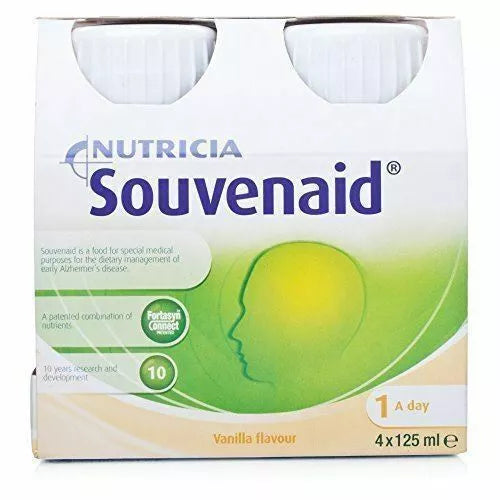
Nutricia Vanilla Souvenaid
- ✔️ Clinically studied to support memory in early Alzheimer's disease
- ✔️ Contains Fortasyn Connect — nutrients targeting brain synaptic health
- ✔️ Ready-to-drink 125ml vanilla carton — no preparation needed
- ✔️ Suitable for long-term daily use under medical supervision
- ✔️ Provides DHA, EPA, choline, and B vitamins in one daily serving
Price Checker
 Discreet, tracked delivery
 Includes FREE private prescription


Couldn't load pickup availability
What Is the Souvenaid Vanilla Drink?
If someone you care for has been diagnosed with early Alzheimer's disease, you may be looking for ways to support their day-to-day nutrition alongside any prescribed treatment. Souvenaid vanilla drink is a food for special medical purposes (FSMP), developed by Nutricia, that has been clinically studied to support memory function in people living with early-stage Alzheimer's disease. Each 125ml carton delivers a carefully formulated blend of nutrients — known as Fortasyn Connect — that targets the brain's synaptic network. It comes in a pleasant vanilla flavour, making it easier to incorporate into a daily routine. If you're exploring nutritional support options, you might also find our range of vitamins and supplements useful alongside medical advice.
Souvenaid is not a medicine and it is not a cure for Alzheimer's disease. It is designed to complement — not replace — any treatment plan agreed with a doctor or specialist. It is available without a prescription, but Nutricia and healthcare professionals recommend it is used under medical supervision.
How Does Souvenaid Work in the Brain?
The science behind Souvenaid centres on synaptic membranes — the connections between nerve cells in the brain that are essential for memory and learning. In Alzheimer's disease, these synaptic connections are progressively lost. Souvenaid provides specific nutrients that the brain needs to form and maintain these connections, but which may be insufficient from diet alone in people with early Alzheimer's.
- DHA and EPA — omega-3 fatty acids that are key structural components of neuronal membranes
- Uridine monophosphate (UMP) — a precursor for the synthesis of phosphatidylcholine, a major membrane phospholipid
- Choline — supports phospholipid synthesis and neurotransmitter production
- B vitamins (B6, B12, folic acid) — involved in homocysteine metabolism and neurological function
- Vitamin C, vitamin E, and selenium — antioxidants that help protect neuronal cells from oxidative stress
- Phospholipids — directly contribute to membrane structure
Together, these nutrients work synergistically as Fortasyn Connect to provide the building blocks for synaptic membrane formation. The Souvenir 1 and Souvenir 2 clinical trials, published in peer-reviewed journals, demonstrated that Souvenaid had a positive effect on memory performance in people with early Alzheimer's disease compared to a control drink.
Who Should Use Souvenaid Vanilla?
Souvenaid is specifically intended for adults in the early stages of Alzheimer's disease. It is not designed for healthy adults seeking general cognitive support, nor is it appropriate for moderate or severe Alzheimer's disease. A diagnosis from a qualified healthcare professional is important before starting this product.
- Adults with a confirmed diagnosis of early Alzheimer's disease
- People whose dietary intake of the specific Fortasyn Connect nutrients may be insufficient
- Those who can swallow liquids safely and without difficulty
- Individuals under the care of a GP, neurologist, or memory clinic specialist
It is not suitable for children, people with galactosaemia, or anyone with a known allergy to fish or soya. Always check the full ingredient list before use.
How Does Souvenaid Compare to Other Memory Nutrition Drinks?
| Feature | Souvenaid Vanilla | Standard Nutritional Supplement Drink |
|---|---|---|
| Intended use | Early Alzheimer's disease (FSMP) | General nutritional support |
| Key active blend | Fortasyn Connect (DHA, UMP, choline, B vitamins) | Varies — typically protein, vitamins, minerals |
| Clinical evidence | Studied in Souvenir 1 & 2 RCTs | Generally not disease-specific |
| Volume per serving | 125ml once daily | Typically 200–220ml |
How Should You Store Souvenaid and Is It Clinically Suitable for Long-Term Use?
Store Souvenaid cartons below 25°C, away from direct sunlight. Do not freeze. Once opened, the carton should be consumed immediately or refrigerated and used within 24 hours. The product has a shelf life printed on the base of each carton — always check this before use.
Regarding long-term suitability, the Souvenaid vanilla drink has been assessed in clinical trials lasting up to 24 months, suggesting it is appropriate for extended daily use in the early Alzheimer's population. However, it should not be used as a sole source of nutrition — it is a supplement to a balanced diet. If you are managing multiple health conditions alongside Alzheimer's, speaking to your GP or pharmacist is always the right first step.
This product is a food for special medical purposes. Speak to your doctor or pharmacist before using if you have an underlying medical condition or are taking other medicines.
Nutricia Souvenaid Vanilla specifications
| Treatment category | Medical nutrition / Food for Special Medical Purposes (FSMP) |
| Mechanism of action | Provides Fortasyn Connect nutrients to support synaptic membrane formation in the brain |
| Effective for | Supporting memory function in early Alzheimer's disease |
| Suitable for | Adults with early-stage Alzheimer's disease |
| Active ingredient | Fortasyn Connect (DHA, EPA, UMP, choline, phospholipids, B vitamins, vitamins C & E, selenium) |
| Pack sizes | 4 × 125ml cartons per pack |
| UK classification | Food for Special Medical Purposes (FSMP) — not a licensed medicine |
| Preparation | Ready-to-drink liquid |
| Route of administration | Oral |
Specifications of Nutricia Souvenaid Vanilla
What Is Souvenaid and What Is It Used For?
Nutricia Souvenaid is a ready-to-drink medical nutrition product classified as a food for special medical purposes (FSMP) in the UK. It is specifically formulated for adults in the early stages of Alzheimer's disease. Each 125ml vanilla-flavoured carton contains Fortasyn Connect — a patented combination of nutrients that includes omega-3 fatty acids (DHA and EPA), uridine monophosphate, choline, phospholipids, B vitamins (B6, B12, and folic acid), vitamins C and E, and selenium. These nutrients are provided in specific amounts and ratios that are difficult to achieve through diet alone.
The product is not a treatment for Alzheimer's disease and does not slow its progression in the way that licensed medicines might. Rather, it is intended to support the nutritional needs of the brain's synaptic network during the early stages of the condition. It should always be used as part of a broader care plan agreed with a healthcare professional.
What Do You Need to Know Before Using Souvenaid?
Before starting Souvenaid, it is important to review the following contraindications and precautions carefully.
Do not use Souvenaid if you:
- Have galactosaemia (an inherited disorder affecting galactose metabolism)
- Are allergic to fish or fish-derived products
- Are allergic to soya or soya-derived products
- Are under 18 years of age
- Have moderate or severe Alzheimer's disease (it is not indicated for these stages)
- Require a sole-source nutritional feed — Souvenaid is a supplement, not a complete nutrition product
Drug and supplement interactions to be aware of:
- High-dose omega-3 fatty acids (DHA/EPA) may have a mild antiplatelet effect — inform your GP if you are taking anticoagulants such as warfarin
- Folic acid in Souvenaid may interact with methotrexate — seek medical advice if relevant
- Avoid taking additional high-dose fish oil supplements alongside Souvenaid without medical guidance
- If you are taking other nutritional supplements, check for potential overlap in fat-soluble vitamins (C, E) with your pharmacist
If you are managing other health conditions alongside early Alzheimer's, it is worth exploring whether any vitamins and supplements you currently take could interact with the nutrients in Souvenaid.
How Should You Use Souvenaid?
Souvenaid is straightforward to use, but following the correct method helps ensure you get the most from each carton.
- Check the expiry date on the base of the carton before opening.
- Shake the carton gently before use.
- Open the carton using the straw provided or pour into a glass.
- Sip slowly — do not drink the entire carton in one gulp.
- Consume the full 125ml serving in one sitting where possible.
- If not consumed immediately after opening, refrigerate and use within 24 hours.
- Do not heat or microwave the drink.
| Indication | Age Group | Dose | Frequency |
|---|---|---|---|
| Early Alzheimer's disease | Adults (18+) | One 125ml carton | Once daily |
What Are the Possible Side Effects of Souvenaid?
Souvenaid is generally well tolerated. In clinical trials, the overall incidence of adverse events was similar between the Souvenaid group and the control group. That said, as with any nutritional product, some people may notice mild digestive changes, particularly in the first few days of use.
Common side effects:
- Mild nausea, especially if taken on an empty stomach
- Loose stools or changes in bowel habit
- Mild bloating or flatulence
Less common side effects:
- Fishy aftertaste (due to omega-3 content)
- Reduced appetite at mealtimes if taken immediately before eating
- Allergic reactions — rare, but seek immediate medical attention if you notice swelling, rash, or difficulty breathing
If side effects persist beyond the first week or feel severe, stop use and speak to your GP or pharmacist. Do not assume symptoms are unrelated to the product without seeking advice.
How Should You Store Souvenaid?
- Store unopened cartons below 25°C in a cool, dry place
- Keep away from direct sunlight and heat sources
- Do not freeze — freezing may alter the product's composition
- Once opened, refrigerate immediately and consume within 24 hours
- Check the best-before date printed on the base of each carton
- Keep out of the reach and sight of children
- Do not use if the carton is damaged, leaking, or the seal has been broken
Proper storage helps maintain the integrity of the omega-3 fatty acids and other sensitive nutrients within the product. If you are unsure whether a carton has been stored correctly, it is safer to discard it and use a fresh one.
References
- https://www.nhs.uk/conditions/alzheimers-disease/
- https://www.nhs.uk/conditions/alzheimers-disease/treatment/
- https://www.nhs.uk/conditions/dementia/about/
- https://www.nhs.uk/conditions/vitamins-and-minerals/others/
- https://www.nhs.uk/conditions/vitamins-and-minerals/vitamin-b/
- https://www.nice.org.uk/guidance/ng97
Written and reviewed by our qualified team
Your safety and success are our highest priorities. Our medical team rigorously evaluates every product and piece of advice we provide, ensuring you receive only the most effective, science-backed solutions available.
Frequently Asked Questions
Where can I buy Souvenaid vanilla drink online in the UK?
You can buy Nutricia Souvenaid vanilla drink directly from Cured Pharmacy, a GPhC-registered UK online pharmacy. It is available without a prescription but is intended for use under medical supervision. Ordering online means you can have it delivered to your door without needing to visit a pharmacy in person.
How does Souvenaid work in the body?
Souvenaid contains Fortasyn Connect, a patented blend of nutrients including DHA, EPA, uridine monophosphate, choline, phospholipids, and B vitamins. These nutrients work together to support the formation and maintenance of synaptic membranes — the connections between brain cells that are critical for memory. In early Alzheimer's disease, these synaptic connections are progressively lost, and Souvenaid aims to provide the nutritional building blocks to support them.
Who is eligible to use Souvenaid?
Souvenaid is intended for adults who have been diagnosed with early-stage Alzheimer's disease by a qualified healthcare professional. It is not suitable for children, people with galactosaemia, or those with a known allergy to fish or soya. It is also not indicated for moderate or severe Alzheimer's disease — only the early stage.
How do I use Souvenaid step by step?
Shake the carton gently, then open it using the straw provided or pour it into a glass. Sip the full 125ml serving slowly — do not rush it. If you cannot finish it in one sitting, refrigerate the remainder and consume within 24 hours. Never heat or microwave the drink, as this may damage the sensitive nutrients inside.
What is the correct dose of Souvenaid?
The recommended dose is one 125ml carton taken once daily. This dose was used in the Souvenir clinical trials and is the amount for which evidence of benefit in early Alzheimer's disease exists. Do not take more than one carton per day unless specifically advised by a healthcare professional.
What is the best time of day to take Souvenaid?
There is no strict requirement for a specific time of day — consistency matters more than timing. Many people find it easiest to take Souvenaid at the same time each day, such as with breakfast or a mid-morning snack. Taking it with food may help reduce the chance of mild nausea, particularly when first starting.
What are the side effects of Souvenaid and how do I manage them?
Most people tolerate Souvenaid well. The most commonly reported side effects are mild gastrointestinal symptoms such as nausea, loose stools, or bloating, which often settle after the first few days. Taking the drink with food and sipping it slowly rather than drinking it quickly can help minimise these effects. If symptoms persist or feel severe, speak to your GP or pharmacist.
How long should you take Souvenaid for?
Souvenaid is designed for long-term daily use. Clinical trials have assessed its use over periods of up to 24 months in people with early Alzheimer's disease. How long you continue using it should be guided by your GP, neurologist, or memory clinic specialist, who can review whether it remains appropriate as your condition evolves.
Can Souvenaid be taken alongside Alzheimer's medication?
Souvenaid is a food for special medical purposes, not a licensed medicine, so it does not interact with Alzheimer's drugs such as donepezil, rivastigmine, or memantine in a pharmacological sense. However, you should always inform your GP or specialist that you are using it, particularly if you are also taking anticoagulants or other supplements. Transparency with your healthcare team is always the safest approach.
What happens if I miss a dose of Souvenaid?
If you forget to take your daily carton, simply take it as soon as you remember — unless it is nearly time for the next day's serving, in which case skip the missed one and carry on as normal. Do not take two cartons in one day to make up for a missed dose. Consistency over time matters more than any single missed serving.
Is Souvenaid suitable for people with diabetes?
Each 125ml carton of Souvenaid contains carbohydrates, so people with diabetes should factor this into their daily dietary management. The carbohydrate content per serving is relatively modest, but it is important to discuss use with your GP or diabetes care team before starting. You may also find our diabetes monitoring range helpful for keeping track of your blood glucose levels.
What are the alternatives to Souvenaid?
There are no other products in the UK that contain the specific Fortasyn Connect blend found in Souvenaid. General omega-3 supplements, B vitamin complexes, or broader nutritional drinks do not replicate the same combination or ratios of nutrients. If Souvenaid is not suitable for a particular individual, a dietitian or specialist can advise on alternative nutritional strategies.
Does Souvenaid contain allergens?
Yes — Souvenaid contains fish (as a source of DHA and EPA) and soya, both of which are listed allergens under UK food labelling regulations. It also contains milk-derived ingredients. Anyone with a known allergy or intolerance to these ingredients should not use Souvenaid and should speak to their healthcare team about alternatives.
What are the latest studies on Souvenaid?
The key clinical evidence comes from the Souvenir I and Souvenir II randomised controlled trials, which demonstrated improvements in memory performance in people with mild Alzheimer's disease compared to a control drink. The LipiDiDiet trial, a larger multicentre study, also assessed Fortasyn Connect in prodromal Alzheimer's disease over three years, showing effects on cognitive composite scores. These studies are published in peer-reviewed journals including the Journal of Alzheimer's Disease and The Lancet Neurology.
Can Souvenaid be used for general memory support in healthy adults?
No — Souvenaid is a food for special medical purposes specifically indicated for early Alzheimer's disease and is not intended or studied for use in healthy adults seeking general cognitive enhancement. If you are looking for general nutritional support for brain health, browse our vitamins and supplements collection and speak to a pharmacist about appropriate options. Using Souvenaid outside its intended indication is not recommended.
Written and reviewed by our qualified team

Reviewed by:
Tarun Kumar
Superintendent/ Clinical Lead
📖 Find out more about our team of medical content authors and how we ensure the accuracy of our content with our content guidelines.
Content last updated: 14 Sep 2026
Other popular options


We’re a safe and
regulated UK service

100% discreet packaging

Discreet, unbranded packaging for every order.

Need help?
Talk to our friendly experts now


How our service works

Service setup

Discreet packaging

Express delivery