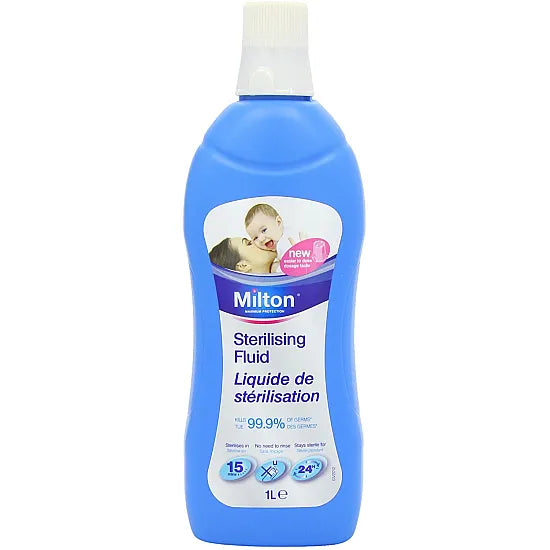
Milton Sterilising Fluid - 1L
Milton Sterilising Fluid - 1L
- ✔️ Kills bacteria, viruses, and fungi within 15 minutes
- ✔️ No electricity needed — works with cold water only
- ✔️ Safe for baby bottles, teats, dummies, and breast pumps
- ✔️ Ideal for travel and holidays — no steriliser required
- ✔️ One litre makes multiple sterilising batches over time
Price Checker
 Lowest price guarantee
 Includes FREE private prescription


Couldn't load pickup availability
What Is Milton Sterilising Fluid and How Does It Help?
When you have a newborn at home, keeping feeding equipment clean isn't just about hygiene — it's about protecting a tiny immune system that hasn't yet built up its defences. Milton sterilising fluid has been trusted by parents in the UK for decades as a straightforward, no-fuss way to sterilise baby bottles, teats, dummies, and other feeding accessories. Available here at Cured Pharmacy for just £5.99, the 1-litre bottle offers excellent value and is simple enough to use even on the most sleep-deprived of nights. You'll find it listed under our Baby and Toddler range alongside other essentials for your little one.
The NHS advises that all feeding equipment should be sterilised until your baby is at least 12 months old, because young infants are particularly vulnerable to infections caused by bacteria and viruses that can survive on surfaces. Milton's cold-water method means there's no need for a microwave or steam steriliser — just water, the solution, and a suitable container.
How Does Milton Sterilising Fluid Work to Kill Germs?
The active ingredient in Milton Sterilising Fluid is sodium hypochlorite (2% w/v), combined with sodium chloride. Sodium hypochlorite is a well-established antimicrobial agent that works by disrupting the structural integrity of microbial cell membranes, effectively destroying bacteria, viruses, and fungi on contact. Here's how the sterilisation process works:
- Sodium hypochlorite releases hypochlorous acid when dissolved in water, which penetrates microbial cell walls.
- It oxidises essential proteins and enzymes within the microorganism, preventing it from functioning or reproducing.
- At the recommended dilution, it achieves broad-spectrum antimicrobial activity — including against E. coli, Salmonella, and common viruses.
- Full sterilisation is achieved within 15 minutes of complete submersion.
Because it works in cold water, there's no heat involved — which means no warping of plastic items and no waiting for equipment to cool down before use.
Who Should Use Milton Sterilising Fluid?
This product is primarily designed for parents and carers of babies under 12 months, but it has a broader range of uses too. It's particularly useful for anyone who needs reliable, chemical-based sterilisation without specialist equipment. It's suitable for:
- Parents sterilising baby bottles, teats, breast pump parts, and dummies.
- Carers in nursery or childminding settings where multiple items need sterilising regularly.
- Travellers who need a portable sterilising method — no electricity required, making it ideal for holidays abroad.
- Anyone needing to sterilise food preparation equipment in situations where boiling isn't practical.
It is not suitable for use on skin, as a wound cleanser, or for internal use. Always keep it out of reach of children.
How Does Milton Sterilising Fluid Compare to Steam Sterilising?
| Feature | Milton Sterilising Fluid | Electric Steam Steriliser |
|---|---|---|
| Requires electricity | No | Yes |
| Sterilisation time | 15 minutes | 8–12 minutes (cycle time) |
| Suitable for travel | Yes | Limited (requires plug socket) |
| Risk of warping plastic | No (cold water method) | Possible with repeated use |
| Cost | Low (£5.99 per litre) | Higher upfront cost |
Is Milton Sterilising Fluid Safe to Store at Home?
Yes — provided you follow a few straightforward storage guidelines. Keep the bottle tightly closed, stored below 25°C, and away from direct sunlight. Don't transfer the solution into unlabelled containers, and always keep it out of reach of children. The 1-litre bottle is compact enough to store in a kitchen cupboard without taking up much space. If you're heading abroad and want to pack it in your luggage, it's worth checking airline liquid restrictions beforehand — it may be easier to purchase on arrival or use Milton Sterilising Tablets as an alternative for travel. For other travel health essentials, browse our Travel collection.
This product is a medicine. Speak to your doctor or pharmacist before using if you have an underlying medical condition or are taking other medicines.
Milton Sterilising Fluid 1L specifications
| Treatment category | Baby and infant hygiene / sterilisation |
| Mechanism of action | Sodium hypochlorite releases hypochlorous acid, destroying microbial cell membranes |
| Effective against | Bacteria, viruses, and fungi (including E. coli, Salmonella) |
| Suitable for | Baby bottles, teats, dummies, breast pump parts, food preparation equipment |
| Active ingredient | Sodium hypochlorite 2% w/v, Sodium chloride |
| Pack size | 1 litre |
| UK classification | General Sale (GSL) |
| Preparation | Liquid solution (for dilution) |
| Route of administration | Topical/immersion (not for internal use) |
Specifications of Milton Sterilising Fluid 1L
What Is Milton Sterilising Fluid and What Is It Used For?
Milton Sterilising Fluid is a cold-water sterilising solution containing sodium hypochlorite 2% w/v and sodium chloride. It is used to sterilise baby feeding equipment — including bottles, teats, dummies, and breast pump components — as well as food preparation utensils and other items that require thorough disinfection. The NHS recommends sterilising all feeding equipment until your baby is at least 12 months old, as infants are highly susceptible to gastrointestinal infections caused by bacteria and viruses that can persist on surfaces even after washing.
Milton Sterilising Fluid is for external use only — specifically for immersion sterilisation of objects. It must never be swallowed, applied to skin as a treatment, or used as a wound cleanser.
What Do You Need to Know Before Using Milton Sterilising Fluid?
Before using this product, read the following warnings carefully:
- Do not use on skin, wounds, or mucous membranes.
- Do not swallow — if ingested accidentally, seek immediate medical advice or contact NHS 111.
- Avoid contact with eyes; if splashed, rinse immediately with plenty of water.
- Do not use undiluted — always dilute as directed before use.
- Not suitable for sterilising metal items, as sodium hypochlorite can cause corrosion.
- Keep out of reach of children at all times.
- Do not mix with other cleaning products, particularly those containing ammonia or acids, as this can release toxic chlorine gas.
- Individuals with known hypersensitivity to sodium hypochlorite or chlorine-based compounds should avoid handling this product.
Drug interactions: This product is not taken internally, so systemic drug interactions are not applicable. However:
- Do not mix with acidic cleaners (e.g. vinegar-based products) — this releases chlorine gas.
- Do not combine with ammonia-based products.
- Do not use alongside other disinfectants in the same sterilising solution.
How Should You Use Milton Sterilising Fluid?
Always wash all items thoroughly with hot soapy water and rinse well before sterilising. Then follow these steps:
- Fill a clean sterilising container with 4.5 litres of cold tap water.
- Add one 30ml capful (one measure using the bottle cap) of Milton Sterilising Fluid.
- Stir gently to mix the solution evenly.
- Fully submerge all items to be sterilised, ensuring there are no air bubbles trapped inside bottles or teats.
- Leave items submerged for a minimum of 15 minutes.
- Remove items and use immediately, or shake off excess solution — rinsing is not required but you may rinse with cooled boiled water if preferred.
- Discard the solution after 24 hours and prepare a fresh batch.
| Indication | Age Group / User | Dose (Fluid) | Frequency |
|---|---|---|---|
| Baby bottle sterilisation | For use by parents/carers | 30ml per 4.5 litres water | Every 24 hours (fresh solution) |
| Dummy/teat sterilisation | For use by parents/carers | 30ml per 4.5 litres water | Every 24 hours (fresh solution) |
| Food preparation equipment | General use | 30ml per 4.5 litres water | As required |
What Are the Possible Side Effects of Milton Sterilising Fluid?
When used correctly as a sterilising solution for objects, Milton Sterilising Fluid does not cause systemic side effects. However, accidental misuse or exposure can lead to the following:
Common effects from accidental exposure:
- Skin irritation or redness if undiluted solution contacts skin for a prolonged period.
- Mild eye irritation if splashed — rinse immediately with water for at least 10 minutes.
- Bleaching of fabrics or surfaces if spilled.
Less common or serious effects:
- If swallowed — nausea, vomiting, abdominal pain, and potential chemical burns to the mouth and throat. Seek emergency medical attention immediately.
- Inhalation of fumes from undiluted solution in a poorly ventilated space may cause respiratory irritation.
- Allergic reaction (rare) — symptoms may include rash, itching, or breathing difficulty. If this occurs, seek medical help promptly.
If you're looking for products to soothe minor skin irritation caused by accidental contact, our Creams and Ointments collection may be helpful.
How Should You Store Milton Sterilising Fluid?
Correct storage helps maintain the effectiveness of the solution and keeps your household safe. Follow these guidelines:
- Store below 25°C, away from direct sunlight and heat sources.
- Keep the bottle tightly closed when not in use.
- Store in the original container — never decant into unlabelled bottles.
- Keep out of reach and sight of children at all times.
- Do not store near food, drink, or animal feed.
- Check the expiry date on the bottle before use — do not use after the stated date.
- Once the sterilising solution is made up (diluted), discard after 24 hours.
For parents who are also managing other aspects of infant health, our First Aid collection includes a range of products useful for families with young children.
References
- https://www.nhs.uk/conditions/baby/breastfeeding-and-bottle-feeding/bottle-feeding/sterilising-baby-bottles/
- https://www.nhs.uk/conditions/baby/breastfeeding-and-bottle-feeding/bottle-feeding/how-to-make-up-baby-formula/
- https://www.nhs.uk/conditions/baby/breastfeeding-and-bottle-feeding/breastfeeding/expressing-breast-milk/
- https://www.nhs.uk/conditions/baby/caring-for-a-newborn/keeping-your-baby-safe/
- https://www.medicines.org.uk/emc/product/1148/smpc
Written and reviewed by our qualified team
Your safety and success are our highest priorities. Our medical team rigorously evaluates every product and piece of advice we provide, ensuring you receive only the most effective, science-backed solutions available.
Frequently Asked Questions
Where can I buy Milton Sterilising Fluid online in the UK?
You can buy Milton Sterilising Fluid 1L directly from Cured Pharmacy online for £5.99, with fast UK delivery to your door. It's available without a prescription as a General Sale product. You'll find it in our Baby and Toddler collection alongside other infant care essentials.
How does Milton Sterilising Fluid work in the body?
Milton Sterilising Fluid is not taken internally — it works by immersing baby equipment in a diluted solution of sodium hypochlorite, which destroys the cell membranes of bacteria, viruses, and fungi on contact. It is not absorbed into the body and should never be swallowed. The antimicrobial action is purely external, targeting pathogens on the surfaces of sterilised items.
How do I use Milton Sterilising Fluid step by step?
First, wash all items thoroughly with hot soapy water and rinse well. Then add one 30ml capful of Milton Sterilising Fluid to 4.5 litres of cold water, submerge all items fully for at least 15 minutes, and remove — no rinsing is necessary. Discard the solution after 24 hours and make a fresh batch each day.
Do I need to rinse baby bottles after sterilising with Milton?
No, rinsing is not required after using Milton Sterilising Fluid at the recommended dilution, as any residual solution left on items is considered safe at that concentration. If you prefer, you can shake off excess solution or rinse with cooled boiled water. Rinsing with unsterilised tap water, however, could reintroduce bacteria to the equipment.
Is Milton Sterilising Fluid safe for newborns?
Yes, Milton Sterilising Fluid is widely used for sterilising feeding equipment for newborns and is considered safe when used as directed. The NHS recommends sterilising all feeding equipment until your baby is at least 12 months old to protect against harmful bacteria and viruses. Always follow the dilution instructions carefully and never use the undiluted solution near infants.
Can I use Milton Sterilising Fluid when travelling abroad?
Yes — Milton Sterilising Fluid is an excellent option for travel because it requires only cold water and no electricity, making it practical for use in hotels, holiday apartments, or areas without access to sterilising equipment. It's particularly useful in countries where water quality may be a concern, as the sterilising solution works with tap water. Check airline liquid restrictions before packing, and browse our Travel collection for other holiday health essentials.
What are the side effects of Milton Sterilising Fluid?
When used correctly for sterilising objects, Milton Sterilising Fluid does not cause side effects. Accidental skin contact with undiluted solution may cause irritation, and eye contact should be avoided — rinse immediately with water if this occurs. If swallowed, seek emergency medical advice immediately by calling 999 or NHS 111.
How long does a Milton sterilising solution last once made up?
Once made up, the Milton sterilising solution remains effective for 24 hours, after which it should be discarded and a fresh solution prepared. You can continue to add items to the solution throughout the day as long as it is within the 24-hour window. Always use a clean, dedicated sterilising container each time.
What is the correct dilution for Milton Sterilising Fluid?
The correct dilution is one 30ml capful of Milton Sterilising Fluid added to 4.5 litres of cold water. Do not use more than the recommended amount, as this will not improve sterilisation and may increase the risk of irritation. Always measure using the bottle cap provided to ensure accuracy.
Who is eligible to use Milton Sterilising Fluid?
Milton Sterilising Fluid is suitable for use by parents, carers, childminders, and anyone who needs to sterilise baby feeding equipment or food preparation utensils. It is a General Sale product, meaning no prescription is needed. It is not suitable for individuals with known hypersensitivity to sodium hypochlorite or chlorine-based compounds.
What happens if Milton Sterilising Fluid is accidentally swallowed?
If Milton Sterilising Fluid is swallowed, do not induce vomiting — seek emergency medical attention immediately by calling 999 or going to your nearest A&E. Take the bottle with you so medical staff can identify the substance. Even small amounts of undiluted sodium hypochlorite solution can cause chemical burns to the mouth, throat, and stomach.
What are the alternatives to Milton Sterilising Fluid?
Alternatives to cold-water chemical sterilisation include electric steam sterilisers, microwave steam sterilisers, and boiling equipment in water for at least 10 minutes. Milton also produces sterilising tablets, which offer the same sodium hypochlorite-based action in a more travel-friendly format. The NHS notes that all methods are effective when used correctly.
Can Milton Sterilising Fluid be used on metal items?
No — Milton Sterilising Fluid is not recommended for use on metal items, as sodium hypochlorite can cause corrosion and discolouration of metals over time. It is designed for use with plastic, glass, and silicone feeding equipment. For metal items, boiling in water for at least 10 minutes is a more appropriate sterilisation method.
How long should I continue sterilising baby equipment?
The NHS recommends sterilising all feeding equipment until your baby is at least 12 months old, as infants under this age are particularly vulnerable to gastrointestinal infections. After 12 months, thorough washing in hot soapy water or a dishwasher is generally considered sufficient. Always follow your health visitor's or GP's guidance if your baby has any underlying health conditions.
What are the latest guidelines on sterilising baby bottles in the UK?
Current NHS guidance recommends sterilising all feeding equipment — including bottles, teats, and breast pump parts — until your baby is 12 months old. The NHS outlines four accepted sterilisation methods: cold-water sterilising (such as with Milton Sterilising Fluid), steam sterilising, microwave sterilising, and boiling. Cold-water chemical sterilisation remains one of the most accessible and travel-friendly options available.
Written and reviewed by our qualified team

Reviewed by:
Tarun Kumar
Superintendent/ Clinical Lead
📖 Find out more about our team of medical content authors and how we ensure the accuracy of our content with our content guidelines.
Content last updated: 14 Sep 2026

We’re a safe and
regulated UK service

Lowest Price Guarantee

We're convinced you won't find your treatment cheaper, but if you do we'll refund the difference.
Find out more
100% discreet packaging

Discreet, unbranded packaging for every order.
Find out more

Need help?
Talk to our friendly experts now


How our service works

Service setup

Discreet packaging

Express delivery