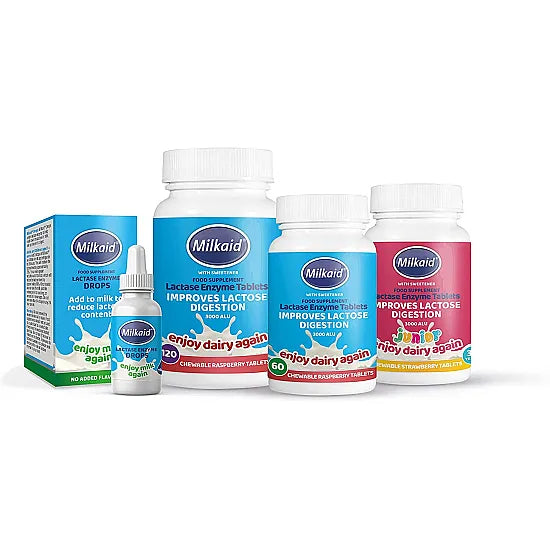
Milkaid Lactase Enzyme Chewable Tablets for Lactose Intolerance Relief
- ✔️ Chewable lactase enzyme tablets for fast-acting dairy digestion support
- ✔️ Prevents bloating, wind, and diarrhoea caused by lactose intolerance
- ✔️ Suitable for adults and children over 4 years of age
- ✔️ Works with all dairy foods including milk, cheese, and yoghurt
- ✔️ Convenient portable format — take before any dairy-containing meal
Price Checker
 Lowest price guarantee
 Includes FREE private prescription


Couldn't load pickup availability
What Are Lactase Enzyme Tablets and How Do They Help?
If you've ever felt bloated, gassy, or rushed to the bathroom after a bowl of cereal or a latte, you'll know how disruptive lactose intolerance can be. It affects a significant proportion of the UK population — the NHS estimates that around 65% of people worldwide have some degree of lactose malabsorption after infancy. Lactase enzyme tablets like Milkaid are designed to step in where your body falls short, supplying the enzyme your digestive system needs to break down lactose before it causes problems. At just £9.99, Milkaid offers a practical, chewable solution you can keep in your bag and use whenever dairy is on the menu.
Lactose intolerance occurs when the small intestine doesn't produce enough lactase — the enzyme responsible for digesting lactose, the natural sugar found in milk and dairy products. Without sufficient lactase, lactose passes undigested into the colon, where gut bacteria ferment it, producing gas and triggering symptoms. If you're managing digestive discomfort alongside other gut issues, you might also find our IBS and cramps collection useful for broader digestive support.
How Do Milkaid Chewable Tablets Work in the Digestive System?
Milkaid works by delivering exogenous lactase directly into your digestive tract at the moment you need it most — just before you eat dairy. The chewable format is deliberate: chewing the tablet releases the enzyme into your saliva and stomach, so it's ready to act as soon as lactose arrives from your food.
- You chew the tablet immediately before consuming dairy food or drink.
- The lactase enzyme is released and mixes with stomach contents.
- As food moves into the small intestine, lactase breaks lactose down into glucose and galactose.
- These simpler sugars are absorbed normally, bypassing the fermentation process that causes symptoms.
- Bloating, wind, cramping, and diarrhoea are reduced or prevented.
It's worth noting that Milkaid doesn't cure lactose intolerance — it manages it. You'll need to take a tablet each time you eat dairy for the effect to work.
Who Is Milkaid Suitable For?
Milkaid is suitable for most adults and children over 4 years of age who experience symptoms of lactose intolerance after consuming dairy. It's particularly helpful if you don't want to eliminate dairy entirely from your diet — whether for nutritional reasons, social convenience, or simply because you enjoy it.
- Adults with diagnosed or suspected lactose intolerance
- Children over 4 years who react to dairy foods
- People who want to enjoy dairy occasionally without discomfort
- Those following a diet that includes dairy for calcium and protein intake
It is not suitable for people with galactosaemia — a rare inherited condition where the body cannot process galactose, one of the sugars produced when lactose is broken down. If you're unsure whether Milkaid is right for you, speak to your pharmacist or GP before starting.
How Does Milkaid Compare to Other Lactase Supplements?
| Feature | Milkaid Chewable Tablets | Lactase Drops (e.g. for milk) |
|---|---|---|
| Form | Chewable tablet | Liquid drops |
| When to use | Just before eating dairy | Added to milk 24 hours before drinking |
| Convenience | Portable, no preparation needed | Requires advance planning |
| Suitable for solid dairy foods | Yes — cheese, yoghurt, cream, etc. | No — only treats liquid milk |
Is Milkaid Safe to Store and Use Long Term?
Milkaid tablets should be stored below 25°C in a cool, dry place away from direct sunlight and out of reach of children. Do not use after the expiry date printed on the packaging. Because lactase enzyme tablets are not absorbed into the bloodstream — they act entirely within the gut — they are generally considered safe for ongoing use as needed. You can browse our wider range of vitamins and supplements if you're looking to support your overall nutritional intake alongside managing lactose intolerance.
This product is a medicine. Speak to your doctor or pharmacist before using if you have an underlying medical condition or are taking other medicines.
Milkaid Lactase Enzyme Chewable Tablets for Lactose Intolerance Relief specifications
| Treatment category | Digestive enzyme supplement / Lactose intolerance management |
| Mechanism of action | Supplies exogenous lactase enzyme to hydrolyse lactose into glucose and galactose |
| Effective for | Reducing symptoms of lactose intolerance including bloating, wind, and diarrhoea |
| Suitable for | Adults and children over 4 years with lactose intolerance |
| Active ingredient | Lactase enzyme |
| UK classification | General Sale / Food supplement |
| Drug class | Digestive enzyme |
| Preparation | Chewable tablet |
| Route of administration | Oral (chewed before dairy consumption) |
Specifications of Milkaid Lactase Enzyme Chewable Tablets for Lactose Intolerance Relief
What Is Milkaid and What Is It Used For?
Milkaid Lactase Enzyme Chewable Tablets are an oral digestive enzyme supplement used to manage the symptoms of lactose intolerance. Lactose intolerance is a common condition in which the body does not produce enough lactase — the enzyme needed to digest lactose, the sugar naturally present in milk and dairy products. According to the NHS, symptoms typically include bloating, flatulence, diarrhoea, stomach cramps, and nausea, usually occurring within a few hours of consuming dairy.
Milkaid is taken just before eating dairy-containing foods or drinks. It does not treat the underlying cause of lactose intolerance, but it effectively reduces or prevents symptoms by supplementing the body's own lactase supply. It is available over the counter without a prescription.
What Do You Need to Know Before Using Milkaid?
Before using Milkaid, it's important to check whether it is appropriate for you. Read the following carefully.
Do not use Milkaid if you:
- Have galactosaemia (an inherited inability to metabolise galactose)
- Are allergic to any of the ingredients in the tablet
- Have been advised by a doctor to avoid lactose for reasons other than intolerance
Speak to your GP or pharmacist before use if you:
- Are pregnant or breastfeeding
- Are giving this product to a child under 4 years of age
- Have any other diagnosed gastrointestinal condition such as Crohn's disease or irritable bowel syndrome
- Have persistent or unexplained digestive symptoms that have not been investigated
Drug interactions:
- No clinically significant drug interactions with lactase enzyme supplements have been established.
- If you are taking any prescribed medicines, check with your pharmacist as a precaution.
How Should You Use Milkaid Correctly?
Using Milkaid correctly is straightforward, but timing is everything. The tablet must be taken immediately before you consume dairy — not after symptoms start. Taking it too late means the lactose will already be in your gut before the enzyme can act.
- Check that you are about to eat or drink something containing dairy (milk, cheese, yoghurt, cream, butter, etc.).
- Take 1 to 2 Milkaid chewable tablets.
- Chew the tablets thoroughly — do not swallow whole.
- Begin eating your dairy-containing meal or drink immediately after chewing.
- If your meal is large or contains a high amount of dairy, you may need an additional tablet.
- Repeat with every dairy-containing meal or snack throughout the day.
| Indication | Age Group | Dose | Frequency |
|---|---|---|---|
| Lactose intolerance symptom prevention | Adults | 1–2 tablets | Before each dairy-containing meal |
| Lactose intolerance symptom prevention | Children over 4 years | 1 tablet | Before each dairy-containing meal |
| Children under 4 years | Under 4 years | Not recommended without medical advice | Consult GP |
If you're also managing other digestive symptoms, it may be worth exploring our diarrhoea relief collection for additional support.
What Are the Possible Side Effects of Milkaid?
Lactase enzyme supplements are generally very well tolerated. Because the enzyme acts locally within the gut and is not absorbed into the bloodstream, systemic side effects are rare. That said, as with any supplement, some people may notice mild reactions.
Common side effects:
- Mild nausea, particularly if taken without food
- Mild abdominal discomfort or bloating (usually transient)
Less common side effects:
- Loose stools or mild diarrhoea
- Flatulence (though this may also be a residual symptom of lactose intolerance itself)
Stop using Milkaid and seek medical advice immediately if you experience any signs of an allergic reaction, including skin rash, itching, swelling of the face or throat, or difficulty breathing. Allergic reactions to lactase enzyme supplements are rare but possible.
How Should You Store Milkaid Tablets?
Proper storage helps maintain the effectiveness of the enzyme. Follow these guidelines:
- Store below 25°C in a cool, dry place
- Keep away from direct sunlight and sources of heat
- Keep the container tightly closed when not in use
- Store out of sight and reach of children
- Do not use after the expiry date printed on the packaging
- Do not store in the bathroom or near a sink — moisture can degrade the enzyme
If you're building a broader supplement routine, our vitamins and supplements range includes a variety of products to support digestive and general health.
References
- https://www.nhs.uk/conditions/lactose-intolerance/
- https://www.nhs.uk/conditions/lactose-intolerance/symptoms/
- https://www.nhs.uk/conditions/lactose-intolerance/treatment/
- https://www.nhs.uk/conditions/lactose-intolerance/causes/
- https://www.nhs.uk/conditions/vitamins-and-minerals/calcium/
- https://bnf.nice.org.uk/drugs/lactase/
Written and reviewed by our qualified team
Your safety and success are our highest priorities. Our medical team rigorously evaluates every product and piece of advice we provide, ensuring you receive only the most effective, science-backed solutions available.
Frequently Asked Questions
Where can I buy Milkaid lactase enzyme tablets online in the UK?
You can buy Milkaid Lactase Enzyme Chewable Tablets directly from Cured Pharmacy online, with UK-wide delivery available. They are sold over the counter without a prescription, making them easy to order whenever you need them. No GP visit is required — simply add to your basket and check out.
How do Milkaid lactase enzyme tablets work in the body?
Milkaid tablets supply lactase, the enzyme your small intestine needs to break down lactose into glucose and galactose — two simpler sugars your body can absorb normally. When lactase is deficient, undigested lactose travels to the colon where bacteria ferment it, producing gas and causing bloating, cramps, and diarrhoea. Taking a Milkaid tablet before dairy consumption replaces the missing enzyme and prevents this fermentation process.
How do I use Milkaid chewable tablets step by step?
Chew one or two tablets immediately before consuming any dairy-containing food or drink — timing is crucial, so don't wait until after you've started eating. Make sure to chew the tablet thoroughly rather than swallowing it whole, as this releases the enzyme where it's needed. Repeat the dose before every dairy-containing meal or snack throughout the day.
What is the correct dose of Milkaid lactase enzyme tablets for adults?
The standard adult dose is 1 to 2 chewable tablets taken immediately before eating dairy. If you're consuming a particularly large or dairy-rich meal, you may find that 2 tablets are more effective than 1. Always follow the instructions on the product label and do not exceed the stated maximum daily dose.
What is the best time to take Milkaid lactase enzyme tablets?
The best time to take Milkaid is immediately before you eat or drink anything containing dairy — not during or after the meal. The enzyme needs to be present in your digestive tract at the same time as the lactose for it to work effectively. If you forget to take it before eating, taking it mid-meal may still offer some benefit, but it will be less effective than taking it beforehand.
Are Milkaid lactase tablets safe for children?
Milkaid tablets are generally considered suitable for children over 4 years of age, using a reduced dose of 1 tablet before dairy consumption. For children under 4, you should consult your GP or pharmacist before use, as lactose intolerance in very young children requires careful medical assessment. Never assume a young child's digestive symptoms are due to lactose intolerance without a proper diagnosis.
Can I take Milkaid tablets if I am pregnant or breastfeeding?
Lactase enzyme supplements act locally within the gut and are not absorbed into the bloodstream, which means systemic exposure is minimal. However, as with any supplement taken during pregnancy or breastfeeding, you should speak to your GP or midwife before use to confirm it is appropriate for your individual circumstances. Maintaining adequate calcium intake during pregnancy is important, so managing lactose intolerance safely is a valid concern to raise with your healthcare team.
What are the side effects of Milkaid lactase enzyme tablets?
Side effects from lactase enzyme tablets are uncommon, but some people may experience mild nausea or temporary abdominal discomfort. Loose stools or mild flatulence have also been reported in rare cases, though these can be difficult to distinguish from residual lactose intolerance symptoms. If you notice any signs of an allergic reaction — such as rash, swelling, or breathing difficulty — stop use immediately and seek medical advice.
How do I manage side effects of Milkaid if they occur?
If you experience mild nausea, try taking the tablet with a small amount of non-dairy food rather than on an empty stomach. Most mild digestive side effects settle on their own within a short time and do not require treatment. If side effects persist or are severe, stop using the product and speak to your pharmacist or GP — you can also explore our indigestion relief collection for additional digestive support.
Who is eligible to use Milkaid lactase enzyme tablets?
Milkaid is suitable for adults and children over 4 years who experience symptoms of lactose intolerance after consuming dairy products. It is not suitable for people with galactosaemia or those allergic to any of the product's ingredients. If your digestive symptoms have never been formally investigated, it's worth speaking to your GP to confirm a diagnosis before relying on lactase supplementation long term.
What happens if I forget to take Milkaid before eating dairy?
If you forget to take Milkaid before your meal, taking it as soon as you remember — even mid-meal — may still reduce the severity of symptoms, though it will be less effective than taking it beforehand. Do not double up on doses to compensate for a missed one. If symptoms do develop, managing them with appropriate remedies such as those in our IBS and cramps collection may help provide relief.
What are the alternatives to Milkaid lactase enzyme tablets?
Alternatives to Milkaid include other lactase enzyme supplements available in capsule or drop form, as well as dietary management strategies such as switching to lactose-free dairy products or plant-based milk alternatives. Some people find that hard cheeses and live yoghurt are naturally lower in lactose and better tolerated. Your GP or a registered dietitian can help you find the approach that works best for your lifestyle and nutritional needs.
How long can you keep taking Milkaid lactase enzyme tablets?
Milkaid can be used on an ongoing, long-term basis whenever you consume dairy — lactose intolerance is a lifelong condition for most people, and lactase supplements are designed for regular use as needed rather than as a short-term course. There is no established maximum duration of use for lactase enzyme supplements. If your symptoms change or worsen over time, consult your GP to rule out other underlying digestive conditions.
Does Milkaid interact with any other medicines?
No clinically significant drug interactions with lactase enzyme supplements have been established in published literature. Because lactase acts locally within the gut and is not absorbed systemically, the risk of interactions with other medicines is considered very low. That said, if you are taking prescribed medication for a gastrointestinal condition, it is always sensible to check with your pharmacist before adding any new supplement to your routine.
What are the latest studies on lactase enzyme supplements for lactose intolerance?
Research consistently supports the use of exogenous lactase enzyme supplements as an effective strategy for reducing lactose intolerance symptoms when taken before dairy consumption. Studies published in clinical nutrition journals have shown that lactase supplementation significantly reduces bloating, flatulence, and diarrhoea compared to placebo in lactose-intolerant individuals. The NHS also recognises lactase supplements as one of the management options for lactose intolerance alongside dietary modification.
Written and reviewed by our qualified team

Reviewed by:
Tarun Kumar
Superintendent/ Clinical Lead
📖 Find out more about our team of medical content authors and how we ensure the accuracy of our content with our content guidelines.
Content last updated: 14 Sep 2026
Other popular options


We’re a safe and
regulated UK service

Lowest Price Guarantee

We're convinced you won't find your treatment cheaper, but if you do we'll refund the difference.
Find out more
100% discreet packaging

Discreet, unbranded packaging for every order.
Find out more

Need help?
Talk to our friendly experts now


How our service works

Service setup

Discreet packaging

Express delivery