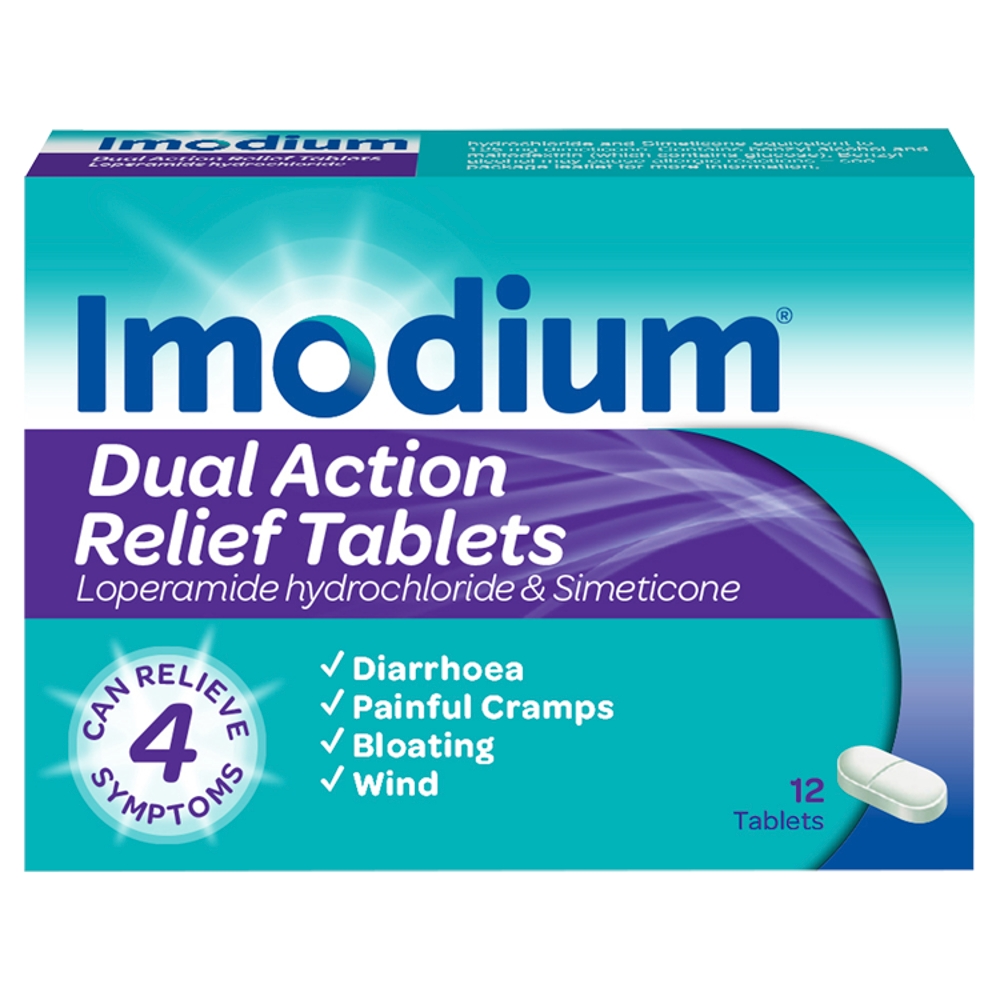
Imodium Dual Action Relief Tablets 12 Pack
- ✔️ Relieves acute diarrhoea and bloating with dual-action formula
- ✔️ Contains loperamide and simeticone for two-symptom relief
- ✔️ Suitable for adults and young people aged 12 and over
- ✔️ Compact 12-pack ideal for home use or travel
- ✔️ Begins working from the first dose to reduce loose stools
Price Checker
Not approved? Full refund
Includes FREE private prescription
Couldn't load pickup availability
How Should You Use Imodium Dual Action Tablets?
These tablets are taken orally with a full glass of water. Swallow each tablet whole — do not crush or chew. Follow these steps for correct use:
Do not crush, split, or chew the tablets. If you have difficulty swallowing tablets, speak to your pharmacist about alternative formulations.
What Is the Correct Dose of Imodium Dual Action Tablets?
The dose depends on your age. These tablets are not suitable for anyone under 12 years of age. Always stay within the maximum daily dose to avoid the risk of side effects.
Never exceed four tablets in any 24-hour period. Taking more than the recommended dose does not speed up recovery and significantly increases the risk of adverse effects.
When Is the Best Time to Use Imodium Dual Action Tablets?
Take the first dose as soon as you notice the onset of diarrhoea — the earlier you act, the sooner symptoms can be brought under control. Subsequent doses should be taken after each loose stool rather than at fixed time intervals. There is no specific time of day that is better than another; the dosing is symptom-led rather than clock-led.
If you are travelling and anticipate exposure to unfamiliar food or water, it is sensible to carry the pack with you so you can act quickly if symptoms develop. Do not take the tablets preventatively before symptoms begin.
How Long Can You Use Imodium Dual Action Tablets For?
These tablets are intended for short-term use only. Do not use them for more than 48 hours without consulting a pharmacist or GP. Most episodes of acute diarrhoea resolve within one to two days with appropriate treatment and adequate fluid intake.
If your symptoms persist beyond 48 hours, worsen, or are accompanied by a high fever, blood in your stools, or severe abdominal pain, stop taking the tablets and seek medical attention promptly. These tablets are not a substitute for medical assessment when symptoms suggest a more serious underlying cause.
Do not exceed the recommended dose. If in doubt, speak to your pharmacist.
What Are the Most Common Side Effects of Imodium Dual Action Tablets?
Most people tolerate Imodium Dual Action tablets well, but as with any medicine, side effects can occur. Common side effects — those that may affect up to 1 in 10 people — are generally mild and tend to resolve once you stop taking the tablets.
- Constipation
- Headache
- Nausea
- Flatulence (wind)
Constipation is the most frequently reported side effect and is a direct result of loperamide slowing bowel motility. If you become constipated, stop taking the tablets and allow your bowel to return to its normal rhythm.
What Are the Less Common Side Effects of Imodium Dual Action Tablets?
Less common side effects — affecting up to 1 in 100 people — may include the following. If any of these bother you or do not go away, speak to your pharmacist.
- Abdominal cramps or pain
- Dizziness or drowsiness
- Dry mouth
- Skin rash or itching
- Indigestion
Dizziness is worth noting if you drive or operate machinery. If you feel dizzy after taking these tablets, avoid these activities until you feel well again.
What Are the Serious Side Effects of Imodium Dual Action Tablets?
Serious side effects are rare when the tablets are used as directed, but you should be aware of them. Stop taking the tablets immediately and seek urgent medical attention if you experience any of the following:
- Signs of a severe allergic reaction: swelling of the face, lips, tongue, or throat; difficulty breathing; widespread skin rash or hives
- Severe abdominal bloating or distension — this could indicate a serious bowel condition
- Irregular or rapid heartbeat — high doses of loperamide have been associated with serious cardiac events
Never exceed the stated maximum dose of four tablets in 24 hours. Cardiac arrhythmias have been reported in cases of loperamide misuse or overdose, and this risk is why the daily limit must be strictly observed.
What Should You Do If You Experience Side Effects?
If you experience any side effect that concerns you, stop taking the tablets and speak to your pharmacist or GP. For mild side effects such as constipation or headache, stopping the medicine is usually sufficient. For any sign of a serious allergic reaction or cardiac symptom, call 999 or go to your nearest A&E immediately.
You can also report suspected side effects directly to the MHRA via the Yellow Card scheme at yellowcard.mhra.gov.uk. Reporting helps improve the safety information available for all medicines.
Can Imodium Dual Action Tablets Interact With Other Medicines?
Yes. Loperamide is metabolised by the liver, and certain medicines can affect how much loperamide remains active in your bloodstream. Known interactions include:
- Quinidine — may increase loperamide plasma levels, raising the risk of side effects
- Ritonavir — can significantly raise loperamide concentrations in the blood
- Other antidiarrhoeal or gut-slowing medicines — additive effects on bowel motility are possible
Always tell your pharmacist about every medicine, supplement, or herbal remedy you are taking before starting Imodium Dual Action tablets. This includes prescription medicines, other over-the-counter products, and vitamins.
If you are concerned about any side effects, contact your pharmacist or GP immediately.
Written and reviewed by our qualified team
Reviewed by:
Tarun Kumar
Superintendent/ Clinical Lead
📖 Find out more about our team of medical content authors.
Content last reviewed: 11 November 2026
★ Other popular options
100% discreet packaging
Discreet, unbranded packaging for every order.
Need help?
Talk to our friendly experts now
How our service works
Service setup
Discreet packaging
Express delivery
Medically reviewed by
Tarun Kumar, Superintendent Pharmacist & Clinical Lead (GPhC 2233073)
Last updated on 11 November 2026.
Review History
Our experts continually monitor new findings in health and medicine, and we update our articles when new information becomes available.
Why this page was updated on 11 November 2026
Content checked and updated as part of our periodic review, to ensure accuracy and currentness.
Current version (11 November 2026)
Edited by: The Editorial Team
Medically reviewed by:
Tarun Kumar, GPhC No. 2233073, Superintendent Pharmacist & Clinical Lead
How we source info.
When we present you with stats, data, opinion or a consensus, we'll tell you where this came from.