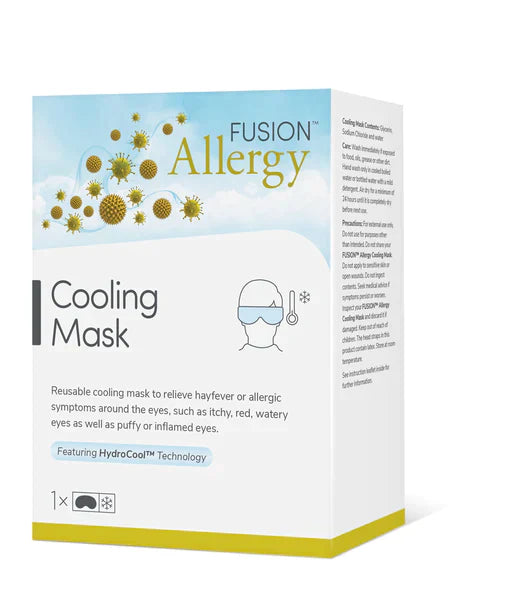
Fusion Allergy Cooling Eye Mask
- ✔️ Soothes itchy, puffy eyes caused by hay fever
- ✔️ Drug-free cooling relief for allergic conjunctivitis
- ✔️ Reusable mask for repeated use all season
- ✔️ Immediate cooling comfort on application
- ✔️ Suitable for use alongside antihistamine eye drops
Price Checker
Not approved? Full refund
Includes FREE private prescription
Couldn't load pickup availability
Fusion Allergy Cooling Eye Mask
The Fusion Allergy Cooling Eye Mask is a cooling mask worn over the eyes. The listing describes a drug-free way to take the edge off itchy, puffy, watery eyes by applying gentle coolness to the eye area.
How to Use
- Follow the directions on the pack for cooling the mask and how long to wear it.
- Place it over closed eyes.
Warnings
- Do not use a damaged mask. Check the pack for how to cool it and clean it.
- Do not apply it to broken or irritated skin.
- Speak to a pharmacist, optician or GP if your eyes are painful, very red or sticky, or if your vision changes.
- Keep out of the reach of children.
Frequently Asked Questions
Where can I buy the Fusion Allergy Cooling Eye Mask in the UK?
Cured Pharmacy, a GPhC-registered UK online pharmacy, sells the Fusion Allergy Cooling Eye Mask.
What is the Fusion Allergy Cooling Eye Mask?
It is a cooling mask worn over the eyes. The listing describes a drug-free way to take the edge off itchy, puffy, watery eyes.
How do I use it?
Follow the directions on the pack for cooling the mask and how long to wear it, then place it over closed eyes.
Does it contain medicine?
The listing describes it as drug-free. If your hay fever symptoms are severe or not controlled, speak to a pharmacist about treatments.
When should I get advice about my eyes?
Speak to a pharmacist, optician or GP if your eyes are painful, very red or sticky, or if your vision changes.
How Should You Use the Fusion Allergy Cooling Eye Mask?
Using the mask correctly is straightforward, but a few simple steps make a real difference to both comfort and effectiveness. Always start with clean hands and a properly chilled mask — rushing this step is the most common mistake people make.
Never apply the mask directly to open eyes or to broken, irritated, or infected skin. If you are using antihistamine eye drops at the same time, apply the drops first and wait a few minutes before placing the mask over your closed eyes.
What Is the Correct Dose of the Fusion Allergy Cooling Eye Mask?
As a non-medicated device, there is no pharmaceutical dose to measure. Instead, the "dose" refers to the duration and frequency of each cooling session. The table below summarises the recommended usage guidance.
Allow the skin around your eyes to return to its normal temperature between sessions before reapplying. There is no strict maximum number of daily uses, but if symptoms are severe or persistent, speak to a pharmacist or GP rather than relying solely on the mask.
When Is the Best Time to Use the Fusion Allergy Cooling Eye Mask?
Timing your use around your symptom pattern makes the mask considerably more effective. Many people find their eyes are at their most puffy and irritated first thing in the morning, after overnight exposure to indoor allergens such as dust mites. Using the mask as part of your morning routine can help you start the day more comfortably.
It's also particularly useful after returning indoors from high-pollen environments — for example, after a walk or time in the garden during spring and summer. Applying the mask promptly after allergen exposure can help interrupt the inflammatory response before symptoms escalate. An evening session can also help soothe eyes that have been irritated throughout the day.
How Long Can You Use the Fusion Allergy Cooling Eye Mask For?
The mask is reusable and can be used throughout the entire hay fever season or on an ongoing basis whenever allergy symptoms are present. Unlike medicated treatments, there is no maximum treatment duration to observe. However, you should inspect the mask regularly for any signs of wear, cracking, or material deterioration, and replace it promptly if damage is found.
If your eye symptoms persist despite regular use of the mask and other over-the-counter allergy treatments, it is worth speaking to your GP. Persistent or worsening allergic conjunctivitis may benefit from prescription-strength treatment or further investigation into the underlying allergen trigger.
Do not exceed the recommended dose. If in doubt, speak to your pharmacist.
What Are the Most Common Side Effects of the Fusion Allergy Cooling Eye Mask?
Because this is a non-medicated cooling device rather than a pharmaceutical product, side effects are uncommon and generally mild. Most people use the mask without any adverse reaction at all. That said, the skin around the eyes is particularly delicate, so it is worth knowing what to look out for.
- Temporary redness of the skin around the eyes immediately after removing the mask.
- Mild tingling or numbness during application — this is a normal response to cold and usually resolves quickly.
- A brief sensation of tightness in the skin around the eye area after use.
What Are the Less Common Side Effects of the Fusion Allergy Cooling Eye Mask?
Less commonly, some individuals may experience reactions related to either the cold temperature or the mask material itself. These are not typical but are worth being aware of before you use the product for the first time.
- Contact dermatitis — a localised skin reaction to the mask material, presenting as redness, itching, or a rash around the eye area.
- Discomfort or a burning sensation if the mask is applied when too cold or left on for longer than recommended.
- Increased sensitivity in the skin around the eyes after repeated use in some individuals.
If you notice any of these reactions, discontinue use and allow the skin to recover. If the reaction is persistent or worsening, seek advice from a pharmacist.
What Are the Serious Side Effects of the Fusion Allergy Cooling Eye Mask?
Serious side effects are rare but possible in people with specific underlying conditions. Cold urticaria is a condition in which the skin develops hives, swelling, or redness in response to cold temperatures. If you have been diagnosed with cold urticaria or have experienced similar reactions to cold in the past, do not use this mask without first speaking to your GP.
In very rare cases, prolonged or excessive cold exposure to the periorbital area could theoretically cause a cold burn to the delicate skin around the eyes. This is why it is essential never to freeze the mask and never to fall asleep while wearing it. If you experience significant pain, blistering, or skin discolouration, seek medical attention promptly.
What Should You Do If You Experience Side Effects?
If you notice any unexpected reaction during or after using the mask, remove it immediately and rinse the affected area gently with lukewarm water. Do not rub the skin around your eyes. For mild reactions such as temporary redness or tingling, no further action is usually needed — symptoms should resolve within a few minutes.
For more persistent reactions, such as a rash, swelling, or skin irritation that does not settle, contact your pharmacist for advice. If you experience any signs of a serious allergic reaction — such as significant swelling of the face, difficulty breathing, or widespread hives — seek emergency medical attention immediately by calling 999 or going to your nearest A&E.
Can the Fusion Allergy Cooling Eye Mask Interact With Other Medicines?
As a non-medicated physical device, the Fusion Allergy Cooling Eye Mask has no known pharmacological interactions with any medicines. It can be used safely alongside antihistamine tablets, antihistamine eye drops, sodium cromoglicate eye drops, and corticosteroid eye drops prescribed by a doctor. If you are using any eye drops, always apply them first and allow them to absorb fully before placing the mask over your closed eyes.
If you are unsure whether the mask is appropriate to use alongside a specific treatment you have been prescribed, ask your pharmacist or GP for guidance before use.
If you are concerned about any side effects, contact your pharmacist or GP immediately.
Written and reviewed by our qualified team
Reviewed by:
Tarun Kumar
Superintendent/ Clinical Lead
📖 Find out more about our team of medical content authors and how we ensure the accuracy of our content with our content guidelines.
Content last reviewed: 11 November 2026
★ Other popular options
100% discreet packaging
Discreet, unbranded packaging for every order.
Need help?
Talk to our friendly experts now
How our service works
Service setup
Discreet packaging
Express delivery
Medically reviewed by
Tarun Kumar, Superintendent Pharmacist & Clinical Lead (GPhC 2233073)
Last updated on 11 November 2026.
Review History
Our experts continually monitor new findings in health and medicine, and we update our articles when new information becomes available.
Why this page was updated on 11 November 2026
Content checked and updated as part of our periodic review, to ensure accuracy and currentness.
Current version (11 November 2026)
Edited by: The Editorial Team
Medically reviewed by:
Tarun Kumar, GPhC No. 2233073, Superintendent Pharmacist & Clinical Lead
How we source info.
When we present you with stats, data, opinion or a consensus, we'll tell you where this came from.