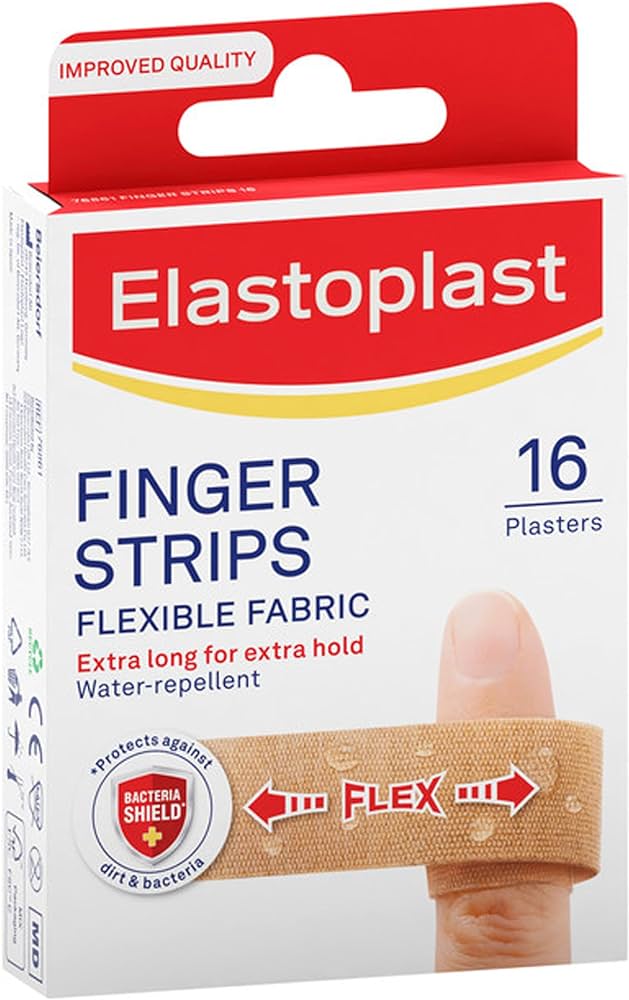
Elastoplast Finger Strips Extra Flexible Fabric 16 Strips
- ✔️ Contoured shape fits securely around finger joints
- ✔️ Flexible fabric moves naturally with finger movement
- ✔️ Breathable construction supports faster wound healing
- ✔️ Absorbent pad protects minor cuts, grazes and blisters
- ✔️ Pack of 16 strips for extended home first aid use
Price Checker
Not approved? Full refund
Includes FREE private prescription
Couldn't load pickup availability
How Should You Use Elastoplast Finger Strips?
Before applying a strip, always clean the wound and the surrounding skin thoroughly. A clean, dry surface is essential — the adhesive will not bond properly to wet or dirty skin, and any debris left in the wound increases the risk of infection.
What Is the Correct Dose of Elastoplast Finger Strips?
As a medical device, there is no pharmaceutical dose to consider — the guidance relates to how many strips to use and how frequently to change them. Use one strip per wound, replacing it at least once daily or whenever it becomes wet, soiled, or loose.
When Is the Best Time to Use Elastoplast Finger Strips?
Apply a fresh strip as soon as possible after a minor cut or graze occurs — prompt wound coverage reduces the risk of contamination and infection. It is also a good idea to change the strip in the morning as part of your daily routine, ensuring the wound is clean and the dressing is fresh before the day's activities begin.
If you work with your hands or engage in activities that expose the wound to water or dirt, consider changing the strip more frequently throughout the day to maintain effective protection.
How Long Can You Use Elastoplast Finger Strips For?
Continue using the strips until the wound has fully closed and is no longer at risk of reopening or contamination. For most minor cuts and grazes on fingers, this typically takes between three and seven days, depending on the depth and location of the wound. Once the skin has healed sufficiently, leaving the wound uncovered allows the skin to breathe and complete the final stages of healing.
If a wound has not shown clear signs of improvement within seven days, or if it worsens at any point, stop using the strips and consult a pharmacist or GP for further assessment.
Do not exceed the recommended dose. If in doubt, speak to your pharmacist.
What Are the Most Common Side Effects of Elastoplast Finger Strips?
Elastoplast Finger Strips are a medical device rather than a medicine, so they do not carry a pharmaceutical side effect profile. That said, some people do experience reactions — most of which are mild and temporary. The most frequently reported issues relate to the adhesive rather than the wound pad itself.
- Mild redness or skin irritation around the adhesive edges after removal
- Slight discomfort or stinging when peeling the plaster away, particularly over hairy skin
- Temporary indentation or marking of the skin from the adhesive
- Mild itching under or around the plaster during wear
What Are the Less Common Side Effects of Elastoplast Finger Strips?
Less commonly, some individuals — particularly those with sensitive skin or a history of adhesive reactions — may experience more noticeable skin responses. These are not dangerous in most cases but do warrant attention.
- Contact dermatitis — an allergic or irritant skin reaction causing a rash, blistering, or persistent itching at the plaster site
- Maceration — where the skin beneath the plaster becomes white, soft, and fragile due to prolonged moisture exposure
- Folliculitis — inflammation of hair follicles around the adhesive area, particularly if the plaster is applied over hairy skin repeatedly
What Are the Serious Side Effects of Elastoplast Finger Strips?
Serious reactions to adhesive plasters are rare but can occur. If you notice any of the following, remove the plaster immediately and seek medical advice:
- Severe allergic reaction (anaphylaxis) — extremely rare, but characterised by swelling, difficulty breathing, or widespread rash
- Signs of wound infection — increasing redness spreading beyond the wound edge, warmth, swelling, pus, or worsening pain that does not improve
- Skin breakdown or ulceration beneath the plaster, particularly in people with fragile or compromised skin
What Should You Do If You Experience Side Effects?
For mild irritation, remove the plaster, clean the area gently, and allow the skin to recover before reapplying. If you suspect contact dermatitis, avoid using the same product again and speak to a pharmacist about alternative wound dressings. For any signs of wound infection or a serious allergic reaction, seek medical attention promptly — do not attempt to manage an infected wound with plasters alone.
It is worth noting that some redness immediately after plaster removal is normal and usually resolves within a few hours. Persistent redness, swelling, or a spreading rash beyond the plaster area is more concerning and should be assessed by a healthcare professional.
Can Elastoplast Finger Strips Interact With Other Products?
As a medical device, Elastoplast Finger Strips have no known pharmaceutical drug interactions. However, applying certain topical creams, ointments, or antiseptic preparations directly under the wound pad may affect the adhesive bond or alter the wound environment. If you are using any topical skin treatments alongside wound care, check with your pharmacist to ensure they are compatible with adhesive dressings.
If you are concerned about any side effects, contact your pharmacist or GP immediately.
Written and reviewed by our qualified team
Reviewed by:
Tarun Kumar
Superintendent/ Clinical Lead
📖 Find out more about our team of medical content authors.
Content last reviewed: 11 November 2026
★ Other popular options
100% discreet packaging
Discreet, unbranded packaging for every order.
Need help?
Talk to our friendly experts now
How our service works
Service setup
Discreet packaging
Express delivery
Medically reviewed by
Tarun Kumar, Superintendent Pharmacist & Clinical Lead (GPhC 2233073)
Last updated on 11 November 2026.
Review History
Our experts continually monitor new findings in health and medicine, and we update our articles when new information becomes available.
Why this page was updated on 11 November 2026
Content checked and updated as part of our periodic review, to ensure accuracy and currentness.
Current version (11 November 2026)
Edited by: The Editorial Team
Medically reviewed by:
Tarun Kumar, GPhC No. 2233073, Superintendent Pharmacist & Clinical Lead
How we source info.
When we present you with stats, data, opinion or a consensus, we'll tell you where this came from.