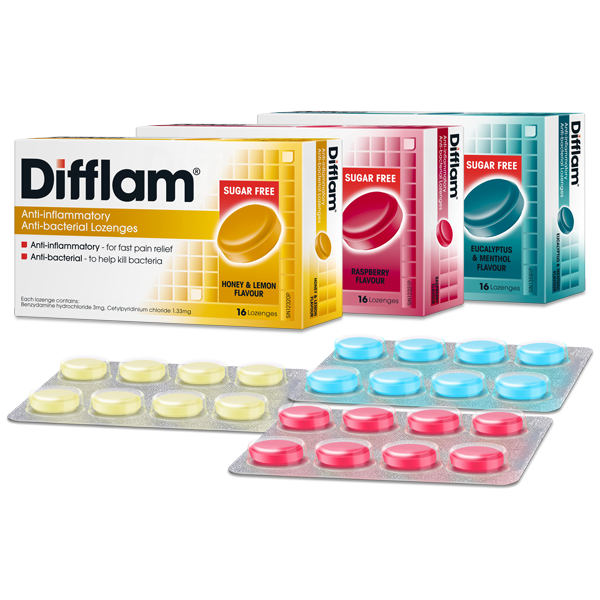
Difflam 3mg Lozenges
Difflam 3mg Lozenges
- ✔️ Relieves sore throat pain and inflammation locally
- ✔️ Contains benzydamine HCl, a clinically proven NSAID
- ✔️ Suitable for adults and children aged 6 and over
- ✔️ Dissolves in the mouth for fast-acting throat relief
- ✔️ No prescription needed — available OTC for £7.49
Price Checker
 Lowest price guarantee
 Includes FREE private prescription


Couldn't load pickup availability
What Are Difflam Sore Throat Lozenges?
A sore throat can make even swallowing feel like a chore. Whether it has crept up after a cold, a bout of tonsillitis, or simply too much talking, the discomfort is hard to ignore. Difflam sore throat lozenges offer targeted, localised relief right where you need it — in the mouth and throat — without the need for a prescription. Each lozenge contains 3mg of benzydamine hydrochloride, a non-steroidal anti-inflammatory drug (NSAID) that works directly on the inflamed tissue of the oropharynx. You can browse our full range of ear, nose and throat remedies if you are looking for additional support alongside these lozenges.
Sore throats are one of the most common reasons people visit a pharmacist in the UK. The NHS notes that most sore throats are caused by viral infections and will resolve on their own within a week, but that does not make the interim any more comfortable. That is exactly where an OTC lozenge like this one earns its place in your medicine cabinet.
How Do Difflam 3mg Lozenges Work?
Benzydamine hydrochloride is the active ingredient in Difflam lozenges. It belongs to the NSAID class of medicines, but unlike oral NSAIDs such as ibuprofen, it acts locally rather than systemically. As the lozenge dissolves slowly in your mouth, benzydamine is absorbed directly through the mucosal lining of the throat, where it gets to work reducing inflammation and numbing pain at the site of irritation.
- Inhibits prostaglandin synthesis locally, reducing inflammatory signalling in the throat tissue
- Produces a mild local anaesthetic effect, temporarily numbing the area to ease pain on swallowing
- Acts within minutes of the lozenge beginning to dissolve
- Does not require absorption through the gastrointestinal tract, minimising systemic effects
Who Is Suitable for Difflam 3mg Lozenges?
These lozenges are suitable for most adults and older children dealing with a painful or inflamed throat. They are particularly useful when swallowing tablets is uncomfortable, since the lozenge dissolves in the mouth without needing to be swallowed whole. That said, they are not appropriate for everyone.
- Adults aged 18 and over with a sore or inflamed throat
- Young people aged 12 to 17 years (adult dosing applies)
- Children aged 6 to 11 years (lower dose — see dosage table)
- People who find oral tablets difficult to swallow due to throat pain
They are not suitable for children under 6 years of age, or for anyone with a known hypersensitivity to benzydamine or other NSAIDs. If you have asthma, speak to your pharmacist before use, as some people with asthma are sensitive to NSAIDs.
How Do Difflam Lozenges Compare to Other Sore Throat Remedies?
| Feature | Difflam 3mg Lozenges | Antiseptic Throat Lozenges (e.g. Strepsils) |
|---|---|---|
| Active ingredient | Benzydamine HCl 3mg (NSAID) | Amylmetacresol / 2,4-dichlorobenzyl alcohol |
| Primary action | Anti-inflammatory + local anaesthetic | Antiseptic (antibacterial/antiviral) |
| Pain relief | Yes — direct analgesic effect | Mild — primarily targets infection |
| Suitable from age | 6 years and over | Varies by product (typically 12+) |
How Should You Store Difflam 3mg Lozenges?
Store your Difflam sore throat lozenges below 25°C in a dry place, away from direct sunlight. Keep them out of reach and sight of children at all times. Do not use the lozenges after the expiry date printed on the packaging — if in doubt, return them to your local pharmacy for safe disposal rather than putting them in household waste.
If you are managing multiple symptoms alongside a sore throat — such as headache or body aches — you might also find our pain relief collection helpful for complementary OTC options.
This product is a medicine. Speak to your doctor or pharmacist before using if you have an underlying medical condition or are taking other medicines.
Difflam 3mg Lozenges specifications
| Treatment category | Sore throat / oropharyngeal pain relief |
| Active ingredient | Benzydamine hydrochloride 3mg |
| Mechanism of action | Local NSAID — inhibits prostaglandin synthesis; local anaesthetic effect |
| Effective for | Sore throat, mouth ulcers, post-dental procedure pain, tonsillitis discomfort |
| Suitable for | Adults and children aged 6 years and over |
| Strengths | 3mg benzydamine hydrochloride per lozenge |
| UK classification | General Sale List (GSL) / Pharmacy (P) — varies by pack size |
| Drug class | Non-steroidal anti-inflammatory drug (NSAID) |
| Preparation | Lozenge (oromucosal) |
| Route of administration | Oromucosal (dissolved in the mouth) |
Specifications of Difflam 3mg Lozenges
What Are Difflam 3mg Lozenges and What Are They Used For?
Difflam 3mg Lozenges are an over-the-counter medicine used to relieve the pain and inflammation associated with sore throats, mouth ulcers, and other conditions affecting the mouth and throat. The active ingredient, benzydamine hydrochloride, is a locally acting NSAID that reduces inflammation and provides temporary pain relief directly at the site of discomfort. The NHS advises that most sore throats are caused by viral infections and do not require antibiotics, making OTC remedies like these lozenges a practical first-line option for symptom management.
These lozenges may also be used to ease discomfort following dental procedures, tonsillitis, or pharyngitis. If you are also dealing with symptoms such as a blocked nose or congestion alongside your sore throat, our cold and flu collection has a range of products that may help.
What Do You Need to Know Before Using Difflam 3mg Lozenges?
Before using these lozenges, it is important to check that they are appropriate for you. Do not use them if any of the following apply:
- You are allergic to benzydamine hydrochloride or any other ingredient in the lozenge
- You have a known hypersensitivity to aspirin or other NSAIDs (e.g. ibuprofen)
- The person needing treatment is under 6 years of age
- You have been told by a doctor not to take NSAIDs
Speak to your pharmacist or GP before use if you:
- Have asthma — some people with asthma are sensitive to NSAIDs
- Are pregnant or breastfeeding
- Have liver or kidney problems
- Have phenylketonuria — check the lozenge ingredients for aspartame content
Drug interactions: Benzydamine lozenges act locally and are not significantly absorbed systemically at OTC doses, so clinically significant drug interactions are uncommon. However, always inform your pharmacist of all medicines you are taking, including herbal remedies.
- No significant interactions are documented at standard OTC doses
- Use with caution alongside other NSAIDs if systemic absorption is a concern
How Should You Use Difflam 3mg Lozenges?
Always use this medicine exactly as described in the patient information leaflet or as directed by your pharmacist. Do not exceed the stated dose.
- Place one lozenge in your mouth
- Allow it to dissolve slowly — do not chew or swallow it whole
- Repeat every 2 to 3 hours as needed (adults and children 12+)
- Do not exceed the maximum daily dose for your age group
- If symptoms persist beyond 3 days, consult your GP or pharmacist
| Age Group | Dose | Frequency | Maximum Daily Dose |
|---|---|---|---|
| Adults & children 12+ | 1 lozenge | Every 2–3 hours | 8 lozenges in 24 hours |
| Children aged 6–11 | 1 lozenge | Every 3 hours | 6 lozenges in 24 hours |
| Children under 6 | Not recommended | ||
What Are the Possible Side Effects of Difflam 3mg Lozenges?
Like all medicines, Difflam lozenges can cause side effects, although not everyone will experience them. Most side effects are mild and localised to the mouth and throat.
Common side effects:
- Temporary numbness or tingling sensation in the mouth or throat
- Mild burning sensation on the tongue or oral mucosa
Less common side effects:
- Nausea
- Dry mouth
- Hypersensitivity reactions such as skin rash or itching
- Photosensitisation (increased sensitivity to sunlight) — rare
Stop using the lozenges and seek immediate medical attention if you develop swelling of the face, lips, tongue, or throat, difficulty breathing, or a severe skin reaction. These may be signs of a serious allergic reaction (anaphylaxis), which requires urgent treatment.
How Should You Store Difflam 3mg Lozenges?
- Store below 25°C in a dry place
- Keep away from direct sunlight and moisture
- Keep out of the sight and reach of children
- Do not use after the expiry date printed on the pack
- Do not dispose of medicines via household waste — return unused lozenges to your pharmacy
If you are supporting a child's recovery from a throat infection and need additional products, our baby and toddler health range includes age-appropriate options for younger children who cannot use these lozenges.
References
- https://www.nhs.uk/conditions/sore-throat/
- https://www.nhs.uk/conditions/tonsillitis/
- https://www.nhs.uk/conditions/mouth-ulcers/
- https://www.nhs.uk/conditions/anti-inflammatory-medicines-nsaids/
- https://www.nhs.uk/medicines/ibuprofen/who-can-and-cannot-take-ibuprofen/
- https://www.medicines.org.uk/emc/product/1051/smpc
Written and reviewed by our qualified team
Your safety and success are our highest priorities. Our medical team rigorously evaluates every product and piece of advice we provide, ensuring you receive only the most effective, science-backed solutions available.
Frequently Asked Questions
Where can I buy Difflam 3mg lozenges online in the UK?
You can buy Difflam 3mg lozenges directly from Cured Pharmacy, a GPhC-registered UK online pharmacy, for just £7.49. No prescription is required, and ordering online means you can get them delivered to your door without leaving the house. They are also stocked in some high street pharmacies across the UK.
How do Difflam 3mg lozenges work in the body?
Difflam lozenges contain benzydamine hydrochloride, a locally acting NSAID that is absorbed through the mucosal lining of the mouth and throat as the lozenge dissolves. It works by inhibiting prostaglandin synthesis at the site of inflammation, reducing both pain and swelling. Because it acts locally rather than systemically, it tends to have fewer whole-body side effects than oral NSAIDs.
How do I use Difflam 3mg lozenges step by step?
Place one lozenge in your mouth and allow it to dissolve slowly — do not chew it or swallow it whole. Repeat every 2 to 3 hours as needed, up to the maximum daily dose for your age group. If your symptoms have not improved after 3 days, speak to your pharmacist or GP.
What is the correct dose of Difflam lozenges for adults?
Adults and young people aged 12 and over should dissolve one lozenge in the mouth every 2 to 3 hours, with a maximum of 8 lozenges in any 24-hour period. Children aged 6 to 11 should use one lozenge every 3 hours, up to a maximum of 6 lozenges per day. These lozenges are not suitable for children under 6 years of age.
When is the best time to use Difflam lozenges?
Use a lozenge whenever your throat pain is at its most uncomfortable — many people find them particularly helpful before meals, when swallowing is most painful. You can also use one before bed to ease discomfort overnight. Just make sure you stay within the maximum daily dose and do not use them for more than 3 days without seeking advice.
What are the side effects of Difflam 3mg lozenges?
The most common side effect is a temporary numbing or tingling sensation in the mouth, which is actually a sign the lozenge is working. Less commonly, some people experience nausea, dry mouth, or mild oral irritation. Stop use immediately and seek medical advice if you develop any signs of an allergic reaction, such as swelling, rash, or difficulty breathing.
How do I manage side effects of Difflam lozenges?
The tingling or numbness in the mouth is temporary and usually resolves once the lozenge has fully dissolved — no action is needed. If you experience nausea, try using the lozenge after eating rather than on an empty stomach. For any persistent or concerning side effects, contact your pharmacist or GP for guidance.
Who should not use Difflam 3mg lozenges?
These lozenges are not suitable for children under 6 years of age, or for anyone with a known allergy to benzydamine or other NSAIDs such as aspirin or ibuprofen. People with asthma should speak to a pharmacist before use, as NSAID sensitivity can trigger bronchospasm in some individuals. Pregnant or breastfeeding women should also seek pharmacist advice before using them.
Can I use Difflam lozenges if I am pregnant or breastfeeding?
You should speak to your pharmacist or GP before using Difflam lozenges if you are pregnant or breastfeeding. While the lozenges act locally, it is always best to seek professional advice before using any medicine during pregnancy or whilst nursing. Your pharmacist can help you weigh up the benefits and any potential risks.
Are Difflam lozenges suitable for children?
Difflam 3mg lozenges are suitable for children aged 6 years and over, with a reduced dosing schedule compared to adults. They are not appropriate for children under 6. If you need throat or cold relief for younger children, take a look at our baby and toddler health range for age-appropriate alternatives.
What happens if I miss a dose of Difflam lozenges?
Difflam lozenges are used on an as-needed basis rather than on a strict schedule, so there is no "missed dose" in the traditional sense. Simply use a lozenge when your symptoms return, provided you have not already reached your maximum daily dose. Never double up to compensate for a missed lozenge.
How long can you use Difflam lozenges for?
Difflam lozenges are intended for short-term use only — typically no longer than 3 days without medical review. If your sore throat has not improved within 3 days, or if it is getting worse, you should consult your GP. A persistent sore throat can occasionally indicate a condition that requires further investigation or treatment.
What are the alternatives to Difflam lozenges for sore throat?
Alternatives include antiseptic lozenges such as Strepsils (containing amylmetacresol), anaesthetic sprays, or oral analgesics such as paracetamol or ibuprofen taken by mouth. For broader symptom relief during a cold or flu, our cold and flu collection includes a variety of options. The best choice depends on your specific symptoms and medical history.
Can Difflam lozenges interact with other medicines?
Because benzydamine acts locally in the mouth and throat and is not significantly absorbed into the bloodstream at OTC doses, clinically significant drug interactions are uncommon. However, you should always tell your pharmacist about all medicines you are taking, including over-the-counter products and herbal supplements. If you are already taking a systemic NSAID, seek pharmacist advice before using these lozenges as well.
What does the latest research say about benzydamine for sore throat?
Benzydamine has been used clinically for several decades and is well established as a locally acting anti-inflammatory and analgesic for oropharyngeal conditions. Published clinical literature supports its efficacy in reducing throat pain and inflammation, including in post-operative and chemotherapy-induced mucositis settings. For everyday sore throat relief, it remains a widely recommended OTC option by UK pharmacists.
Written and reviewed by our qualified team

Reviewed by:
Tarun Kumar
Superintendent/ Clinical Lead
📖 Find out more about our team of medical content authors and how we ensure the accuracy of our content with our content guidelines.
Content last updated: 14 Sep 2026
Other popular options


We’re a safe and
regulated UK service

Lowest Price Guarantee

We're convinced you won't find your treatment cheaper, but if you do we'll refund the difference.
Find out more
100% discreet packaging

Discreet, unbranded packaging for every order.
Find out more

Need help?
Talk to our friendly experts now


How our service works

Service setup

Discreet packaging

Express delivery