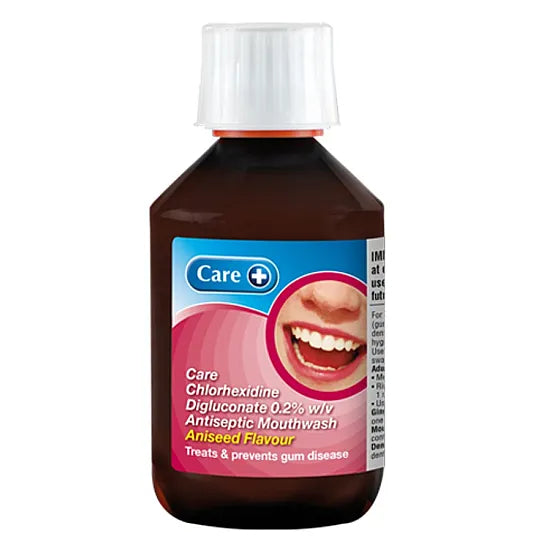
Care Chlorhexidine Digluconate 0.2% Antiseptic Aniseed Mouthwash - 300ml
Care Chlorhexidine Digluconate 0.2% Antiseptic Aniseed Mouthwash - 300ml
- ✔️ Kills bacteria that cause plaque and gum disease
- ✔️ Chlorhexidine 0.2% provides hours of antibacterial protection
- ✔️ Aniseed flavour makes twice-daily rinsing more tolerable
- ✔️ Clinically recognised treatment for gingivitis and oral infections
- ✔️ Supports healing after tooth extractions and dental procedures
Price Checker
 Lowest price guarantee
 Includes FREE private prescription


Couldn't load pickup availability
What Is Chlorhexidine Mouthwash and How Does It Help?
If you've been dealing with sore, bleeding gums or your dentist has flagged early signs of gum disease, you may have been pointed towards a chlorhexidine mouthwash. Care Chlorhexidine Digluconate 0.2% Antiseptic Aniseed Mouthwash is a clinically recognised oral antiseptic rinse, available over the counter for just £3.99. It contains chlorhexidine digluconate at a 0.2% concentration — the same active ingredient used in dental practice for decades — and comes in a refreshing aniseed flavour that makes daily use a little more pleasant. Whether you're managing gingivitis, recovering from dental surgery, or simply trying to keep your mouth in better shape, this mouthwash is a straightforward, affordable option worth knowing about. You can browse the full range of oral health products at Cured Pharmacy to find what suits your needs.
How Does Care Chlorhexidine Digluconate Mouthwash Work?
Chlorhexidine digluconate is an antiseptic agent with a well-established mechanism of action. It works by binding to bacterial cell membranes and disrupting their integrity, which ultimately kills the bacteria responsible for plaque build-up and gum inflammation. What makes it particularly effective is its substantivity — it adheres to oral tissues and continues releasing its antibacterial effect for several hours after you've rinsed and spat.
- Binds to negatively charged bacterial cell walls, destabilising the membrane
- Causes leakage of intracellular components, leading to bacterial cell death
- Adsorbs to oral mucosa and tooth surfaces, providing prolonged antibacterial activity
- Reduces plaque formation and the bacterial load associated with gingivitis
Who Should Use Care Chlorhexidine Antiseptic Mouthwash?
This mouthwash is suitable for adults and young people aged 12 and over who need targeted antibacterial support for their oral health. It's particularly useful in the following situations:
- People diagnosed with gingivitis or early-stage gum disease
- Those recovering from dental procedures such as extractions, implants, or periodontal treatment
- Individuals with mouth ulcers or oral infections requiring antiseptic support
- People who wear dentures or orthodontic appliances and are prone to bacterial build-up
It is not intended as a permanent replacement for regular brushing and flossing. Think of it as a short-term therapeutic tool rather than an everyday maintenance rinse. If you're unsure whether it's right for you, your pharmacist or dentist can advise.
How Does Care Chlorhexidine Mouthwash Compare to Other Antiseptic Rinses?
| Feature | Care Chlorhexidine 0.2% Mouthwash | Essential Oil Mouthwash (e.g. Listerine) |
|---|---|---|
| Active ingredient | Chlorhexidine digluconate 0.2% | Thymol, eucalyptol, menthol, methyl salicylate |
| Antibacterial substantivity | Up to 12 hours | Shorter duration |
| Recommended use duration | Short-term (up to 4 weeks) | Suitable for long-term daily use |
| Risk of tooth staining | Yes, with prolonged use | Minimal |
| Flavour | Aniseed | Mint variants |
Is Care Chlorhexidine Mouthwash Suitable for Long-Term Use and How Should It Be Stored?
This product is designed for short-term therapeutic use, typically up to four weeks, unless a dentist or doctor advises otherwise. Using it beyond this period without professional guidance increases the risk of tooth and tongue staining, as well as potential changes to your sense of taste. If your symptoms persist after four weeks, it's worth booking a dental appointment rather than continuing to self-treat.
Store the mouthwash below 25°C, away from direct sunlight, and keep it out of reach of children. Do not use after the expiry date printed on the bottle. If you're looking for complementary products to support your recovery from dental procedures, our dental products collection has a range of options to consider.
This product is a medicine. Speak to your doctor or pharmacist before using if you have an underlying medical condition or are taking other medicines.
Care Chlorhexidine Digluconate 0.2% Antiseptic Aniseed Mouthwash 300ml specifications
| Treatment category | Oral antiseptic / Dental hygiene |
| Mechanism of action | Disrupts bacterial cell membranes; bactericidal with prolonged substantivity |
| Effective against | Plaque-forming bacteria, gingivitis-associated pathogens |
| Suitable for | Adults and children aged 12 and over |
| Active ingredient | Chlorhexidine digluconate 0.2% w/v |
| Pack size | 300ml |
| Strength | 0.2% w/v |
| UK classification | General Sale List (GSL) |
| Drug class | Antiseptic / Bisbiguanide |
| Preparation | Aqueous oral solution |
| Route of administration | Oral rinse (not to be swallowed) |
Specifications of Care Chlorhexidine Digluconate 0.2% Antiseptic Aniseed Mouthwash 300ml
What Is Care Chlorhexidine Digluconate Mouthwash and What Is It Used For?
Care Chlorhexidine Digluconate 0.2% Antiseptic Aniseed Mouthwash is an over-the-counter oral antiseptic rinse used to reduce harmful bacteria in the mouth. It is indicated for the treatment and prevention of gingivitis (gum inflammation), as an adjunct to oral hygiene in the management of periodontal disease, and to support healing after dental procedures such as extractions or implant placement. It may also be used to help manage mouth ulcers and oral infections where an antiseptic environment is beneficial. The NHS recognises chlorhexidine as a first-line antiseptic mouthwash for gum disease management.
What Do You Need to Know Before Using Care Chlorhexidine Mouthwash?
Before using this mouthwash, read the following carefully. There are certain situations where it should not be used, and others where caution is needed.
Do not use this product if you:
- Are allergic to chlorhexidine digluconate or any other ingredient in the formulation
- Are under 12 years of age
- Have had a previous severe allergic reaction (anaphylaxis) to chlorhexidine — this is a known, albeit rare, risk
Use with caution and speak to a pharmacist or dentist if you:
- Are pregnant or breastfeeding — while topical oral use is generally considered low risk, always seek professional advice
- Have open wounds or ulceration in the mouth that are severe or worsening
- Have a known sensitivity to aniseed or anethole (the flavouring agent)
Drug interactions to be aware of:
- Chlorhexidine is inactivated by anionic compounds found in many toothpastes — always wait at least 30 minutes after brushing before using this mouthwash
- Avoid using simultaneously with other oral antiseptic products unless directed by a healthcare professional
How Should You Use Care Chlorhexidine Digluconate Mouthwash?
Using this mouthwash correctly makes a real difference to how well it works. Follow these steps each time:
- Measure 10ml of the mouthwash using the cap or a measuring cup
- Rinse vigorously around your mouth for approximately one minute
- Spit the mouthwash out completely — do not swallow
- Do not eat, drink, or rinse your mouth with water for at least 30 minutes afterwards
- Use twice daily — morning and evening — after brushing your teeth
- Wait at least 30 minutes after using toothpaste before rinsing with this product
| Indication | Age Group | Dose | Frequency |
|---|---|---|---|
| Gingivitis / gum disease | Adults and children 12+ | 10ml | Twice daily |
| Post-dental procedure care | Adults and children 12+ | 10ml | Twice daily (as directed by dentist) |
| Mouth ulcers / oral infections | Adults and children 12+ | 10ml | Twice daily |
| Children under 12 | Not recommended | — | — |
What Are the Possible Side Effects of Care Chlorhexidine Mouthwash?
Like all medicines, this product can cause side effects, although not everyone will experience them. Knowing what to look out for helps you use it safely. If you experience any severe or unexpected reactions, stop use and contact your pharmacist or GP. You might also find it helpful to explore our first aid collection if you need to manage minor oral irritation alongside your treatment.
Common side effects:
- Brown staining of teeth, tongue, and dental restorations (fillings, crowns)
- Altered or reduced sense of taste (dysgeusia), particularly in the first few days
- Mild burning or tingling sensation in the mouth
- Increased tartar (calculus) build-up with prolonged use
Less common side effects:
- Mouth irritation or soreness
- Swelling of the parotid (salivary) glands — rare but documented
- Allergic reactions including rash, itching, or swelling — seek immediate medical attention if this occurs
- Anaphylaxis — extremely rare but serious; call 999 immediately if you experience difficulty breathing, swelling of the face or throat, or a sudden drop in blood pressure
How Should You Store Care Chlorhexidine Digluconate Mouthwash?
Correct storage keeps the product effective and safe for the duration of use. If you're managing multiple oral health products, our dental products page has further options to complement your routine.
- Store below 25°C in a cool, dry place
- Keep away from direct sunlight and heat sources
- Keep the bottle tightly closed when not in use
- Store out of sight and reach of children
- Do not use after the expiry date printed on the bottle or carton
- Do not transfer to another container
- Do not freeze
References
- https://www.nhs.uk/conditions/gum-disease/
- https://www.nhs.uk/conditions/mouth-ulcers/
- https://www.nhs.uk/live-well/healthy-teeth-and-gums/how-to-keep-your-teeth-clean/
- https://www.nhs.uk/conditions/dental-abscess/
- https://www.nhs.uk/conditions/anaphylaxis/
- https://bnf.nice.org.uk/drugs/chlorhexidine/
Written and reviewed by our qualified team
Your safety and success are our highest priorities. Our medical team rigorously evaluates every product and piece of advice we provide, ensuring you receive only the most effective, science-backed solutions available.
Frequently Asked Questions
Where can I buy chlorhexidine mouthwash online in the UK?
You can buy Care Chlorhexidine Digluconate 0.2% Antiseptic Aniseed Mouthwash directly from Cured Pharmacy for just £3.99, with no prescription required. It's a General Sale List (GSL) medicine, meaning it's available over the counter. Browse our full oral health range for complementary products to support your dental care routine.
How does chlorhexidine digluconate mouthwash work in the mouth?
Chlorhexidine digluconate works by binding to bacterial cell membranes and disrupting their structure, which kills the bacteria responsible for plaque and gum disease. It has a property called substantivity, meaning it continues to release its antibacterial effect for several hours after you've rinsed. This makes it more effective than many standard mouthwashes for short-term therapeutic use.
How do I use Care Chlorhexidine Mouthwash step by step?
Measure 10ml using the bottle cap, rinse vigorously around your mouth for one full minute, then spit it out completely — never swallow it. Do not eat, drink, or rinse with water for at least 30 minutes after use. Use twice daily, morning and evening, and always wait at least 30 minutes after brushing your teeth before using the mouthwash.
What is the correct dose of Care Chlorhexidine Mouthwash?
The standard dose for adults and children aged 12 and over is 10ml, used as an oral rinse twice daily. Do not increase the dose or frequency without advice from a dentist or pharmacist. Children under 12 should not use this product.
Can chlorhexidine mouthwash stain your teeth?
Yes — brown or yellowish staining of teeth, the tongue, and dental restorations is one of the most commonly reported side effects of chlorhexidine mouthwash, particularly with prolonged use. The staining is generally reversible and can be removed by a dental hygienist during a professional clean. To minimise staining, avoid tea, coffee, and red wine during the course of treatment where possible.
How long can you use chlorhexidine mouthwash for?
This mouthwash is intended for short-term use, typically up to four weeks, unless your dentist or doctor advises a longer course. Using it beyond this period without professional guidance increases the risk of tooth staining and taste disturbance. If your symptoms haven't improved after four weeks, book an appointment with your dentist rather than continuing to self-treat.
Is chlorhexidine mouthwash safe to use during pregnancy?
Topical oral use of chlorhexidine mouthwash is generally considered low risk during pregnancy, as systemic absorption from rinsing and spitting is minimal. However, you should always speak to your midwife, GP, or dentist before using any medicine during pregnancy. They can confirm whether it's appropriate for your specific situation.
Who is eligible to use Care Chlorhexidine Antiseptic Mouthwash?
This product is suitable for adults and young people aged 12 and over who need antibacterial support for conditions such as gingivitis, mouth ulcers, or post-dental procedure care. It is not suitable for children under 12, or for anyone with a known allergy to chlorhexidine or aniseed. If you have any underlying health conditions, check with your pharmacist before use.
What happens if I accidentally swallow chlorhexidine mouthwash?
Swallowing a small amount accidentally is unlikely to cause serious harm, but this product is not intended to be ingested. If a large amount is swallowed, or if a child swallows any amount, contact NHS 111 or your nearest A&E immediately. Always keep the bottle out of reach of children.
Can I use chlorhexidine mouthwash after a tooth extraction?
Yes — chlorhexidine mouthwash is frequently recommended by dentists after tooth extraction to reduce the risk of infection and dry socket. Your dentist will usually advise you to start using it 24 hours after the procedure, not immediately, to allow initial clot formation. Always follow your dentist's specific instructions regarding timing and frequency.
Why should I wait after brushing before using chlorhexidine mouthwash?
Many toothpastes contain anionic surfactants such as sodium lauryl sulphate, which can inactivate chlorhexidine and significantly reduce its effectiveness. Waiting at least 30 minutes after brushing ensures the toothpaste has been cleared from your mouth and the mouthwash can work properly. This is one of the most important — and most commonly overlooked — instructions for this product.
What are the alternatives to chlorhexidine mouthwash?
Alternatives include essential oil-based mouthwashes (such as those containing thymol and eucalyptol), cetylpyridinium chloride rinses, or fluoride mouthwashes for cavity prevention rather than antibacterial action. Each has different strengths and is suited to different needs — your dentist or pharmacist can help you choose. You can also explore our wider dental products collection for other oral care options.
Can chlorhexidine mouthwash cause an allergic reaction?
Allergic reactions to chlorhexidine are rare but can be serious, ranging from mild skin rashes and itching to severe anaphylaxis in very rare cases. If you notice swelling of the face, lips, or throat, difficulty breathing, or a sudden rash after use, stop immediately and call 999. Always tell healthcare professionals about any previous reactions to chlorhexidine before procedures or treatments.
What are the latest findings on chlorhexidine mouthwash for gum disease?
Chlorhexidine remains one of the most studied and clinically validated antiseptic agents for oral use, with decades of evidence supporting its effectiveness in reducing plaque and gingivitis when used as an adjunct to mechanical cleaning. Current guidance from dental bodies continues to recommend it for short-term therapeutic use in gum disease management. Research is ongoing into formulations that reduce staining while maintaining antibacterial efficacy.
How do I manage the taste change caused by chlorhexidine mouthwash?
Altered taste sensation is a common and temporary side effect that usually improves within a few days of starting use or after completing the course. Rinsing with plain water (at least 30 minutes after using the mouthwash) can help, and the aniseed flavour in this particular formulation is designed to make the experience more tolerable. If taste disturbance is severe or persists after stopping use, speak to your pharmacist or GP.
Written and reviewed by our qualified team

Reviewed by:
Tarun Kumar
Superintendent/ Clinical Lead
📖 Find out more about our team of medical content authors and how we ensure the accuracy of our content with our content guidelines.
Content last updated: 14 Sep 2026

We’re a safe and
regulated UK service

Lowest Price Guarantee

We're convinced you won't find your treatment cheaper, but if you do we'll refund the difference.
Find out more
100% discreet packaging

Discreet, unbranded packaging for every order.
Find out more

Need help?
Talk to our friendly experts now


How our service works

Service setup

Discreet packaging

Express delivery