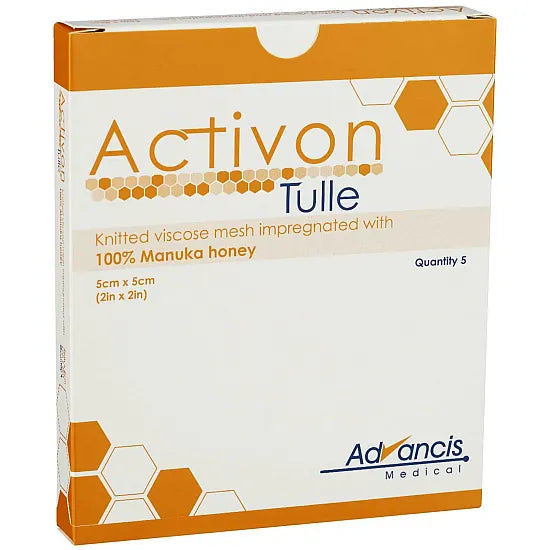
Activon Tulle Manuka Honey Dressings
- ✔️ Impregnated with 100% medical-grade manuka honey
- ✔️ Supports moist wound healing for faster tissue repair
- ✔️ Antibacterial action targets MRSA and common wound pathogens
- ✔️ Non-adherent tulle base prevents trauma on dressing removal
- ✔️ Suitable for leg ulcers, burns, and pressure ulcers
Price Checker
 Discreet, tracked delivery
 Includes FREE private prescription


Couldn't load pickup availability
What Is a Manuka Honey Wound Dressing?
If you've been searching for a gentle yet clinically supported way to manage wounds at home, Activon Tulle Manuka Honey Dressings could be exactly what you need. These sterile, knitted viscose dressings are impregnated with 100% medical-grade manuka honey — no additives, no fillers. They're designed to sit directly on the wound surface, creating the kind of moist environment that supports natural tissue repair. You can find them alongside other first aid products at Cured Pharmacy, available without a prescription for £12.99.
Wound care has come a long way. Honey has been used medicinally for thousands of years, but it's only in recent decades that clinical research has caught up with what traditional healers long suspected. Manuka honey, derived from the Leptospermum scoparium plant native to New Zealand and Australia, has properties that set it apart from standard honey. The NHS recognises that moist wound healing promotes faster tissue repair and reduces scarring compared with letting wounds dry out.
How Does Activon Tulle Work on Wounds?
The mechanism behind Activon Tulle is actually quite elegant. Manuka honey works through several complementary pathways simultaneously, which is part of why it's become a respected option in wound care settings.
- Osmotic action: Honey draws fluid from the wound bed through osmosis, helping to lift and soften necrotic (dead) tissue — a process called autolytic debridement.
- Acidic pH: Manuka honey maintains a low pH environment at the wound surface, which is known to inhibit bacterial growth and support the activity of proteases involved in healing.
- Hydrogen peroxide release: When honey contacts wound fluid, a slow, controlled release of hydrogen peroxide occurs, contributing to its antibacterial effect without damaging healthy tissue.
- Methylglyoxal (MGO): Unique to manuka honey, MGO provides an additional antibacterial mechanism that remains active even in the absence of hydrogen peroxide.
- Moist wound environment: The tulle base keeps the dressing non-adherent, meaning it won't stick to the wound bed and cause trauma on removal.
Together, these actions help reduce bacterial burden, manage wound odour, and encourage the formation of healthy granulation tissue — all key steps in wound closure.
Who Should Use Activon Tulle Dressings?
Activon Tulle is suitable for a wide range of wound types, both chronic and acute. It's particularly well regarded in community nursing and tissue viability settings for wounds that are slow to heal or at risk of infection. That said, it's also practical for home use when wounds are superficial and manageable without clinical intervention.
This dressing is appropriate for:
- Leg ulcers (venous, arterial, or mixed aetiology)
- Pressure ulcers (grades 2–4)
- Diabetic foot ulcers — though always under healthcare supervision
- Minor burns and scalds
- Surgical wounds healing by secondary intention
- Traumatic wounds such as abrasions or lacerations
It is not suitable for people with a known allergy to honey, bee products, or any component of the dressing. If you're unsure whether this product is right for your wound, speak to your pharmacist or GP before use.
How Does Activon Tulle Compare to Other Wound Dressings?
| Feature | Activon Tulle (Manuka Honey) | Standard Hydrocolloid Dressing |
|---|---|---|
| Active ingredient | 100% medical-grade manuka honey | Gelatin, pectin, carboxymethylcellulose |
| Antibacterial action | Yes — via MGO, hydrogen peroxide, low pH | No direct antibacterial action |
| Debridement support | Yes — autolytic via osmotic action | Yes — autolytic via moisture retention |
| Suitable for infected wounds | Yes (with clinical oversight) | Generally not recommended |
| Non-adherent | Yes — knitted tulle base | Yes |
How Should You Store Activon Tulle and Is It Clinically Safe?
The manuka honey wound dressing should be stored below 25°C, away from direct sunlight and sources of heat. Do not freeze the product, as this can alter the consistency of the honey and affect its performance. Once the sterile packaging has been opened, the dressing should be used immediately and any unused portion discarded — do not re-seal and reuse.
From a safety perspective, Activon Tulle has a well-established profile when used as directed. It's worth noting that people with diabetes should always have their wounds assessed by a healthcare professional, as diabetic foot complications require specialist management. If you're managing a wound alongside other skin concerns, you might also find our skin care collection useful for supporting the surrounding skin during healing.
This product is a medicine. Speak to your doctor or pharmacist before using if you have an underlying medical condition or are taking other medicines.
Activon Tulle Manuka Honey Dressings specifications
| Treatment category | Wound care / First aid |
| Mechanism of action | Osmotic debridement, antibacterial via MGO and hydrogen peroxide, moist wound healing |
| Effective for | Leg ulcers, pressure ulcers, minor burns, surgical wounds, traumatic wounds |
| Suitable for | Adults and children; not suitable for those allergic to honey or bee products |
| Active ingredient | Manuka honey 100% |
| UK classification | CE-marked medical device |
| Preparation | Sterile knitted viscose tulle impregnated with manuka honey |
| Route of administration | Topical (applied directly to wound surface) |
Specifications of Activon Tulle Manuka Honey Dressings
What Is Activon Tulle and What Is It Used For?
Activon Tulle Manuka Honey Dressings are sterile, non-adherent wound contact dressings impregnated with 100% medical-grade manuka honey. They are used to manage a variety of wound types where a moist healing environment is beneficial. The dressing is placed directly onto the wound surface and covered with a suitable secondary dressing to hold it in place and manage exudate.
Clinically, Activon Tulle is indicated for chronic wounds such as venous leg ulcers, pressure ulcers, and diabetic foot ulcers, as well as acute wounds including minor burns, abrasions, and post-surgical wounds healing by secondary intention. The NHS advises that moist wound healing is the preferred approach for most wound types, as it reduces pain, minimises scarring, and supports faster tissue regeneration.
What Do You Need to Know Before Using Activon Tulle?
Before applying this dressing, there are some important contraindications and precautions to be aware of. Please read these carefully.
Do not use Activon Tulle if you:
- Have a known allergy to honey, bee products, or any component of the dressing
- Are using it on a wound that is clinically infected without first seeking medical advice
- Have a deep cavity wound that requires specialist packing — seek clinical assessment first
- Are applying it near the eyes or on mucous membranes
Use with caution if you:
- Have diabetes — diabetic foot wounds must be assessed and managed by a healthcare professional
- Are treating a wound in a child under 2 years — seek pharmacist or GP advice first
- Notice signs of spreading infection (increasing redness, warmth, swelling, pus, or fever) — stop use and seek medical attention promptly
Drug interactions:
- No clinically established drug interactions have been identified for topical manuka honey dressings
- If you are using topical antibiotics or antiseptics on the same wound, consult your pharmacist before combining treatments
How Should You Use Activon Tulle Correctly?
Applying Activon Tulle correctly makes a real difference to how well it performs. Follow these steps each time you change the dressing.
- Wash your hands thoroughly with soap and water before handling the dressing.
- Gently clean the wound with saline solution or clean running water and pat the surrounding skin dry.
- Open the sterile packaging carefully and remove the Activon Tulle dressing without touching the honey-impregnated surface.
- Cut the dressing to fit the wound if necessary — it should cover the wound bed without overlapping significantly onto intact skin.
- Apply the dressing directly onto the wound surface, honey side down.
- Cover with an appropriate secondary dressing (such as an absorbent pad or foam dressing) to manage exudate and keep the primary dressing in place.
- Secure with a bandage or medical tape as appropriate.
- Dispose of used dressings hygienically and wash your hands again after the procedure.
| Wound Type | Age Group | Dressing Size | Change Frequency |
|---|---|---|---|
| Minor burns / abrasions | Adults & children | Cut to wound size | Every 1–3 days |
| Leg ulcers | Adults | Cut to wound size | Every 2–3 days (or as directed) |
| Pressure ulcers | Adults | Cut to wound size | Every 1–3 days depending on exudate |
| Surgical wounds | Adults | Cut to wound size | As directed by healthcare professional |
If you're managing a wound alongside other health concerns, our pain relief collection includes options that may help with wound-related discomfort during the healing process.
What Are the Possible Side Effects of Activon Tulle?
Like all wound care products, Activon Tulle can occasionally cause unwanted effects. Most are mild and temporary.
Common side effects:
- Localised stinging or burning sensation on initial application — this is due to the osmotic action of honey and usually settles within a few minutes
- Increased wound exudate in the first few days of use — this is a normal response as the honey draws fluid from the wound bed
Less common side effects:
- Skin irritation or maceration of the surrounding skin if the dressing is not changed frequently enough or if honey leaks onto intact skin
- Allergic contact reaction — redness, itching, or rash around the wound margins; stop use immediately if this occurs
- Sensitisation in people with bee venom allergy — seek medical advice before use if you have a history of severe allergic reactions
If you experience signs of a serious allergic reaction — including swelling of the face, difficulty breathing, or widespread rash — seek emergency medical attention immediately by calling 999 or going to your nearest A&E.
How Should You Store Activon Tulle Dressings?
Correct storage keeps the dressings sterile and ensures the manuka honey retains its properties until use.
- Store below 25°C in a cool, dry place
- Keep away from direct sunlight and sources of heat
- Do not freeze
- Keep out of reach and sight of children
- Do not use after the expiry date printed on the packaging
- Once the sterile packaging is opened, use the dressing immediately — do not reseal or store for later use
- Dispose of used dressings in accordance with your local waste disposal guidelines
For broader wound care and recovery support, you might also explore our creams and ointments collection, which includes products to help protect and soothe the skin around healing wounds.
References
Written and reviewed by our qualified team
Your safety and success are our highest priorities. Our medical team rigorously evaluates every product and piece of advice we provide, ensuring you receive only the most effective, science-backed solutions available.
Frequently Asked Questions
Where can I buy Activon Tulle manuka honey wound dressings online in the UK?
You can buy Activon Tulle Manuka Honey Dressings online from Cured Pharmacy, a GPhC-registered UK online pharmacy, for £12.99. No prescription is required as this is an over-the-counter wound care product. Browse our full range of first aid products for additional wound care essentials.
How does Activon Tulle work on wounds?
Activon Tulle releases manuka honey slowly into the wound bed, creating a moist healing environment and an acidic pH that discourages bacterial growth. The osmotic action of honey draws fluid from the wound, helping to debride necrotic tissue naturally. The unique compound methylglyoxal (MGO) found in manuka honey provides an additional antibacterial effect not seen in standard honey.
How do I apply Activon Tulle dressing step by step?
Clean the wound with saline or clean water, then cut the Activon Tulle dressing to fit the wound area without overlapping onto intact skin. Apply it directly to the wound surface, honey side down, then cover with a secondary absorbent dressing and secure in place. Always wash your hands before and after the procedure.
How often should I change an Activon Tulle dressing?
Dressing change frequency depends on wound exudate levels — generally every one to three days for most wound types. Heavily exuding wounds may need more frequent changes to prevent maceration of the surrounding skin. Always follow the advice of your nurse, pharmacist, or GP regarding change intervals for your specific wound.
Can Activon Tulle cause side effects?
Some people experience a localised stinging or burning sensation when the dressing is first applied, particularly on wounds with exposed nerve endings — this usually settles within a few minutes. Increased wound exudate in the first few days is also common and is a normal response to the osmotic action of honey. Skin irritation or allergic reactions around the wound margins are less common but possible; stop use and seek advice if this occurs.
Who is Activon Tulle suitable for?
Activon Tulle is suitable for adults and children with chronic wounds such as leg ulcers, pressure ulcers, and diabetic foot ulcers, as well as acute wounds including minor burns and surgical wounds. It is not suitable for people with a known allergy to honey or bee products. People with diabetes should always have their wounds assessed by a healthcare professional before self-managing at home.
Is Activon Tulle safe to use on infected wounds?
Activon Tulle can be used on wounds with signs of localised infection, but you should seek medical advice before doing so — particularly if the wound shows signs of spreading infection such as increasing redness, warmth, swelling, pus, or if you develop a fever. Manuka honey has recognised antibacterial properties, but it is not a substitute for systemic antibiotic treatment when infection is spreading. Always consult your GP or nurse if you are concerned about wound infection.
What are alternatives to Activon Tulle manuka honey wound dressings?
Alternatives include other honey-based dressings such as Medihoney or Algivon Plus, as well as non-honey moist wound dressings like hydrocolloids, alginate dressings, or foam dressings. The best choice depends on wound type, depth, and exudate level. Speak to your pharmacist or tissue viability nurse for personalised guidance on the most appropriate dressing for your wound.
How long can I use Activon Tulle for?
Activon Tulle can be used throughout the wound healing process until the wound has fully closed. For chronic wounds that are not showing signs of improvement after two to four weeks of consistent treatment, you should seek assessment from a GP, practice nurse, or wound care specialist. Prolonged self-management of non-healing wounds without clinical review is not recommended.
Can I use Activon Tulle on a child's wound?
Activon Tulle can be used on children's wounds, but for children under two years of age it is advisable to seek pharmacist or GP advice before use. For older children, the dressing is applied in the same way as for adults, cut to fit the wound size. If a child shows any signs of allergic reaction or the wound is not healing, seek medical attention promptly.
Does Activon Tulle help with wound odour?
Yes — one of the recognised benefits of manuka honey dressings is their ability to reduce wound malodour. Wound odour is often caused by bacterial activity and the breakdown of necrotic tissue; by reducing bacterial burden and supporting debridement, Activon Tulle can help manage this effectively. Many patients and clinicians report a noticeable reduction in odour within the first few dressing changes.
What is the difference between Activon Tulle and Activon Tube?
Activon Tulle is a knitted viscose dressing impregnated with manuka honey, designed for flat or shallow wounds where a non-adherent contact layer is needed. Activon Tube contains the same 100% medical-grade manuka honey in a gel form, which is better suited to cavity wounds, sinuses, or wounds with irregular surfaces that need the honey to be packed in. Both products are made by Advancis Medical and contain the same active ingredient.
What are the latest studies on manuka honey for wound healing?
Clinical research supports the use of medical-grade manuka honey dressings for a range of wound types, with studies demonstrating antibacterial activity against common wound pathogens including MRSA. NICE and NHS wound care guidelines acknowledge honey dressings as a valid option within moist wound healing frameworks. Research continues to explore the role of methylglyoxal (MGO) and other bioactive compounds in manuka honey's wound-healing properties.
Can I use Activon Tulle alongside other skin care products?
You should avoid applying other topical creams, ointments, or antiseptics directly to the wound bed at the same time as Activon Tulle, as this may interfere with the dressing's performance. However, you can use appropriate barrier creams or emollients on the intact skin surrounding the wound to prevent maceration. Browse our skin care collection for suitable products to support the skin around your wound.
Is Activon Tulle available on the NHS?
Activon Tulle is available on NHS prescription and is listed in the Drug Tariff, meaning it can be prescribed by GPs and nurses for eligible patients. It is also available to purchase over the counter without a prescription from registered pharmacies including Cured Pharmacy. If you have a chronic wound managed by your GP or district nurse, ask whether it can be prescribed for you to reduce out-of-pocket costs.
Written and reviewed by our qualified team

Reviewed by:
Tarun Kumar
Superintendent/ Clinical Lead
📖 Find out more about our team of medical content authors and how we ensure the accuracy of our content with our content guidelines.
Content last updated: 14 Sep 2026

We’re a safe and
regulated UK service

100% discreet packaging

Discreet, unbranded packaging for every order.

Need help?
Talk to our friendly experts now


How our service works

Service setup

Discreet packaging

Express delivery