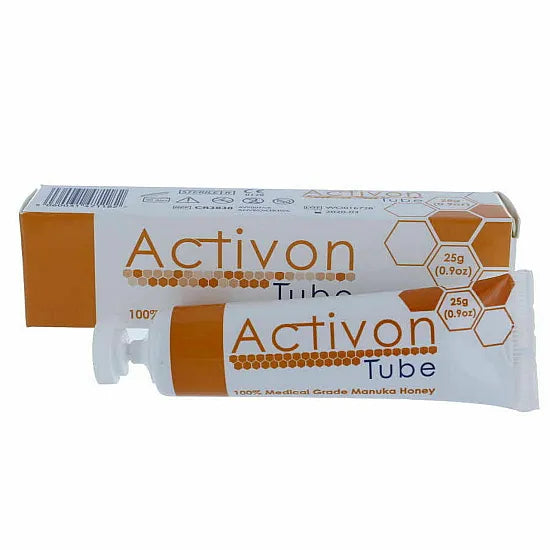
Activon Medical Grade Manuka Honey
- ✔️ Supports healing of minor cuts, burns, and skin ulcers
- ✔️ Sterile medical grade honey — safe on open wounds
- ✔️ Antimicrobial action targets bacteria including MRSA
- ✔️ Creates moist wound environment to aid tissue repair
- ✔️ Suitable for adults and children over 12 months
Price Checker
 Discreet, tracked delivery
 Includes FREE private prescription


Couldn't load pickup availability
What Is Manuka Honey Wound Dressing and How Can It Help You?
If you have ever struggled with a slow-healing cut, a minor burn, or a stubborn skin ulcer, you will know how frustrating the process can be. Manuka honey wound dressing has been used in clinical settings for decades, and Activon Medical Grade Manuka Honey brings that same wound-care science to your first aid kit at home. Made from 100% Leptospermum scoparium (manuka) honey, this product is sterile, medical grade, and designed specifically for topical wound management. You can find it alongside other trusted wound care options in our first aid collection.
Activon is manufactured by Advancis Medical and is classified as a medical device in the UK. It is not simply a food product repurposed for wounds — it undergoes gamma irradiation to ensure sterility, which is a critical distinction when applying anything to broken skin. The NHS recognises honey-based dressings as a legitimate option for certain wound types, and Activon is one of the most widely referenced products in this category.
How Does Activon Medical Grade Manuka Honey Work on Wounds?
The mechanism behind manuka honey wound dressing is genuinely interesting. It is not just one thing doing the work — it is several overlapping actions happening simultaneously at the wound site.
- Osmotic action: Honey's high sugar concentration draws fluid out of the wound bed, reducing swelling and creating a moist healing environment that supports tissue repair.
- Acidic pH: Manuka honey has a naturally low pH (typically 3.2–4.5), which inhibits the growth of many common wound pathogens including Staphylococcus aureus and Pseudomonas aeruginosa.
- Hydrogen peroxide release: When honey contacts wound fluid, glucose oxidase in the honey produces low, sustained levels of hydrogen peroxide, providing additional antimicrobial activity without damaging surrounding tissue.
- Methylglyoxal (MGO): Unique to manuka honey, MGO contributes a non-peroxide antimicrobial effect that remains active even in wound environments where hydrogen peroxide activity may be reduced.
- Debridement support: The osmotic draw helps lift slough and necrotic tissue from the wound surface, aiding natural debridement without the need for sharp instruments.
Who Should Use Activon Medical Grade Manuka Honey?
Activon is suitable for a wide range of people dealing with minor to moderate wound care needs at home. It is particularly useful when standard wound dressings are not providing adequate moisture balance or when you want an antimicrobial option without reaching for topical antibiotics. That said, it is not appropriate for every situation — deep wounds, heavily infected wounds, or wounds that are not improving should always be assessed by a healthcare professional.
Activon may be suitable for you if you are managing any of the following:
- Minor cuts, abrasions, and lacerations
- Superficial and partial-thickness burns
- Leg ulcers and pressure ulcers (under healthcare supervision)
- Surgical wounds healing by secondary intention
- Skin grafts and donor sites (when directed by a clinician)
How Does Activon Compare to Standard Wound Dressings?
| Feature | Activon Manuka Honey | Standard Hydrocolloid Dressing |
|---|---|---|
| Antimicrobial action | Yes — multi-mechanism | No inherent antimicrobial activity |
| Moist wound environment | Yes | Yes |
| Debridement support | Yes — osmotic autolytic | Mild autolytic only |
| Suitable for infected wounds | Minor bacterial load — yes | Not recommended |
| Requires secondary dressing | Yes | No (self-adhesive) |
How Should You Store Activon and Is It Suitable for Sensitive Skin?
Store Activon below 25°C, away from direct sunlight, and do not refrigerate. Cold temperatures can cause the honey to crystallise, making it harder to apply evenly. Once opened, use within the timeframe stated on the packaging. If you have sensitive skin or a history of reactions to bee products, patch-test on a small area first and discontinue use if irritation develops. For those also managing skin conditions, our skin care collection includes complementary products that may support your overall skin health.
This product is a medicine. Speak to your doctor or pharmacist before using if you have an underlying medical condition or are taking other medicines.
Activon Medical Grade Manuka Honey specifications
| Treatment category | Wound care / First aid |
| Active ingredient | Leptospermum scoparium honey (100% manuka honey) |
| Mechanism of action | Osmotic, antimicrobial (hydrogen peroxide and methylglyoxal), low pH inhibition |
| Suitable for | Adults and children (seek advice for infants); minor wounds, burns, ulcers |
| Pack sizes | 25 g tube |
| UK classification | Medical device (CE marked) |
| Preparation | Sterile topical gel (gamma-irradiated) |
| Route of administration | Topical (applied directly to wound or wound dressing) |
Specifications of Activon Medical Grade Manuka Honey
What Is Activon Medical Grade Manuka Honey and What Is It Used For?
Activon Medical Grade Manuka Honey is a sterile, 100% natural honey preparation derived from the Leptospermum scoparium (manuka) plant, native to New Zealand and parts of Australia. It is classified as a medical device in the UK and is intended for topical application to wounds. Unlike food-grade honey, Activon is gamma-irradiated to eliminate any risk of microbial contamination, making it safe for use on open skin.
It is used to support the management of a range of wound types, including minor cuts and abrasions, superficial burns, leg ulcers, pressure ulcers, and post-surgical wounds healing by secondary intention. The product works by creating a moist, antimicrobial wound environment that supports the body's natural healing processes. It is available over the counter and does not require a prescription.
What Do You Need to Know Before Using Activon Medical Grade Manuka Honey?
Before applying Activon, there are some important safety considerations to be aware of. Do not use this product if any of the following apply to you:
- You have a known allergy to honey, bee products, or any component of the formulation
- The wound is deep, penetrating, or involves underlying structures such as tendons or bone
- The wound shows signs of serious infection (spreading redness, fever, pus, or red streaking)
- You are applying it near the eyes or mucous membranes
- You are using it on an infant under 12 months old without medical supervision
There are no established significant drug interactions with topically applied manuka honey. However, if you are using other topical wound treatments simultaneously, speak to your pharmacist before combining them. People with diabetes should be aware that wound healing may be slower and should seek professional wound assessment for any wound that does not improve within two weeks. If you are managing a long-term condition alongside wound care, our creams and ointments collection may offer additional supportive options.
- No clinically established drug interactions with topical application
- Avoid concurrent use of other topical antimicrobials on the same wound without professional advice
How Should You Use Activon Medical Grade Manuka Honey?
Applying Activon correctly makes a real difference to how well it works. Follow these steps each time you dress the wound:
- Wash your hands thoroughly with soap and water before touching the wound or the product.
- Gently clean the wound with saline solution or clean running water and pat dry with a sterile gauze pad.
- Apply Activon directly to the wound surface or onto a non-adherent dressing pad, using enough to cover the wound bed with a thin, even layer (approximately 3–5 mm depth).
- Cover with a suitable secondary dressing (such as a foam or absorbent pad) to keep the honey in contact with the wound and absorb any excess exudate.
- Secure the dressing in place with tape or a bandage as appropriate.
- Change the dressing every one to three days, or more frequently if exudate levels are high.
| Indication | Age Group | Amount to Apply | Dressing Change Frequency |
|---|---|---|---|
| Minor cuts and abrasions | Adults and children over 1 year | Thin layer to cover wound bed | Every 1–2 days |
| Superficial burns | Adults and children over 1 year | Thin layer to cover wound bed | Every 1–3 days |
| Leg or pressure ulcers | Adults (under clinical supervision) | As directed by clinician | Every 2–3 days or as directed |
What Are the Possible Side Effects of Activon Medical Grade Manuka Honey?
Activon is generally well tolerated, but as with any wound care product, some people do experience reactions. Knowing what to expect can help you manage them calmly.
Common side effects:
- Temporary stinging or burning sensation at the wound site immediately after application — this usually settles within a few minutes
- Increased wound exudate (fluid) in the first few days of use — this is a normal response to the osmotic action of the honey and is not a sign of infection
Less common side effects:
- Localised skin irritation or redness around the wound margins
- Allergic contact reaction in individuals sensitive to bee products — discontinue use immediately if this occurs
If you experience signs of a serious allergic reaction — such as swelling of the face, difficulty breathing, or widespread rash — seek emergency medical attention immediately. For general wound pain management alongside your dressing changes, you may find our pain relief collection helpful.
How Should You Store Activon Medical Grade Manuka Honey?
- Store below 25°C in a cool, dry place
- Keep away from direct sunlight and heat sources
- Do not refrigerate — cold temperatures cause crystallisation
- Keep the tube tightly closed when not in use
- Keep out of the reach and sight of children
- Do not use after the expiry date printed on the tube
- Once opened, use within the period indicated on the packaging
References
Written and reviewed by our qualified team
Your safety and success are our highest priorities. Our medical team rigorously evaluates every product and piece of advice we provide, ensuring you receive only the most effective, science-backed solutions available.
Frequently Asked Questions
Where can I buy Activon Medical Grade Manuka Honey online in the UK?
You can buy Activon Medical Grade Manuka Honey directly from Cured Pharmacy for just £4.99, with no prescription required. It is dispatched from a GPhC-registered UK pharmacy, so you can be confident you are receiving a genuine, properly stored medical device. Browse our full first aid collection for other wound care essentials.
How does Activon Medical Grade Manuka Honey work on wounds?
Activon works through a combination of osmotic action, low pH, hydrogen peroxide release, and the unique methylglyoxal (MGO) content of manuka honey — all of which inhibit bacterial growth and support a moist wound healing environment. The osmotic draw also helps lift slough and dead tissue from the wound bed naturally. These overlapping mechanisms make it more versatile than single-action wound dressings.
How do I apply Activon Manuka Honey step by step?
Clean the wound with saline or clean water, then apply a thin layer of Activon directly to the wound surface or onto a non-adherent dressing pad. Cover with a secondary absorbent dressing and secure in place, changing every one to three days depending on how much fluid the wound is producing. Always wash your hands before and after the procedure.
What is the correct dose of Activon Manuka Honey to use?
There is no fixed dose in milligrams — instead, you apply enough honey to cover the wound bed with a layer approximately 3–5 mm deep. For very small wounds, a small pea-sized amount may be sufficient, while larger wounds will naturally require more. If you are unsure, your pharmacist can advise on the right amount for your specific wound.
Is Activon Medical Grade Manuka Honey safe for children?
Activon can generally be used on children over 12 months of age for minor wound care, but you should always consult a pharmacist or GP before using it on young children. It must never be given orally to infants under one year due to the risk of infant botulism — this applies to all honey products. For children's wound care queries, speaking to a healthcare professional first is always the safest approach.
Can I use Activon Manuka Honey on an infected wound?
Activon has antimicrobial properties that can help manage bacterial load in minor wounds with low-level contamination, but it is not a replacement for prescribed antibiotics in clinically infected wounds. If your wound shows spreading redness, warmth, swelling, pus, or you develop a fever, you should seek medical attention promptly rather than relying on honey alone. Always err on the side of caution with any wound that appears to be worsening.
What are the side effects of Activon Medical Grade Manuka Honey?
The most commonly reported side effect is a temporary stinging or burning sensation at the wound site immediately after application, which typically settles within a few minutes. Some people also notice an increase in wound fluid (exudate) in the first few days, which is a normal part of the osmotic healing process and not a cause for alarm. Rarely, individuals with bee product allergies may experience a localised skin reaction — discontinue use and seek advice if this happens.
How long can I use Activon Manuka Honey for?
You can continue using Activon until the wound has fully healed, provided it is showing signs of improvement. If there is no meaningful progress after two to three weeks of consistent use, you should seek assessment from a pharmacist or GP. Chronic wounds such as leg ulcers or pressure ulcers should always be managed under the supervision of a healthcare professional.
What is the difference between medical grade manuka honey and supermarket manuka honey?
Medical grade manuka honey like Activon is sterilised by gamma irradiation to eliminate any risk of bacterial contamination, making it safe to apply to open wounds. Supermarket manuka honey is food-grade and not sterile — applying it to a wound could introduce bacteria and worsen the situation. The distinction is clinically significant and is why only medical grade products should be used for wound care.
Who is eligible to use Activon Medical Grade Manuka Honey?
Activon is suitable for most adults and children over 12 months who need topical wound care for minor cuts, abrasions, superficial burns, or skin ulcers. It is not suitable for people with known allergies to honey or bee products, and those with deep or seriously infected wounds should seek professional medical assessment instead. People with diabetes or compromised immune systems should use it under healthcare supervision.
What happens if I miss a dressing change with Activon?
If you miss a scheduled dressing change, simply change the dressing as soon as you remember and resume your normal schedule. Do not apply a double amount of honey to compensate — just apply the usual layer as you would normally. Consistency matters more than perfection, so try to keep to your dressing change routine as closely as possible.
What are the alternatives to Activon Medical Grade Manuka Honey for wound care?
Alternatives include hydrocolloid dressings, foam dressings, silver-containing antimicrobial dressings, and iodine-based preparations such as povidone-iodine. Each has different indications depending on wound type, depth, and exudate level. Our creams and ointments collection includes a range of topical wound care options to suit different needs.
Can I use Activon Manuka Honey on a burn?
Activon is suitable for superficial and partial-thickness burns, where it can help maintain a moist healing environment and reduce bacterial contamination. However, deep burns, burns covering a large area, burns on the face or hands, or any burn in a child should be assessed by a healthcare professional or at an NHS urgent treatment centre before you apply any product. The NHS advises cooling a burn under cool running water for 20 minutes before applying any dressing.
What does the latest research say about manuka honey for wound healing?
Clinical evidence supports the use of medical grade manuka honey for wound management, particularly for its antimicrobial properties against antibiotic-resistant organisms such as MRSA. Research published in peer-reviewed journals has demonstrated that honey-based dressings can reduce wound healing time and bacterial load in certain wound types compared to conventional dressings. NICE guidelines acknowledge honey-based dressings as an option within wound care pathways, particularly for leg ulcers.
How should I store Activon Medical Grade Manuka Honey?
Store Activon below 25°C in a cool, dry place away from direct sunlight — do not refrigerate it, as cold temperatures cause the honey to crystallise and become difficult to apply. Keep the tube tightly closed between uses and store it out of reach of children. Always check the expiry date on the tube before use and discard if it has passed.
Written and reviewed by our qualified team

Reviewed by:
Tarun Kumar
Superintendent/ Clinical Lead
📖 Find out more about our team of medical content authors and how we ensure the accuracy of our content with our content guidelines.
Content last updated: 14 Sep 2026

We’re a safe and
regulated UK service

100% discreet packaging

Discreet, unbranded packaging for every order.

Need help?
Talk to our friendly experts now


How our service works

Service setup

Discreet packaging

Express delivery