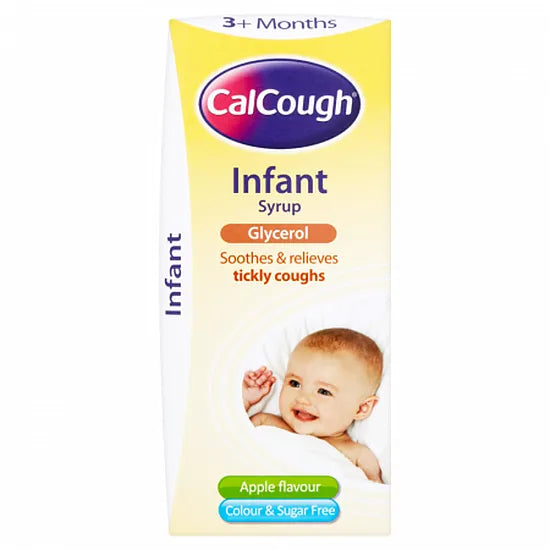
Calcough Infant Syrup For Tickly Coughs Apple – 125ml
- ✔️ Soothes tickly coughs in babies from 3 months old
- ✔️ Glycerol demulcent coats and calms irritated throat lining
- ✔️ Apple flavour improves palatability for young children
- ✔️ Sugar-free-friendly formula gentle on infant digestion
- ✔️ 125ml bottle provides multiple doses per pack
Price Checker
 Discreet, tracked delivery
 Includes FREE private prescription


Couldn't load pickup availability
Is Calcough Infant Syrup the Right Infant Cough Syrup for Tickly Cough?
When your little one develops a persistent tickly cough, it can be distressing for the whole family. Sleepless nights, a restless baby, and the worry of not knowing what to do — it all adds up. Infant cough syrup for tickly cough is one of the most searched-for remedies by parents in the UK, and Calcough Infant Syrup Apple 125ml is a trusted, pharmacist-recommended option available without a prescription. Priced at just £3.89, it offers an accessible way to help soothe your baby's throat quickly and gently. You can find it alongside other trusted products in our baby and toddler range.
Tickly coughs in infants are usually caused by irritation of the throat lining — often linked to a mild cold, dry air, or post-nasal drip. The NHS notes that most coughs in children are caused by viral infections and will resolve on their own, but that doesn't make the waiting any easier. A soothing syrup can help ease discomfort while your child's immune system does its job.
How Does Calcough Infant Syrup Work to Soothe a Tickly Cough?
Unlike some adult cough medicines that contain codeine or other active suppressants, Calcough Infant Syrup uses a simple, gentle mechanism that is appropriate for young children. Here's how it works:
- The active ingredient, glycerol, acts as a demulcent — a substance that forms a soothing, protective film over the mucous membranes of the throat.
- This coating reduces the irritation that triggers the tickly cough reflex.
- It does not suppress the cough centrally (i.e., it doesn't act on the brain), making it a safer choice for infants.
- The apple flavour makes it more palatable for young children, which helps with compliance.
Glycerol is a well-established ingredient in paediatric medicines. It is generally recognised as safe and has a long history of use in over-the-counter products for children.
Who Should Use Calcough Infant Syrup?
This syrup is specifically formulated for infants and young children. It is not intended for adults. If you're unsure whether it's right for your child, speak to your pharmacist before use.
- Children aged 3 months and over with a tickly or dry cough
- Infants experiencing throat irritation associated with a mild cold
- Children who need a gentle, non-drowsy cough remedy
- Families looking for a sugar-free-friendly, simple formulation without multiple active ingredients
It is not suitable for babies under 3 months of age. If your child has a persistent cough lasting more than 5 days, a high temperature, difficulty breathing, or you are concerned for any reason, always seek medical advice from your GP or call NHS 111.
How Does Calcough Infant Syrup Compare to Other Baby Cough Remedies?
| Feature | Calcough Infant Syrup Apple 125ml | Typical Adult Cough Linctus |
|---|---|---|
| Active ingredient | Glycerol (demulcent) | Pholcodine / Guaifenesin / Dextromethorphan |
| Suitable age | 3 months and over | Usually 12 years and over |
| Mechanism | Coats and soothes throat lining | Suppresses cough reflex centrally or thins mucus |
| Prescription required | No — OTC | No — OTC (some require prescription) |
Is Calcough Infant Syrup Safe to Store at Home?
Storage is straightforward. Keep the bottle below 25°C, away from direct sunlight, and out of reach of children. Do not refrigerate — cold temperatures can affect the consistency of the syrup. Once opened, check the label for any in-use shelf life guidance and do not use the product beyond the expiry date printed on the packaging.
If you're building a home medicine cabinet for your family, it's worth knowing that this syrup sits neatly alongside other essentials. You might also want to explore our cold and flu range for additional products to help manage seasonal illness in the household.
This product is a medicine. Speak to your doctor or pharmacist before using if you have an underlying medical condition or are taking other medicines.
Calcough Infant Syrup For Tickly Coughs Apple – 125ml specifications
| Treatment category | Cough relief (tickly / dry cough) |
| Mechanism of action | Demulcent — glycerol coats and soothes the throat lining |
| Effective for | Tickly coughs in infants and young children |
| Suitable for | Children aged 3 months and over |
| Active ingredient | Glycerol |
| Pack size | 125ml |
| UK classification | General Sale List (GSL) |
| Drug class | Demulcent |
| Preparation | Oral syrup |
| Route of administration | Oral |
Specifications of Calcough Infant Syrup For Tickly Coughs Apple – 125ml
What Is Calcough Infant Syrup and What Is It Used For?
Calcough Infant Syrup For Tickly Coughs Apple 125ml is an over-the-counter oral medicine designed to relieve tickly and dry coughs in infants and young children aged 3 months and over. Its active ingredient is glycerol, a demulcent that works by coating the throat to reduce irritation. It is available without a prescription and is classified as a General Sale List (GSL) medicine in the UK.
Tickly coughs are one of the most common reasons parents seek advice from a pharmacist. The NHS advises that most coughs in children are caused by viral upper respiratory tract infections and do not require antibiotics. This syrup helps manage the discomfort while the body recovers naturally. It is not intended to treat productive (chesty) coughs, fever, or lower respiratory tract infections.
What Do You Need to Know Before Using Calcough Infant Syrup?
Before giving this syrup to your child, read the following carefully. If you are unsure about anything, speak to your pharmacist or GP.
Do not use Calcough Infant Syrup if your child:
- Is under 3 months of age
- Has a known allergy or hypersensitivity to glycerol or any other ingredient in the product
- Has a cough accompanied by high fever, difficulty breathing, or wheezing — seek urgent medical attention in these cases
- Has a persistent cough that may be a sign of asthma or another underlying condition
Drug interactions:
- No significant drug interactions with glycerol-based demulcent syrups are currently documented in standard UK clinical references
- Always inform your pharmacist of any other medicines your child is taking, including herbal remedies
How Should You Use Calcough Infant Syrup?
Always follow the dosage instructions on the product label. Use the measuring device supplied with the bottle to ensure accuracy — never estimate using a household spoon, as this can lead to incorrect dosing.
- Shake the bottle gently before use.
- Measure the correct dose using the supplied measuring device.
- Administer the syrup orally, directly into your child's mouth.
- Give up to four times daily as needed.
- Do not exceed the recommended dose for your child's age.
- If symptoms persist beyond 5 days, consult your GP or pharmacist.
| Age Group | Dose | Frequency |
|---|---|---|
| 3 months – under 1 year | As directed on label | Up to 4 times daily |
| 1 year – under 5 years | As directed on label | Up to 4 times daily |
| 5 years and over | As directed on label | Up to 4 times daily |
Always refer to the product packaging for the exact dose volumes, as these may be updated by the manufacturer. If you are browsing for additional support products, our ear, nose and throat range includes other remedies that may help manage cold and cough symptoms in children and adults.
What Are the Possible Side Effects of Calcough Infant Syrup?
Calcough Infant Syrup is generally very well tolerated in infants and young children. Because glycerol is a naturally occurring substance, adverse reactions are uncommon. That said, it's important to know what to look out for.
Common side effects:
- Mild stomach discomfort if the child is sensitive to glycerol
- Slightly loose stools if larger-than-recommended amounts are given
Less common side effects:
- Nausea in sensitive individuals
- Allergic reaction (rash, itching, swelling) — rare but stop use immediately and seek medical advice if this occurs
If your child shows any signs of a serious allergic reaction — including swelling of the face, lips, or throat, or difficulty breathing — call 999 immediately. The NHS provides clear guidance on recognising allergic reactions in children, and it is always better to act quickly if you are concerned.
How Should You Store Calcough Infant Syrup?
Correct storage helps maintain the quality and safety of the product throughout its shelf life.
- Store below 25°C in a cool, dry place
- Do not refrigerate
- Keep the bottle tightly closed when not in use
- Store out of sight and reach of children
- Do not use after the expiry date printed on the label
- Do not dispose of medicines via wastewater or household waste — return unused medicine to your pharmacist for safe disposal
If you're managing a range of family health products at home, it's also worth exploring our vitamins and supplements collection for immune-support options suitable for children and adults alike.
References
Written and reviewed by our qualified team
Your safety and success are our highest priorities. Our medical team rigorously evaluates every product and piece of advice we provide, ensuring you receive only the most effective, science-backed solutions available.
Frequently Asked Questions
Where can I buy Calcough Infant Syrup online in the UK?
You can buy Calcough Infant Syrup For Tickly Coughs Apple 125ml directly from Cured Pharmacy, a GPhC-registered UK online pharmacy. It is available without a prescription as an over-the-counter medicine. Simply add it to your basket and it will be dispatched to your door.
How does Calcough Infant Syrup work in the body?
Calcough Infant Syrup contains glycerol, which acts as a demulcent — it coats the lining of the throat and forms a soothing barrier that reduces the irritation responsible for triggering a tickly cough. It does not act on the brain or suppress the cough reflex centrally, which makes it appropriate for infants. The effect is localised to the throat and upper airway.
What age can babies have Calcough Infant Syrup?
Calcough Infant Syrup is suitable for children aged 3 months and over. It must not be given to babies younger than 3 months. If your baby is under 3 months and has a cough, always consult your GP or call NHS 111 for advice rather than using any over-the-counter medicine.
How do I give Calcough Infant Syrup to my baby step by step?
Shake the bottle gently before each use, then measure the correct dose using the measuring device provided — never use a household teaspoon. Administer the syrup directly into your child's mouth and give up to four times daily as needed. Always follow the dosage instructions on the product label for your child's specific age group.
What is the correct dose of Calcough Infant Syrup for my child's age?
The dose varies depending on your child's age, and the exact volume is printed on the product label. As a general guide, the syrup can be given up to four times daily. Always refer to the packaging for the precise dose, and if you are unsure, ask your pharmacist before administering.
Does Calcough Infant Syrup contain sugar or artificial colours?
Calcough Infant Syrup is formulated with infants in mind and is designed to be gentle on young digestive systems. For the full list of excipients including sweeteners, colours, and preservatives, always check the product label or patient information leaflet supplied with the bottle. If your child has a known sensitivity to any ingredient, consult your pharmacist before use.
How long can I give my baby Calcough Infant Syrup?
You should not use Calcough Infant Syrup for more than 5 consecutive days without seeking medical advice. If your child's cough persists beyond 5 days, worsens, or is accompanied by fever, difficulty breathing, or wheezing, stop use and consult your GP or call NHS 111. Prolonged coughs in infants can sometimes indicate an underlying condition that needs assessment.
Are there any side effects of Calcough Infant Syrup I should know about?
Calcough Infant Syrup is generally very well tolerated. In rare cases, glycerol may cause mild stomach discomfort or slightly loose stools if more than the recommended dose is given. Allergic reactions are uncommon but possible — if you notice any rash, swelling, or breathing difficulty after giving the syrup, stop use immediately and seek urgent medical attention.
Who is eligible to use Calcough Infant Syrup?
This syrup is intended for infants and young children aged 3 months and over who have a tickly or dry cough. It is not suitable for babies under 3 months, and it is not designed for adults. Children with underlying respiratory conditions such as asthma should be assessed by a GP before any cough remedy is used.
What happens if I accidentally give my baby too much Calcough Infant Syrup?
If you think your child has been given more than the recommended dose, contact NHS 111 or your nearest A&E for advice. Glycerol in large amounts may cause loose stools or stomach upset, but serious toxicity is unlikely at doses close to the recommended amount. Always keep medicines stored safely out of children's reach to prevent accidental ingestion.
Can I use Calcough Infant Syrup alongside other medicines?
No significant drug interactions with glycerol-based demulcent syrups are currently documented in standard UK clinical references. However, you should always tell your pharmacist about any other medicines your child is taking — including infant paracetamol, ibuprofen, or any prescribed medicines — before using this syrup. Our baby and toddler range includes other products that are commonly used alongside cough remedies.
What are the alternatives to Calcough Infant Syrup for babies?
For children over 1 year, a small amount of warm water with honey is a well-known home remedy recommended by the NHS for soothing a tickly cough. Other glycerol-based infant cough syrups are available from pharmacies. For broader symptom management, you might also explore our cold and flu range for additional options suitable for families.
Is Calcough Infant Syrup suitable for a baby with a chesty cough?
No — Calcough Infant Syrup is specifically formulated for tickly or dry coughs, not chesty or productive coughs. A chesty cough produces mucus and may require a different type of remedy or medical assessment. If your baby has a chesty cough, particularly with fever or rapid breathing, consult your GP promptly as this can sometimes indicate a chest infection.
What are the latest recommendations on cough medicines for infants in the UK?
The MHRA and NHS advise that over-the-counter cough and cold medicines containing certain active ingredients (such as antihistamines, decongestants, or cough suppressants) should not be used in children under 6 years. Glycerol-based demulcent syrups like Calcough Infant Syrup are considered appropriate for infants from 3 months as they work locally in the throat without systemic effects. Always follow current NHS guidance and consult your pharmacist if you are unsure.
How should I store Calcough Infant Syrup at home?
Store Calcough Infant Syrup below 25°C in a cool, dry place away from direct sunlight. Do not refrigerate the bottle, as cold temperatures can affect the syrup's consistency. Always keep it out of sight and reach of children, and do not use it after the expiry date printed on the packaging.
Written and reviewed by our qualified team

Reviewed by:
Tarun Kumar
Superintendent/ Clinical Lead
📖 Find out more about our team of medical content authors and how we ensure the accuracy of our content with our content guidelines.
Content last updated: 14 Sep 2026
Other popular options


We’re a safe and
regulated UK service

100% discreet packaging

Discreet, unbranded packaging for every order.

Need help?
Talk to our friendly experts now


How our service works

Service setup

Discreet packaging

Express delivery