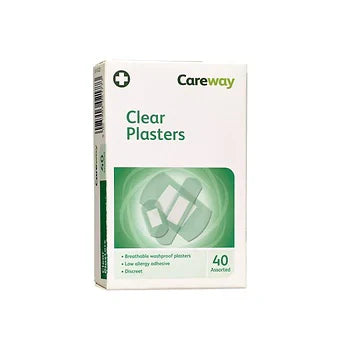
Careway Clear Plasters Assortment 40 Plasters
- ✔️ Covers minor cuts, grazes, and blisters effectively
- ✔️ Clear film allows wound monitoring without removal
- ✔️ 40 assorted sizes suit a range of wound types
- ✔️ Skin-friendly adhesive holds securely during daily activity
- ✔️ Affordable first aid essential at just £1.80 per pack
Price Checker
 Lowest price guarantee
 Includes FREE private prescription


Couldn't load pickup availability
What Are Assorted Plasters and How Do They Help?
Minor cuts, grazes, and blisters are part of everyday life — and having the right cover on hand makes all the difference. The Careway Clear Plasters Assortment 40 Plasters gives you a ready-to-use selection of assorted plasters in multiple sizes, so you're never caught short when a small wound needs attention. At just £1.80 for 40 plasters, it's one of the most cost-effective first aid essentials you can keep at home. Whether it's a kitchen nick, a blister from new shoes, or a playground graze, this pack has you covered. You'll find everything you need in our first aid collection at Cured Pharmacy.
These clear plasters are designed to sit discreetly on the skin, blending in rather than standing out. The transparent film allows you to monitor the wound without removing the dressing — a genuinely useful feature, especially for children who'd rather not have a plaster peeled off unnecessarily. Each plaster features an absorbent wound pad at the centre and a skin-friendly adhesive border that holds firmly without being harsh on removal.
How Do Careway Clear Plasters Work to Protect a Wound?
Plasters work through a straightforward but clinically important mechanism. The NHS advises that covering minor wounds helps prevent infection and supports the body's natural healing process. Here's how each component plays its part:
- Absorbent pad: Sits directly over the wound to absorb light exudate (fluid) and keep the area clean.
- Clear film backing: Acts as a physical barrier against dirt, bacteria, and moisture from the environment.
- Adhesive border: Secures the dressing to surrounding skin, keeping the pad in place during movement.
- Assorted sizing: Multiple sizes in one pack mean you can match the plaster to the wound rather than using an ill-fitting one.
Keeping a wound covered in the early stages of healing reduces the risk of contamination and helps maintain a moist wound environment, which research consistently links to faster tissue repair.
Who Should Use Careway Clear Plasters?
These plasters are suitable for most adults and children dealing with everyday minor injuries. They're particularly handy for households with young children, active individuals, or anyone who works with their hands. That said, they're not appropriate for every wound type — deep lacerations, puncture wounds, or injuries with heavy bleeding need professional medical assessment.
This product is well suited to:
- Adults and children with minor cuts and grazes
- People managing small blisters from footwear or activity
- Those who need a discreet, skin-tone-friendly dressing for visible areas
- Households wanting a multi-size first aid solution in one affordable pack
How Do Careway Clear Plasters Compare to Fabric Plasters?
| Feature | Careway Clear Plasters | Standard Fabric Plasters |
|---|---|---|
| Visibility on skin | Discreet, transparent film | Visible, skin-tone or coloured |
| Wound monitoring | Yes — see through the dressing | No — must remove to check |
| Flexibility | Moderate | High — conforms to movement |
| Water resistance | Moderate splash resistance | Varies by product |
| Pack size | 40 assorted plasters | Typically 20–40 per pack |
Are Careway Clear Plasters Suitable for Sensitive Skin?
If you have sensitive skin or a history of adhesive reactions, it's worth testing a plaster on a small area before applying it to a wound. People with conditions such as eczema or psoriasis should speak to a pharmacist first — the adhesive in standard plasters can occasionally cause localised irritation or contact dermatitis. If you're managing a skin condition alongside wound care, our skin care collection includes products that may help support skin health more broadly.
Store these plasters in a cool, dry place below 25°C and away from direct sunlight. Check the expiry date before use — adhesive quality can deteriorate over time, reducing how well the plaster stays in place. Keep out of reach of children.
This product is a medical device. Speak to your doctor or pharmacist before using if you have an underlying medical condition or are taking other medicines.
Careway Clear Plasters Assortment 40 Plasters specifications
| Treatment category | First aid / wound care |
| Mechanism of action | Physical barrier; absorbs wound exudate and protects against contamination |
| Effective for | Minor cuts, grazes, and blisters |
| Suitable for | Adults and children |
| Active ingredient | None — medical device |
| Pack size | 40 plasters |
| UK classification | Medical device (CE/UKCA marked) |
| Preparation | Adhesive wound dressing |
| Route of administration | Topical / external |
Specifications of Careway Clear Plasters Assortment 40 Plasters
What Are Careway Clear Plasters and What Are They Used For?
Careway Clear Plasters Assortment 40 Plasters is an over-the-counter medical device used to cover and protect minor wounds on the skin. The pack contains 40 individual adhesive plasters in a range of sizes — giving you flexibility to match the right plaster to the right wound. They are intended for use on minor cuts, small grazes, superficial abrasions, and small blisters caused by friction.
These are not medicinal products and contain no active pharmaceutical ingredients. They work purely as a physical barrier. The NHS advises that minor wounds should be cleaned and covered promptly to reduce the risk of infection and support healing. This pack of assorted plasters is designed to make that process simple and accessible for the whole family.
What Do You Need to Know Before Using Careway Clear Plasters?
Before applying any plaster, it's important to assess the wound. Not all injuries are suitable for self-treatment with an adhesive dressing. Do not use these plasters if any of the following apply:
- The wound is deep, gaping, or will not stop bleeding after 10 minutes of firm pressure
- There are signs of infection — redness spreading beyond the wound edge, warmth, swelling, pus, or fever
- You have a known allergy to adhesive plasters or latex (check product packaging for material details)
- The wound was caused by an animal bite or a dirty or rusty object — seek medical advice
- The wound is on the face or near the eyes — seek professional assessment
Drug interactions are not applicable to this product as it contains no active pharmaceutical ingredients. However, if you are using any topical creams or ointments on the wound area, allow them to absorb fully before applying a plaster. For topical wound treatments, our creams and ointments collection includes a range of suitable options.
How Should You Use Careway Clear Plasters?
Correct application is key to getting the most from any wound dressing. Follow these steps each time you apply a plaster:
- Wash your hands thoroughly with soap and water before touching the wound or the plaster.
- Clean the wound gently under cool running water to remove any dirt or debris.
- Pat the wound and surrounding skin dry with a clean cloth or sterile gauze.
- Select the appropriately sized plaster from the assortment — the pad should fully cover the wound.
- Peel back the protective paper strips without touching the absorbent pad.
- Centre the pad directly over the wound and press the adhesive edges firmly onto dry skin.
- Smooth down the edges to ensure a secure seal.
| Indication | Age Group | Plaster Size | Frequency of Change |
|---|---|---|---|
| Minor cut or graze | Adults and children | Match to wound size | At least once daily or when wet/dirty |
| Small blister | Adults and children | Larger size to cover fully | Daily or when dislodged |
| Superficial abrasion | Adults and children | Largest available size | At least once daily |
What Are the Possible Side Effects of Careway Clear Plasters?
As a medical device rather than a medicine, Careway Clear Plasters do not carry the same side effect profile as pharmaceutical products. However, some individuals may experience reactions related to the adhesive or the occlusive nature of the dressing.
Common side effects:
- Mild skin redness at the adhesive border after removal
- Slight itching or tingling under the plaster, particularly in warm conditions
- Minor skin irritation if the plaster is left in place for an extended period
Less common side effects:
- Contact dermatitis — a localised allergic reaction causing a rash, blistering, or more pronounced redness
- Maceration of the surrounding skin if the wound is heavily exuding and the plaster is not changed frequently enough
- Skin stripping on fragile or elderly skin upon removal
If you notice spreading redness, increasing pain, warmth, or any discharge from the wound, remove the plaster and seek medical advice promptly — these may be signs of infection rather than a reaction to the plaster itself.
How Should You Store Careway Clear Plasters?
Proper storage keeps your plasters in good condition and ensures the adhesive remains effective when you need it most. If you're building a home first aid kit, it's worth pairing these plasters with other essentials — you can browse our full first aid range for additional supplies.
- Store below 25°C in a cool, dry location
- Keep away from direct sunlight, heat sources, and damp environments
- Do not store in a bathroom cabinet where humidity is high
- Keep the pack sealed until use to maintain sterility of individual plasters
- Keep out of reach and sight of young children
- Check the expiry date printed on the packaging before use — do not use after the stated date
- Dispose of used plasters in household waste; do not flush
References
Written and reviewed by our qualified team
Your safety and success are our highest priorities. Our medical team rigorously evaluates every product and piece of advice we provide, ensuring you receive only the most effective, science-backed solutions available.
Frequently Asked Questions
Where can I buy Careway Clear Plasters Assortment 40 Plasters online in the UK?
You can buy Careway Clear Plasters Assortment 40 Plasters directly from Cured Pharmacy online for just £1.80 — no prescription required. They're available as part of our first aid collection, which includes a wide range of wound care essentials. Simply add to your basket and choose your preferred delivery option at checkout.
How do assorted plasters protect a minor wound?
Assorted plasters work by placing a physical barrier over the wound, preventing dirt, bacteria, and moisture from entering while the body heals naturally. The central absorbent pad manages light bleeding and wound fluid, while the adhesive border keeps everything securely in place. This combination reduces infection risk and supports the skin's own repair process.
How do I apply a Careway clear plaster correctly step by step?
Start by washing your hands and cleaning the wound under cool running water, then pat the area dry. Peel back the protective strips without touching the absorbent pad, centre the pad over the wound, and press the adhesive edges firmly onto dry skin. Smooth down the edges to create a secure seal and check the plaster is sitting flat with no lifted corners.
How often should I change a plaster on a cut or graze?
The NHS recommends changing a plaster at least once a day, or sooner if it becomes wet, dirty, or starts to peel away from the skin. Changing regularly lets you clean the wound and check for any early signs of infection such as increasing redness, swelling, or discharge. Never leave a plaster on for several days without checking underneath.
Are Careway clear plasters suitable for children?
Yes, these plasters can be used on children for minor cuts and grazes, though adult supervision is recommended during application and removal. Choose the smallest appropriate size from the assortment to avoid covering more skin than necessary. If a child has very sensitive skin or a known adhesive allergy, speak to a pharmacist before use.
Can I use these plasters if I have sensitive or eczema-prone skin?
If you have sensitive skin, eczema, or a history of reactions to adhesive dressings, it's advisable to speak to your pharmacist before use. Some people experience contact dermatitis — a localised skin reaction — at the adhesive border. You may also find it helpful to explore our skin care collection for products that support skin barrier health alongside wound care.
What size plasters are included in the 40-plaster assortment?
The pack contains a mix of sizes designed to cover a range of minor wound types — from small fingertip cuts to larger grazes on the knee or elbow. Having multiple sizes in one pack means you can always select the most appropriate fit rather than using an oversized or undersized dressing. Check the packaging for the exact size breakdown included in this assortment.
What are the alternatives to clear plasters for wound care?
Alternatives include fabric plasters (which offer more flexibility over joints), waterproof plasters (better for hands or areas exposed to water), hydrocolloid dressings (useful for blisters and moist wound healing), and sterile non-adhesive dressings secured with medical tape. The right choice depends on the wound location, size, and how much movement the area experiences. Your pharmacist can help you decide.
When should I not use a plaster and seek medical help instead?
You should seek medical attention rather than self-treating with a plaster if the wound is deep, gaping, or won't stop bleeding after 10 minutes of firm pressure. Animal bites, puncture wounds, wounds with embedded objects, and any injury showing signs of infection — spreading redness, pus, fever, or increasing pain — all require professional assessment. The NHS advises attending A&E or an urgent treatment centre for wounds that may need stitches or specialist cleaning.
Can I use Careway clear plasters on a blister?
Yes — a plaster can be placed over an intact blister to protect it from friction and reduce the risk of it bursting prematurely. The NHS advises against deliberately bursting blisters as this increases infection risk. If a blister has already burst, clean the area gently, allow it to dry slightly, and then cover with an appropriately sized plaster from the assortment.
Are these plasters waterproof?
Careway Clear Plasters offer moderate splash resistance due to their clear film backing, but they are not fully waterproof in the way that specialist waterproof plasters are. If you need to wash your hands or the plaster is likely to be submerged, it's best to replace it afterwards with a fresh one. Keeping the adhesive dry helps the plaster stay in place for longer.
How long can I leave a plaster on before changing it?
As a general guide, plasters should be changed at least once every 24 hours for minor wounds. Leaving a plaster on for too long without changing it can lead to maceration — where the surrounding skin becomes soft and white from prolonged moisture exposure — which can slow healing. Always change sooner if the plaster becomes wet, soiled, or starts to lift at the edges.
What should I do if my skin reacts to the plaster adhesive?
If you notice a rash, blistering, or significant redness at the adhesive border, remove the plaster and wash the area gently with cool water. Mild redness that fades quickly after removal is common and usually not a cause for concern. However, if the reaction is severe, spreads, or doesn't settle within a day or two, speak to your pharmacist or GP — you may have a contact allergy to the adhesive material.
Is it safe to use plasters on elderly or fragile skin?
Elderly skin is often thinner and more fragile, which means standard adhesive plasters can sometimes cause skin stripping or tearing on removal. If this is a concern, remove the plaster slowly and gently — pressing the skin down as you peel back the adhesive rather than pulling sharply. Speak to a pharmacist about whether a low-trauma or silicone-bordered dressing might be more appropriate for very fragile skin.
What are the latest recommendations on wound care for minor injuries?
Current NHS guidance recommends cleaning minor wounds under running water, avoiding antiseptic solutions on the wound itself (as these can damage healing tissue), and covering with an appropriate dressing. Keeping a wound moist rather than letting it dry out and scab has been shown in clinical literature to support faster healing. For pain associated with minor injuries, you can also explore our pain relief collection for suitable over-the-counter options.
Written and reviewed by our qualified team

Reviewed by:
Tarun Kumar
Superintendent/ Clinical Lead
📖 Find out more about our team of medical content authors and how we ensure the accuracy of our content with our content guidelines.
Content last updated: 14 Sep 2026
Other popular options


We’re a safe and
regulated UK service

Lowest Price Guarantee

We're convinced you won't find your treatment cheaper, but if you do we'll refund the difference.
Find out more
100% discreet packaging

Discreet, unbranded packaging for every order.
Find out more

Need help?
Talk to our friendly experts now


How our service works

Service setup

Discreet packaging

Express delivery