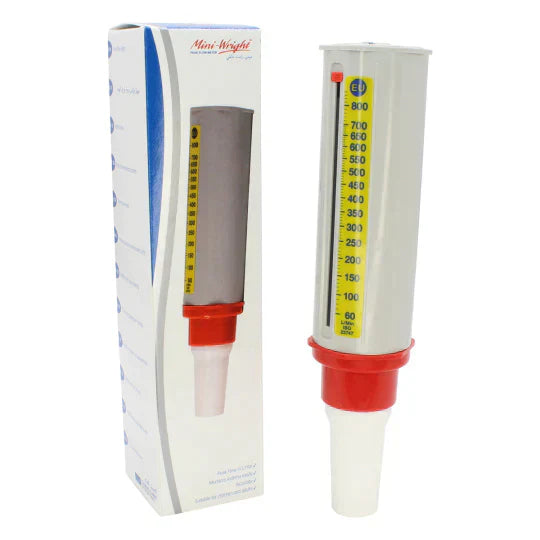
Mini-Wright Peak Flow Meter
Mini-Wright Peak Flow Meter
- ✔️ Measures peak expiratory flow rate accurately at home
- ✔️ Suitable for adults and children aged five and over
- ✔️ Helps detect early signs of asthma deterioration
- ✔️ Compact and portable for everyday asthma monitoring
- ✔️ No batteries or calibration required — ready to use
Price Checker
 Lowest price guarantee
 Includes FREE private prescription


Couldn't load pickup availability
What Is a Peak Flow Meter and How Can It Help You?
If you live with asthma or another respiratory condition, keeping track of how well your lungs are working is genuinely important — not just at clinic appointments, but every single day. The Mini-Wright peak flow meter is a compact, handheld device that lets you do exactly that from the comfort of your own home. It measures your peak expiratory flow rate (PEFR), which is the maximum speed at which you can force air out of your lungs. That single number can tell you — and your healthcare team — a great deal about how well your airways are functioning on any given day. You can browse our full range of electrical health and diagnostic devices for other home monitoring tools too.
Asthma affects around 5.4 million people in the UK, and regular monitoring is a cornerstone of good asthma management. The NHS recommends that people with asthma use a peak flow meter as part of their personal asthma action plan, particularly if their condition is moderate or severe. At just £8.49, this device offers an accessible and clinically recognised way to stay on top of your respiratory health without needing to visit a clinic every time you feel a change in your breathing.
How Does the Mini-Wright Peak Flow Meter Work?
The device works on a straightforward mechanical principle. When you blow into the mouthpiece, the force of your breath moves a small marker along a numbered scale. The number where the marker stops is your PEFR reading, measured in litres per minute (L/min). It requires no batteries, no calibration, and no technical knowledge to operate.
- You exhale forcefully through the mouthpiece in a single sharp breath
- The internal piston moves in proportion to the speed of airflow
- The marker records the highest point reached during that breath
- You repeat the process three times and record the highest reading
- Readings are compared against your personal best or predicted normal values
Over time, tracking these readings in an asthma diary helps you and your GP or asthma nurse spot patterns — for example, whether your PEFR dips in the morning, after exercise, or during periods of high pollen. That kind of insight is genuinely useful for adjusting your treatment plan.
Who Should Use the Mini-Wright Peak Flow Meter?
This device is suitable for a wide range of people. It is most commonly used by those with a confirmed asthma diagnosis, but it can also be helpful for anyone whose GP has recommended home lung function monitoring. Children aged 5 and over can use it with appropriate adult supervision, and it is equally suitable for adults of all ages.
- Adults and children (aged 5+) with diagnosed asthma
- People with chronic obstructive pulmonary disease (COPD) where PEFR monitoring is advised
- Those recovering from a respiratory illness who need to track lung function
- Anyone whose GP or asthma nurse has recommended regular peak flow monitoring
It is not intended as a diagnostic tool on its own. If you have not yet been assessed by a healthcare professional for a respiratory condition, please speak to your GP before relying on peak flow readings to guide any treatment decisions.
How Does the Mini-Wright Compare to Other Peak Flow Meters?
| Feature | Mini-Wright Peak Flow Meter | Standard Wright Peak Flow Meter |
|---|---|---|
| Size | Compact and portable | Larger, less portable |
| Measurement range | 60–800 L/min | 60–900 L/min |
| Suitable for children | Yes (aged 5+) | Less practical for children |
| Price | £8.49 | Typically higher |
How Should You Store and Care for Your Peak Flow Meter?
Proper care of your device ensures accurate readings over time. The Mini-Wright peak flow meter should be stored at room temperature, away from direct sunlight, moisture, and extreme heat or cold. Do not submerge it in water. The mouthpiece can be removed and washed in warm soapy water, then left to air dry completely before reattaching. Avoid sharing your device with others, as this poses an infection risk.
The NHS advises replacing your peak flow meter every 12 months, or sooner if readings seem inconsistent or the device shows signs of wear. If you are also managing other long-term health conditions, you might find our diabetes monitoring range useful for keeping all your home health checks in one place.
This product is a medicine. Speak to your doctor or pharmacist before using if you have an underlying medical condition or are taking other medicines.
Mini-Wright Peak Flow Meter specifications
| Treatment category | Respiratory monitoring / Asthma management |
| Mechanism of action | Mechanical measurement of peak expiratory flow rate (PEFR) |
| Effective for | Monitoring asthma, COPD, and other respiratory conditions |
| Suitable for | Adults and children aged 5 and over |
| Active ingredient | N/A — mechanical diagnostic device |
| Measurement range | 60–800 L/min |
| UK classification | Medical device (CE marked) |
| Preparation | Handheld mechanical device with disposable mouthpiece |
| Route of administration | Exhalation (oral) |
Specifications of Mini-Wright Peak Flow Meter
What Is the Mini-Wright Peak Flow Meter and What Is It Used For?
The Mini-Wright Peak Flow Meter is a handheld mechanical device used to measure peak expiratory flow rate (PEFR) — the maximum speed at which you can exhale air from your lungs. It is primarily used by people with asthma to monitor their lung function at home on a daily basis. Regular monitoring allows you and your healthcare team to assess how well your asthma is controlled, identify early warning signs of a flare-up, and adjust your treatment plan accordingly.
The NHS recommends that people with moderate to severe asthma use a peak flow meter as part of a written personal asthma action plan. It can also be used to monitor other respiratory conditions such as COPD, where tracking airflow over time provides clinically useful information. This is a medical device, not a medicine, and it does not treat or cure any condition — it simply provides a measurable, objective reading of your lung function.
What Do You Need to Know Before Using the Mini-Wright Peak Flow Meter?
Before you begin using this device, there are a few important points to be aware of. While it is safe for most people, it is not appropriate in every situation.
Do not use this device if:
- You are currently experiencing a severe asthma attack — seek emergency medical help immediately
- You have recently had surgery to your mouth, throat, or chest and have been advised to avoid forced exhalation
- You feel faint, dizzy, or unwell before attempting a reading
- Your child is under 5 years of age, as reliable readings are difficult to obtain
Interactions and additional warnings:
- This is a mechanical device and does not interact with any medicines
- Do not use readings from this device to self-diagnose a new respiratory condition
- Always follow the asthma action plan provided by your GP or asthma nurse
- If your readings drop significantly below your personal best, follow your action plan and contact your GP or call 111
How Should You Use the Mini-Wright Peak Flow Meter?
Using the device correctly is essential for getting accurate, reliable readings. Follow these steps each time you take a measurement.
- Wash your hands before handling the device
- Attach a clean mouthpiece to the device
- Slide the marker to the lowest point on the scale (zero)
- Stand upright or sit up straight — do not slouch
- Take the deepest breath you can
- Place your lips firmly around the mouthpiece, ensuring a tight seal
- Blow out as hard and as fast as possible in a single sharp breath
- Note the number where the marker has stopped
- Reset the marker to zero and repeat the process twice more
- Record the highest of your three readings in your asthma diary
| Indication | Age Group | Frequency | When to Seek Help |
|---|---|---|---|
| Asthma monitoring | Adults | Twice daily (morning and evening) | If reading falls below 50% of personal best |
| Asthma monitoring | Children (5+) | As directed by GP or asthma nurse | If reading falls below 50% of personal best |
| COPD monitoring | Adults | As directed by GP | If readings show a consistent downward trend |
If you are also managing allergy-related triggers that affect your breathing, you may find our allergy and hay fever range helpful alongside your peak flow monitoring routine.
What Are the Possible Side Effects of the Mini-Wright Peak Flow Meter?
As a mechanical device, the Mini-Wright Peak Flow Meter does not cause pharmacological side effects. However, the act of forced exhalation can occasionally cause mild, temporary symptoms in some people.
Common effects associated with use:
- Mild lightheadedness or dizziness after blowing forcefully — this usually passes within seconds
- Temporary shortness of breath immediately after the effort of blowing
- Slight coughing triggered by the forced exhalation
Less common concerns:
- Feeling faint if you hyperventilate during repeated attempts — sit down and rest if this happens
- Jaw or lip discomfort if the mouthpiece is not positioned correctly
If you feel unwell during or after using the device, stop immediately and rest. If symptoms persist or you are concerned, contact your GP or call NHS 111.
How Should You Store the Mini-Wright Peak Flow Meter?
- Store at room temperature (between 15°C and 25°C)
- Keep away from direct sunlight, moisture, and extreme temperatures
- Do not submerge in water or place in a dishwasher
- Remove and wash the mouthpiece separately in warm soapy water; allow to air dry fully
- Do not share the device or mouthpiece with other people
- Replace the device every 12 months or sooner if readings appear inconsistent
- Keep out of reach of young children when not in use
For other home health monitoring needs, take a look at our electrical health and diagnostic collection, which includes a range of devices to support your wellbeing at home.
References
Written and reviewed by our qualified team
Your safety and success are our highest priorities. Our medical team rigorously evaluates every product and piece of advice we provide, ensuring you receive only the most effective, science-backed solutions available.
Frequently Asked Questions
Where can I buy a peak flow meter online in the UK?
You can buy the Mini-Wright Peak Flow Meter directly from Cured Pharmacy online for just £8.49, with no prescription required. It is a medical device available over the counter and can be ordered quickly and discreetly. No GP referral is needed to purchase one.
How does a peak flow meter work in the body?
A peak flow meter measures how fast you can force air out of your lungs in a single breath — this is called your peak expiratory flow rate (PEFR). When your airways are narrowed, as happens during an asthma flare-up, your PEFR reading will be lower than your personal best. Tracking this number over time helps you and your healthcare team understand how well your asthma is controlled.
How do I use a peak flow meter step by step?
Set the marker to zero, stand or sit upright, take the deepest breath you can, seal your lips around the mouthpiece, and blow out as hard and fast as possible. Repeat three times and record the highest reading in your asthma diary. Always follow the technique recommended by your GP or asthma nurse for the most accurate results.
How often should I use my peak flow meter?
The NHS recommends taking readings twice daily — once in the morning and once in the evening — for people with asthma who are monitoring their condition at home. Your GP or asthma nurse may advise a different frequency depending on your individual asthma action plan. Consistent timing each day gives the most useful data.
What is a normal peak flow reading for an adult?
Normal PEFR values vary depending on your age, height, and sex, so there is no single universal figure. Your GP or asthma nurse will help you establish your personal best reading, which becomes the reference point for your asthma action plan. Readings are typically compared as a percentage of your personal best rather than against a population average.
Who is eligible to use a peak flow meter?
The Mini-Wright Peak Flow Meter is suitable for adults and children aged 5 and over who have been diagnosed with asthma, COPD, or another respiratory condition where monitoring airflow is clinically useful. It is not suitable for children under 5, as reliable readings are difficult to obtain at that age. Always use it as part of a care plan agreed with your GP or asthma nurse.
Can children use a peak flow meter?
Yes — children aged 5 and over can use the Mini-Wright Peak Flow Meter with adult supervision. The technique requires a degree of coordination and effort, so younger children may need guidance and practice before readings become reliable. If your child has asthma, their GP or asthma nurse will advise on whether peak flow monitoring is appropriate for them. You might also find our baby and toddler health range useful for younger children's health needs.
What happens if my peak flow reading is low?
If your reading falls below 50% of your personal best, this is considered a medical emergency and you should follow your asthma action plan immediately — which may include taking your reliever inhaler and calling 999 if symptoms do not improve. A reading between 50% and 75% of your personal best suggests your asthma is not well controlled and you should contact your GP or call NHS 111. Never ignore a significantly low reading.
What are the alternatives to a peak flow meter for monitoring asthma?
Spirometry is a more detailed lung function test that measures several aspects of breathing, but it is only available in clinical settings and cannot be done at home. A peak flow meter remains the most practical, affordable, and widely recommended option for daily home monitoring of asthma. Some digital peak flow meters are also available, though they tend to cost significantly more than the Mini-Wright.
How long can I use the same peak flow meter for?
The NHS advises replacing your peak flow meter every 12 months to ensure readings remain accurate, or sooner if the device is damaged or readings seem inconsistent. Over time, the internal mechanism can wear, which may affect the reliability of your measurements. Replacing it annually is a small investment in the accuracy of your asthma monitoring.
Can I use a peak flow meter during an asthma attack?
You should not attempt to use a peak flow meter if you are having a severe asthma attack — your priority should be using your reliever inhaler and calling 999 if symptoms are serious. During a mild or moderate flare-up, a reading can help you assess severity and decide on next steps according to your action plan. Always follow the guidance in your written asthma action plan provided by your GP.
Do I need a prescription to buy a peak flow meter in the UK?
No — a peak flow meter is a medical device, not a prescription medicine, so you can buy one over the counter without a GP referral. It is available from Cured Pharmacy for £8.49 and can be ordered online for home delivery. If you are unsure whether you need one, speak to your GP or asthma nurse first.
How do I clean and maintain my peak flow meter?
Remove the mouthpiece and wash it in warm soapy water, then allow it to air dry completely before reattaching. Do not submerge the main body of the device in water or put it in a dishwasher. Wipe the exterior with a clean, dry cloth and store it in a clean, dry place away from direct sunlight and moisture.
What are the latest guidelines on using peak flow meters for asthma?
NICE guideline NG80 (updated 2017) recommends peak flow monitoring as part of asthma management, particularly for people with moderate to severe asthma or those whose symptoms are difficult to control. The NHS also recommends that all people with asthma have a written personal asthma action plan that includes peak flow targets. Speak to your GP or asthma nurse to ensure your monitoring plan is up to date. For additional respiratory support products, explore our cold and flu range.
Can I use a peak flow meter if I have COPD?
Yes — peak flow monitoring can be useful in COPD management, though spirometry is generally considered the gold standard for diagnosing and staging COPD. Your GP will advise whether regular peak flow monitoring is appropriate for your specific situation. If recommended, the Mini-Wright Peak Flow Meter is a practical and affordable option for home use.
Written and reviewed by our qualified team

Reviewed by:
Tarun Kumar
Superintendent/ Clinical Lead
📖 Find out more about our team of medical content authors and how we ensure the accuracy of our content with our content guidelines.
Content last updated: 14 Sep 2026

We’re a safe and
regulated UK service

Lowest Price Guarantee

We're convinced you won't find your treatment cheaper, but if you do we'll refund the difference.
Find out more
100% discreet packaging

Discreet, unbranded packaging for every order.
Find out more

Need help?
Talk to our friendly experts now


How our service works

Service setup

Discreet packaging

Express delivery